
New York State Notary Public License Law: Complete 2026 October Guide
What is a notary public? Learn NY State notary public license law, stamp rules, how to become one & find free notary services near you. ✅
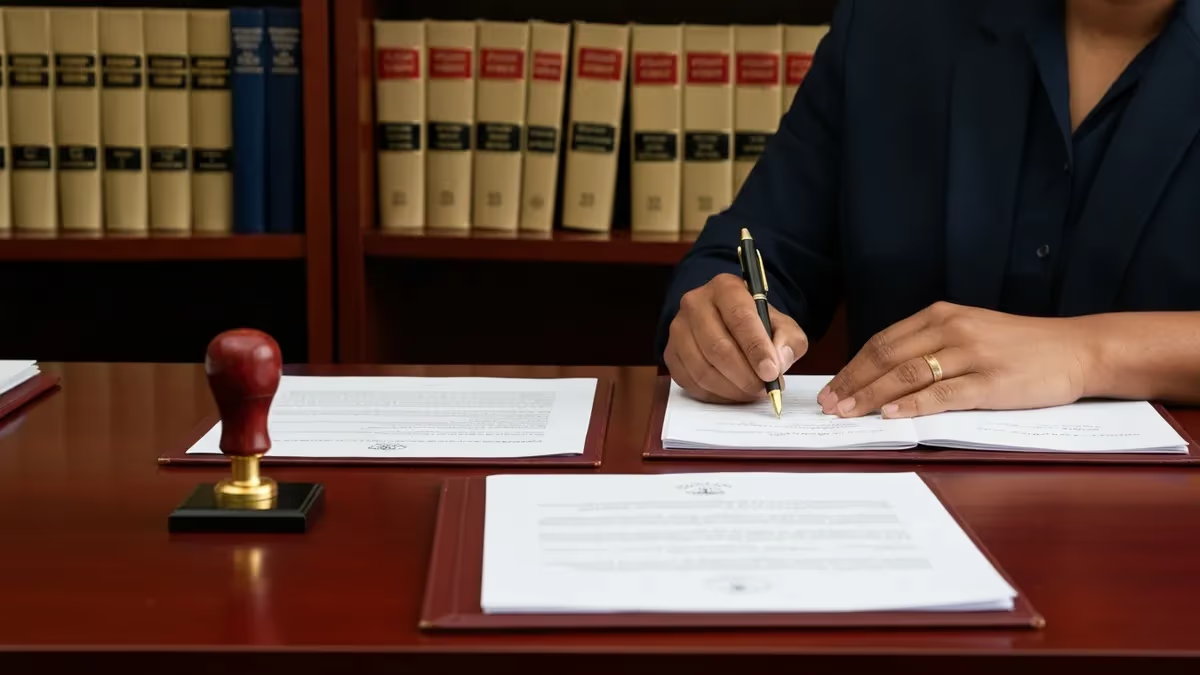
Understanding new york state notary public license law is essential for anyone who needs documents authenticated or who is considering a career as a commissioned officer of the state. A notary public is an official appointed by the state government to serve as an impartial witness to the signing of important documents, administer oaths and affirmations, and verify the identity of the parties involved in legal transactions.
In New York, the notary public role is governed by a detailed body of statutes found primarily in the Executive Law, Article 6, which outlines everything from eligibility requirements to the precise duties a notary must perform on every act.
Many people first encounter notarization when they need to finalize a real estate deed, execute a power of attorney, or notarize an affidavit for court. The moment a notary presses their official notary public stamp onto a document and affixes their signature, that document gains a layer of legal authenticity recognized across state lines and, in many cases, internationally through an apostille. Without a valid notarization, countless documents — wills, loan agreements, business contracts — could be challenged or deemed unenforceable, underscoring just how critical this role is in the everyday machinery of commerce and law.
New York distinguishes itself from many other states by requiring applicants to pass a written examination before they can be commissioned. This notary public exam tests knowledge of state law, proper notarial procedures, ethical obligations, and document types. Passing the exam demonstrates that a prospective notary understands not only the mechanics of stamping and signing but also the legal weight of every act they perform. If you are preparing for this exam, understanding the underlying legal framework is far more valuable than memorizing isolated facts, because the questions are grounded in real statutory language.
The term notario publico is widely used in Spanish-speaking communities across the United States, but it carries a critical caveat in the American legal context. In many Latin American countries, a notario publico is a highly trained legal professional equivalent to an attorney. In the United States, however, a notary public has a much narrower role and is not authorized to give legal advice. New York has specific laws that prohibit non-attorneys from advertising as a notario publico in ways that imply they can provide legal services, protecting immigrant communities from exploitation.
Finding notary services has become easier than ever, with options ranging from free notary public library near me searches to bank branches and mobile notaries. Notary public in Bank of America branches, for example, is a common search because many major banks offer free notarization to their account holders. Understanding where services are available — and at what cost — is part of navigating the broader ecosystem that New York's notary public license law has created to serve the public interest efficiently and accessibly.
This guide covers everything you need to know about New York notary public law: the legal definitions, the duties and limitations of a commissioned notary, how the stamp and seal requirements work, how to become licensed, where to find free services, and how to prepare for the official state examination. Whether you are a consumer needing documents notarized or a professional pursuing a commission, the information below is organized to give you a complete, authoritative picture of how this system works in 2026.
Throughout this article you will also find practice quiz tiles linked to free study tools that mirror the actual New York notary exam. Using these resources alongside a careful reading of the statutory material is the most effective preparation strategy available. Real exam questions frequently reference specific sections of the Executive Law, so developing familiarity with the legal text — not just summaries of it — is the fastest path to a passing score and a long, compliant career as a New York notary public.
New York Notary Public by the Numbers

New York Notary Public Exam Format
| Section | Questions | Time | Weight | Notes |
|---|---|---|---|---|
| Notary Public Law & Definitions | 12 | ~18 min | 30% | Executive Law Article 6, definitions, eligibility |
| Duties, Powers & Prohibited Acts | 10 | ~15 min | 25% | Acknowledgments, jurats, oaths, limitations |
| Fees & Signature Requirements | 8 | ~12 min | 20% | Statutory fee schedule, signature rules |
| Ethical Conduct & Fraud Prevention | 10 | ~15 min | 25% | Prohibited conduct, penalties, misconduct |
| Total | 40 | 1 hour | 100% |
The duties and powers of a New York notary public are precisely defined under Executive Law §135, and understanding them is critical for both the state exam and for lawful practice in the field. At its core, a notary public is enabled to administer oaths and affirmations, take affidavits and depositions, receive and certify acknowledgments of written instruments, and protest notes and bills of exchange. Each of these acts carries distinct procedural requirements, and performing them incorrectly — even with good intentions — can expose the notary to civil liability and disciplinary action by the Secretary of State.
An acknowledgment is one of the most common notarial acts in New York. In an acknowledgment, the signer appears before the notary and declares that they executed the document as their free and voluntary act. The notary must positively identify the signer, typically through government-issued photo identification, and must complete a certificate of acknowledgment that includes the notary's commission expiration date, county of qualification, and official signature. The notary does not attest to the truth of the document's contents — only that the signature was acknowledged by the named individual.
A jurat, by contrast, requires the signer to swear or affirm that the contents of a document are true and correct. The signer must physically sign the document in the presence of the notary, and the notary administers an oral oath or affirmation before completing the jurat certificate. Jurats are commonly used for affidavits, which are sworn written statements used in legal proceedings. Failing to administer the oath aloud — even if the document is signed correctly — renders the jurat defective and the affidavit potentially inadmissible.
Notaries in New York have important limitations that are just as legally significant as their powers. A notary public is explicitly prohibited from practicing law, meaning they cannot draft legal documents, advise clients on which form to use, or explain the legal consequences of signing. This restriction is frequently tested on the New York notary exam. Additionally, a notary may not notarize their own signature or any document in which they have a direct financial or beneficial interest, as this would violate the impartiality requirement that is central to the office.
The fee schedule established by New York law is another area that exam candidates must master. Under Executive Law §136, a notary may charge a maximum of $2.00 per signature for acknowledgments, jurats, and oaths. For certifying a copy of a power of attorney under General Obligations Law §5-1510, the fee is also capped at $2.00.
These statutory maximums have remained in place for many years, and while they are low by modern standards, they reflect the legislature's intent that notarization remain accessible and affordable for all New Yorkers. Charging more than the statutory maximum is a prohibited act that can result in removal from office.
Bank employees who hold notary commissions occupy a special place in the New York notary ecosystem. When someone searches for a notary public in Bank of America or any major financial institution, they are often looking for free notarization services for mortgage documents, account agreements, or personal affidavits.
Many banks direct their commissioned employees to notarize documents for customers at no charge as a customer service benefit, but the notary must still comply with all state law requirements regardless of whether a fee is charged. Exploring notary public jobs at financial institutions is a common career path that combines the notary role with broader financial services responsibilities.
Understanding the difference between notarial acts and legal advice is particularly important when serving diverse populations. In New York City and other urban areas, many immigrants from Latin American countries arrive expecting a notario publico to provide the same comprehensive legal services as a Latin American-style notario. New York's unauthorized practice of law statutes, combined with Executive Law provisions, are specifically designed to prevent notaries from exploiting this cultural misunderstanding. Notaries who misrepresent their authority in this way face criminal charges in addition to loss of their commission, making ethical awareness a non-negotiable element of notarial practice.
Notary Public Stamp, Seal & Record Requirements
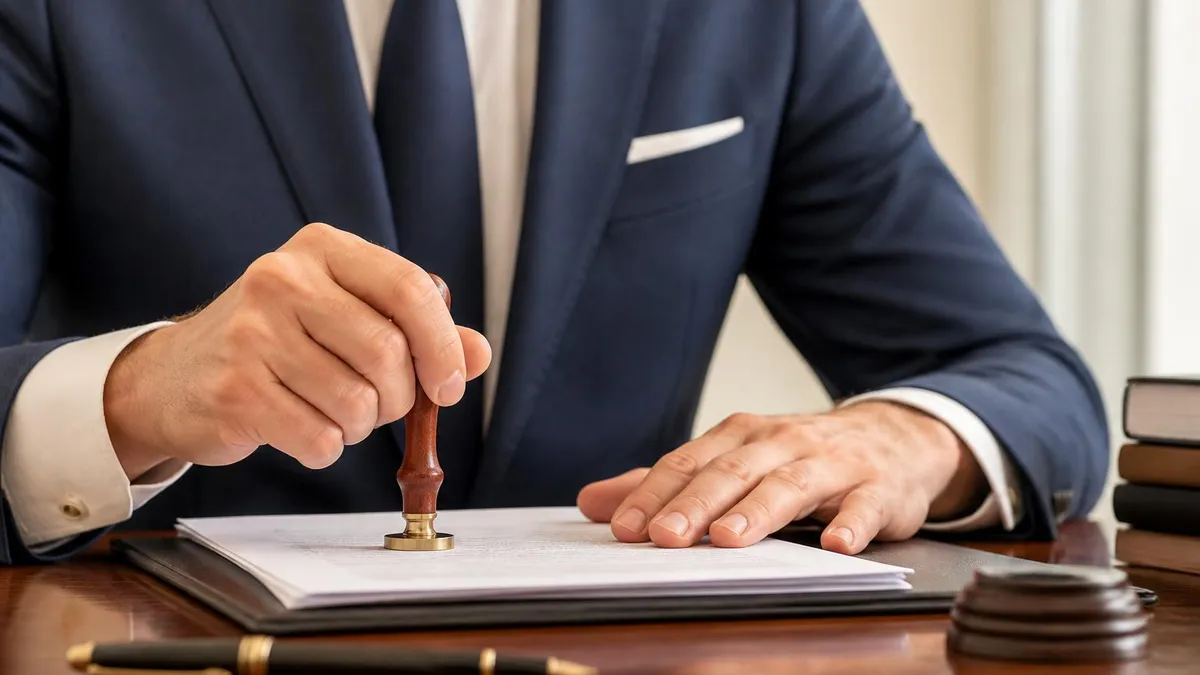
The notary public stamp in New York must contain the notary's full legal name exactly as it appears on the commission, the words "Notary Public State of New York," the county in which the notary is qualified, and the commission expiration date. New York law does not require a raised embossing seal like some other states do — an inked rubber stamp that produces a legible impression is fully acceptable and is, in fact, the most common format used statewide. The stamp must always produce a clear, reproducible image because documents are frequently photocopied or scanned for court filings and real estate closings.
Using an expired stamp or a stamp that does not reflect the current commission term is a common compliance error. When a notary renews their commission, they should immediately update or replace their stamp to reflect the new expiration date. Notarizing a document with an expired commission — even if the notary subsequently renews — renders that notarization invalid. Exam questions often test whether candidates understand that it is the commission's validity at the time of the notarial act, not at the time the document is filed, that determines legal sufficiency.
Pros and Cons of Becoming a New York Notary Public
- +Low cost to obtain — application fee is only $60 and exam prep materials are widely available for free
- +Adds professional value in legal, banking, real estate, and administrative careers
- +Flexible side income — notaries can charge statutory fees and build a mobile notary business
- +Commission is valid statewide, allowing you to serve clients across all 62 New York counties
- +Renewal every two years keeps credentials current without requiring a full re-examination
- +Growing demand for remote online notarization creates new revenue opportunities statewide
- −Strict liability for errors — mistakes in the notarization process can lead to civil lawsuits
- −Statutory fee cap of $2.00 per signature limits earnings from individual notarial acts
- −Written exam requirement means preparation time is needed before applying for commission
- −Notaries cannot practice law, which limits the scope of services they can offer clients
- −Commission is county-specific for qualification purposes, requiring careful attention to jurisdictional rules
- −Personal surety bond is not required in New York, leaving notaries personally liable for errors without default coverage
How to Become a Notary Public in New York: Complete Checklist
- ✓Confirm eligibility: you must be at least 18 years old, a U.S. citizen or permanent resident alien, and a resident or regularly employed in New York State.
- ✓Obtain the official NYS Notary Public License Law booklet from the Department of State website and study all statutory provisions thoroughly.
- ✓Register to take the written notary public exam at a New York Department of State licensing examination site near you.
- ✓Study the exam topics: Executive Law Article 6, Real Property Law, Domestic Relations Law, Banking Law, and the Public Officers Law as they relate to notarial acts.
- ✓Pass the written examination with a score of at least 70% (28 out of 40 questions correct).
- ✓Complete Form DOS-0386 (Application for Appointment as Notary Public) and gather required documentation including proof of exam passage.
- ✓Submit your application and the $60 fee to your county clerk's office or the New York Department of State.
- ✓Receive your commission certificate and oath of office from the county clerk, then take and file the oath to activate your commission.
- ✓Purchase a compliant notary public stamp that includes your name, commission county, and exact expiration date.
- ✓Begin performing notarial acts only within New York State borders and only for acts you are legally authorized to perform under Executive Law §135.
New York Notaries Cannot Notarize Their Own Signature
One of the most frequently violated rules in notarial practice is self-notarization. New York law absolutely prohibits a notary public from notarizing any document to which they are a party, in which they have a financial interest, or which bears their own signature. Violating this rule does not merely voidthe notarization — it constitutes official misconduct and can result in removal from office and civil liability. Always identify a disinterested notary for documents you sign personally.
Finding free public notary near me services is a common need for New Yorkers dealing with time-sensitive documents. The good news is that free notarization is far more widely available than most people realize. Major banks including Chase, Bank of America, Wells Fargo, and Citibank routinely offer complimentary notarization to their checking or savings account holders. The service is typically performed by a bank employee who holds a valid New York notary commission, and appointments can often be made through the bank's mobile app or website, minimizing wait times at busy branch locations.
Public libraries across New York State have become an increasingly important resource for free notary public near me searches. Many branch libraries employ staff members with active notary commissions and offer free notarization services to library card holders or community members. Service availability varies by branch and day of the week, so calling ahead to confirm availability is always recommended. The New York Public Library system, as well as the Brooklyn and Queens Public Library systems, periodically publish updated notary availability schedules on their websites to help residents plan their visits efficiently.
Credit unions are another underutilized source of free notarization. Like banks, credit unions frequently commission their member service representatives as notaries and offer the service to members at no charge. Because credit unions are member-owned financial cooperatives, they tend to provide personalized service and are often willing to accommodate members with complex or multi-document notarization needs that a busy bank branch might handle less graciously. Many credit union branches in New York also offer extended evening and weekend hours that can be more convenient for working adults.
For documents that require notarization outside of normal business hours or in locations where no physical notary is conveniently available, remote online notarization (RON) has emerged as a powerful solution. New York formally authorized RON in 2023, allowing residents to connect with a commissioned notary via secure two-way audio-visual technology. RON services verify the signer's identity using knowledge-based authentication and credential analysis tools, and the notarized document is stored electronically with a tamper-evident digital seal. This option is particularly valuable for New Yorkers who are traveling, living abroad temporarily, or who have mobility limitations.
For those searching for how to become a notary public in california or comparing state systems, it is worth noting that New York's notary framework shares many features with other major states but has unique characteristics. The two-year commission term is shorter than the four-year terms offered in states like California and Florida. New York's fee structure is also among the most restrictive nationally, with the $2.00 per-signature maximum far below what mobile notaries in other states can charge for loan signings and complex multi-document packages.
Mobile notary services fill a gap in the free notary ecosystem by bringing a commissioned notary directly to the client's location — home, hospital, office, or detention facility. While mobile notaries do charge for their travel and time (typically $25–$150 depending on distance and complexity), they provide an invaluable service for signers who cannot easily travel to a bank or library. Hospital and nursing home notarizations, in particular, often require a mobile notary who can assess a patient's capacity to sign, understand the ethical obligations of the role, and complete the act under difficult emotional circumstances with care and professionalism.
The UPS Store network, shipping centers, and AAA offices represent additional free or low-cost notarization venues found throughout New York State. UPS Store locations typically charge a small fee per notarized signature, but the widespread geographic distribution of their stores makes them a reliable fallback when bank branches or libraries are unavailable. AAA offers free notarization to members at their travel agency offices, a benefit that is frequently overlooked by members who are unaware of it. Knowing the full landscape of available notarization resources enables New Yorkers to find cost-effective solutions for their specific document needs without unnecessary delays.
A notarial act performed after your New York commission has expired is legally void, regardless of whether you have already submitted your renewal application. Do not perform any notarial act after your expiration date — even by a single day. Set a calendar reminder at least 60 days before your commission expiration to initiate the renewal process and ensure there is no gap in your authorized service period.
Preparing for the notary public exam in New York requires a structured, statute-first approach. Unlike licensing exams in other fields that test broad conceptual knowledge, the New York notary exam is closely tied to the specific language of the Executive Law and the handful of related statutes that govern notarial practice. This means that rote memorization of statutory text, while not glamorous, is genuinely effective. Candidates who can recall the precise fee amounts, the exact wording of the acknowledgment certificate, and the specific penalties for misconduct are the candidates who pass on their first attempt.
The New York Department of State publishes an official Notary Public License Law booklet that is the primary study resource for the examination. This booklet contains the full text of all relevant statutes along with explanatory commentary and sample forms. Reading this document cover-to-cover at least twice before taking the exam is the single most important preparation step. Supplement your reading with practice questions that mirror the format and difficulty of the actual exam — multiple-choice questions that test both knowledge of statutory text and application of that knowledge to realistic scenarios.
Time management on the exam is rarely a problem for candidates who have studied thoroughly, as the 40-question format with a one-hour time limit gives most examinees ample time to read carefully and review their answers. However, certain categories of questions consistently trip up unprepared candidates.
Questions about the geographic jurisdiction of a New York notary (acts must be performed within New York State), questions about the distinction between an acknowledgment and a jurat, and questions about prohibited acts and their consequences are among the most commonly missed. Focused study on these topics can have an outsized impact on your final score.
Using online practice tests is one of the most efficient ways to identify knowledge gaps before test day. A timed practice session of 40 questions reveals both what you know and how you perform under mild pressure. Review every question you missed — not just the ones you got right — and trace each answer back to the specific statutory provision it references.
This feedback loop accelerates learning far more effectively than re-reading the booklet repeatedly. Most candidates who engage in two to three weeks of daily practice test sessions report feeling fully confident by the time they sit for the official examination.
Study groups and online forums have proven valuable for many notary exam candidates, particularly in New York City where there is a large community of people pursuing commissions simultaneously. Explaining a statutory concept to another person is one of the most effective ways to cement your own understanding of it.
Discussion forums also surface edge cases and nuanced questions that you might not encounter in standard practice materials, preparing you for the more challenging questions that appear in the upper difficulty range of the exam. For those who prefer structured instruction, chase bank notary public resources and third-party prep courses are available in both in-person and online formats.
The practical dimension of notary practice deserves as much attention as the theoretical. Understanding the law is necessary but not sufficient — a commissioned notary must also develop the professional habits that protect them from liability and serve their clients well.
These habits include verifying identification methodically every time (never assuming you recognize someone), completing certificates fully and accurately before handing the document back, and refusing to notarize when any element of the transaction feels coerced, fraudulent, or legally problematic. Developing good instincts about red-flag situations is a skill that grows with experience but can be cultivated even before your commission begins through careful study of fraud prevention and ethics materials.
After passing the exam and receiving your commission, the learning does not stop. New York notaries should monitor updates from the Department of State, which periodically issues guidance memoranda and policy updates that affect notarial practice. Major legislative changes — such as the 2023 authorization of remote online notarization — can significantly expand or modify a notary's authorized acts and the procedures required to perform them lawfully. Staying current with these developments is a professional obligation and a practical safeguard against inadvertently performing an act under outdated procedures that no longer comply with current law.
The broader context of notary public law in the United States reveals why New York's requirements are among the most rigorous in the nation. As a major commercial and financial hub, New York processes an enormous volume of legal documents daily — real estate closings, corporate filings, court affidavits, immigration documents, and international business contracts all pass through notaries' hands. The legislative decision to require a written examination reflects a recognition that poorly trained notaries create systemic risk, particularly in high-stakes financial transactions where a defective notarization can derail a closing or invalidate security interests worth millions of dollars.
The role of the county clerk in New York's notary system is worth understanding in depth. When a notary passes the exam, their commission is issued by the Secretary of State, but it is the county clerk of the county in which the notary is primarily qualified who maintains the official record of that commission and receives the notary's oath of office.
If a notary qualifies in additional counties — which is permitted under New York law — they must file a certificate of official character with each additional county clerk. This county-based system means that attorneys and parties to transactions can verify a notary's credentials and commission status through their county clerk's office.
Misconduct by a New York notary public can result in penalties that range from a reprimand to removal from office and, in cases involving fraud, criminal prosecution.
Executive Law §135-a specifically addresses the offense of a notary who takes an acknowledgment or administers an oath without the personal appearance of the individual involved — known colloquially as "wet signing" fraud or "drive-by notarization." This practice became the subject of intense scrutiny during the foreclosure crisis of the late 2000s, when it was discovered that mortgage servicers had notarized thousands of affidavits without the required personal appearances. New York courts have consistently held that such notarizations are void ab initio, meaning they are treated as if they never occurred.
The intersection of notary public law and digital technology is one of the most rapidly evolving areas of practice. Beyond remote online notarization, New York is closely monitoring developments in blockchain-based document authentication, electronic signatures under the Electronic Signatures and Records Act (ESRA), and the use of artificial intelligence in identity verification.
While none of these technologies has yet replaced the traditional notarial act, notaries who understand how digital tools interact with their legal obligations are better positioned to serve clients in an increasingly paperless environment and to avoid inadvertently bypassing required procedural steps in the rush to adopt convenient new technologies.
For notaries who work in multilingual environments — and New York City is arguably the most linguistically diverse urban area in the world — understanding the rules around language barriers in notarial acts is critical. A notary is not required to speak the same language as the signer, but they must be able to communicate with the signer sufficiently to verify identity, explain the nature of the notarial act, and administer an oath or affirmation.
Using an interpreter is permissible in certain circumstances, but it introduces additional complexity and potential points of failure. Notaries who regularly serve non-English-speaking populations should consult legal guidance on best practices for multilingual notarizations to ensure their acts are legally defensible.
The professional landscape for notaries in New York has expanded considerably with the growth of the loan signing agent specialty. Loan signing agents are notaries who have received additional training to guide borrowers through the signing of mortgage loan packages, which typically consist of 80 to 150 pages of documents requiring multiple notarizations.
This specialty commands significantly higher fees than standard notarial acts — often $75 to $200 per signing — and is in high demand from title companies, escrow companies, and mortgage lenders. Becoming a certified loan signing agent requires additional training beyond the basic notary commission, but the investment pays off quickly for notaries who want to build a substantial income from their commission.
Understanding the full scope of New York notary public license law — from the foundational statutory framework to the practical realities of daily notarial practice — is both an academic exercise for exam candidates and a living professional obligation for commissioned notaries. The law is not static: it responds to fraud patterns, technological change, and the evolving needs of a complex, multilingual, digital society.
Notaries who approach their role as lifelong learners, staying current with legal developments and refining their professional practices over time, provide a genuinely valuable public service and build careers that are both financially rewarding and legally sound.
Notary Public Questions and Answers

Public Library Notary: Where to Find Free Notary Services Near You
Notary Public Training: Complete 2026 Guide to Requirements, Certification & Exam Prep

Remote Notary Public: The Complete Guide to Online Notarization in 2026

Where Can I Find a Notary Public Near Me? Your Complete 2026 Locator Guide
Notary Public Requirements: Complete 2026 Guide to Becoming a Commissioned Notary
About the Author

Notary Public Law Expert & State Notary Exam Specialist
Georgetown University Law CenterAttorney Sarah Williams is a licensed attorney and National Notary Association (NNA) certified notary with a Juris Doctor from Georgetown University Law Center. She has 13 years of experience in notarial law, document authentication, and real estate closings. Sarah coaches candidates through state notary public examinations, notary signing agent certification, and loan signing agent training programs.