
What Is a Notary Public? Document Certification, Stamps, Seals & How to Find One
What is a notary public? Learn about notary stamps, seals, document certification, and how to find a free notary near you. 📝 Complete 2026 guide.

If you have ever wondered what is a notary public and why so many important documents require one, you are not alone. A notary public is a state-commissioned official authorized to serve as an impartial witness during the signing of legal documents, administer oaths, and certify the authenticity of signatures. Practice with the free Notary Public practice test on PracticeTestGeeks (11 questions with answer explanations).
In the United States, notaries play a critical role in deterring fraud and ensuring that the parties signing a document are who they claim to be. Whether you need a notary public รับรอง เอกสาร for immigration papers, real estate deeds, or power of attorney forms, understanding what a notary does is the first step.
The office of the notary public dates back thousands of years, with roots in ancient Rome where scribes called notarii recorded legal transactions. Today, every U.S. state commissions its own notaries, and while the core duties remain consistent — verifying identity, witnessing signatures, and affixing a notary public stamp or seal — the specific rules, fees, and procedures vary considerably from state to state. Knowing those differences can save you time, money, and legal headaches down the road.
One of the most common questions people ask is how a notary differs from a lawyer. A notary is not an attorney and cannot provide legal advice, draft contracts, or represent clients in court. Their role is purely administrative and ministerial: they confirm that signers appear willingly, present valid identification, and sign documents in the notary's presence. This narrow but vital function makes notarized documents far more trustworthy in the eyes of courts, government agencies, and financial institutions.
You may have heard the term notario publico used in Spanish-speaking communities. In Latin American countries, a notario publico is actually a highly trained legal professional comparable to an attorney. In the United States, however, the term simply refers to the same state-commissioned notary public — a crucial distinction that has led to fraud in immigrant communities when unscrupulous individuals claim attorney-level authority under that title. Always verify credentials before sharing sensitive documents.
Finding a notary has never been easier. Banks, credit unions, shipping centers, libraries, and courthouses typically offer notary services, sometimes at no charge. If you need a public notary near me free, your local bank branch or public library is often the best starting point. Many states also allow remote online notarization (RON), letting you connect with a commissioned notary via live video call from anywhere with an internet connection.
For those considering a career as a commissioned notary, the path is more accessible than most professional licenses. Most states require applicants to be at least 18 years old, a legal resident of the state, and free of felony convictions. Some states — including California, New York, and Colorado — require passing a notary public exam before commissioning. Study materials, state handbooks, and practice tests are widely available online to help candidates prepare thoroughly and confidently.
This comprehensive guide covers everything you need to know about notary public document certification: what the stamp and seal mean, how to locate free notary services, what the commissioning process looks like, and how to prepare for a state notary exam. Whether you are a consumer needing a document certified today or a professional exploring how to become a notary public, the sections below will walk you through every detail step by step.
Free Notary Public Exam Study Tools
Interactive Notary Public Exam resources on PracticeTestGeeks, free to start:
- Free Notary Public Questions and Answers 1 — 11 questions with instant scoring and answer explanations
- Notary Public Exam flashcards — review key terms and concepts card by card
- Notary Public Exam study guide — topic-by-topic overview of what the exam covers
- Notary Public Exam cheat sheet — one-page printable summary for last-minute review
Notary Public in the U.S. by the Numbers

Notary Public Stamp vs. Seal: What Each Means
An inked rubber stamp impression applied directly to a document. It displays the notary's name, state, commission number, and expiration date. The notary public stamp is the most common tool used across the United States and must meet state-specific size and content requirements.
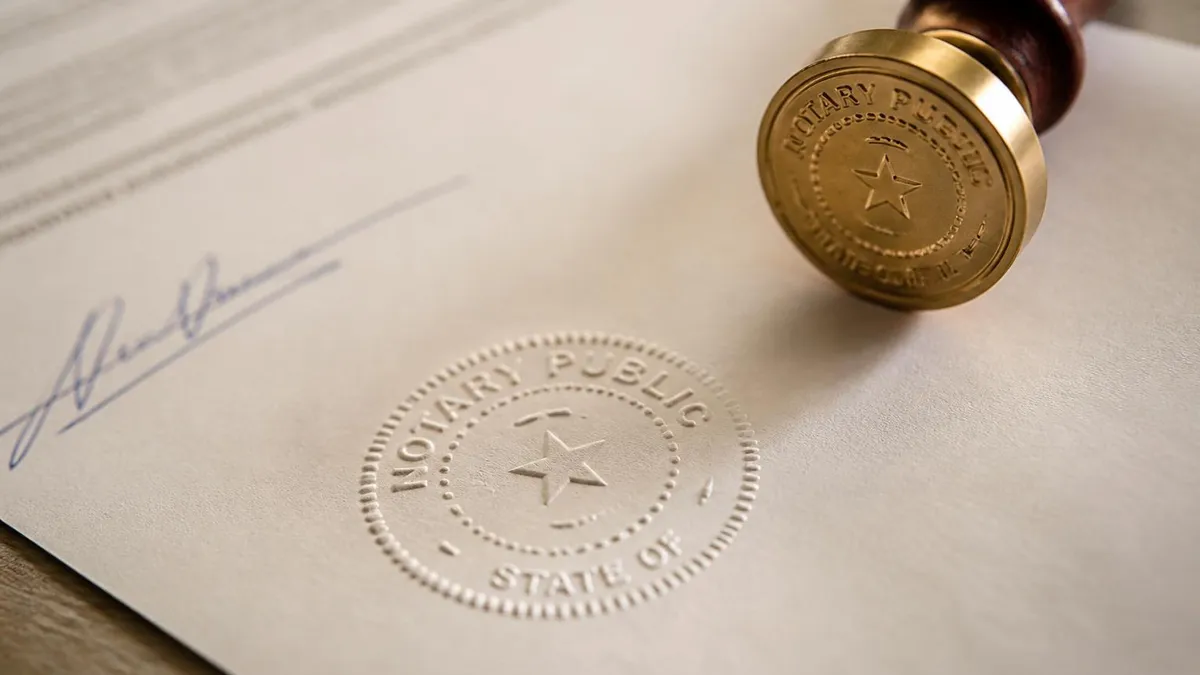
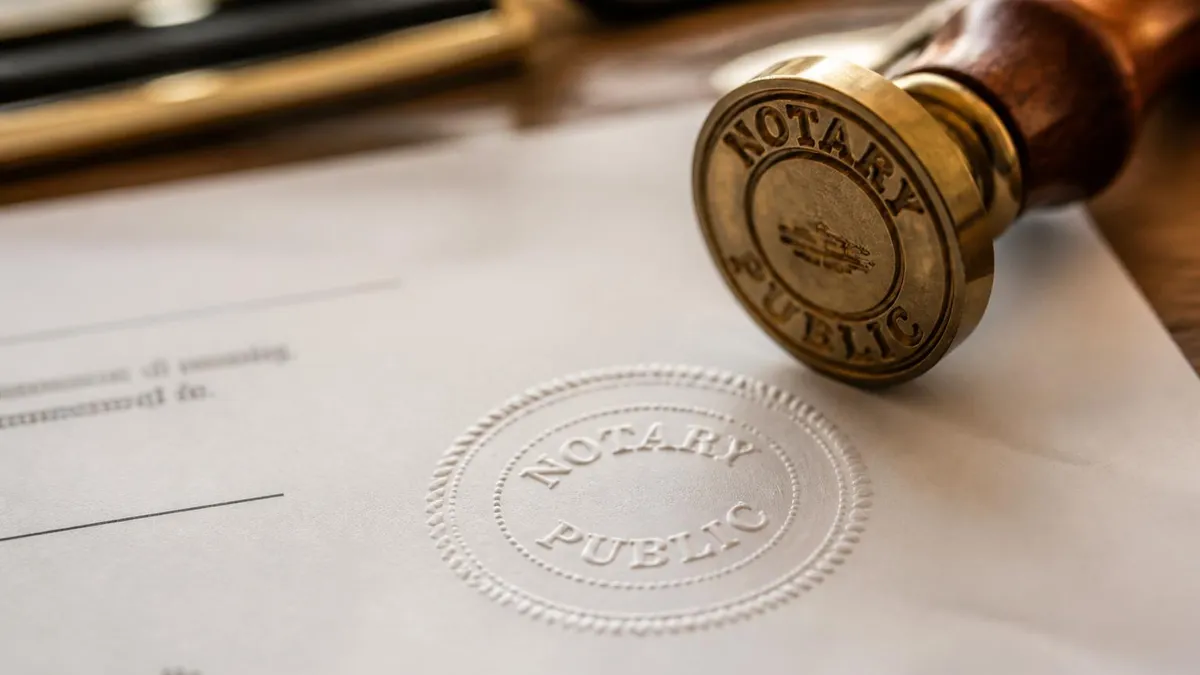
An embossed or crimped metal seal that creates a raised impression on paper. Historically preferred for formal legal documents, the notary public seal proves difficult to photocopy and offers an extra layer of authenticity. Some states require it; others accept either the seal or stamp.
Used in remote online notarization (RON), an electronic notary certificate includes a digital image of the notary's seal or stamp, a tamper-evident seal, and an electronic signature. It carries the same legal weight as a physical stamp in states that have adopted RON legislation.
Most states require notaries to maintain a sequential journal recording every notarization performed. Entries typically include the date, document type, signer name, identification used, and fee charged. This journal serves as crucial evidence if a notarization is ever challenged in court.
Knowing where to find a notary public can save you hours of frustration when you need a document certified quickly. The most convenient option for many Americans is their own bank or credit union. Notary public in Bank of America branches, for example, is a commonly searched service — and yes, Bank of America does provide notary services to account holders at most locations free of charge, though availability varies by branch and appointment may be required. Other major banks like Chase, Wells Fargo, and U.S. Bank offer similar services to their customers.
Public libraries are another excellent, often overlooked resource. Many library systems employ at least one commissioned notary on staff and offer services at no cost to library card holders. Hours may be limited, so calling ahead is always wise. Shipping and business centers such as UPS Store locations typically offer notary services for a small per-signature fee, making them convenient for after-hours or weekend needs when banks are closed.
If you need a free public notary near me and are on a tight budget, consider contacting your local AAA chapter, credit union, or state legislator's office. Many elected officials provide free notary services to their constituents as a community benefit. Public assistance offices, military installations (for service members and their families), and some hospital social services departments also offer free notarizations for qualifying individuals.
For documents that cannot wait — or when physical mobility is a challenge — a mobile notary public can travel to your home, office, hospital, or any location where signing is most convenient. Mobile notaries typically charge a travel fee on top of the standard per-signature fee, but the convenience is often well worth the added cost for time-sensitive real estate closings, estate planning documents, or healthcare directives.
Remote online notarization has expanded dramatically since its introduction, especially following the COVID-19 pandemic. Platforms such as Notarize.com, DocuSign Notary, and Notarize connect signers with commissioned notaries via two-way audio-video technology. The notary verifies identity through knowledge-based authentication (KBA) questions and credential analysis, then witnesses the signing electronically. All session recordings are stored as a permanent audit trail, often more secure than traditional in-person notarization.
When selecting a notary, always verify that their commission is current and in good standing. Most state notary regulatory offices maintain searchable online databases where you can confirm a notary's commission expiration date and whether any disciplinary actions have been taken. This is especially important when dealing with high-stakes documents like deeds, wills, or immigration affidavits where an improperly notarized document can cause delays or rejection by the receiving agency.
For Spanish-speaking communities, it is worth emphasizing again that a U.S. notario publico does not have the same authority as a Latin American notary. If you encounter someone advertising as a notario publico who offers to file immigration forms or provide legal advice, that person may be engaging in unauthorized practice of law. Report such incidents to your state's attorney general office. Legitimate U.S. notaries are restricted strictly to the ministerial acts described in state statutes — witnessing signatures, administering oaths, and certifying copies.
Types of Notarial Acts: Acknowledgments, Jurats & More
An acknowledgment is the most common notarial act in the United States. The signer appears before the notary and acknowledges that they signed the document voluntarily and for the purposes stated within it. The signer does not need to sign the document in the notary's presence — only acknowledge that the signature on the document is theirs. Acknowledgments are standard for real estate deeds, mortgages, powers of attorney, and many corporate documents requiring proof of voluntary execution.
To complete an acknowledgment, the notary must positively identify the signer using acceptable government-issued photo identification, confirm the signer's willingness to sign without duress, and complete the notarial certificate wording required by the state. The notary then affixes their notary public stamp or seal and signature. If the document will be used in another country, an apostille from the Secretary of State's office may also be required to certify the notary's authority internationally under the Hague Convention.

Becoming a Notary Public: Pros and Cons to Consider
- +Low startup cost — most states charge under $200 for training, exam, bond, and supplies
- +Flexible side income with mobile notary fees ranging from $75 to $200+ per appointment
- +High demand driven by real estate closings, estate planning, and immigration documents
- +Commission renewal is straightforward with continued good standing and no felony convictions
- +Remote online notarization expands your client base beyond your local area
- +Valuable professional credential that complements careers in law, banking, and real estate
- −State-by-state regulations mean your commission is not valid across state lines
- −Strict liability for errors — mistakes on notarial certificates can result in commission suspension
- −Revenue can be seasonal, peaking during real estate booms and slowing in downturns
- −Notary public exam required in some states adds preparation time and exam fees
- −Errors and omissions (E&O) insurance is strongly recommended but adds annual cost
- −You cannot provide legal advice, limiting the scope of help you can offer clients
Pros and Cons at a Glance
| Pros | Cons |
|---|---|
| High demand driven by real estate closings, estate planning, and immigration documents | State-by-state regulations mean your commission is not valid across state lines |
| Commission renewal is straightforward with continued good standing and no felony convictions | Strict liability for errors — mistakes on notarial certificates can result in commission suspension |
| Remote online notarization expands your client base beyond your local area | Revenue can be seasonal, peaking during real estate booms and slowing in downturns |
| Valuable professional credential that complements careers in law, banking, and real estate | Notary public exam required in some states adds preparation time and exam fees |
Notary Public Document Certification Checklist
- ✓Confirm the document is complete with no blank spaces before the notary appointment.
- ✓Bring at least one government-issued photo ID (driver's license, passport, or state ID).
- ✓Verify the notary's commission is active before trusting them with important documents.
- ✓Do not sign the document before appearing before the notary unless instructed for an acknowledgment.
- ✓Inform the notary if you need an oath administered versus a simple acknowledgment.
- ✓Check whether the receiving agency requires an apostille for international use.
- ✓Confirm the notary's stamp or seal includes their name, state, commission number, and expiration.
- ✓Request a certified copy of the completed notarial certificate for your personal records.
- ✓For sensitive documents, use a notary with Errors & Omissions (E&O) insurance coverage.
- ✓If using remote online notarization, verify the platform's compliance with your state's RON statute.
Most States Limit Notary Fees to $5–$15 Per Signature
Every U.S. state sets a maximum fee a notary may charge per notarial act — typically between $5 and $15 per signature, though California allows up to $15 and some states allow higher fees for remote online notarizations. Mobile notaries may charge additional travel fees on top of the per-act fee. Always ask for the fee schedule upfront so there are no surprises at signing time.
Learning how to become a notary public is simpler than most people expect, but the exact requirements differ significantly from state to state. At the federal level, there is no national notary commission — authority is granted entirely at the state level. This means a notary commissioned in Texas cannot legally perform notarial acts in Georgia without also holding a Georgia commission, although some border states have reciprocity agreements for specific circumstances. Understanding the commissioning process in your target state is therefore the essential first step.
Most states share a common set of eligibility requirements. Applicants must be at least 18 years of age, a legal resident of the state (some states also accept non-residents who work within the state), and must not have been convicted of a felony or a crime involving moral turpitude. Some states conduct background checks as part of the application process, while others rely on the applicant's sworn declaration. Providing false information on a notary application is a criminal offense in every jurisdiction.
Several states require completion of an approved notary education course before applying for a commission. California, for instance, mandates a six-hour state-approved course for new applicants. Other states, including Florida and Colorado, require passing a written notary public exam administered by a state-approved testing center. The exam typically covers state notary law, proper procedures for each type of notarial act, identification requirements, journal recordkeeping, and prohibited acts. Passing scores generally range from 70% to 80% depending on the state.
After meeting educational requirements and passing any required exam, applicants submit a commission application to the appropriate state office — usually the Secretary of State or the Department of State. The application requires a filing fee, proof of a surety bond (most states require a $5,000 to $25,000 bond to protect the public from notary errors), and in some states, an oath of office administered by a county clerk or other authorized official. Processing times vary from a few days to several weeks.
Once commissioned, new notaries must purchase their supplies: a notary public stamp or seal, a journal of notarial acts (required in most states), and optionally Errors & Omissions insurance. E&O insurance is not required by law in most states, but it is strongly recommended because a notary's surety bond protects the public — not the notary — from financial loss. E&O insurance covers the notary's own legal defense costs if a notarization is challenged or results in a lawsuit.
Commission terms typically run four years, after which notaries must complete the notary public renewal process, which in most states involves reapplying, repurchasing the surety bond, and in some states retaking the exam or completing continuing education. Keeping track of your commission expiration date is crucial — performing notarial acts with an expired commission is considered the unauthorized practice of notarization and can expose you to civil and criminal penalties.
For those interested in expanding their notary practice, becoming a certified Notary Signing Agent (NSA) is a popular specialization. NSAs are trained to handle loan document packages for real estate closings and refinances, working with title companies, escrow officers, and lenders. The National Notary Association (NNA) and similar organizations offer NSA training and background screening certifications that many title companies require before assigning signing appointments. NSAs typically earn $75 to $200 per loan signing, making it one of the most lucrative applications of a notary commission.
In many Spanish-speaking immigrant communities, individuals who are not licensed attorneys advertise as notarios publicos and claim they can help with immigration filings, green card applications, or citizenship petitions. This is illegal unauthorized practice of law. If you or someone you know has been victimized by a fraudulent notario, contact your state's attorney general consumer protection division or the American Immigration Lawyers Association (AILA) for assistance.
Preparing for a notary public exam requires targeted study of your state's specific notary handbook, which is typically available as a free PDF download from the Secretary of State's website. The handbook outlines every rule, procedure, and penalty relevant to notaries in your state. Reading it cover to cover — not just skimming — is non-negotiable. Many exam questions are drawn almost verbatim from handbook language, so familiarity with the exact wording of statutes and definitions gives you a significant advantage on test day.
Practice tests are arguably the most effective study tool available. Taking timed practice exams under realistic conditions helps you identify weak areas, build confidence, and calibrate your pacing so you do not run out of time on the actual test. PracticeTestGeeks.com offers free notary practice quizzes covering basic notary knowledge, duties and responsibilities, ethics, fraud prevention, identification verification, and jurats and acknowledgments — all the core topic areas that appear on state notary exams across the country.
Time management during the exam itself is a skill worth developing in advance. Most state notary exams are 30 to 45 questions long with a time limit of 30 to 60 minutes, meaning you have roughly one to two minutes per question. If a question stumps you, mark it and move on rather than spending five minutes on a single item. Return to flagged questions after completing the rest of the exam. This strategy ensures that easier questions at the end of the exam do not go unanswered because you spent too long on an early difficult item.
Pay particular attention to the identification requirements section of your state handbook. The question of what constitutes acceptable identification for a notarial act is one of the most frequently tested topics. Most states accept a current driver's license, state-issued ID card, U.S. passport, military ID, or permanent resident card. Some states also allow credible witness identification — where a person known to the notary vouches for the signer's identity — under specific circumstances. Knowing the complete list and the rules governing each type of ID is essential.
Ethics and professional conduct questions are another major exam category. These questions often present scenario-based situations: a family member wants you to notarize their will, a signer appears to be under duress, or a document has a blank space that the signer wants to fill in after notarization.
Knowing the correct response in each scenario — and understanding why that response is correct based on the underlying legal principle — is far more valuable than memorizing rules in isolation. The texas notary public office, like many state offices, publishes disciplinary case summaries that serve as excellent real-world study examples of what can go wrong and why certain behaviors are prohibited.
Journal recordkeeping is tested heavily in states that require it, and questions often focus on the sequence of entries, what information must be recorded, how long journals must be retained after a commission expires, and what to do with a journal if the notary dies or moves out of state. In California, for example, journals must be kept for 10 years after the last entry. In Texas, the retention period is three years. These state-specific details are exactly the kind of information that separates prepared candidates from those who fail on their first attempt.
Finally, do not underestimate the importance of understanding fees. Your state handbook will specify the maximum fee per notarial act, whether travel fees are separately permissible, and what constitutes overcharging (which can result in commission revocation). Knowing these numbers cold — not approximately, but exactly as written in the statute — is the difference between a confident correct answer and an educated guess on exam day. Use every free practice resource available, review your errors carefully, and approach the exam with the same rigor you would bring to any professional licensing test.
Once you have passed your state's notary exam and received your commission, the real learning begins in the field. The transition from knowing notary law in the abstract to applying it correctly during live signings reveals subtleties that no handbook fully prepares you for. One of the most common challenges new notaries face is handling incomplete documents. State law universally prohibits notarizing a document that contains blank spaces intended to be filled in after notarization, because a signer could later alter the document's terms. Always instruct signers to complete every field before the appointment begins.
Dealing with signers who lack proper identification is another frequent real-world challenge. When a signer presents an expired ID or no ID at all, you must decline to notarize rather than proceed on good faith. Some states allow credible identifying witnesses as an alternative — two people known to the notary who can vouch for the signer's identity — but the rules governing this procedure are strict and vary by state. Attempting to identify a signer using methods not authorized by your state statute can expose you to personal liability if the document is later challenged.
Maintaining strict impartiality is a legal and ethical obligation that notaries must uphold in every situation. You may not notarize a document in which you have a financial interest, and in most states, you may not notarize documents for your spouse or immediate family members. This rule exists to prevent conflicts of interest that could compromise the integrity of the notarization. If a family member asks for your help, the appropriate response is to refer them to another commissioned notary — not to bend the rules as a personal favor.
Document fraud detection is an increasingly important skill for practicing notaries. Fraudsters sometimes attempt to use altered, counterfeit, or misrepresented identification documents to gain notarizations for transactions they are not authorized to enter. Knowing how to spot security features on common ID documents — holograms, microprinting, UV-reactive inks, and machine-readable zones — helps you avoid becoming an unwitting participant in fraud. If you have reasonable doubt about a signer's identity or the legitimacy of a document, you have both the right and the responsibility to refuse the notarization.
Building a professional notary practice also involves marketing your services effectively. Creating a business profile on Google Maps, listing your services on the National Notary Association's directory, and networking with local real estate agents, attorneys, and title companies can generate a steady stream of clients. Loan signing agents who join signing service platforms such as Snapdocs, Signing Order, or Notary Rotary gain access to a high volume of mortgage closing assignments. Maintaining a reputation for punctuality, accuracy, and professionalism is the single most effective marketing strategy in this relationship-driven business.
Technology continues to reshape the notary landscape. Electronic notarization — where the notary and signer are physically present but the document and seal are electronic — is now permitted in most states. Remote online notarization extends this further by removing the geographic requirement entirely. As a commissioned notary, staying current with your state's evolving RON statutes and investing in the necessary audio-video platform and digital certificate technology positions you at the forefront of a growing market segment. The American Society of Notaries and the National Notary Association both publish regular updates on RON legislation and best practices.
For those who want to go beyond basic commission work, specialty certifications in areas like healthcare document notarization, estate planning signings, or immigration document handling can differentiate your practice and command higher fees. Some practitioners combine their notary commission with complementary credentials such as a certified paralegal certification, a title insurance license, or a real estate license to offer clients a more comprehensive range of administrative and transactional services. Whatever direction you choose, the notary commission is a foundational credential that opens doors across the legal, financial, and real estate sectors.
Sample Notary Public Exam Practice Questions
Try these questions from our free Notary Public Exam practice tests. The correct answer and an explanation follow each question.
A notary public is presented with a document in a language they cannot read. What should they do?
- A. Notarize it anyway since the signer appears to understand it
- B. Refuse to notarize unless the document is translated or they can communicate with the signer
- C. Ask a bystander to translate and then proceed
- D. Notarize only the signature page since that is in English
Answer: B. Refuse to notarize unless the document is translated or they can communicate with the signer
A notary must be able to communicate directly with the signer to confirm identity and willingness, which requires a shared language or qualified interpreter.
A notary's seal impression accidentally overlaps the signer's signature on the document. What should the notary do?
- A. Re-stamp the seal in a clear area near the certificate wording so the impression is fully legible
- B. Leave it as-is because the overlap does not affect validity
- C. Ask the signer to re-sign in a different location and then re-stamp
- D. Void the document and require an entirely new one to be prepared
Answer: A. Re-stamp the seal in a clear area near the certificate wording so the impression is fully legible
The seal must be legible and fully readable; if the first impression is obscured, the notary should place a clear impression in an appropriate area of the certificate.
A notary is asked to notarize a document in which the notary is named as a beneficiary. What is the correct action?
- A. Proceed, since the notary knows the facts well
- B. Refuse, because the notary has a disqualifying financial or beneficial interest
- C. Proceed but waive the fee
- D. Have a coworker sign the certificate instead
Answer: B. Refuse, because the notary has a disqualifying financial or beneficial interest
A notary may not notarize a document in which they have a direct financial or beneficial interest. The notary must be an impartial witness.
An elderly signer appears confused and cannot explain what the document is or why they are signing it. What should the notary do?
- A. Proceed because the signer's family is present
- B. Decline, because the notary has reasonable doubt about the signer's awareness and willingness
- C. Proceed but note the confusion in the certificate
- D. Ask the family to explain the document and then proceed
Answer: B. Decline, because the notary has reasonable doubt about the signer's awareness and willingness
A notary must be satisfied the signer understands the nature of the document and is signing willingly. When there is reasonable doubt about awareness, the notary should refuse.
Notary Public Questions and Answers

How to Become a Notary Public: Complete State-by-State Training Guide

NC Notary Public Course: Complete Training Guide for North Carolina

Notary Public Commission Application: Complete Step-by-Step Guide for 2026
What Is a Notary Public Office? Everything You Need to Know

Notario Publico Near Me: How to Find, Verify, and Use a Notary Public in Your Area
How this page was made: written with AI tools. Exam facts are checked against the official sources listed below. Not reviewed by a subject-matter expert. Editorial policy
Sources & references
Exam facts on this page (fees, format, dates, passing scores) are checked against these official sources; the date is our last check. Editorial policy
- sos.ca.gov — Eligibility, score release, fees, retake policy, renewal · verified Oct 2026
- sos.la.gov — Fees, test delivery, passing score, renewal, score validity, registration · verified Oct 2026
- coraweb.sos.la.gov — Registration deadline · verified Oct 2026
- static.sos.la.gov — Exam information · verified Oct 2026
- dos.ny.gov — Score validity, time limit, fees, exam dates, registration · verified Oct 2026
- cpshr.us — Exam format, retake fee, passing score, time limit, registration, test dates · verified Oct 2026