
NJ Notary Application: 7 Tips to Know 2026 October
Free NJ Notary Application: 7 Tips to Know practice test with instant feedback and detailed answer explanations. Prepare for your exam. 💯
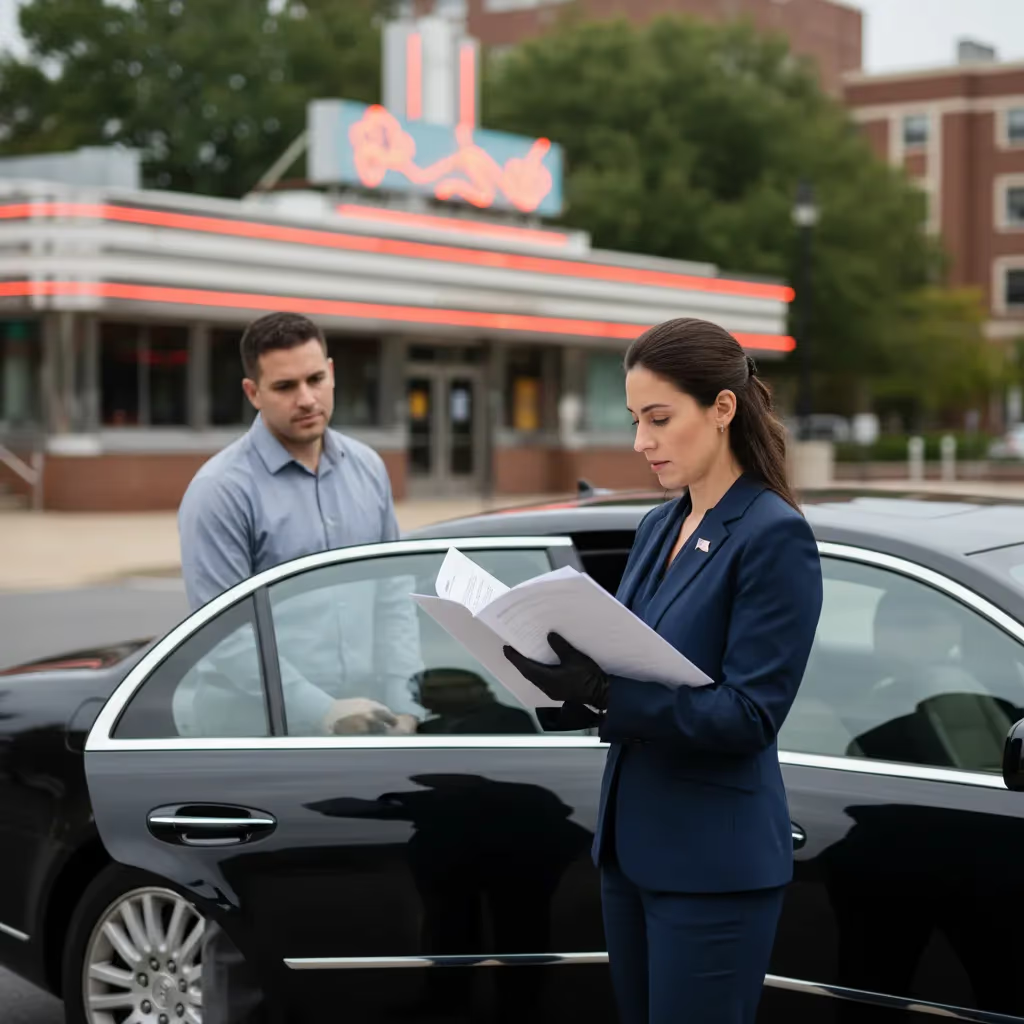
In the professional landscape of New Jersey, becoming a commissioned notary public is a significant milestone that opens doors to numerous opportunities. Whether you are an administrative professional looking to enhance your skillset, a real estate agent aiming to simplify closings, or an entrepreneur seeking to start a mobile business, the NJ Notary Application process is your gateway. The State of New Jersey has modernized its procedures, moving towards a digital-first approach that ensures efficiency and security. However, with these changes come specific nuances that every applicant must understand.
Navigating the requirements can sometimes feel overwhelming, but the role is critical to the state's legal and commercial infrastructure. A notary serves as a gatekeeper against fraud, verifying identities and ensuring the voluntary nature of binding agreements. This article provides a comprehensive guide, detailing 7 crucial tips you need to know to successfully become and remain a notary. We will also address the most frequently asked questions, clarifying exactly how to become a notary in nj, so you can start on this path with confidence and clarity.
NJ Notary Practice Test Questions
Prepare for the NJ Notary - New Jersey Notary Exam exam with our free practice test modules. Each quiz covers key topics to help you pass on your first try.
NJ Notary Duties and Responsibilities
NJ Notary Exam Questions covering Duties and Responsibilities. Master NJ Notary Test concepts for certification prep.
NJ Notary Ethical Conduct
Free NJ Notary Practice Test featuring Ethical Conduct. Improve your NJ Notary Exam score with mock test prep.
NJ Notary Legal Requirements and Qualifica...
NJ Notary Mock Exam on Legal Requirements and Qualifications. NJ Notary Study Guide questions to pass on your first try.
NJ Notary Public Identification and Record...
NJ Notary Test Prep for Public Identification and Record-keeping. Practice NJ Notary Quiz questions and boost your score.
NJ Notary Administering Oaths and Affirmat...
NJ Notary Questions and Answers on Administering Oaths and Affirmations. Free NJ Notary practice for exam readiness.
NJ Notary Identifying Document Signers
NJ Notary Mock Test covering Identifying Document Signers. Online NJ Notary Test practice with instant feedback.
NJ Notary Journal and Seal Requirements
Free NJ Notary Quiz on Journal and Seal Requirements. NJ Notary Exam prep questions with detailed explanations.
NJ Notary Maximum Allowable Fees
NJ Notary Practice Questions for Maximum Allowable Fees. Build confidence for your NJ Notary certification exam.
NJ Notary - New Jersey Notary Administerin...
NJ Notary Test Online for - New Jersey Notary Administering Oaths and Affirmations. Free practice with instant results and feedback.
NJ Notary - New Jersey Notary Identifying ...
NJ Notary Study Material on - New Jersey Notary Identifying Document Signers. Prepare effectively with real exam-style questions.
NJ Notary - New Jersey Notary Journal and ...
Free NJ Notary Test covering - New Jersey Notary Journal and Seal Requirements. Practice and track your NJ Notary exam readiness.
NJ Notary - New Jersey Notary Maximum Allo...
NJ Notary Exam Questions covering - New Jersey Notary Maximum Allowable Fees. Master NJ Notary Test concepts for certification prep.
NJ Notary - New Jersey Notary Performing N...
Free NJ Notary Practice Test featuring - New Jersey Notary Performing Notarial Acts. Improve your NJ Notary Exam score with mock test prep.
NJ Notary - New Jersey Notary Prohibited A...
NJ Notary Mock Exam on - New Jersey Notary Prohibited Acts and Misconduct. NJ Notary Study Guide questions to pass on your first try.
NJ Notary - New Jersey Notary Qualificatio...
NJ Notary Test Prep for - New Jersey Notary Qualifications and Commission Process. Practice NJ Notary Quiz questions and boost your score.
NJ Notary - New Jersey Notary Remote and E...
NJ Notary Questions and Answers on - New Jersey Notary Remote and Electronic Notarization. Free NJ Notary practice for exam readiness.
NJ Notary - Notarial Certificates and Ackn...
NJ Notary Mock Test covering NJ Notary - Notarial Certificates and Acknowledgments. Online NJ Notary Test practice with instant feedback.
NJ Notary - Signature Witnessing and Copy ...
Free NJ Notary Quiz on NJ Notary - Signature Witnessing and Copy Certification. NJ Notary Exam prep questions with detailed explanations.
NJ Notary Performing Notarial Acts
NJ Notary Practice Questions for Performing Notarial Acts. Build confidence for your NJ Notary certification exam.
NJ Notary Prohibited Acts and Misconduct
NJ Notary Test Online for Prohibited Acts and Misconduct. Free practice with instant results and feedback.

NJ Notary: Pros and Cons
- +NJ Notary credential is recognized by employers and industry professionals
- +Higher earning potential compared to non-credentialed peers
- +Expanded career opportunities and professional advancement
- +Structured learning path builds comprehensive knowledge
- +Professional development that stays current with industry standards
- −Preparation requires significant time and study commitment
- −Associated costs for exams, materials, and renewal fees
- −Continuing education needed to maintain credentials
- −Competition for advanced positions can be challenging
- −Requirements and standards may vary by state or region
Pros and Cons at a Glance
| Pros | Cons |
|---|---|
| NJ Notary credential is recognized by employers and industry professionals | Preparation requires significant time and study commitment |
| Higher earning potential compared to non-credentialed peers | Associated costs for exams, materials, and renewal fees |
| Expanded career opportunities and professional advancement | Continuing education needed to maintain credentials |
| Structured learning path builds comprehensive knowledge | Competition for advanced positions can be challenging |
| Professional development that stays current with industry standards | Requirements and standards may vary by state or region |
Sample NJ Notary - New Jersey Notary Exam Practice Questions
Try these questions from our free NJ Notary - New Jersey Notary Exam practice tests. The correct answer and an explanation follow each question.
A candidate for a New Jersey Notary Public commission was convicted of a second-degree crime five years ago. How does this affect their application?
- A. It automatically disqualifies them from becoming a notary.
- B. They can be appointed if they receive a pardon from the Governor.
- C. The application is automatically approved after a five-year waiting period.
- D. They are eligible to become a notary without any extra steps.
Answer: A. It automatically disqualifies them from becoming a notary.
New Jersey law states that the State Treasurer may not appoint any person who has been convicted of a crime of the first or second degree, or an offense involving dishonesty. This is a key disqualifier for the office.
A New Jersey notary is preparing to perform a remote online notarization (RON) for a signer they do not personally know. Which of the following is a mandatory requirement for identifying the remotely located individual?
- A. The signer must answer a series of knowledge-based authentication (KBA) questions.
- B. The signer must present one form of government-issued photo ID during the audio-visual session.
- C. A credible witness known to the notary must be physically present with the signer.
- D. The use of at least two different types of identity proofing, such as KBA and biometric verification.
Answer: D. The use of at least two different types of identity proofing, such as KBA and biometric verification.
New Jersey law requires a robust identity verification process for remote notarizations when the notary does not have personal knowledge of the signer. The law specifies the use of at least two different types of identity proofing processes or services. Common methods include knowledge-based authentication (KBA), biometric identity verification, or a digital public key certificate. Simply presenting one ID is insufficient for a remote session.
A signer appears before a New Jersey notary but cannot produce a government-issued photo ID. The notary personally knows the signer well. What may the notary do?
- A. Refuse to notarize since only photo ID is accepted
- B. Proceed based on personal knowledge of the signer's identity
- C. Require the signer to return with ID on another day only
- D. Ask the signer to write a sworn statement about their identity
Answer: B. Proceed based on personal knowledge of the signer's identity
Under NJ law, personal knowledge of the signer's identity is a recognized form of satisfactory evidence and allows the notary to proceed without a photo ID.
Which identity verification method is required for Remote Online Notarization in New Jersey when the notary does not personally know the signer?
- A. Verbal confirmation of the signer's name and date of birth only
- B. Credential analysis and knowledge-based authentication (KBA)
- C. A notarized letter of introduction from a credible witness
- D. Two forms of non-photo government ID
Answer: B. Credential analysis and knowledge-based authentication (KBA)
New Jersey RON requires credential analysis (examination of the signer's ID) and knowledge-based authentication (KBA questions) to verify identity when the notary does not personally know the signer.
Take the full NJ Notary - New Jersey Notary Exam practice test
(NJ Notary) New Jersey Notary Exam Questions and Answers

Conclusion
Navigating the NJ Notary Application process may seem detailed, but it is a straightforward path if you follow these tips. From understanding the core role of an nj notary to mastering the nj notary exam, each step prepares you for the responsibilities ahead. By staying informed about nj notary renewal timelines and adhering to the regulations set by the state of nj notary commission, you can build a successful practice offering notary services nj. Remember, the title of notary public nj carries weight and requires diligence, integrity, and a commitment to public service.
About the Author

Attorney & Bar Exam Preparation Specialist
Yale Law SchoolJames R. Hargrove is a practicing attorney and legal educator with a Juris Doctor from Yale Law School and an LLM in Constitutional Law. With over a decade of experience coaching bar exam candidates across multiple jurisdictions, he specializes in MBE strategy, state-specific essay preparation, and multistate performance test techniques.