
NFPA Standards Explained: Codes, Categories, and How They Shape Fire Safety
NFPA standards cover fire alarms, sprinklers, electrical work, and more. ✍🏼 Get a plain-English guide to the major codes, their numbers, and how they apply.

NFPA standards are the rulebook behind almost everything that protects buildings and people from fire in the United States. The National Fire Protection Association publishes more than 300 separate codes and standards, and they touch every corner of the built environment, from the wiring inside your kitchen wall to the sprinkler heads in a warehouse the size of a city block.
Most folks who run into NFPA standards for the first time get a little dizzy. The numbers do not follow any obvious logic. NFPA 1 is the Fire Code. NFPA 70 is the National Electrical Code. NFPA 101 is the Life Safety Code. NFPA 13 covers sprinklers. NFPA 72 covers fire alarms. The numbering grew over a century of standards work, and the pattern, frankly, is more historical than systematic.
That said, once you sit with the standards for a while, the picture clears up. Each NFPA document tackles a specific slice of fire and life safety, and together they form a fairly complete safety net. Architects, electricians, fire inspectors, contractors, and facility managers all live in different rooms of this same house. They each use a handful of standards heavily, glance at others occasionally, and ignore the rest.
This guide gives you the big-picture view. We will walk through the most-used standards, explain how the numbering grew, show how the codes connect to one another, cover the three-year update cycle, and break down how a standard moves from a committee proposal to enforceable law in your city. Whether you are studying for an NFPA exam, sitting for a fire inspector certification, or just trying to figure out which code applies to a building you own, you should leave with a working map of the territory.
NFPA Standards by the Numbers
The NFPA itself is a Massachusetts-based nonprofit, founded in 1896 by a group of insurance executives tired of paying claims on warehouse fires that started in faulty sprinkler installations. The first standard, what we now call NFPA 13, was published a year later. The next century stacked one code on top of another as new fire problems showed up. NFPA 70 emerged after a wave of electrical fires in the early 1900s. NFPA 72 followed the rise of automatic fire detection. NFPA 1600 grew out of post-9/11 demand for emergency management standards.
None of these codes is law by itself. The NFPA is a private organization, so its documents have no inherent legal force. They become law when a state, county, or city adopts them by reference into local ordinances. That adoption can happen quickly, slowly, or not at all, and the specific edition adopted is often several cycles behind the most recent published version. That is why a 2026 edition of NFPA 70 might sit on a shelf for years before your jurisdiction starts enforcing it.

NFPA uses two words for its documents, and the distinction matters. A code is written as a complete set of enforceable rules ready to be adopted into law. A standard is more technical, written to support codes by spelling out testing, installation, or maintenance methods. NFPA 13 is a standard. NFPA 1 is a code. Most people use the words interchangeably in everyday conversation, and even NFPA documents sometimes blur the line. Just know that both carry weight once a jurisdiction adopts them.
The most-used NFPA documents tend to be the ones with the lowest numbers, which is more historical accident than design. NFPA 1, the Fire Code, gives local fire marshals their day-to-day inspection authority. It covers everything from exit signs and extinguisher placement to outdoor fire pits and food truck propane tanks. If your fire department shows up for an annual walk-through, they are probably running an NFPA 1 inspection checklist behind the clipboard.
NFPA 13 covers sprinkler system design, installation, and acceptance testing. It is the bible for sprinkler contractors and the standard that determines whether a building is even allowed to be occupied at its planned capacity. Companion documents NFPA 13D and 13R cover residential variants for one- and two-family homes and low-rise residential buildings respectively. Inspectors who handle sprinkler approvals usually have all three memorized cover to cover.
NFPA 70, the National Electrical Code (NEC), is the most widely adopted single NFPA document in the country. Every state references some edition of it, often with state-specific amendments tacked on. Electricians spend their careers inside the NEC, and the document is dense enough that most professionals own a multi-volume commentary set just to navigate the implications. The NFPA 70E companion focuses on workplace electrical safety, which is the OSHA-relevant document for arc flash and shock protection.
NFPA 72, the National Fire Alarm and Signaling Code, covers everything that detects fire and alerts occupants. Smoke detectors, manual pull stations, voice evacuation systems, mass notification, carbon monoxide detection in commercial spaces, even some areas of elevator recall control. It overlaps with NFPA 101 at the building level and with NFPA 70 at the wiring level. Inspectors who specialize in fire alarms usually know all three intimately.
NFPA 101, the Life Safety Code, takes the building-occupant point of view. It tells you how wide a corridor has to be, how far you can travel before hitting an exit, how often fire-rated doors need testing, and how a hospital's defend-in-place strategy differs from a school's evacuation plan. NFPA 101 is enforced by both building departments at construction time and fire marshals during ongoing occupancy, which can lead to the rare jurisdictional disagreement between the two agencies.
Five NFPA Standards You Will See Most Often
General fire safety rules for buildings, vehicles, special events, and outdoor fires. Used by fire marshals during routine inspections of occupied buildings.
Design, installation, and testing of automatic sprinkler systems. Covers commercial, industrial, and high-rise residential applications. NFPA 13D and 13R handle smaller residential variants.
The NEC. Covers electrical installation in nearly every type of building. Adopted in some form by all 50 states. Updated on a strict three-year cycle.
Detection, notification, and signaling systems. Covers smoke alarms, pull stations, voice evacuation, mass notification, and emergency communications integration.
Building design and operation from the occupant safety angle. Egress, fire compartmentation, occupancy classifications, and special use cases like healthcare and detention facilities.
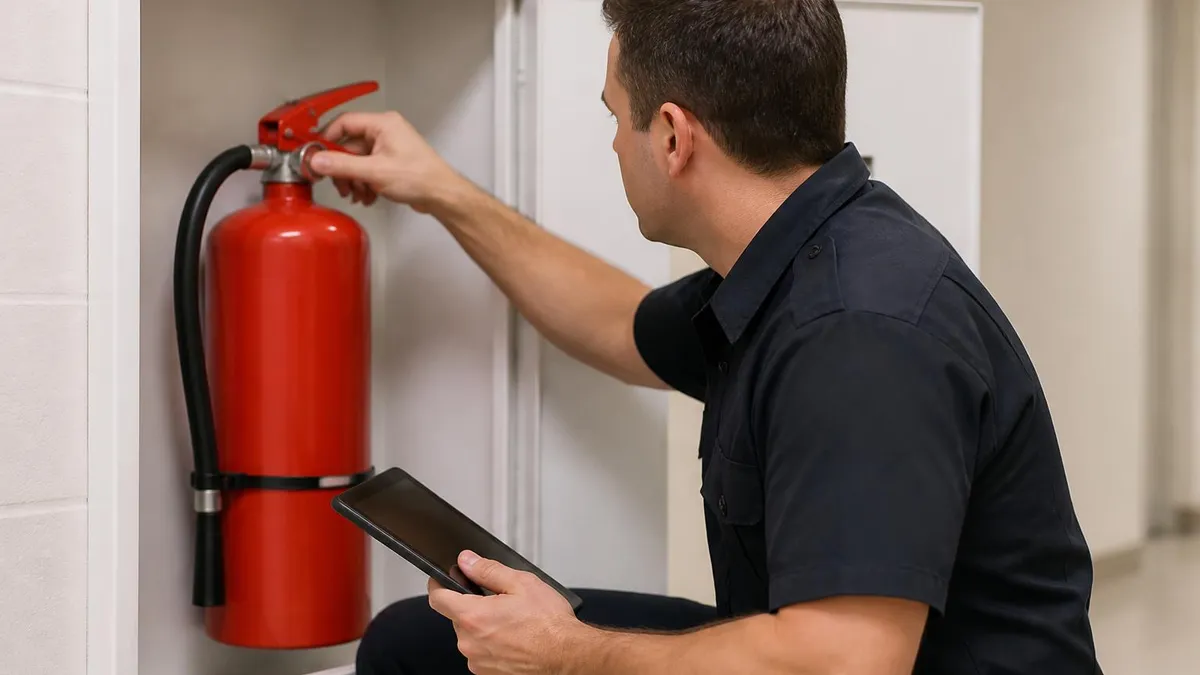
Beyond the top five, the next tier of frequently used standards covers more specialized topics. NFPA 10 governs portable fire extinguisher selection, placement, and inspection. NFPA 25 covers inspection and testing of water-based fire protection systems, which is the document that determines whether your existing sprinkler system stays compliant year after year. NFPA 80 handles fire-rated door and window assemblies, with a strong focus on annual inspection requirements that fire marshals enforce strictly.
NFPA 30 covers flammable and combustible liquids storage, the kind of standard you reach for when designing a paint warehouse or a chemical plant. NFPA 54 is the National Fuel Gas Code, covering natural gas and LP-gas piping inside buildings. NFPA 58 handles LP-gas outside of buildings, which means propane tanks at restaurants, RV parks, and rural homes.
NFPA 99 covers healthcare facilities, with detailed requirements for medical gas systems, emergency power, and the unique fire safety needs of hospitals. NFPA 110 and 111 handle emergency and standby power systems and stored energy power, respectively, which is where backup generators and battery systems live in code. NFPA 1600 covers business continuity, emergency management, and crisis communications, the standard that surged in importance after September 11, 2001.
Standards Grouped by Discipline
NFPA 13 (commercial sprinklers), 13D (one and two-family residential), 13R (low-rise residential), 14 (standpipes), 20 (fire pumps), 22 (water tanks), 24 (underground supply piping), and 25 (inspection and testing of all the above). Contractors who specialize in water-based systems live across this whole set.

The update cycle for NFPA standards runs on a roughly three-year clock, though some standards move faster or slower depending on committee workload and topic urgency. The process starts with a public input phase, where anyone, literally any member of the public, can submit a proposed change. The technical committee reviews the inputs, drafts revised text, and publishes a first draft for public comment. After a second round of comments and committee response, the document goes to NFPA membership for a final vote at the annual association meeting.
The whole cycle takes about two and a half years from public input opening to the new edition appearing on shelves. Standards in different cycles overlap, which is why NFPA always has multiple revision processes running at the same time. Looking at any given month, you can usually find a dozen standards somewhere in the input or comment phase.
Adoption is where things get messy. A new edition might publish in 2026 but not get adopted by your state until 2029 or later. Some states adopt the most recent edition automatically through a referenced standard clause. Others require legislative action for each cycle. A few jurisdictions skip editions, jumping from a 2017 version straight to a 2023 version when their building code finally gets updated. The result is a patchwork where two buildings on opposite sides of a state line can be governed by different editions of the same code.
Before designing or inspecting to any NFPA standard, check which edition your local Authority Having Jurisdiction (AHJ) actually enforces. The published edition and the adopted edition can be five or more years apart. NFPA maintains a state-by-state adoption tracker on its website, but the most reliable source is your local building or fire department directly. Working from the wrong edition produces wasted design work and frustrated clients during plan review.
Free access to NFPA standards was a major change in the early 2010s. For most of the organization's history, you had to buy each standard, and the cost added up fast. A working professional in fire protection could easily spend several thousand dollars a year on current editions. That changed when NFPA launched the free public access program, which now lets anyone read the full text of any adopted standard at nfpa.org/freeaccess. The interface is clunky, but the content is complete.
The catch is that you can read but not print or download. Working professionals still buy printed editions or digital subscriptions for daily use, since flipping back and forth in a web viewer is slow. Students and casual users get full access without paying anything, which makes self-study much easier than it was a generation ago. Many candidates studying for inspector certifications use the free access pages to review specific code sections before exams.
Commentary editions and handbooks are a separate product line. NFPA publishes annotated versions of major standards, with explanations, examples, and figures alongside the code text. These are not free. They are pricey. They are also worth the money for working professionals because they cut hours off the time it takes to figure out the practical meaning of a given paragraph. The NEC handbook is the most widely owned NFPA publication after the NEC itself.
For folks studying for certifications, NFPA standards are tested on essentially every fire-related exam in North America. The NFPA 70B test covers electrical equipment maintenance. ICC fire inspector exams pull heavily from NFPA 1, 10, 13, 25, and 72. CFPS (Certified Fire Protection Specialist) requires familiarity across most of the major standards. NICET (National Institute for Certification in Engineering Technologies) breaks its certifications down by discipline, with separate exams for water-based systems, fire alarm systems, and special hazards.
Standards Most Cited in Fire Inspector Exams
- ✓NFPA 1 - Fire Code, the daily inspection backbone
- ✓NFPA 10 - Portable fire extinguisher selection and placement
- ✓NFPA 13 - Sprinkler system design and installation
- ✓NFPA 25 - Inspection and testing of water-based systems
- ✓NFPA 72 - National Fire Alarm and Signaling Code
- ✓NFPA 80 - Fire-rated door and window assembly inspection
- ✓NFPA 101 - Life Safety Code, especially egress chapters
- ✓NFPA 704 - Hazard rating diamond used on chemical containers
Cross-references between NFPA standards are everywhere, and learning to follow them is half the skill of working with the codes. NFPA 1 references dozens of other NFPA documents for specific topics. The Fire Code might say a building must have fire alarms compliant with NFPA 72, sprinklers per NFPA 13, and emergency lighting per NFPA 101. Each referenced standard then references others, and the chain can run three or four levels deep before you find the actual rule that controls a specific installation detail.
This referenced-standard structure has practical consequences. When NFPA 1 references NFPA 72, the question becomes which edition of NFPA 72. Most jurisdictions specify that the adopted edition of NFPA 1 brings along the editions of referenced standards as they existed when NFPA 1 was adopted. That can leave you working from a NFPA 1 2024 edition that points to a NFPA 72 2022 edition even though a NFPA 72 2025 edition is already published. The current version is not always the version that controls.
For students and new professionals, the best way to internalize the cross-reference structure is to pick one practical scenario and trace it through. Imagine a 5,000 square foot retail store.
You can walk through NFPA 1 for the occupancy classification and required protections, jump to NFPA 13 for sprinkler design, hit NFPA 72 for fire alarm specifications, then NFPA 70 for the electrical work supporting both systems, and finally NFPA 101 for the egress design. By the time you finish, you have touched a half dozen standards and you understand how they fit together in a way that no textbook can teach you.
Working with NFPA Standards: Pros and Cons
- +Consensus-based development pulls in real-world expertise from across the industry
- +Three-year cycle means standards evolve faster than legislative updates
- +Free public access removes the cost barrier for students and small contractors
- +Cross-referencing creates a comprehensive net without duplicating content across documents
- +Adoption flexibility lets states tailor enforcement to local conditions and political realities
- −Edition mismatches between adopted code and referenced standards cause real confusion
- −Free access is read-only, which slows down day-to-day reference for working pros
- −Numbering is historical, not logical, so beginners struggle to find what they need
- −Commentary handbooks cost extra, creating a two-tier access problem
- −Cross-references can chain four levels deep before reaching the actual rule
Pros and Cons at a Glance
| Pros | Cons |
|---|---|
| Consensus-based development pulls in real-world expertise from across the industry | Edition mismatches between adopted code and referenced standards cause real confusion |
| Three-year cycle means standards evolve faster than legislative updates | Free access is read-only, which slows down day-to-day reference for working pros |
| Free public access removes the cost barrier for students and small contractors | Numbering is historical, not logical, so beginners struggle to find what they need |
| Cross-referencing creates a comprehensive net without duplicating content across documents | Commentary handbooks cost extra, creating a two-tier access problem |
| Adoption flexibility lets states tailor enforcement to local conditions and political realities | Cross-references can chain four levels deep before reaching the actual rule |
One question that comes up over and over in beginner conversations is how NFPA relates to other code-making bodies. The answer is that NFPA is one of several major players. The International Code Council (ICC) publishes the I-Codes, which include the International Building Code (IBC), International Fire Code (IFC), and International Mechanical Code (IMC). The IBC and IFC overlap heavily with NFPA 101 and NFPA 1, respectively. Most jurisdictions adopt either the I-Codes or the NFPA versions, with a small number adopting both and writing rules for conflict resolution.
OSHA, the federal workplace safety regulator, references NFPA standards by name in many of its rules. NFPA 70E is the OSHA-accepted standard for electrical workplace safety, even though OSHA does not publish the standard itself. Underwriters Laboratories (UL) publishes product testing standards that NFPA references for things like fire alarm system components and sprinkler hardware. ASTM International publishes material testing standards that NFPA uses for fire-rated assemblies. The web of organizations is tangled, but each plays a specific role.
NFPA also publishes a number of less famous but still important documents. NFPA 600 covers industrial fire brigades. NFPA 1670 covers technical search and rescue operations. NFPA 1006 covers technical rescuer professional qualifications. NFPA 1500 covers fire department occupational safety. These tend to be invisible to civilians but vital to firefighters, paramedics, and emergency responders. Many career firefighters know more about NFPA 1500 than about NFPA 1, simply because 1500 governs their own working conditions.
The qualifications standards, sometimes called the Pro Qual series, are another whole category. NFPA 1001 covers firefighter qualifications, with separate Levels I and II. NFPA 1031 covers fire inspector qualifications, again with multiple levels. NFPA 1051 covers wildland firefighter qualifications. State fire training agencies typically certify firefighters and inspectors to these NFPA Pro Qual standards, with the certification recognized across jurisdictions through reciprocity agreements.
Studying NFPA standards for a certification exam takes a different approach than studying them for design work. For design, you read deeply through the chapters most relevant to your project type and gloss over the rest. For exams, you need broad familiarity across many documents, with deeper knowledge of the most-cited ones. Most successful exam candidates build a study schedule that hits a different standard each week, with a final month of mixed practice questions to lock in the cross-reference structure.
Practice tests are essential. The format of NFPA exam questions tends to be very specific, often asking for a number from a table or a percentage from a calculation. Memorizing the structure of the most important tables, like the sprinkler density-area curve from NFPA 13 or the hazard classification table from NFPA 704, pays off on test day. Many free and paid practice question banks exist, and most candidates work through several thousand questions before sitting for a major certification.
One subtle skill that separates strong exam takers from average ones is knowing when not to look something up. Working professionals can reach for a code book when needed, but in an exam, time is short and the answer needs to come from memory. The strongest candidates do not memorize every paragraph. They memorize the section structure so they can flip to the right table or paragraph in seconds, even on an open-book exam. This pattern recognition is what separates someone who has read the code from someone who has lived in it.
If you are early in your NFPA learning curve, do not try to swallow everything at once. Pick one or two standards relevant to your current work or studies and read them slowly. Cross-reference what you read against real buildings or systems you can observe. Sit next to an experienced inspector or contractor for a few site visits. The standards make far more sense once you have walked through enough buildings to recognize the patterns they describe in print.
The most common beginner mistake is trying to learn the entire NFPA library at once. Pick one standard relevant to your work or upcoming exam and spend a month inside it. NFPA 1 is the best starting point for general fire safety work, NFPA 70 for electrical, NFPA 72 for alarms, NFPA 101 for building design. Once you know one standard well, the others become much easier to absorb because the structure and language patterns repeat across documents.
The future direction of NFPA standards looks a lot like the present, just with more attention to electrification, energy storage, and emerging fire risks. Battery energy storage systems have become a major topic, with NFPA 855 published in 2020 to cover stationary lithium-ion installations. Electric vehicle charging infrastructure gets attention in recent NFPA 70 cycles. Wildland-urban interface fire risks, the kind of fires that have devastated communities in California, Colorado, and Hawaii, have driven new attention to NFPA 1140 and 1144.
Cybersecurity is another emerging frontier. As fire alarm and building automation systems become more network-connected, the technical committees have started addressing how to keep these systems secure from network attacks. The line between cybersecurity standards and fire safety standards used to be clean. It is fuzzier now, and the codes are still catching up to the reality of internet-connected life safety equipment.
For students entering the fire protection field today, the NFPA standards library will look different in twenty years. Some standards will merge. Others will split. New ones will emerge for problems we cannot yet predict. The skill that endures is not memorizing the current text, it is learning how to read NFPA documents quickly, find what you need, and apply it to real situations. Build that skill early, and the changing landscape becomes opportunity instead of obstacle.
NFPA standards are, in the end, a quiet form of public infrastructure. Most people never read a word of them, and yet they shape the buildings everyone lives and works in.
The doors that swing the right way during a fire, the sprinklers that activate before the smoke gets thick, the wiring that does not arc inside the wall, the alarm that sounds at three in the morning when a smoldering toaster forgets its job, all of it traces back to volunteer technical committees, three-year cycles, and the dense gray text of NFPA codes. The work is invisible until it matters. Then it is everything.
Sample NFPA - National Fire Protection Association Practice Questions
Try these questions from our free NFPA - National Fire Protection Association practice tests. The correct answer and an explanation follow each question.
According to the NFPA Life Safety Code, how often should fire drills be conducted in healthcare facilities?
- A. Quarterly
- B. Monthly
- C. Semi-annually
- D. Annually
Answer: A. Quarterly
The LSC mandates that fire drills in healthcare facilities should be conducted quarterly to ensure staff preparedness.
According to NFPA 1, what must a fire safety and evacuation plan include?
- A. Utility shutoff locations only
- B. Emergency procedures, staff assignments, evacuation routes, and training requirements
- C. Contact information for the fire department only
- D. Insurance policy number and coverage details
Answer: B. Emergency procedures, staff assignments, evacuation routes, and training requirements
NFPA 1 requires fire safety and evacuation plans to address emergency procedures, staff responsibilities, evacuation routes, and staff training.
According to NFPA 72, where must a remote annunciator panel be located?
- A. At the main electrical panel
- B. At a location approved by the authority having jurisdiction
- C. Adjacent to the main fire alarm control unit
- D. In the mechanical room
Answer: B. At a location approved by the authority having jurisdiction
NFPA 72 requires remote annunciator panels to be located where approved by the authority having jurisdiction (AHJ).
Under NFPA 10, what is the maximum travel distance to a Class B extinguisher in a low-hazard occupancy?
- A. 30 feet
- B. 50 feet
- C. 75 feet
- D. 100 feet
Answer: B. 50 feet
NFPA 10 limits travel distance to a Class B extinguisher in low-hazard areas to 50 feet.
Take the full NFPA - National Fire Protection Association practice test
NFPA Questions and Answers
About the Author

Certified Safety Professional & OSHA Compliance Expert
Indiana University of Pennsylvania Safety SciencesDr. William Foster holds a PhD in Safety Science from Indiana University of Pennsylvania and is a Certified Safety Professional (CSP) and Certified Hazardous Materials Manager. With 20 years of occupational health and safety management experience across construction, manufacturing, and chemical industries, he coaches safety professionals through OSHA certification, CSP, CHST, and safety management licensing programs.
Join the Discussion
Connect with other students preparing for this exam. Share tips, ask questions, and get advice from people who have been there.
View discussion (8 replies)