
National Electrical Code (NEC) 2026 September: Complete Guide for Electricians
Prepare for the National Electrical Code (NEC) 2026 September: certification. Practice questions with answer explanations covering all exam domains. 📝
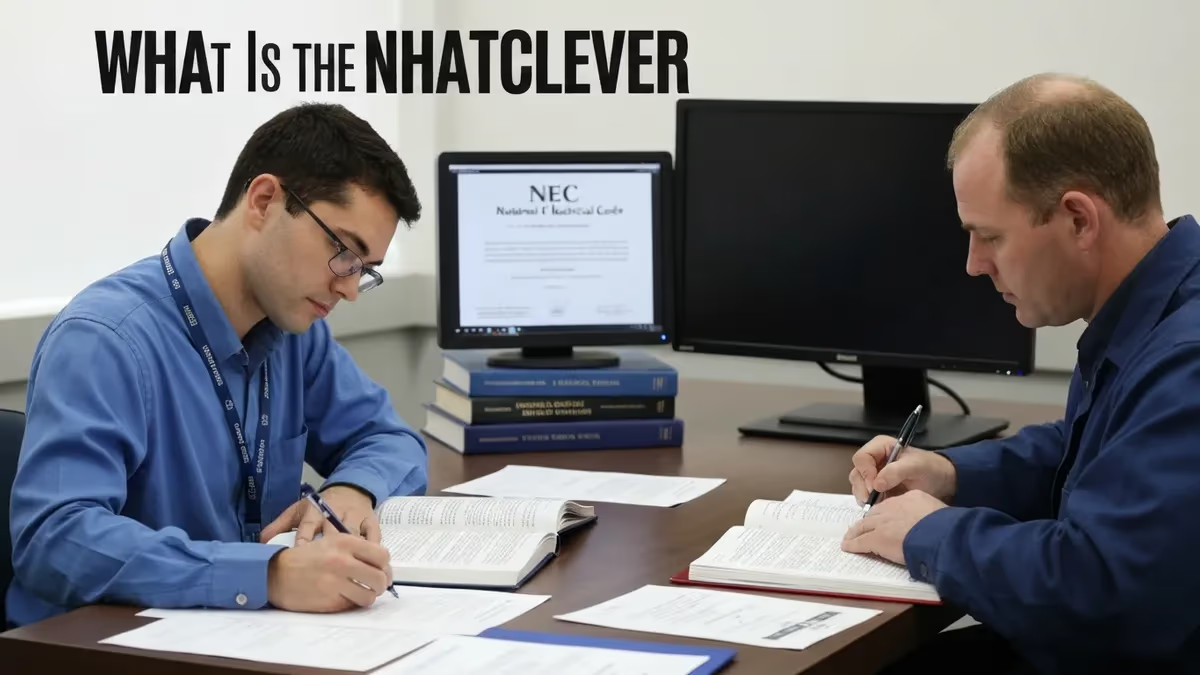
What Is the National Electrical Code (NEC)?
The National Electrical Code (NEC), officially known as NFPA 70, is the benchmark standard for safe electrical installation in the United States. Published by the National Fire Protection Association (NFPA), the NEC is updated every three years — the most recent edition is the 2023 NEC, with adoption varying by state and jurisdiction. The code establishes minimum requirements for the installation of electrical conductors, equipment, and raceways for residential, commercial, and industrial occupancies.
The NEC is not a federal law — it is a model code adopted at the state, county, or municipal level by authorities having jurisdiction (AHJs). As of 2025, all 50 states have adopted some version of the NEC, though many have adopted older editions and some have local amendments. Electricians must know which edition and amendments apply in their jurisdiction, as inspectors enforce local code, not necessarily the most recent NEC edition.
The NEC is the primary reference for all electrician licensing exams in the United States. Journeyman and master electrician exams are open-book tests — you bring your NEC codebook to the exam and must know how to navigate it efficiently to find answers within the allotted time. Strong familiarity with the NEC structure and high-frequency code articles is essential for passing licensing exams and for performing code-compliant work in the field.
Why the NEC Exists
The NEC was first published in 1897 in response to the growing hazards of electrical installation as electrification expanded. The primary purpose of the NEC is to protect persons and property from the hazards arising from the use of electricity. Electrical fires and electrocutions are leading causes of residential deaths and property loss in the United States. NEC provisions address these hazards by establishing minimum standards for wire sizing, insulation types, grounding, overcurrent protection, and installation methods that reduce risk when followed correctly.

How the NEC Is Organized
The National Electrical Code is organized into a series of articles, each covering a specific aspect of electrical installation. Knowing the structure of the NEC is critical for electrician exam takers, who must locate answers quickly in an open-book format. Here is the high-level organization:
General Articles (100–110)
Article 100 contains definitions — the meanings of terms used throughout the code. Article 110 covers general requirements for electrical installations, including examination and approval of equipment, installation and use, spaces about electrical equipment, and mechanical execution of work. These foundational articles are among the most frequently referenced in NEC exams.
Wiring and Protection (200–285)
This chapter covers branch circuits, feeders, services, overcurrent protection, grounding and bonding, surge protection, and power monitoring. Articles in this range include: Article 200 (grounded conductors), Article 210 (branch circuits), Article 215 (feeders), Article 220 (branch circuit, feeder, and service load calculations), Article 230 (services), Article 240 (overcurrent protection), Article 250 (grounding and bonding), and Article 285 (surge protective devices). These articles are heavily tested on licensing exams.
Wiring Methods and Materials (300–399)
This chapter specifies approved wiring methods and materials. Articles include: Article 300 (general requirements for wiring methods), Article 310 (conductors for general wiring), Article 314 (outlet, device, pull, and junction boxes), Article 320 (armored cable — AC), Article 330 (metal-clad cable — MC), Article 334 (nonmetallic-sheathed cable — Romex), Article 344 (rigid metal conduit — RMC), Article 348 (flexible metal conduit — FMC), Article 352 (rigid PVC conduit), and Article 358 (electrical metallic tubing — EMT).
Equipment Articles (400–499, 500–590, 600–695, 700–770, 800–840)
Subsequent chapters address specific equipment types, special occupancies and conditions, and communications systems. Key articles for general electricians include Article 404 (switches), Article 406 (receptacles), Article 408 (switchboards and panelboards), Article 410 (luminaires and lamps), Article 430 (motors), and Article 440 (air conditioning and refrigerating equipment).
Wiring Methods and Materials
Chapter 3 of the NEC (Articles 300–399) governs wiring methods and materials. Understanding approved wiring methods, their permitted applications, and their installation requirements is critical for both the licensing exam and for daily electrical work.
Conductors and Wire Sizing
Article 310 covers conductors for general wiring. The size of a conductor is specified by its American Wire Gauge (AWG) number — a lower gauge number indicates a larger conductor. Common sizes: 14 AWG is the minimum for 15-amp circuits, 12 AWG for 20-amp circuits, 10 AWG for 30-amp circuits, 8 AWG for 40-amp circuits, and 6 AWG for 55-amp circuits. Ampacity — the current-carrying capacity of a conductor — depends on conductor material (copper vs. aluminum), insulation type, and ambient temperature. Conductor ampacity tables in Article 310 are among the most frequently referenced in NEC exams.
Nonmetallic-Sheathed Cable (NM-B, Romex)
Article 334 covers nonmetallic-sheathed cable, commonly known by the trade name Romex. NM-B cable is the most common wiring method for residential construction. It consists of two or more insulated conductors wrapped in a plastic jacket. NM-B cable is permitted in one- and two-family dwellings and multi-family dwellings not exceeding three floors above grade. It is not permitted in commercial buildings, in areas exposed to physical damage, in wet or damp locations, or where embedded in concrete. Common exam questions address minimum stapling distances (NM-B must be secured within 12 inches of each box and at intervals not exceeding 4.5 feet).
Electrical Metallic Tubing (EMT)
Article 358 governs electrical metallic tubing, the most commonly used conduit type in commercial construction. EMT is a thin-walled, unthreaded metal raceway that provides mechanical protection for conductors. EMT is permitted in most locations except where subject to severe physical damage. Key EMT installation requirements: must be supported within 3 feet of each box and at intervals not exceeding 10 feet; bends must not reduce the internal diameter; the number of conductors permitted in EMT is determined by fill calculations using NEC conduit fill tables.
Conduit Fill Calculations
When installing multiple conductors in conduit, the total cross-sectional area of all conductors must not exceed the permitted fill percentage for the conduit. For two conductors, maximum fill is 31% of conduit interior area. For three or more conductors, maximum fill is 40%. For a single conductor, fill can be up to 53%. NEC Annex C provides tables showing the maximum number of specific conductor sizes permitted in each conduit size, making these calculations straightforward for standard configurations.
Load Calculations (Article 220)
Article 220 of the NEC governs branch circuit, feeder, and service load calculations. Load calculations determine the minimum size required for service entrance conductors, service panels, feeder conductors, and branch circuits based on the anticipated electrical loads in a building. Accurate load calculations are required for new construction, service upgrades, and addition of significant new loads.
Dwelling Unit Load Calculations
For single-family dwellings, the NEC provides a standard calculation method (Part III) and an optional method (Part IV). The standard method calculates loads as follows: general lighting and receptacles at 3 VA per square foot of floor area, small appliance circuits at 1,500 VA per required circuit (minimum two), laundry circuit at 1,500 VA, fixed appliances at nameplate ratings, largest motor at 125% of nameplate, and heating or cooling load (whichever is larger). After tabulating all loads, demand factors from NEC Table 220.42 are applied to the general lighting load — the first 3,000 VA at 100%, the next 117,000 VA at 35%, and anything over 120,000 VA at 25%. The optional calculation method allows a single demand factor applied to all loads and often produces a smaller calculated load for larger homes.
Commercial Load Calculations
Commercial load calculations follow similar principles but account for different occupancy types (office, retail, restaurant, hospital) with different lighting load values per square foot. NEC Table 220.12 provides unit lighting loads by occupancy in VA per square foot. Commercial calculations also address large motor loads, HVAC systems, and special equipment more rigorously than residential calculations.
Service Size Determination
After completing load calculations, the service size is determined by dividing the total VA load by the service voltage (typically 240V for residential). This yields the minimum ampere rating required. Service conductors are then selected from Article 310 ampacity tables based on this minimum ampere rating. Most modern single-family homes require 200-amp service — older homes may have 100-amp or 150-amp service that requires upgrading when significant loads are added.
Overcurrent Protection (Article 240)
Article 240 covers the requirements for overcurrent protection devices (OCPDs) — circuit breakers and fuses — that protect conductors and equipment from excessive current. Overcurrent protection is one of the most fundamental concepts in electrical safety, and questions from Article 240 appear on virtually every electrician licensing exam.
What Is Overcurrent Protection?
An overcurrent condition occurs when current in a circuit exceeds the ampacity of the conductors or the current rating of equipment. Overcurrent can result from overloads (equipment drawing more current than designed) or short circuits (an unintended low-resistance path between conductors). Without protection, overcurrent heats conductors to the point of insulation failure, potentially causing fires or electrocution. Circuit breakers and fuses interrupt the circuit when current exceeds their rating, preventing conductor damage.
Standard Breaker and Fuse Ratings
Circuit breakers and fuses are manufactured in standard ampere ratings defined by NEC Section 240.6: 15, 20, 25, 30, 35, 40, 45, 50, 60, 70, 80, 90, 100, 110, 125, 150, 175, 200, 225, 250, 300, 350, 400, 450, 500, 600, 700, 800, 1000, 1200, 1600, 2000, 2500, 3000, 4000, 5000, and 6000 amperes. When the calculated load falls between standard ratings, the NEC generally permits the next higher standard rating (240.4(B)) — but not when the conductor is 10 AWG or smaller, which must be protected at or below its ampacity.
Ground Fault and Arc Fault Protection
The NEC requires Ground Fault Circuit Interrupters (GFCIs) in areas where electrical equipment might come into contact with water — bathrooms, kitchens, garages, outdoors, crawl spaces, unfinished basements, and other locations specified in Article 210. GFCI devices trip when they detect a ground fault of 5 milliamps or more, preventing electrocution. Arc Fault Circuit Interrupters (AFCIs) are required for most circuits in dwelling units (Article 210.12) and detect the signatures of electrical arcing that can cause fires even without a conventional overcurrent condition. AFCIs are one of the most significant expansions of the NEC in recent decades.
NEC Checklist
- ✓Know the NEC chapter and article organization — which articles cover which topics
- ✓Memorize the most commonly referenced articles: 100, 110, 210, 220, 230, 240, 250, 300, 310, 334, 358
- ✓Practice conductor sizing and ampacity calculations using Article 310 tables
- ✓Practice conduit fill calculations using NEC Annex C tables
- ✓Know dwelling unit load calculation steps (Article 220 standard and optional methods)
- ✓Understand GFCI and AFCI requirements and where each is required
- ✓Know standard breaker and fuse ratings (NEC Section 240.6)
- ✓Practice locating code provisions under time pressure — exam timing matters
- ✓Take full-length NEC practice tests to identify weak areas before your licensing exam
NEC Practice Test Questions
Prepare for the NEC - National Electrical Code exam with our free practice test modules. Each quiz covers key topics to help you pass on your first try.
NEC Code Basic
NEC Exam Questions covering Code Basic. Master NEC Test concepts for certification prep.
NEC Electrical Assessment
NEC Mock Exam on Electrical Assessment. NEC Study Guide questions to pass on your first try.
NEC ELECTRIC TEST
NEC Mock Test covering ELECTRIC TEST. Online NEC Test practice with instant feedback.
NEC Load Calculations & Branch Circuits
Free NEC Quiz on Load Calculations & Branch Circuits. NEC Exam prep questions with detailed explanations.
NEC - National Electrical Code Branch Circ...
NEC Practice Questions for - National Electrical Code Branch Circuit Requirements. Build confidence for your NEC certification exam.
NEC - National Electrical Code Grounding a...
NEC Test Online for - National Electrical Code Grounding and Bonding. Free practice with instant results and feedback.
NEC Overcurrent Protection & Controls
NEC Study Material on Overcurrent Protection & Controls. Prepare effectively with real exam-style questions.
NEC Pros and Cons
- +NEC has a defined, publicly available content blueprint — candidates know exactly what to prepare for
- +Multiple preparation pathways (self-study, courses, coaching) accommodate different learning styles and schedules
- +A growing ecosystem of study resources means candidates at any budget level can access quality preparation materials
- +Clear score reporting allows candidates to identify specific strengths and weaknesses for targeted remediation
- +Professional recognition associated with strong performance provides tangible career and academic benefits
- −The scope of tested content requires substantial preparation time that competes with existing professional or academic commitments
- −No single resource covers the full content scope — candidates typically need multiple study tools for comprehensive preparation
- −Test anxiety and exam-day performance variability mean preparation effort does not always translate linearly to scores
- −Registration, preparation, and potential retake costs accumulate into a significant financial investment
- −Content and format can change between exam versions, making older preparation materials less reliable
NEC Questions and Answers





About the Author

Educational Psychologist & Academic Test Preparation Expert
Columbia University Teachers CollegeDr. Lisa Patel holds a Doctorate in Education from Columbia University Teachers College and has spent 17 years researching standardized test design and academic assessment. She has developed preparation programs for SAT, ACT, GRE, LSAT, UCAT, and numerous professional licensing exams, helping students of all backgrounds achieve their target scores.
Join the Discussion
Connect with other students preparing for this exam. Share tips, ask questions, and get advice from people who have been there.
View discussion (8 replies)