
Non Destructive Testing Methods and Techniques: Complete 2026 October Guide
NDT methods and techniques explained: 🧠 UT, RT, MT, PT, VT, ET. Aerospace, concrete, pipeline, and gold testing applications. Pass your ASNT exam.
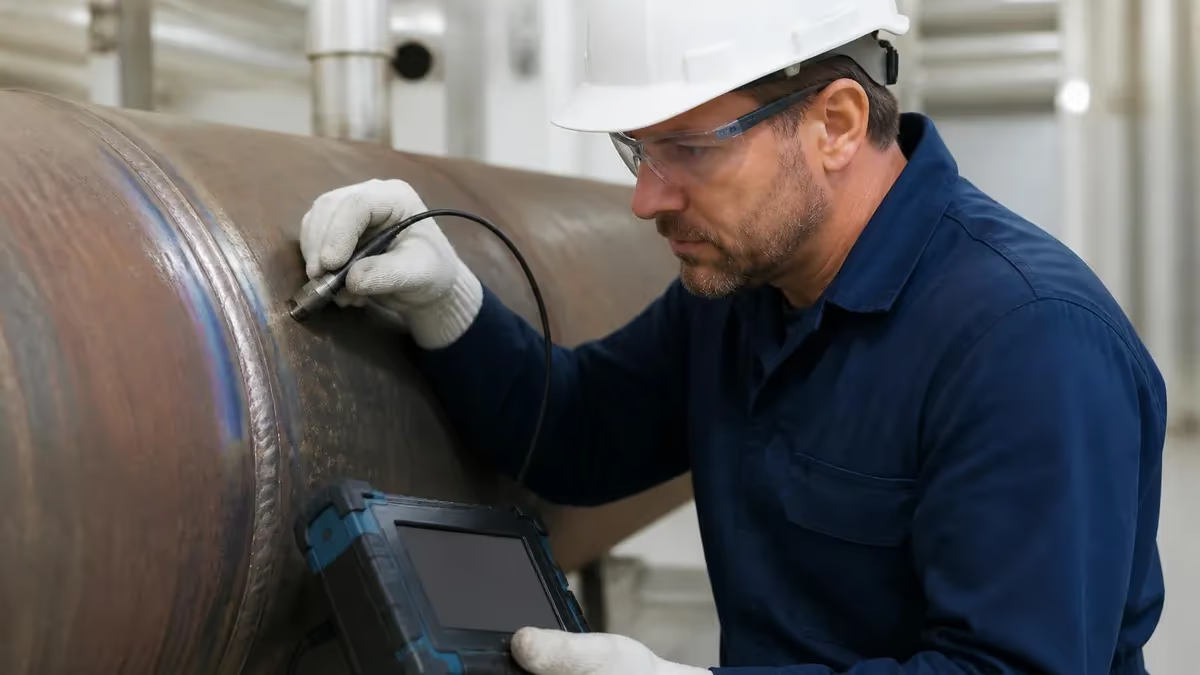
Walk onto any aerospace shop floor, refinery, or jewelry assay lab and you'll find the same six letter codes scribbled on inspection reports: UT, RT, MT, PT, VT, and ET. Those abbreviations cover the six methods that ASNT recognizes as the backbone of the discipline. They govern almost every weld, casting, composite panel, and gold bar that gets stamped "fit for service."
You don't pick between them at random. The defect you're hunting, the material in front of you, and the access you've got all push you toward one technique over another. The best inspectors mix two or three to cross-check what they find.
This guide walks through the methods one by one and shows where each shines. We'll dig into ultrasonic and shear wave testing for thick steel welds. Then radiography and X-ray work for pipelines and aerospace skin. Magnetic particle and penetrant for surface-breaking cracks. Visual inspection — still the most overlooked tool in the kit. And eddy current for conductive materials.
Then we tie it back to real industries — aerospace composites, concrete rebar and voids, pipeline corrosion, and yes, even gold authentication via XRF. Because that's where this knowledge actually gets paid. If you're prepping for an ASNT Level II exam or just trying to figure out which method to spec on your next inspection plan, the next 2,500 words will save you a lot of guesswork.
Free Boilermaker Nondestructive Testing Certification Study Tools
Interactive Boilermaker Nondestructive Testing Certification resources on PracticeTestGeeks, free to start:
- Boilermaker Nondestructive Testing Certification flashcards — review key terms and concepts card by card
- Boilermaker Nondestructive Testing Certification study guide — topic-by-topic overview of what the exam covers
- Boilermaker Nondestructive Testing Certification cheat sheet — one-page printable summary for last-minute review
NDT by the Numbers
What "Non Destructive" Actually Means
Destructive testing pulls a sample apart until it breaks, measures the load it took, and throws the wreckage away. That works fine for batch certification. Try doing it to the wing spar of a 737 in service, though, and you've just grounded a fleet.
Non destructive testing inspects the part where it sits, keeps it intact, and gives you a verdict on whether it can stay in service or needs to come out. The advantages of non destructive testing stack up fast — lower cost per inspection over the asset life, no scrap, and the ability to monitor the same component every six or twelve months and trend the data.
Aerospace, oil and gas, power generation, and civil engineering can't function without it. The trade-off? NDT measures indirectly. You're inferring a flaw from a reflected sound wave, an absorbed photon, or a leaking magnetic field.
That means interpretation matters more than instrumentation. That's why ASNT certification — Level I, II, and III — exists. A Level II UT tech who's seen 10,000 weld scans will catch a lack-of-fusion defect that an automated system misses every time.
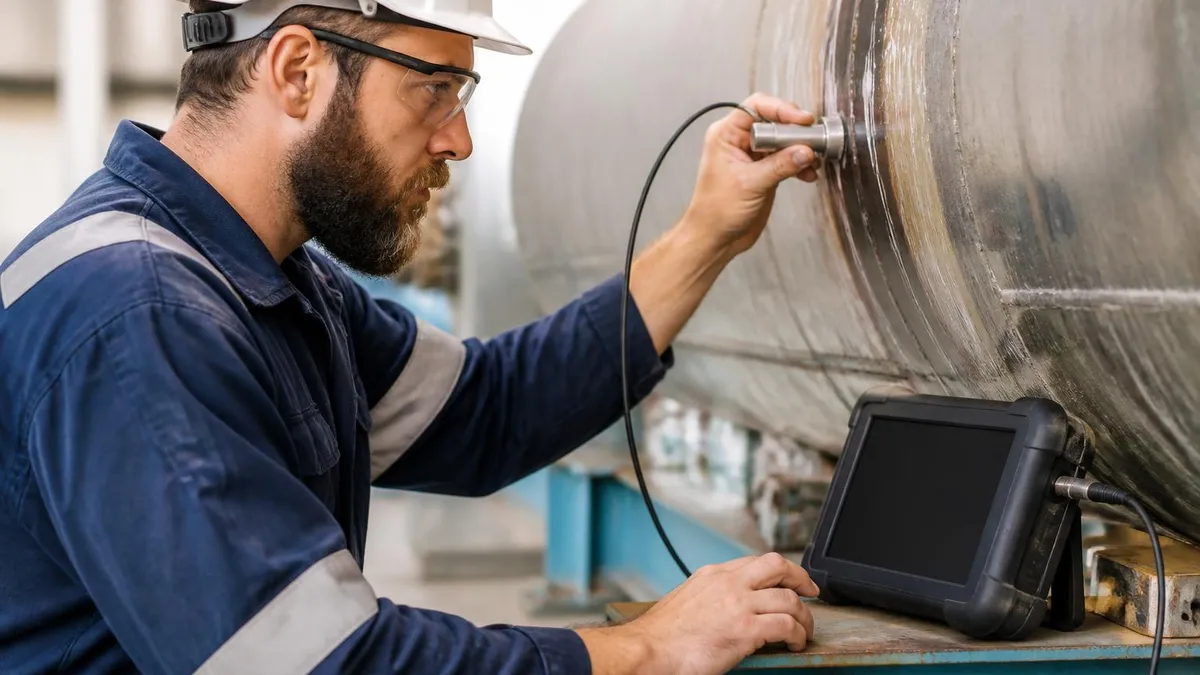
If the defect is on the surface, reach for PT or MT first — they're cheap, fast, and give a visual indication. If it's buried in the parent material, switch to UT (for thickness and internal flaws) or RT (when you need a permanent image record). Composites? Phased array UT or thermography. Don't waste a radiograph on a surface crack you can see with a 10x loupe and dye penetrant.
Ultrasonic Testing (UT): The Workhorse
Ultrasonic NDT testing fires a high-frequency sound pulse — usually 1 to 10 MHz — into the part and listens for the echo. A back-wall echo means the material is sound. An early reflection means something interrupted the wave: a crack, void, inclusion, or lack of fusion.
Conventional pulse-echo UT uses a single transducer that both transmits and receives. The technician moves the probe across the surface, watching the A-scan trace on the flaw detector and noting any signals above the reference threshold. That's the basic version.
In the field you'll see three flavors stacked on top of it. Shear wave NDT angles the beam — typically 45°, 60°, or 70° — so it bounces through a weld at a slant, catching defects that a straight beam would skim past. Shear wave is the standard for inspecting butt welds in pressure vessels and pipelines because the weld cap blocks straight-down access.
Phased array UT (PAUT) uses a probe with 16 to 128 elements that can be electronically steered and focused, building a 2D image of the inspection volume in real time. Think medical ultrasound for steel. Time-of-flight diffraction (TOFD) measures the diffraction signals from crack tips and gives you the most accurate sizing data in the business — down to ±1 mm on a 50 mm weld.
Where does ultrasound NDT earn its keep? Steel weld inspection on offshore platforms, refineries, and shipyards. Corrosion mapping on tank bottoms. Thickness gauging on aging pipe. And increasingly on composite layups in aerospace.
The downsides? It needs a couplant — gel, water, or oil. The surface has to be reasonably smooth. Rough castings can scatter the beam into uselessness.
The Six ASNT NDT Methods
High-frequency sound waves detect internal defects, measure thickness, and inspect welds. Variants include shear wave UT, phased array (PAUT), and time-of-flight diffraction (TOFD). Industry workhorse for thick steel and weld inspection.
X-ray NDT or gamma radiation creates a permanent image — film or digital — of internal structure. Best for porosity, slag, and weld cross-section verification. Required by ASME and API codes for pipeline girth welds.
Magnetizes ferromagnetic parts and uses iron particles to reveal surface and near-surface cracks. Fast, cheap, brutally effective. Limited to carbon steel and low-alloy steel — won't work on stainless or aluminum.
Capillary action draws dye into surface-breaking flaws. Works on any non-porous material — metals, ceramics, plastics, composites. Available as visible red dye or fluorescent (UV) for high-sensitivity aerospace work.
Direct or remote visual inspection using borescopes, drones, and remote visual inspection (RVI) gear. Underrated, but still finds 60% of all NDT indications before any other method runs. Requires Jaeger 2 eye certification.
Eddy currents detect surface and subsurface flaws in conductive materials. Heavily used on aircraft fuselage skin, fastener holes, and heat exchanger tubing. Works through paint and coatings without surface prep.
Radiographic Testing (RT): The Permanent Record
If UT is the workhorse, RT is the historian. Radiography uses ionizing radiation — X-rays from an electrical tube or gamma rays from a sealed isotope source. Iridium-192 and Cobalt-60 are the common sources — to pass through the part and expose a film or digital detector on the other side.
Denser regions absorb more radiation and show up lighter on the image. Voids, cracks parallel to the beam, and porosity show up darker. The result is a permanent record you can re-examine years later. That's why pipeline construction codes (ASME B31.3, API 1104) still default to RT for girth welds.
X-ray NDT and gamma RT do roughly the same job with different trade-offs. X-ray equipment is bulkier and needs mains power, but it's safer (the radiation stops the second you flip the switch) and gives better contrast on thin sections.
Gamma sources are portable — a tech can carry an Iridium camera up a scaffold in a backpack. But the source is always "on," so radiation safety controls (exclusion zones, dosimeters, source-out-of-shield alarms) are non-negotiable.
Digital radiography (DR) and computed radiography (CR) have largely replaced wet film in modern shops because they cut exposure times and let you tweak contrast in software. RT's weakness is geometry. Cracks oriented perpendicular to the beam are nearly invisible because they present almost no through-thickness change.
That's why an RT shop will often back up a critical weld with shear wave UT — the two methods catch each other's blind spots.
UT vs RT: Choose the Right Method
You need real-time results at the inspection point. You're sizing a known defect and need accurate depth and length data. You're working on thick sections (over 50 mm) where RT exposure times become impractical. You don't have access to both sides of the part — UT only needs one. Radiation safety zones aren't feasible — for example, on a live refinery deck.
Magnetic Particle, Penetrant, and Visual: The Surface Trio
Not every defect is buried. A huge percentage of in-service failures start as surface cracks — fatigue cracks from cyclic loading, stress corrosion cracks in stainless steel, or grinding cracks in heat-treated components. Three NDT methods specialize in surface and near-surface inspection. They're the ones a new inspector cuts their teeth on.
Magnetic particle testing (MT) works only on ferromagnetic materials — carbon steel, low-alloy steel, some martensitic stainless. You induce a magnetic field in the part (using a yoke, prods, or a coil), and any discontinuity that breaks the surface or sits within about 6 mm of it disturbs the field, creating a leakage flux.
Fluorescent or visible iron particles dusted onto the surface gather at the leakage point and trace the flaw. The method is fast — you can MT a 6-inch flange in under two minutes — forgiving of rough surfaces, and dirt cheap. A yoke kit runs about $500 and lasts a decade.
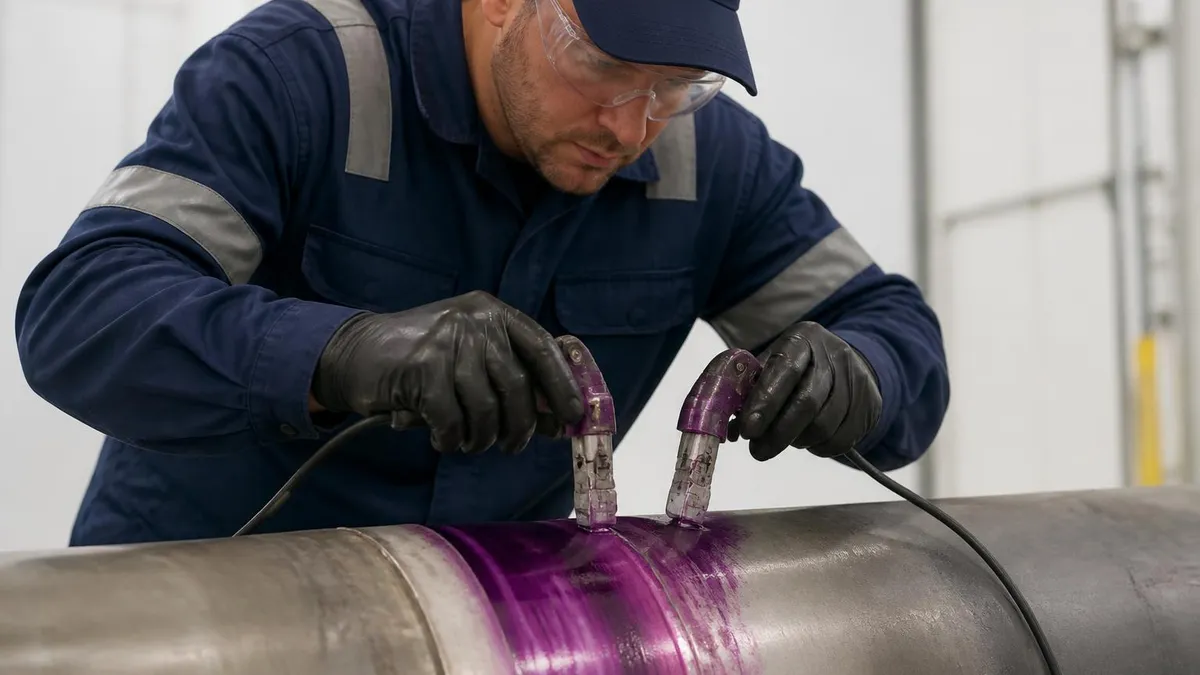
Liquid penetrant testing (PT) covers the gap for non-ferrous and non-magnetic materials: aluminum, copper, austenitic stainless, titanium, ceramics, and most plastics. You apply a low-viscosity dye to the cleaned surface, let it dwell so capillary action pulls it into any surface-breaking crack, wipe the excess, and apply a developer that draws the dye back out into a visible indication.
Two variants matter — visible red dye for general work and fluorescent for high-sensitivity aerospace inspection under UV light. The trap with PT: it only finds surface-breaking defects. A crack with a closed mouth (from peening or grinding) won't bleed and won't show.
Visual testing (VT) sounds trivial but it's where every inspection starts and where the majority of indications first appear. Modern VT goes way beyond a flashlight and a mirror.
Remote visual inspection (RVI) with high-resolution borescopes, articulating probes for turbine engine internals, and drone-mounted cameras for flare stack and bridge inspection have made VT a serious engineering discipline. ASNT requires a specific eye test (Jaeger 2 at 12 inches) before you can certify, and a Level II VT inspector knows the codes (ASME Section V, AWS D1.1) cold.
Radiographic testing involves ionizing radiation, and gamma sources don't switch off. Every year inspectors get over-exposed because someone shortcut the survey, lost the source, or walked into an active shoot. Always verify the source position before entering the exclusion zone, wear your dosimeter, and follow the ALARA principle. If your shop tells you to "just go quick," walk off the job — your bone marrow doesn't grow back.
Eddy Current and Aerospace NDT
Eddy current testing (ET) is the dark horse of NDT. A coil carrying alternating current induces circular currents — eddies — in any nearby conductor. Defects, edge effects, and conductivity changes disturb the eddy flow, and the coil's impedance shifts in response.
You read the shift on an impedance plane display and interpret the signal pattern. ET is the method of choice for aerospace fuselage inspection — riveted lap joints, hidden corrosion under the skin, fatigue cracks at fastener holes — because it works through paint, doesn't need couplant, and runs fast.
Heat exchanger tubing inspection in refineries and power plants is also dominated by ET, specifically bobbin coil and array probes. Aerospace non-destructive testing is where all six methods get pushed to their limits.
A commercial aircraft contains hundreds of thousands of fasteners, miles of welded structure, composite control surfaces, and titanium fittings. Every one of them is inspected on a defined schedule. The maintenance program is built around ATA chapters and the Maintenance Steering Group MSG-3 logic.
Composite inspection has driven huge investment in phased array UT, infrared thermography, and shearography because traditional methods don't translate well to carbon fiber laminates. Bond integrity, delamination, water ingress in honeycomb cores — these are aerospace problems that need aerospace solutions.
Rope access NDT has become a serious sub-discipline of its own. Wind turbine blades, offshore platforms, refinery flare stacks, and high-rise structural steel can't all be scaffolded economically.
IRATA and SPRAT-certified inspectors carry compact MT yokes, dye penetrant kits, and phased array units down ropes and inspect on station. The combination of access certification (IRATA L1/L2/L3) and NDT certification (ASNT Level II) opens jobs that pay 50% above ground-based rates.
NDT Inspection Pre-Flight Checklist
- ✓Verify inspector certification level matches the procedure requirement (Level II minimum for interpretation)
- ✓Confirm equipment calibration is in date — block, transducer, source, exposure device
- ✓Review the applicable code (ASME Section V, AWS D1.1, API 1104) and acceptance criteria
- ✓Clean the surface to the required finish before MT, PT, or UT couplant application
- ✓Set up exclusion zones and radiation surveys for any RT work
- ✓Document the part, weld, or component with unique ID and reference orientation marks
- ✓Record temperature, ambient conditions, and any process variables that affect results
- ✓Cross-check critical findings with a second method (UT plus RT, or PT plus MT)
Concrete, Pipelines, and Gold: Three Specialist Applications
NDT doesn't stop at steel welds. Concrete non destructive testing has its own toolkit — ultrasonic pulse velocity (UPV) for compressive strength estimation, rebound hammer for surface hardness, ground-penetrating radar (GPR) for rebar location and void detection, and ultrasonic tomography for slab integrity.
Civil engineers use these to assess aging bridges, parking decks, and post-tensioned concrete without coring out destructive samples. The challenge is that concrete is inherently heterogeneous — aggregate, cement, voids — so the noise floor is higher than in steel. Interpretation depends heavily on baseline calibration cores.
Pipeline inspection runs at industrial scale. In-line inspection (ILI) tools — "smart pigs" — travel inside live pipelines carrying magnetic flux leakage (MFL), ultrasonic, or caliper sensors that map wall loss, dents, cracks, and ovality over hundreds of kilometers.
Above ground, technicians follow up with shear wave UT and external corrosion direct assessment (ECDA) on identified anomalies. The integrity management program built around this data is what keeps oil and gas pipelines from rupturing. When it fails — Aliso Canyon, Mayflower, Kalamazoo — the consequences are environmental disasters.
Non destructive gold testing deserves its own paragraph because the techniques are entirely different. Jewelers and bullion dealers use X-ray fluorescence (XRF) spectrometers — handheld guns that fire a low-power X-ray at the surface, excite the gold atoms, and read the characteristic fluorescent X-rays they emit back.
The spectrum tells you the exact karat (8K, 14K, 18K, 22K, 24K) and reveals any tungsten or platinum core fakery. Ultrasonic gold testing measures sound velocity through the metal — pure gold has a specific velocity that tungsten substitutes can't match.
Both methods leave the piece intact, which is why pawn shops, refineries, and central banks rely on them. Acid testing is destructive (scratches the surface) and obsolete for high-value items.
Trade-offs of the Major NDT Methods
- +UT excels at depth and sizing accuracy, works on thick steel, gives real-time results
- +RT produces a permanent image record, finds volumetric defects, code-trusted for decades
- +MT is fast, cheap, and offers very high sensitivity on ferrous surface cracks
- +PT works on any non-porous material, low cost, easy for new inspectors to learn
- +ET inspects through paint, scans fast, and is ideal for aerospace skin and tubing
- +VT has the lowest cost and catches obvious defects before any other method runs
- −UT requires couplant, struggles on rough castings, and is heavily operator-dependent
- −RT carries radiation safety overhead, has slow exposure, and misses tight planar cracks
- −MT only works on ferromagnetic materials, and only catches surface and near-surface flaws
- −PT only detects surface-breaking defects and is very sensitive to cleaning prep quality
- −ET only works on conductive materials, and signal interpretation is complex to learn
- −VT only finds what the eye (or camera) can resolve at the surface — misses internal flaws
Pros and Cons at a Glance
| Pros | Cons |
|---|---|
| UT excels at depth and sizing accuracy, works on thick steel, gives real-time results | UT requires couplant, struggles on rough castings, and is heavily operator-dependent |
| RT produces a permanent image record, finds volumetric defects, code-trusted for decades | RT carries radiation safety overhead, has slow exposure, and misses tight planar cracks |
| MT is fast, cheap, and offers very high sensitivity on ferrous surface cracks | MT only works on ferromagnetic materials, and only catches surface and near-surface flaws |
| PT works on any non-porous material, low cost, easy for new inspectors to learn | PT only detects surface-breaking defects and is very sensitive to cleaning prep quality |
| ET inspects through paint, scans fast, and is ideal for aerospace skin and tubing | ET only works on conductive materials, and signal interpretation is complex to learn |
| VT has the lowest cost and catches obvious defects before any other method runs | VT only finds what the eye (or camera) can resolve at the surface — misses internal flaws |
Building a Career in NDT
If you're reading this because you're planning to certify, here's the realistic path. Start with ASNT SNT-TC-1A or NAS 410 (for aerospace) Level I in one or two methods — usually PT and MT because they're cheap to train on.
Build hours under a Level II supervisor. The required hours are method-specific — typically 70 hours of training plus 210 hours of OJT for UT Level II. Pass the general, specific, and practical exams. Then pick up additional methods. Most working inspectors carry Level II in 3 to 5 methods by their fifth year.
Level III is where the money is. A Level III writes procedures, approves techniques, and signs off on disputed indications. The exam is brutal — broad coverage of all methods, materials science, codes, and the specific method you're certifying in.
Pass rates run around 50% on the first attempt. But once you've got it, $120K to $180K base salary in the US is realistic. ASNT Level III consultants on offshore or nuclear projects pull day rates that make tech-sector engineers blink.
The other route is into specialty methods — phased array UT, advanced composites NDT, in-line pipeline inspection, or guided wave testing. These pay premium because the inspector pool is small and the equipment is expensive. Composites inspection in aerospace is one of the fastest-growing niches as carbon fiber primary structures take over from aluminum.
Where the Field Is Heading
NDT in 2026 isn't the same job it was in 1996. Three shifts are reshaping the work. First, digital and array techniques have largely replaced film and single-element probes. Phased array UT, digital radiography, and array eddy current dominate new procurement.
Second, automation is moving in. Robotic UT scanners on tank floors, drone-mounted RVI on flare stacks, autonomous crawlers on pipeline outer walls. The Level II inspector now interprets data more than they swing a yoke.
Third, machine learning is starting to handle defect classification on phased array C-scans and digital radiographs. The human still signs the report, but the first-pass screening is increasingly algorithmic.
None of that replaces the fundamentals. You still need to know why a 60° shear wave catches a sidewall lack of fusion that a 45° misses. You still need to read a radiograph and tell porosity from slag inclusions from tungsten inclusions.
You still need to know that PT won't find a crack that's been peened closed. The methods themselves — UT, RT, MT, PT, VT, ET — aren't going anywhere. The hardware just keeps getting smarter, and the inspectors who learn the new tools while keeping their old fundamentals sharp are the ones running departments by their tenth year.
Sample Boilermaker Nondestructive Testing Certification Practice Questions
Try these questions from our free Boilermaker Nondestructive Testing Certification practice tests. The correct answer and an explanation follow each question.
In acoustic emission testing (AET) of a pressure vessel during hydrostatic testing, what does a cluster of AE events from a localized area indicate?
- A. Normal background noise from fluid turbulence
- B. Active crack growth or significant structural activity at that location
- C. Successful completion of the pressure hold period
- D. Proper calibration of the AE sensor array
Answer: B. Active crack growth or significant structural activity at that location
A cluster of acoustic emission events localized to one area during pressurization indicates active energy release — typically associated with crack growth, deformation, or structural discontinuity activity.
When using eddy current testing to inspect non-ferromagnetic boiler tubes, a phase angle shift of approximately 90° between two indications MOST likely distinguishes:
- A. Inside diameter (ID) defects from outside diameter (OD) defects
- B. Cracks from corrosion pits
- C. Ferrous from non-ferrous materials
- D. Deep defects from shallow defects only
Answer: A. Inside diameter (ID) defects from outside diameter (OD) defects
In eddy current tube inspection, the phase angle of the signal response indicates the depth location of the discontinuity, with ID and OD defects typically separated by approximately 90° on the impedance plane.
How should Boilermaker Nondestructive Testing Certification professionals handle equipment showing signs of malfunction during operation?
- A. Continue operating while monitoring
- B. Immediately cease operation, secure the equipment, and report
- C. Attempt field repairs while running
- D. Finish the current task first
Answer: B. Immediately cease operation, secure the equipment, and report
Immediate cessation prevents safety hazards, further damage, or compromised results.
Which ASME standard governs the inspection and testing of pressure vessels?
- A. ASME B31.3
- B. ASME Section VIII
- C. ASME Section IX
- D. ASME B16.5
Answer: B. ASME Section VIII
ASME Section VIII, Division 1 and 2 cover the design, fabrication, and inspection requirements for pressure vessels.
Take the full Boilermaker Nondestructive Testing Certification practice test
NDT Questions and Answers
About the Author

Educational Psychologist & Academic Test Preparation Expert
Columbia University Teachers CollegeDr. Lisa Patel holds a Doctorate in Education from Columbia University Teachers College and has spent 17 years researching standardized test design and academic assessment. She has developed preparation programs for SAT, ACT, GRE, LSAT, UCAT, and numerous professional licensing exams, helping students of all backgrounds achieve their target scores.
Join the Discussion
Connect with other students preparing for this exam. Share tips, ask questions, and get advice from people who have been there.
View discussion (8 replies)