
NCLEX Study Guide: How to Study Effectively for First-Try Pass 2026 September
⏳ How to study for the NCLEX: active recall, Qbank strategy, content review, pharmacology approach, lab values, weak-area remediation, and study

NCLEX Study: Process Matters More Than Materials
Most nursing graduates own the right materials. UWorld, Saunders, Mark Klimek, NCLEX Bootcamp — the resources sit in tabs and stacks. The candidates who pass on first try aren't using better books than the ones who fail. They're studying differently. The process — how you engage with each question, each rationale, each weak area — is what separates a pass-first-try transcript from a 45-day retake notice.
This guide breaks down the study process itself: the active-learning techniques that compound, the Qbank workflow most students get wrong, content review strategy by week, weak-area remediation, and the specific mistakes that wreck otherwise-prepared candidates. If you took the HESI vs TEAS in nursing school, you already know testing format basics — this is about depth and process.
Think of it like learning a sport. Two athletes do the same number of reps. One mindlessly grinds through them. The other films every rep, watches it back, identifies the technical flaw, drills the correction, and re-tests. After 100 reps, they look like two different athletes. Same materials, radically different outcomes. NCLEX prep works exactly the same way.
The good news is process is teachable. Every technique in this guide is something you can implement starting tomorrow. The bad news is process requires discipline. Active recall feels harder than re-reading. Rationale journaling feels slower than clicking through. The candidates who pass are the ones who do the harder work, knowing the harder work is the only work that compounds.
The other thing worth flagging early: study fatigue is real and cumulative. Three or four weeks into a prep window, motivation flags. Productivity drops. The solution isn't pushing harder — it's building in scheduled rest days. Most pass-first-try candidates take one full day off per week with no NCLEX content at all. That day off pays dividends in retention and exam-day mental sharpness.
Set realistic boundaries. Tell family and friends you're studying for a high-stakes exam and need uninterrupted blocks. Most people will respect it. The candidates who try to keep up with social commitments, side jobs, and family events while preparing for NCLEX almost always study less than they think they do. Track real hours, not intended hours.
Trust the process. Show up, do the reps, track the data, and let the work compound.
The Study Method Hierarchy
Cognitive science is clear on what works for high-stakes exam prep: active recall (testing yourself) beats passive review by 2-3x. Spaced repetition (reviewing material at increasing intervals) cements memory. Rationale journaling (writing why an answer is right) deepens understanding. Mind-mapping disease processes builds the relational knowledge NCLEX rewards. If your study session involves highlighting and re-reading without testing yourself or writing anything, you're working hard but learning little.
How to Actually Use a Qbank
Most students use their Qbank wrong. They click through 50 questions in tutor mode, scan the rationale for two seconds, and move on. That's not studying — that's confirming what you already know and not learning what you don't. The Qbank is the most powerful tool in your stack, but only if you use it like a diagnostic instrument, not a quiz game.
Use a two-phase approach. Phase one (weeks 1-6): tutor mode, 25-50 questions per session, untimed. Read every rationale completely — even on questions you got right. Write the WHY in a notebook. Phase two (weeks 6-12): timed mode in blocks of 75 questions to mimic exam fatigue. Mark every question you're not 100% sure about. After the block, review every marked question AND every wrong question with full rationale read-through.
One small habit changes everything: read the rationale on questions you got right. Not just the WHY of the correct answer, but the WHY of why each wrong answer was wrong. That distractor logic is often what NCLEX retests in different wording later. Skimming past a right answer because you got it right is throwing away free learning. Every question is four learning opportunities, not one.
One advanced technique: after every 25-question block, before you review answers, predict your score. Most candidates calibrate poorly early in prep — they think they aced a block and got 60%, or they think they tanked and got 78%. The gap between predicted and actual score is itself information. As you study, predicted and actual converge. When you can predict within 5% reliably, you've developed exam intuition that translates to test day.

Active Learning Techniques That Work
Close the book and write down everything you remember about a topic. Then check against the source. The retrieval effort itself strengthens memory more than re-reading the same content five times.
Review yesterday's mistakes today, last week's mistakes this week, last month's content this month. Anki flashcards automate this — top NCLEX deck is NCLEX Comprehensive on shared Anki repositories.
For every wrong question, write 2-3 sentences: what you thought, why you were wrong, what the correct logic actually is. By exam day you'll have 200-300 entries of personal failure patterns.
Map disease processes — pathology → signs/symptoms → labs → diagnostics → interventions → complications. One sheet per condition. Forces relational learning over rote memorization.
Content Review: When and How
Content review is necessary but not sufficient. You can't pass the NCLEX from a Qbank alone if you have content gaps from nursing school. But you also can't pass from content review alone if you haven't practiced applying that content under question pressure. The right ratio for most candidates is 30% content review, 70% question practice across the prep window — shifted heavier toward questions in the final weeks.
Saunders Comprehensive Review remains the standard. Rotate through it system-by-system over weeks 1-6, taking 20-30 review questions at the end of each chapter. Don't try to read it cover-to-cover linearly — match your content review to your Qbank weak areas. If yesterday's pharmacology questions tanked at 50%, today's content review is pharmacology. The Best NCLEX Prep breakdown covers stack alternatives if Saunders doesn't fit your learning style.
One pattern works for almost every learner: skim a Saunders chapter at full speed first, taking 10-15 minutes to get the territory. Then go back to the sections that surprised you or felt fuzzy. Take focused notes only on those. By limiting the deep work to weak areas you cut content review time in half and retention doubles. Spending 4 hours linearly reading a 60-page chapter is the lowest-yield activity in nursing prep.
Skip the cover-to-cover myth. Saunders, Davis, ATI — these are reference books, not novels. Read them like a tool, not a story. Treat each chapter as a 30-minute investment: 10 minutes skimming, 10 minutes deep on weak sections, 10 minutes on the end-of-chapter questions. Multiply by 30 chapters and you've covered the core content in 15 efficient hours instead of 50 grinding hours.
Content Review Resources Compared
2,400-page bible of NCLEX content. Dense but exam-aligned. Best for visual readers who want everything in one place. Each chapter ends with 10-25 review questions and rationales. The companion question bank (5,000+ questions) is included. Most candidates use Saunders as their primary text and reference it as a lookup for weak areas surfaced by their Qbank.
Pharmacology Study: Classes, Not Pills
Pharmacology breaks more candidates than any other content area. The mistake is studying individual medications. There are 5,000+ drugs and you can't memorize them all. The fix is studying drug classes. Once you know that beta-blockers end in -olol and lower heart rate and blood pressure, you can answer any beta-blocker question — metoprolol, atenolol, carvedilol, propranolol — without having memorized each one.
Build a pharmacology framework: drug class → mechanism of action → main uses → top 2-3 side effects → key nursing implications → contraindications. One index card per class. Drill them daily with 15-20 cards on rotation. By week 6 you'll know the 50 most-tested classes cold. Spend extra time on the highest-yield classes: anticoagulants, antibiotics, antihypertensives, insulin, opioids, psychiatric medications, and chemotherapy basics.
Don't neglect drug names entirely. While drug class logic does the heavy lifting, the exam still uses generic names freely. Know the top 100 generic-to-class mappings cold: lisinopril is an ACE inhibitor, metoprolol is a beta-blocker, warfarin is an anticoagulant. Tape a one-page generic-to-class cheat sheet to your wall and glance at it for a few seconds three times a day. Spaced exposure beats marathon memorization.
One additional pharm tactic: identify the 10 "high-alert" medications NCLEX favors heavily — insulin, heparin, warfarin, digoxin, opioids, chemotherapy agents, lithium, neuromuscular blockers, concentrated electrolytes, IV anticoagulants. These appear disproportionately because they cause the most real-world patient harm. Know their indications, side effects, antidotes, and nursing implications inside out.
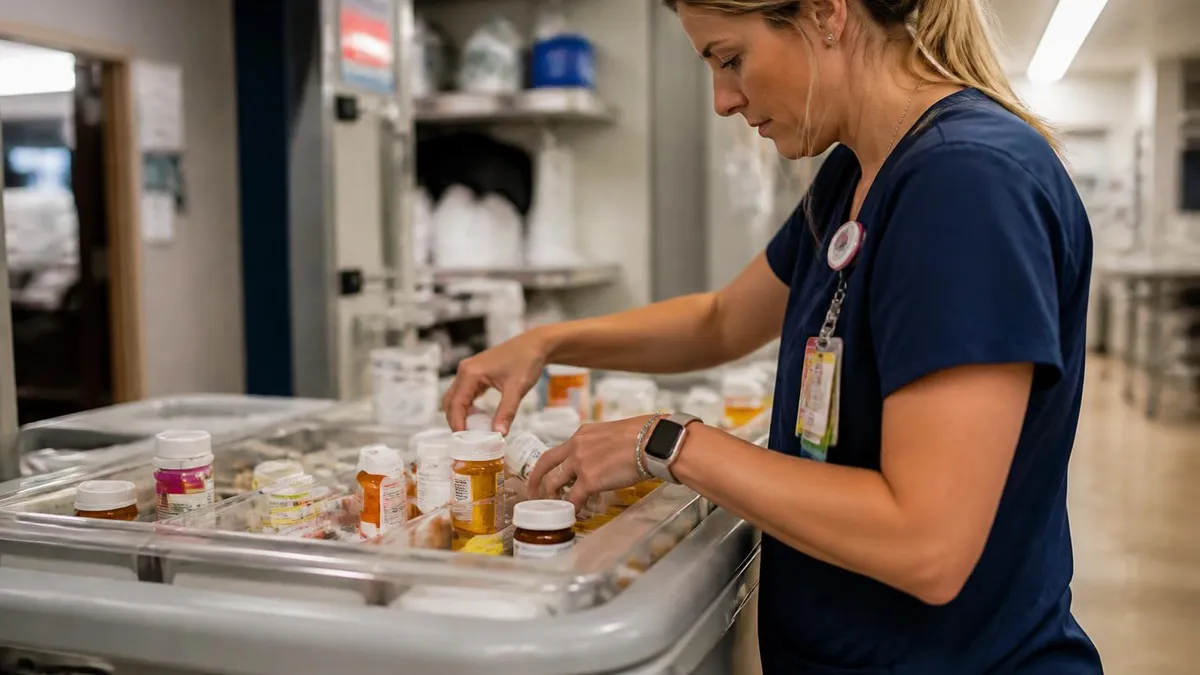
This is the single most common study mistake — getting frustrated with UWorld at week 4, switching to Archer, getting frustrated with Archer at week 6, switching to Kaplan. Each switch means you abandon thousands of unfinished questions, lose your performance tracking, and never finish a complete Qbank. Pick one primary Qbank in week one. Commit. The grass is the same color everywhere.
Lab Values, Dose Calc, and Priority Drilling
Three areas need pure repetition drilling because NCLEX tests them in clinically realistic ways: lab values, dose calculations, and prioritization. None of these can be 'understood' your way through. They need rep volume until the answers come without effort.
Lab values: memorize the top 20 ranges cold — Na, K, Ca, Mg, glucose, BUN, creatinine, hemoglobin, hematocrit, platelets, WBC, INR, PT, PTT, troponin, ABGs (pH, PaO2, PaCO2, HCO3), ammonia, digoxin level, lithium level. Make flashcards. Drill daily. By week 4 they should be instant. Dose calculations: practice 5-10 calculations per day across IV drips, weight-based pediatric doses, unit conversions.
Use the desired/have method or dimensional analysis — whichever stuck in nursing school. Prioritization and delegation: drill these specifically — 20+ items per day in the final 3 weeks. Most Qbanks let you generate custom assessments by content area; use this for targeted drilling.
The 20 lab values aren't arbitrary — they're the ones that drive nursing decisions on shift. Sodium tells you about fluid status. Potassium tells you about cardiac risk. Creatinine and BUN tell you about kidney function and drug dosing. INR drives warfarin titration. PTT drives heparin titration. Memorizing values is necessary, but knowing why each value matters clinically is what NCLEX rewards.
For dose calculations, choose one method and master it. Switching between dimensional analysis and the desired/have formula mid-prep produces error spikes under pressure. Both methods work fine if practiced consistently. Most candidates pick whichever method clicked in nursing school and stick with it through prep.
Daily Study Schedule (Weeks 4-10)
- ✓9:00 AM - Warmup: 10 pharmacology flashcards review
- ✓9:15 AM - Qbank block #1: 25 questions in tutor mode, full rationale review
- ✓10:30 AM - Content review: 1 chapter from Saunders matched to yesterday's weak area
- ✓11:30 AM - Break: walk, hydrate, snack
- ✓1:00 PM - Qbank block #2: 25 questions, mark all uncertain
- ✓2:15 PM - Lab values + dose calc drilling: 20 minutes each
- ✓3:00 PM - NGN case study: 1 full case with all 6 linked questions
- ✓3:30 PM - Prioritization/delegation drill: 15 targeted questions
- ✓4:15 PM - Rationale journaling: write up 5 hardest misses from the day
- ✓5:00 PM - Day done — close all tabs, separate from study
- ✓Phone in another room during study blocks — notifications fragment attention
- ✓Dedicated study space — same chair, same desk, brain learns this is work mode
- ✓Weekly progress check-in: review tracking spreadsheet, adjust plan for next week
NGN Practice Volume Matters
NGN case studies eat time on test day if you haven't practiced the format. The interface is unfamiliar, the multi-question case structure is unfamiliar, and the scoring rules (partial credit, polytomous scoring) require a different mental approach than legacy NCLEX items. The fix is volume — 50-100 NGN case studies before exam day so the format becomes invisible.
UWorld's NGN content has the largest library, with case studies built around the six clinical judgment measurement model steps: recognize cues, analyze cues, prioritize hypotheses, generate solutions, take action, evaluate outcomes. Practice these explicitly. Archer Review also has strong NGN content. The NCLEX Bootcamp Review includes hundreds of NGN-style cases as part of the subscription. Whichever Qbank you use, allocate at least one NGN case study per study day in your final 6 weeks.
Don't panic about NGN difficulty. The partial credit scoring means imperfect answers still earn points. Approach each case methodically: read the unfolding case carefully, identify the priority finding, pick the most clinically supported response. Speed matters but accuracy matters more. Three well-reasoned NGN responses beat ten rushed guesses on the same case.
Build NGN into your weekly rotation rather than treating it as a separate task. One case study per study day, scattered across systems, mimics how the real test serves them up. By exam day you'll have done 60-80 cases across all body systems without any one week feeling NGN-heavy.
Save your full-length practice tests for milestones, not weekly. Two or three across the full prep window is plenty. Treat them like dress rehearsals — full 150 questions, no breaks except scheduled, no phone, no looking up answers mid-block. The data they produce shapes your final two weeks of focus.
Weak-Area Remediation Loop
The fastest study gains come from a tight feedback loop. End each Qbank session knowing your three weakest content areas from that block. Spend tomorrow's content review on those areas. Drill those areas in tomorrow's targeted Qbank block. Re-test those areas next week. This loop — diagnose, remediate, re-test — compounds faster than any other study strategy.
Set up a simple tracking spreadsheet with date, total questions, percentage correct, and three weak topics from each session. After two weeks, patterns are obvious. Maybe endocrine sits at 55% while cardiac is at 80%. Now you know exactly where to focus. Without tracking, you'll either over-study what you already know (comfortable but useless) or under-study what you don't (anxiety-producing and useless). The data drives the plan.
Most candidates resist tracking because it feels like extra admin. Push past that. Ten minutes a day of tracking saves dozens of hours of mis-targeted study across a 10-week prep. The candidates who land in the High band on UWorld self-assessments are almost always the ones who tracked rigorously and let the data shape every week of study.
Re-test your weak areas weekly using custom assessments. Most Qbanks let you generate 25-question sets filtered by content area or by your previously-missed questions. This kind of targeted re-testing is the single highest-yield activity in the final 6 weeks of prep — far more valuable than blind random blocks.

Study Volume Benchmarks for Pass-First-Try
Common Study Mistakes That Wreck First-Try Pass Rates
Highlighting and re-reading without testing yourself feels productive but builds little. Replace with active recall — close the book and write what you remember.
Clicking 'continue' after seeing the right answer without reading WHY wastes the entire question. Rationales are where learning happens, not the answer key.
Switching from UWorld to Archer to Kaplan because the percentage isn't where you want it. Commit early. Finish one Qbank before considering another.
Test-day stamina is a separate skill. Without 2-3 full-length 150-question simulations under proctored conditions, your endurance and pacing will collapse around question 80.
Day 7 to day 1 should be light review, lab values flashcards, prioritization drilling, and rest — not pulling all-nighters on new content. Sleep beats cramming for cognitive performance.
Solo Study, Study Buddy, or Group?
Most pass-first-try candidates study solo with occasional study buddy sessions for accountability or hard content. Groups of 4+ tend to drift toward social time, chat, and the slowest content pace. Solo study with one trusted study partner — meeting 1-2 times per week to drill the hardest content together — strikes the right balance for most candidates.
The exception: structured group classes. Kaplan, NCLEX Bootcamp, and similar paid courses offer structured group sessions with instructor-led content review. These work well for candidates who lack self-discipline or need external accountability. They're not better than solo prep — they're a different tool for a different learner. If you're tempted by a course, ask yourself honestly whether you'll follow a self-directed plan. If the answer is 'probably not,' the course is worth the cost.
Study Discord servers and Reddit communities (r/NCLEX) provide passive community support without the time cost of formal study groups. Post your weak areas, see how others handled them, lurk on success threads for motivation. Just don't fall into the trap of doom-scrolling failure stories the final week — anxiety contagion is a real performance hit on exam day.
Some candidates benefit from a single study partner for accountability check-ins. Once a week, share your weak areas, hardest misses, and questions answered. The act of explaining out loud forces clearer thinking. Just keep these sessions short — 30-45 minutes max — and stay disciplined about not drifting into venting or social chat.
Tutor Mode vs Timed Mode
- +Tutor mode in weeks 1-6 maximizes learning per question
- +Tutor mode shows rationale immediately — feedback loop tight
- +Timed mode in weeks 6-12 builds exam-day stamina and pacing
- +Timed mode reveals anxiety patterns under pressure
- −Tutor mode alone leaves you unprepared for exam pacing
- −Tutor mode can feel slow when motivation flags
- −Timed mode without rationale review wastes the learning opportunity
- −Timed mode early in prep can produce demoralizing low percentages
NCLEX Questions and Answers
About the Author

Registered Nurse & Healthcare Educator
Johns Hopkins University School of NursingDr. Sarah Mitchell is a board-certified registered nurse with over 15 years of clinical and academic experience. She completed her PhD in Nursing Science at Johns Hopkins University and has taught NCLEX preparation and clinical skills courses for nursing students across the United States. Her research focuses on evidence-based exam preparation strategies for healthcare certification candidates.
Join the Discussion
Connect with other students preparing for this exam. Share tips, ask questions, and get advice from people who have been there.
View discussion (8 replies)