
NCLEX Requirements for International Nurses: Steps, Fees and State Rules 2026
🎓 NCLEX requirements for international nurses: board eligibility, Pearson registration, $200 fee and an Authorization to Test. Full steps inside.
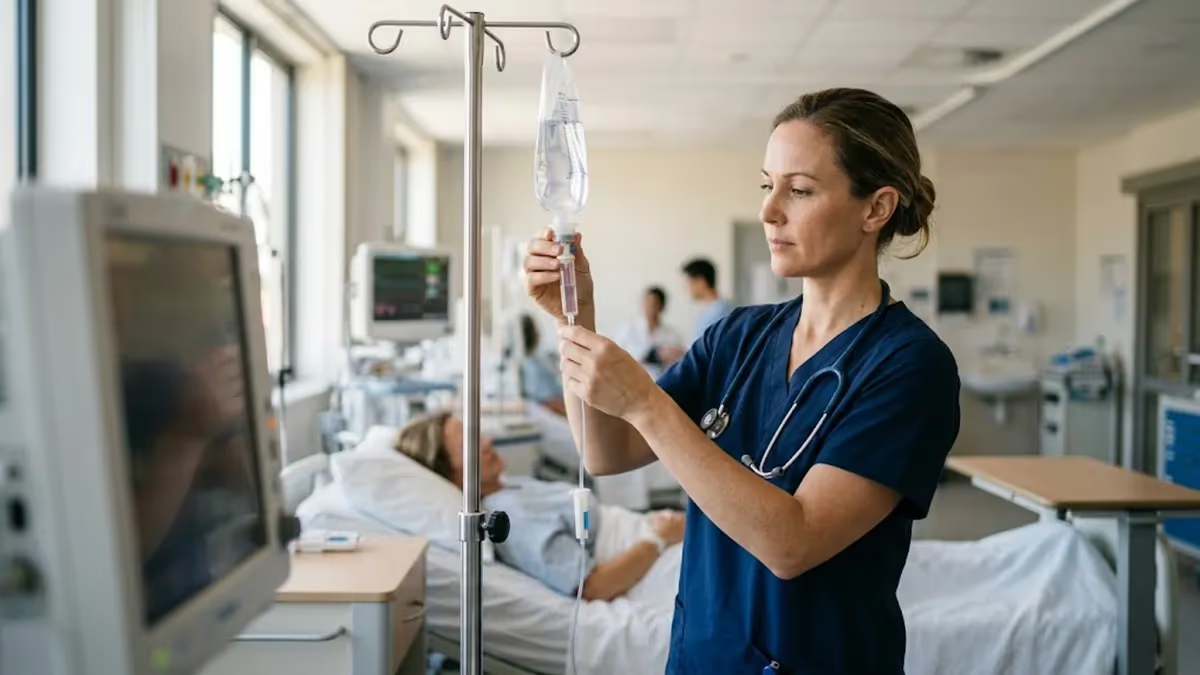
NCLEX requirements for international nurses start with a nursing degree and a licensing application to a US state board or Canadian regulator. That regulator approves your eligibility, you register with Pearson VUE and pay the US$200 fee, then you receive an Authorization to Test and sit the 85–150 question exam at a Pearson Professional Center.
Nclex Requirements for International Nurses: Key Facts (Updated October 2026)
| Fact | Details | Source |
|---|---|---|
| Who sets eligibility | The nursing regulatory body where you seek licensure or registration determines your eligibility requirements. | NCSBN |
| Exam format | NCLEX-RN and NCLEX-PN each contain 85 to 150 questions, delivered in person at Pearson Professional Centers year-round. | NCLEX.com |
| Passing standard | NCLEX-RN: 0.00 logits. NCLEX-PN: -0.18 logits. Both apply through March 31, 2029. | NCSBN Passing Standard |
| Current test plan | The 2026 NCLEX-RN and NCLEX-PN test plans took effect April 1, 2026 and remain effective through March 31, 2029. | NCSBN Test Plans |
| Registration fee | US$200 for US licensure; C$360 (excluding local taxes) for NCLEX-RN in Canada; US$200 for NCLEX-RN in Australia. All figures apply before the February 1, 2027 fee increase. | NCLEX.com Fees |
| Authorization to Test | Valid for the period your regulator specifies, averaging 90 days. You must test within those dates. | NCLEX.com Registration |
| Retake rules | Up to eight attempts per year with at least 45 days between attempts; regulators may set stricter limits. Retakes cost the full registration fee. | NCLEX Candidate Bulletin |
| Results | Official results come from your regulator within six weeks. US candidates in participating states can buy unofficial Quick Results two business days after testing. | NCLEX.com FAQs |
Every international nurse starts with the same fact: the NCLEX is a licensing exam, not an immigration exam. Requirements come from the regulator that will license you, not from NCSBN or Pearson. A nurse educated in Manila, Lagos or Mumbai applies to a board such as the California Board of Registered Nursing, and that board sets the rules. Before buying study guides, take a free nclex practice test to see where your knowledge stands today.
Most boards ask for the same core documents. You need proof that you graduated from a nursing program, an official transcript sent directly from your school, and verification of any nursing license you already hold. Many boards also want a credential evaluation from CGFNS or a similar service, which compares your coursework against US standards for theory and clinical hours. Pediatric nurse applicants may be asked to show documented pediatric clinical hours, because boards check content areas such as maternal-child and mental health.
English proof is the next gate. Some boards accept graduation from an English-language program, while others require TOEFL iBT, IELTS Academic or a similar test with minimum section scores. A few boards also ask for a Social Security number, though several accept applicants without one under specific conditions. These rules differ by state, and they change, so check the board website before paying for any evaluation or translation service. Doing this first prevents expensive surprises later.
After the board approves your application, you register with Pearson VUE and pay the exam fee. The registration fee is US$200 for US licensure, and it is charged again for every retake. You then wait for the Authorization to Test, which arrives by email and is valid for a limited window that averages 90 days. You schedule inside that window, because an expired authorization cannot be extended, and you would need to pay a new fee to register again.
On exam day you bring valid identification that exactly matches your registration name, arrive early and complete biometric check-in at the Pearson Professional Center. The NCLEX adapts to your answers, so the test ends between 85 and 150 questions depending on how clearly your ability sits above or below the passing standard. Many international candidates test at centers in their home countries, which can save travel costs, as long as their regulator allows testing outside the licensing jurisdiction.
Preparation matters as much as paperwork. The 2026 test plans took effect April 1, 2026, so older books may miss current Next Generation item types such as case studies and bowtie questions. Start with a printable set of nclex practice exam questions, treat every nclex q you miss as a lesson, and track weak areas. Nurses trained abroad often know the clinical content but need practice with US-style prioritization, delegation and safety wording.
For a fuller set of questions on this topic, see our mark klimek resource.
For a fuller set of questions on this topic, see our nclex practice questions pdf resource.
For a fuller set of questions on this topic, see our nclex quizlet resource.
What Are the Key NCLEX Numbers for International Nurses?
How to Apply for NCLEX for International Nurses?
Choose Your Licensing Regulator
Submit Your Application and Documents
Wait for Eligibility Approval
Register With Pearson VUE and Pay
Receive Your Authorization to Test
Schedule and Take the Exam
Is the Canadian NCLEX Different From the US NCLEX?
No, the Canadian NCLEX is not a different exam: Canadian and US candidates sit the same NCLEX-RN, built from the same test plan and scored against the same passing standard of 0.00 logits. What differs is the registration route, the fee and the regulator. Canadian applicants register through a Canadian nursing regulatory body, and the NCLEX-RN fee is C$360 excluding local taxes, compared with US$200 for US licensure, both before the February 1, 2027 increase.
Can you use your US NCLEX in Canada? It depends on the regulator, and it is never automatic. Some Canadian regulators accept an NCLEX-RN pass earned in the United States, provided the exam was taken within the regulator's time limits and your results are transferred officially. You still apply to the province or territory where you want to work, and you still pass the regulator's other checks, including education assessment, language proficiency and a criminal record check.
Canada also differs on practical nurse licensing. NCLEX-RN is the registered nurse exam used by most Canadian provinces, but licensed practical nurses and registered practical nurses in most provinces follow separate national and provincial exams rather than the NCLEX-PN. Quebec runs its own licensing process through its order of nurses. If you trained as a pediatric nurse or in another specialty, the entry exam is still the general NCLEX-RN, and specialty certification comes later through Canadian professional bodies.
Many candidates search for how long does it take to get nclex results, and the answer depends on where you test. Official results come from your regulator within six weeks. Candidates seeking licensure through participating US boards can buy unofficial Quick Results two business days after testing, but Canadian and most other international candidates should plan on waiting for the official notice before making job or travel commitments.
Content wise, nothing changes when you cross the border. The 2026 NCLEX-RN test plan, effective April 1, 2026 through March 31, 2029, covers management of care, safety and infection control, health promotion, psychosocial integrity, basic care and comfort, pharmacological therapies, risk reduction and physiological adaptation. Because the exam is built on US nursing practice, Canadian nurses still benefit from sample nclex questions that teach the exam's wording and its focus on the safest, most immediate action.
Costs add up beyond the exam fee. Canadian regulators charge separate application, assessment and registration fees, and credential evaluations through services such as the National Nursing Assessment Service can add several hundred dollars. International nurses should budget for transcripts, translation, language testing, fingerprinting or police certificates, and travel to a test center. Building a written budget before applying keeps you from letting an authorization expire while you wait for money to arrive.
A simple rule helps: decide your destination first, then choose the exam route. If Canada is your goal, apply to the Canadian regulator and register with Pearson through that body. If the United States is your goal, apply to a US state board. Registering through the wrong jurisdiction can leave you with a passing score that your target regulator will not use, and you may have to pay again, so confirm in writing before paying.
Is US NCLEX Accepted in Canada, Australia and New Zealand?
Yes, in many cases, but only through the right regulator. Canadian nursing regulators use the NCLEX-RN as the entry exam for registered nurses, so a US pass carries real weight. Whether a US-earned result transfers depends on the province, the date you tested and whether your results are officially released to the regulator. Always ask the regulator, in writing, whether a US result will be accepted before you rely on it.
Plan for the other requirements too. Canadian regulators typically assess your education through the National Nursing Assessment Service, review your English or French proficiency, and require proof of good standing from every place you have been licensed. Expect the full process to take several months. Nurses who want a pediatric nurse role often add Canadian Nurses Association specialty certification after they have worked the required practice hours in Canada. Keep digital copies of every document, receipt and email you send.
Is Taking the NCLEX as an International Nurse Worth It?
- +It is the exam standard for RN licensure across the United States
- +US hospitals offer strong demand and competitive pay for licensed nurses
- +The same exam is offered worldwide, so you can often test near home
- +A license supports employer sponsorship for work visas and green cards
- +Canada and some Australian pathways also use the NCLEX-RN
- +The adaptive format can end after as few as 85 questions
- −Evaluation, language testing, transcripts and exam fees add up quickly
- −Board review of foreign education can take several months
- −Your Authorization to Test expires, averaging about 90 days
- −US-style prioritization questions can feel unfamiliar at first
- −Passing does not automatically license you in every state
- −Visa processing can delay your start date even after you pass
How Do You Prepare Before You Apply for NCLEX for International Nurses?
- ✓Pick the US state or Canadian regulator where you plan to work.
- ✓Read that regulator's international applicant instructions line by line.
- ✓Order official transcripts to be sent directly from your nursing school.
- ✓Request verification of every nursing license you currently hold.
- ✓Book a credential evaluation if your target board requires one.
- ✓Schedule an English test if your board does not waive it.
- ✓Confirm whether the board requires a Social Security number.
- ✓Budget for exam fees, evaluations, fingerprints and a possible retake.
- ✓Take a baseline practice test and list your weakest test plan areas.
- ✓Set a study schedule that ends before your Authorization to Test expires.
Check Before You Register
A US pass can be useful in Canada, but each regulator decides whether to accept it. Ask in writing first, and register through the regulator for the place you plan to work, because the exam is the same but the fee is not: US$200 in the US versus C$360 excluding taxes in Canada.
Does the NCLEX Work in All States?
Passing the NCLEX satisfies the exam requirement in every US state board, but it does not give you a license everywhere. Licensure is state by state. Your result goes to the board you applied to, and that board decides whether your education, background check and other documents meet its standards. So the answer is yes for the exam, and no for automatic practice rights across all fifty states.
Think of your first license as a home base. Choose the state that gives international graduates the smoothest path, often one with clear foreign-education rules and no Social Security number barrier, then take the exam through that board. Once you hold an active license there, you can add other states later by endorsement, which usually means verifying your license, submitting fingerprints and paying a fee instead of retaking the exam.
New York and California show why state choice matters. The New York State Education Department reviews foreign nursing education through its own process and may request detailed documentation, so timelines can be long. California's Board of Registered Nursing expects an approved credential evaluation and checks that your coursework covered required content areas, including pediatric, obstetric and psychiatric nursing. Always read the board's international applicant page before paying for anything.
Multistate privileges add another layer. The Nurse Licensure Compact lets a nurse whose primary residence is in a compact state practice in other compact states with one multistate license. As an international nurse, you generally qualify only after you live in a compact state and hold its license, so the compact rarely helps before you arrive. Plan your first state around where you will actually live and work, since your residence determines which license you can hold.
After testing, waiting tests everyone's patience. Candidates often want to know how to know if you passed the nclex right away, and the legitimate options are limited. Some participating boards let you buy unofficial Quick Results two business days after the exam, while your official result comes from the board itself. Avoid unofficial tricks that circulate online, since only the board's notice confirms your licensure status. Use the waiting days to organize job applications and employer paperwork.
Employers add their own requirements on top of licensure. Hospitals hiring a new international nurse for a pediatric nurse position will typically ask for an active license, BLS certification, and sometimes PALS, along with proof of work authorization. Because US hospitals often sponsor internationally educated nurses, recruiters may also ask for your VisaScreen certificate from CGFNS, which confirms your education, license and English proficiency for immigration purposes. Confirm these items early so a visa delay does not stall your start date.
Finally, remember that licensure rules for foreign graduates are not static. Boards update education requirements, fees and processing times, and a document that worked for a friend two years ago may be rejected today. Keep a folder with your transcripts, evaluation reports, identification and every confirmation email. If a board asks for something unexpected, ask for the request in writing, respond quickly and keep copies, because delays at this stage are a common reason international candidates miss their Authorization to Test window.
The NCLEX registration fee changes after February 1, 2027, and retakes use whatever fee applies when you register again. Your Authorization to Test also expires, averaging 90 days, and cannot be extended, so schedule your appointment as soon as it arrives.
How Much Does the NCLEX Cost, and How Many Times Can You Retake It?
The NCLEX registration fee is US$200 for candidates seeking US licensure, and C$360 excluding local taxes for NCLEX-RN candidates seeking Canadian licensure. Australian NCLEX-RN candidates pay US$200. These amounts apply before the February 1, 2027 fee increase, so registering earlier can save money. Always confirm the fee shown at checkout, since NCSBN applies the fee in effect on the day you complete registration, and your regulator may charge separate application fees.
Retakes follow clear rules. NCSBN guidelines allow up to eight attempts per year, with at least 45 days between attempts, though some regulators set stricter limits. Some boards cap total lifetime attempts or require remedial coursework after repeated failures. A retake costs the same registration fee as the first attempt, using whatever fee applies when you register again, and you must receive a new Authorization to Test before scheduling.
Understanding the passing standard removes some mystery. The NCLEX-RN passing standard is 0.00 logits and the NCLEX-PN standard is -0.18 logits, both in effect through March 31, 2029. Because the exam is computer adaptive, there is no fixed percentage you must hit. The software estimates your ability after each question and stops when it is confident you are above or below the standard, which is why the exam can end at 85 questions or run to 150.
Question formats matter, too. Candidates now see case studies, bowtie, matrix, drag-and-drop and extended multiple response items alongside classic multiple choice. Working through nclex test sample questions in each format builds speed and confidence, and our NGN guide shows what each item type looks like, how it is scored and how to avoid the most common mistakes. Practice with a timer from the start, because pacing problems hurt international candidates who are also reading in a second language.
Add up the full budget before you commit. A realistic estimate for a nurse applying to a US state might include a credential evaluation of roughly US$350 to US$500, English testing around US$200 to US$250, transcript and translation costs, a state application fee, fingerprinting, the US$200 exam fee and study materials. Totals can reach US$1,000 to US$2,000 before travel. Budgeting for a possible retake, an extra US$200, keeps your plan from stalling.
Authorization timing is the hidden cost. Your Authorization to Test is valid for the period your regulator specifies, averaging 90 days, and you must test within those dates. If you cannot find an appointment, travel plans fall through or a visa interview conflicts, you lose the fee and start over. Schedule your appointment the same day your authorization arrives, choose a center near your home, and leave a buffer for weather, transport and identification problems.
Finally, consider the immigration side. For many nurses, the NCLEX is just one step before a visa and green card process. Employment-based green cards for nurses typically require a VisaScreen certificate and an offer from a sponsoring employer, and processing can take many months. No legitimate pathway lets an international RN skip the licensing exam and still practice, so treat any offer of a green card without NCLEX with serious caution.
How Should International Nurses Prepare for the NCLEX?
Start your preparation by diagnosing, not memorizing. Take a full-length baseline exam before opening any textbook, then sort your misses by test plan category. International graduates often score well on pathophysiology and pharmacology but lose points on management of care, delegation, and legal and ethical practice in the United States. Knowing where you stand lets you assign study hours to your weakest areas instead of rereading the topics you already understand.
Build a daily routine around questions. Aim for 50 to 100 items a day during the final eight weeks, and review the rationale for every answer, including the ones you got right. Search for practice questions for nclex that explain why each wrong option fails, because that reasoning teaches you how the exam thinks. A short notebook of recurring errors, such as lab values or prioritization frameworks, becomes your most valuable review tool in the last week.
Use varied question sources. Work through practice nclex questions by topic first, then move to nclex practise questions that mimic newer item types, and finish with timed full-length exams. Mixing sources keeps you from memorizing one author's style, and nclex example questions that include rationales show how test writers phrase priority and safety decisions. Free quizzes on this site cover basic care, coordination of care and other test plan areas, so you can practice in short sessions between shifts or classes.
Language skills deserve their own plan. Even strong English speakers can stumble on questions that hinge on words like 'first,' 'best,' 'most likely' or 'further teaching is needed.' Read each stem slowly, identify what is being asked, and mentally note the qualifier before looking at options. Keep a personal glossary of unfamiliar terms, such as US brand names for medications or abbreviations your school never used, and review it each morning for ten minutes.
Match your study to your specialty goals. A nurse aiming for a pediatric nurse role should still prepare for the full NCLEX-RN, since the exam is a general entry-level test, but pediatric growth and development, dosage calculations and family-centered care deserve extra review because they appear within several categories. After licensure, credentials such as the CPN from the Pediatric Nursing Certification Board help you stand out when applying to children's hospitals.
Protect your health and schedule in the final week. Stop learning new material two days before the exam, review your error notebook, and confirm the route to the test center, your identification and your appointment time. Sleep matters more than another practice set. Plan a light meal, arrive early and use scheduled breaks to stretch and breathe. If anxiety is high, rehearse the check-in process in advance so unfamiliar procedures do not drain your focus.
Have a plan for the unexpected outcome. If you do not pass, review your candidate performance report, rebuild your study plan around the weakest categories and wait the required period before your next attempt, at least 45 days under NCSBN guidelines. Many successful nurses passed on a second try. What matters is that you keep your Authorization to Test timing, fees and board communication organized so one setback does not become a long delay in your career.
NCLEX Questions and Answers

NCLEX Practice 2026 Questions Free

How Long Does It Take to Become a Nurse? 2026 Complete Guide

How to Know If You Passed the NCLEX (2026 Guide)

Sample NCLEX Questions in NGN Formats: What to Expect and How to Prepare
NCLEX Practice Test PDF (Free Printable 2026)

What Is Nursing School Like? Tips to Help You Succeed

Building Expertise: The Essential Competencies of Family Nurse Practitioner Education
About the Author

Registered Nurse & Healthcare Educator
Johns Hopkins University School of NursingDr. Sarah Mitchell is a board-certified registered nurse with over 15 years of clinical and academic experience. She completed her PhD in Nursing Science at Johns Hopkins University and has taught NCLEX preparation and clinical skills courses for nursing students across the United States. Her research focuses on evidence-based exam preparation strategies for healthcare certification candidates.
Join the Discussion
Connect with other students preparing for this exam. Share tips, ask questions, and get advice from people who have been there.
Start the conversation