
NCCER Certification Guide for Construction Trades 2026 September
🔎 Pass the NCCER Certification Guide for exam with confidence. Practice questions with detailed explanations and instant feedback on every answer.

What Is NCCER?
NCCER — the National Center for Construction Education and Research — is a nonprofit organization founded in 1996 by a coalition of construction industry leaders, contractors, and academic institutions. Its mission is to develop and maintain standardized craft training and assessments that the entire construction industry recognizes.
NCCER operates through a network of accredited training sponsors — including community colleges, vocational schools, contractor associations, and union training centers — who deliver the curriculum and administer credentials. When you earn an NCCER credential, it is recorded in the NCCER Registry, a permanent transcript system that follows you throughout your career regardless of which employer or state you work in.
NCCER covers more than 70 crafts and management disciplines, including electrical, plumbing, HVAC, pipefitting, welding, carpentry, instrumentation, heavy equipment operations, and industrial maintenance. Safety-related training such as OSHA 10 certification online is often taken alongside NCCER craft modules to build a complete safety and skills profile.
NCCER Craft Levels: Core Through Advanced
NCCER's structured curriculum is divided into progressive levels, allowing workers to build mastery step by step:
- Core Curriculum: The entry point for all NCCER programs. Covers basic safety, hand and power tools, introduction to construction math, rigging, and blueprint reading. No prior experience required. Completion typically takes 60–80 hours.
- Level 1: Introduces craft-specific fundamentals. For example, Electrical Level 1 covers electrical theory, conduit bending basics, and residential wiring. Each craft's Level 1 runs approximately 200 hours.
- Level 2: Builds on Level 1 with intermediate skills. Trainees gain deeper technical competency in their chosen trade, including more complex installations, code compliance, and troubleshooting.
- Level 3: Advanced technical content including system design, code mastery, and supervision fundamentals. Many journeyman-level positions require completion through Level 3.
- Level 4: The highest standard craft credential, focusing on project coordination, blueprint interpretation at scale, and leadership skills. Equivalent in scope to journeyman recognition in most trades.
- Advanced Modules: Specialty topics such as green/sustainable construction, advanced rigging, or industrial instrumentation. These stack on top of the core levels for workers seeking highly specialized roles.
Many contractors align NCCER levels with apprenticeship pay scales — advancing a level often means a direct wage increase. NCCER credentials are also recognized by the Department of Labor's Registered Apprenticeship framework, making them portable across programs. Similar tiered certification systems exist in other technical fields; see the ASE certification guide for a comparable structure in automotive trades.
Who Accepts NCCER Credentials?
NCCER credentials are accepted by more than 4,000 contractors and employers across the United States, including some of the largest construction and industrial firms in the country. Key sectors that recognize NCCER include:
- Commercial and industrial construction: Turner Construction, Bechtel, Fluor, and most ENR Top 400 contractors
- Oil, gas, and petrochemical: Refineries and pipeline operators frequently require NCCER pipefitting or instrumentation credentials
- Military and federal projects: Many DoD and federal construction contracts require NCCER-credentialed workforce
- Union programs: Several IBEW, UA, and other union training programs accept or integrate NCCER modules into apprenticeship curricula
- State workforce boards: Multiple states use NCCER as the standard for career and technical education (CTE) programs in high schools and community colleges
Key Takeaway: NCCER certification demonstrates expertise in this field. Most candidates spend 4-8 weeks preparing with practice tests before taking the exam.

NCCER Exam Format and Assessment Structure
NCCER assessments are delivered in two parts: a written knowledge test and a performance profile (hands-on skill verification). Both must be passed to receive the credential for a given module or level.
Written Knowledge Test
The written test consists of multiple-choice questions drawn from the NCCER module content. Key facts:
- Format: Multiple choice, typically 20–50 questions per module
- Passing score: 70% or higher is required to pass
- Content: Covers all learning objectives in the module — theory, code requirements, safety procedures, and calculations
- Delivery: Paper-based or computer-based depending on the training sponsor
- Retakes: Most sponsors require remediation study before allowing a retake; specific policies vary
Performance Profile
The performance profile is an observed practical evaluation. A certified NCCER instructor watches the trainee complete specific tasks from a standardized checklist and marks each item satisfactory or unsatisfactory. Tasks are drawn directly from the module's learning objectives and must reflect real job-site competency. Examples include:
- Electrical: Correctly terminate a 20A circuit with proper grounding and torque specs
- Plumbing: Cut and join copper pipe using sweat-soldering technique with no leaks
- HVAC: Perform a refrigerant recovery and recharge to manufacturer specifications
- Pipefitting: Lay out and fabricate a spool piece to blueprint dimensions within tolerance
Preparation Tips
NCCER provides official study guides and module reviews through accredited sponsors. Trainees should review all module objectives, work through end-of-module review questions, and practice every hands-on task until it can be performed consistently and safely. Practice tests for related technical knowledge areas can sharpen your test-taking skills significantly.
Construction Career Salary and Outlook with NCCER
NCCER credentials directly translate to higher wages and better career mobility in the construction trades. The U.S. Bureau of Labor Statistics and industry surveys consistently show that certified tradespeople earn significantly more than uncredentialed workers, and demand for skilled trades continues to outpace supply.
Salary Ranges by Trade (U.S. National Average, 2026)
- Electrician (Journeyman): $62,000–$95,000/year; top 10% earn over $100,000
- Plumber: $60,000–$90,000/year; master plumbers often exceed $100,000
- HVAC Technician: $55,000–$85,000/year; commercial specialists earn more
- Pipefitter/Steamfitter: $65,000–$105,000/year; industrial/refinery work commands premium
- Ironworker: $60,000–$90,000/year; structural specialists in high demand
- Carpenter: $50,000–$80,000/year; finish carpenters and estimators earn at the high end
Career Progression Path
A typical NCCER career trajectory looks like this: Apprentice/Trainee (Core + Levels 1–2) → Journeyman (Levels 3–4) → Foreman (Level 4 + management modules) → General Foreman / Superintendent → Project Manager. Each step up typically brings a 15–25% wage increase and greater job security.
Job Market Outlook
The construction industry faces a critical skilled trades shortage. The Associated Builders and Contractors (ABC) estimates the industry needs more than 500,000 additional workers annually over the next decade. NCCER-certified workers have a decisive advantage in this environment — contractors pay premiums for documented, verifiable skills, and many projects (especially federal and industrial) contractually require a credentialed workforce. For workers in heavy equipment operations, see related salary data in the excavator operator salary resource linked below.
- ✓Review the official NCCER exam content outline
- ✓Take a diagnostic practice test to identify weak areas
- ✓Create a study schedule (4-8 weeks recommended)
- ✓Focus on your weakest domains first
- ✓Complete at least 3 full-length practice exams
- ✓Review all incorrect answers with detailed explanations
- ✓Take a final practice test 1 week before exam day
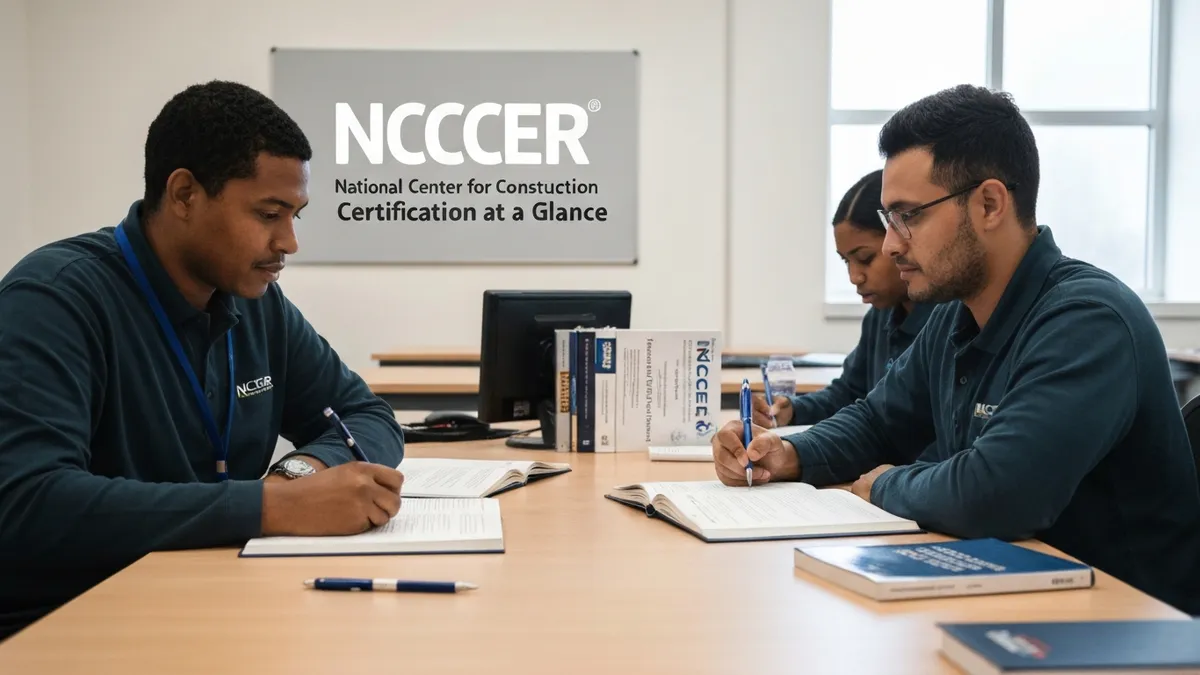
NCCER Key Concepts
What is the passing score for the NCCER exam?
Most NCCER exams require 70-75% to pass. Check the official exam guide for exact requirements.
How long is the NCCER exam?
The NCCER exam typically allows 2-3 hours. Time management is critical for success.
How should I prepare for the NCCER exam?
Start with a diagnostic test, create a 4-8 week study plan, and take at least 3 full practice exams.
What topics does the NCCER exam cover?
The NCCER exam covers multiple domains. Review the official content outline for the complete list.
- +Nationally recognized credential respected by contractors and unions across all 50 states
- +NCCER credentials stack — Core, Level 1–4 build toward Journey-level cards
- +Employers often pay for NCCER training or reimburse exam fees
- +NCCER cards port between states with no reciprocity exam required
- +Over 1,100 NCCER accredited training sponsors nationwide
- −NCCER programs must be completed at accredited sponsors — cannot self-study for card
- −Some union locals require their own apprenticeship programs on top of NCCER
- −Costs vary widely by sponsor — some programs charge ,000–,000+
- −NCCER Journey-level recognition still not universal in all markets
- −Continuing education requirements vary by craft and sponsor
NCCER Questions and Answers
More Trades Certification Resources
Join the Discussion
Connect with other students preparing for this exam. Share tips, ask questions, and get advice from people who have been there.
View discussion (7 replies)