
MTA OMNY: How the New York Transit Contactless Payment System Works and What It Means for Riders
🔎 Learn how MTA OMNY works, how to tap to pay on NYC subways and buses, OMNY card options, weekly fare caps, and what OMNY means for riders.
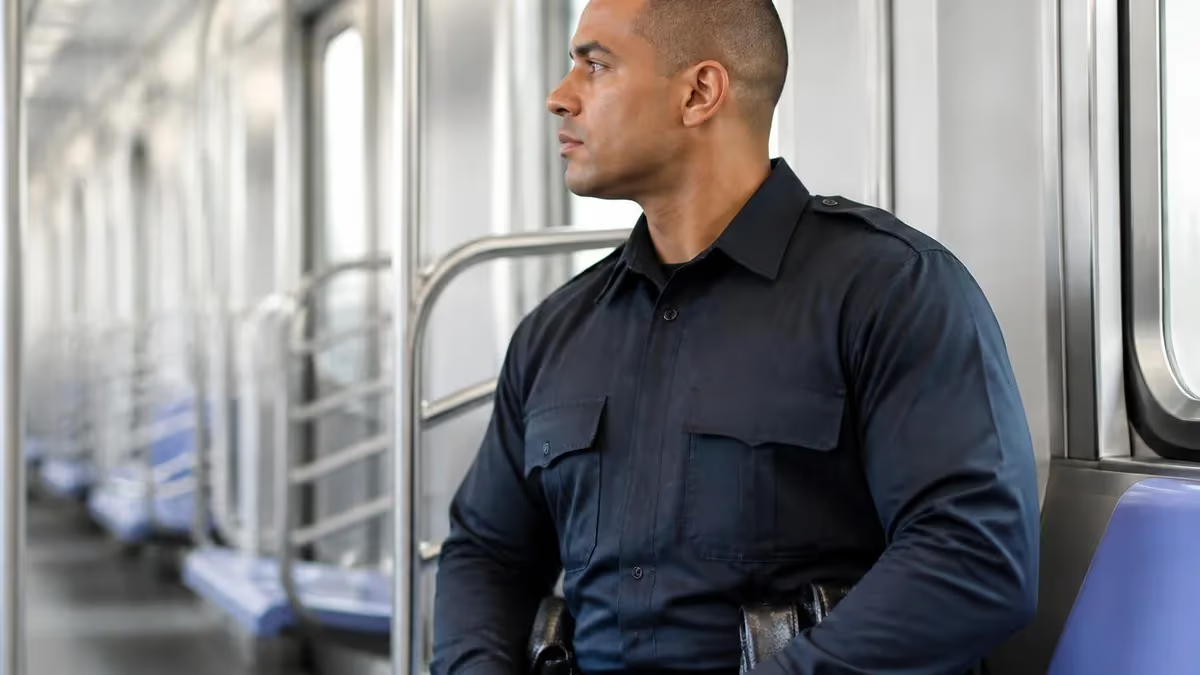
MTA OMNY is the Metropolitan Transportation Authority's modern contactless payment system that has transformed how millions of New Yorkers pay for subway and bus rides across New York City and surrounding commuter rail networks.
Launched in 2019 and fully rolled out across the entire subway and bus system by 2023, OMNY allows riders to tap a contactless credit card, debit card, smartphone, or smartwatch directly on a reader to pay their fare instantly — no MetroCard required. The system represents the biggest upgrade to New York City transit fare payment in more than three decades, replacing the aging magnetic-stripe MetroCard that first appeared in 1994.
The technology behind OMNY — which stands for One Metro New York — uses near-field communication, commonly called NFC, to process payments in under half a second. When a rider taps a contactless card or device on the bright yellow OMNY reader, the system communicates with the payment network, verifies the fare, and opens the turnstile or allows bus boarding in a fraction of the time it takes to swipe a MetroCard.
This speed improvement matters enormously at busy stations like Times Square, Atlantic Avenue-Barclays Center, and Grand Central Terminal, where long swipe lines historically caused delays and crowding at peak hours.
One of the most significant features of mta omny is its weekly fare cap. Once a rider pays for twelve individual base fares within a rolling seven-day period using the same contactless card or device, all additional rides for the remainder of that week are free.
This cap effectively mirrors the value of the old 7-Day Unlimited MetroCard, which cost $34, but with the added flexibility that the week starts on the first tap rather than a fixed calendar Monday. Riders who commute five days a week and take two trips per day reach the cap by Wednesday or Thursday, saving money automatically without purchasing a special pass.
The OMNY system is also the foundation for the new OMNY Card, a physical contactless card issued by the MTA that functions like a prepaid transit card for riders who do not have a contactless bank card or prefer not to use their personal financial accounts on transit equipment.
The OMNY Card can be loaded with cash at subway station vending machines, online, or at retail locations, and it supports the same weekly cap and reduced-fare benefits as bank-issued contactless cards. This option ensures that unbanked and underbanked riders, who make up a significant portion of New York City's transit population, are not excluded from the new system.
For workers interested in careers at the MTA — including those pursuing law enforcement roles with the MTA Police Department — understanding OMNY is increasingly important because the system generates large volumes of transaction data, requires maintenance and customer service support, and affects station operations that MTAPD officers oversee every day.
OMNY readers are installed at every single subway station entrance and exit, on every bus in the fleet, and across the Staten Island Railway. Officers respond to fare evasion incidents involving OMNY just as they did with MetroCard-related disputes, and understanding how the payment system works helps officers make informed decisions at turnstile lines.
OMNY also integrates with reduced-fare programs for seniors aged 65 and older and riders with qualifying disabilities. These riders register their contactless card or OMNY Card through the MTA's Reduced-Fare MetroCard program portal, and the discount — currently half the base fare — is automatically applied at every tap. This digital enrollment process replaced the previous requirement to carry a special reduced-fare MetroCard, though the MTA has maintained legacy reduced-fare MetroCard support during the transition period to avoid leaving vulnerable riders behind.
The rollout of OMNY has been one of the most closely watched transit technology projects in the United States, and New York's experience is already influencing how other major systems approach fare modernization. Chicago's CTA, Washington's WMATA, and transit agencies in Boston and Philadelphia have all studied the OMNY implementation as they plan or execute their own contactless upgrades.
Understanding the full scope of OMNY — how it works, who benefits, what the weekly cap means, and how the OMNY Card fits into the broader equity picture — gives riders, transit workers, and aspiring MTA employees a clearer picture of where New York City public transportation is headed in the coming decade.
MTA OMNY by the Numbers
How OMNY Works: Core Technology and System Components
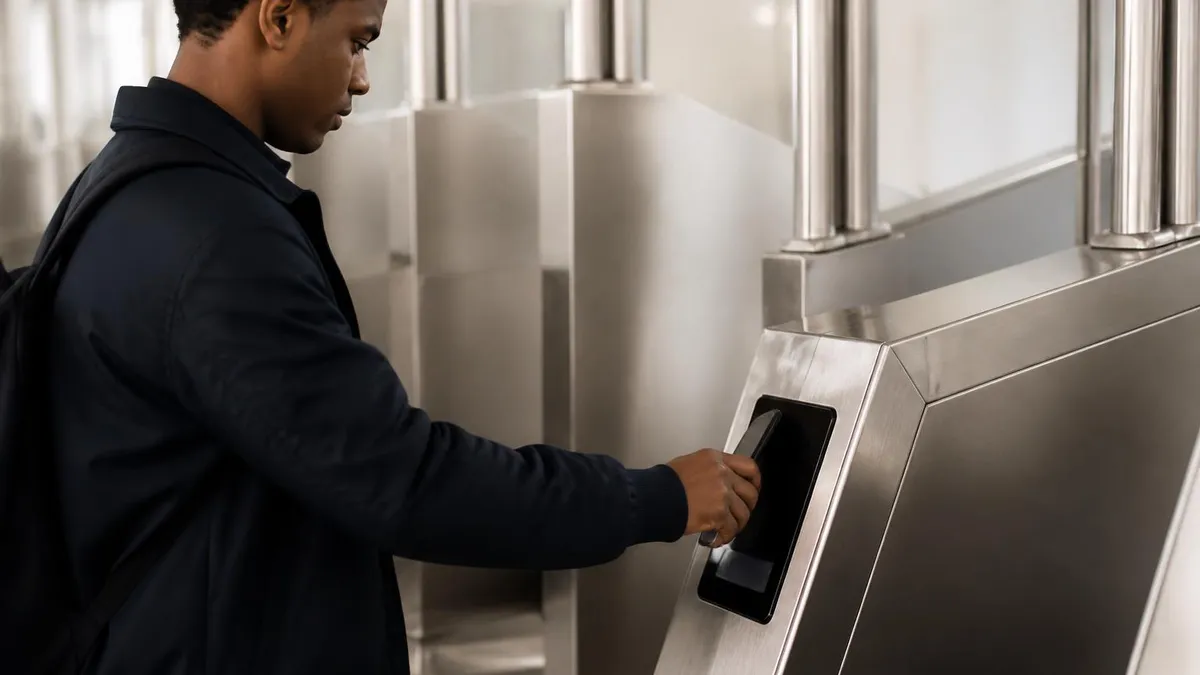
OMNY uses near-field communication (NFC) built into contactless bank cards, Apple Pay, Google Pay, and Samsung Pay. Riders hold their device or card within an inch of the yellow OMNY reader for under half a second. No app download or account registration is needed for basic contactless bank cards.
Bright yellow OMNY readers are installed at every turnstile in all 472 subway stations and on every MTA bus and Staten Island Railway train. Each reader connects in real time to OMNY's payment processing backend, which communicates with Visa, Mastercard, American Express, and Discover networks instantly.
OMNY automatically tracks the number of base fares paid with the same card or device within a rolling seven-day window. After twelve paid rides, all subsequent rides within that window are free. The cap resets exactly seven days after the first tap in the sequence, not on a fixed Monday.
The physical OMNY Card functions as a prepaid contactless transit card available at station vending machines and participating retail stores. It supports the same weekly cap, reduced-fare benefits, and tap-to-pay speed as bank-issued contactless cards, making the system accessible to unbanked and underbanked riders.
Riders who register their contactless card or OMNY Card at omny.info gain access to a full trip history, can report lost or stolen cards to transfer remaining balances, and can manage reduced-fare enrollment online. Registration is optional for basic use but required for full account protection features.
The weekly fare cap is arguably the most financially impactful feature of the OMNY system for regular New York City commuters, and understanding exactly how it works can save riders a meaningful amount of money every week. Under the cap, the MTA counts each tap of the same contactless card or registered device as one ride at the base fare — currently $2.90 per trip as of 2024.
After a rider has paid for exactly twelve rides within a rolling seven-day period, every additional ride taken with that same payment method during the remaining days of that window costs nothing. The cap is applied automatically; no opt-in, no special pass, and no separate purchase is required.
The rolling seven-day window is a key distinction from the old 7-Day Unlimited MetroCard, which ran on a fixed calendar week beginning the moment of first use but expiring exactly 168 hours later. The OMNY cap works the same way in terms of duration — seven days from the first tap — but resets automatically once the window closes, then starts again the next time the rider taps.
For riders whose commutes are irregular, shift workers, weekend travelers, and part-time commuters, this rolling model is more equitable because value is never wasted if a rider does not travel on certain days within a fixed billing period.
To illustrate the cap in practice: a rider who taps on Monday morning, rides twice daily through Friday, and takes one trip on Saturday will have made eleven taps by Saturday. If they tap once more on Sunday, that twelfth tap is paid at the base fare, and from that point forward, any taps before the following Monday morning (seven days after the first Monday tap) are entirely free.
A rider who commutes more — taking the subway to work, to lunch, to the gym, and home again — could hit the cap by Tuesday or Wednesday and essentially ride free for the rest of the workweek, saving more than $20 over what a simple pay-per-ride approach would cost.
It is important to note that the weekly cap applies per payment method, not per rider. If a commuter uses two different credit cards on alternating days, the cap counts separately for each card and neither may reach twelve rides within the seven-day window. Riders who want to benefit from the cap should consistently use the same contactless card or device for every ride.
Families or households where multiple members share a single card for transit should be aware that all taps from all users on that card are pooled together, which can accelerate reaching the cap but also means the cap resets on the same schedule for everyone who shares that payment credential.
Reduced-fare riders receive the same weekly cap protection, but the cap is calculated based on the discounted fare they pay rather than the full base fare. Since reduced-fare riders pay roughly $1.45 per trip, they still reach a cap after twelve rides and ride free beyond that point within their rolling window. The MTA has stated publicly that it intends to maintain fare equity across OMNY's features, ensuring that reduced-fare participants are not inadvertently penalized by the transition away from the reduced-fare MetroCard to the OMNY-based digital enrollment system.
The cap also applies when riding across different modes within the MTA network — subway, local bus, Select Bus Service, and the Staten Island Railway all count toward the same cap if paid with the same contactless credential. However, LIRR and Metro-North Railroad fares are separate and do not count toward the OMNY subway and bus cap, since those services use different fare structures and their own OMNY integration is still being phased in as of 2024. Riders who use both commuter rail and local transit should track their credits separately across those two segments of their commute.
For those curious about MTA employment, transit technology, and the operations side of fare systems, understanding the cap mechanism is part of the broader picture of how the MTA manages revenue. Fare revenue funds a significant portion of MTA operating costs, and the weekly cap is designed to balance ridership incentives with financial sustainability.
Aspiring MTA police officers, customer service agents, and station managers are all expected to be familiar with OMNY basics because riders frequently ask transit employees about the cap, about discrepancies in their trip counts, and about what to do if a tap does not register correctly at a reader.
MTA Practice Test Questions
Prepare for the MTA - Police Exam exam with our free practice test modules. Each quiz covers key topics to help you pass on your first try.
MTA Police MCQ
MTA Exam Questions covering Police MCQ. Master MTA Test concepts for certification prep.
MTA Police Reading Comprehension Test
Free MTA Practice Test featuring Police Reading Comprehension Test. Improve your MTA Exam score with mock test prep.
MTA Police Written Test
MTA Mock Exam on Police Written Test. MTA Study Guide questions to pass on your first try.
MTA Community Policing
MTA Test Prep for Community Policing. Practice MTA Quiz questions and boost your score.
MTA Constitutional Rights
MTA Questions and Answers on Constitutional Rights. Free MTA practice for exam readiness.
MTA Criminal Law
MTA Mock Test covering Criminal Law. Online MTA Test practice with instant feedback.
MTA Emergency Response
Free MTA Quiz on Emergency Response. MTA Exam prep questions with detailed explanations.
MTA Investigation Techniques
MTA Test Online for Investigation Techniques. Free practice with instant results and feedback.
MTA Law Enforcement Procedures
MTA Study Material on Law Enforcement Procedures. Prepare effectively with real exam-style questions.
MTA Traffic and Patrol Procedures
Free MTA Test covering MTA Traffic and Patrol Procedures. Practice and track your MTA exam readiness.
MTA Transit System Knowledge
MTA Exam Questions covering MTA Transit System Knowledge. Master MTA Test concepts for certification prep.
OMNY Card vs. Contactless Bank Card vs. MetroCard: Which Should You Use?
The OMNY Card is a physical prepaid contactless card issued by the MTA and available at subway station vending machines, online at omny.info, and at thousands of retail locations across New York City. It is ideal for riders who do not have a bank-issued contactless card or who prefer to keep their transit spending separate from personal finances. The OMNY Card supports the weekly fare cap and reduced-fare enrollment, making it fully functional for regular commuters. Balances can be added in increments as small as $5.50, and cards can be registered online for balance protection if lost or stolen.
One practical advantage of the OMNY Card over a personal credit or debit card is privacy: using a registered OMNY Card creates a transit-specific account rather than linking MTA trip data to a bank account. Unregistered OMNY Cards can be purchased and used with cash, leaving no personal data trail at all — though unregistered cards cannot be refunded or have balances transferred if lost. For riders who commute five days a week, loading $40-$50 onto the OMNY Card at the start of the month covers most typical commuter costs, with the weekly cap ensuring no overpayment during heavy travel weeks.
OMNY: Advantages and Drawbacks for NYC Riders
- +No MetroCard purchase needed — tap any contactless card or phone you already carry
- +Weekly fare cap automatically saves money for frequent commuters with no special pass purchase
- +Faster boarding — NFC tap takes under 0.5 seconds versus MetroCard swipe delays
- +Trip history and balance tracking available online at omny.info after free registration
- +Works with Apple Pay, Google Pay, and Samsung Pay for maximum device compatibility
- +Reduced-fare enrollment is digital — no separate reduced-fare card needed
- −Weekly cap does not apply to LIRR or Metro-North fares, limiting cross-mode savings
- −Cap counts separately per payment credential — using multiple cards delays reaching the cap
- −Lost or stolen unregistered OMNY Cards cannot have balances recovered or transferred
- −Contactless bank card users risk cap count reset if card is replaced due to fraud
- −Not all riders own smartphones or contactless bank cards — OMNY Card still requires a purchase
- −Older turnstiles at some stations may have OMNY readers with slower response times
How to Use OMNY: Step-by-Step Rider Checklist
- ✓Check that your credit or debit card has the contactless wave symbol printed on the front or back.
- ✓Enable NFC payments on your smartphone and add your card to Apple Pay, Google Pay, or Samsung Pay.
- ✓If you prefer a dedicated transit card, purchase an OMNY Card at any subway station vending machine or online at omny.info.
- ✓Load at least $2.90 (one base fare) onto your OMNY Card before your first ride if using the prepaid option.
- ✓Tap your card or device on the yellow OMNY reader — hold it within one inch of the reader for under one second.
- ✓Wait for the green checkmark or green light on the reader before walking through the turnstile or boarding the bus.
- ✓Register your OMNY Card or contactless bank card at omny.info to access full trip history and balance protection.
- ✓Track your weekly tap count in the OMNY account dashboard to know how close you are to the free-ride cap threshold.
- ✓Enroll in the reduced-fare program at omny.info if you are 65 or older or have a qualifying disability.
- ✓Contact OMNY customer service at 877-789-6669 if a tap does not register correctly or if you are charged in error.
Always Use the Same Card to Hit the Weekly Cap Faster
The single most effective way to maximize the OMNY weekly fare cap is to consistently use the same contactless card or device for every subway and bus ride during the week. Because the cap is tracked per payment credential — not per rider account — switching between two credit cards splits your ride count across two separate caps, potentially costing you up to $29 in fares you would have ridden free if you had used one card consistently all week.
The MTA Police Department — officially known as the Metropolitan Transportation Authority Police Department, or MTAPD — is a full-service state law enforcement agency with jurisdiction over MTA property throughout New York, including all subway stations, bus depots, commuter rail lines, bridges, and tunnels. With over 700 sworn officers, MTAPD officers are responsible for enforcing transit rules, responding to crimes on MTA property, and working with New York City Transit, the Long Island Rail Road, and Metro-North Railroad on safety and security initiatives that directly intersect with the operations of systems like OMNY.
Fare evasion is one of the most frequent low-level offenses that MTAPD officers and NYPD transit bureau officers encounter on the subway system every day, and OMNY has changed the landscape of fare evasion enforcement in meaningful ways. Under the MetroCard era, fare evasion typically involved jumping a turnstile or passing through an emergency exit door without swiping.
Under OMNY, new forms of evasion have emerged: riders who tap but use a card with insufficient funds, riders who attempt to tailgate through a turnstile immediately after a legitimate tap, and cases where a malfunctioning reader fails to register a valid tap, creating ambiguity about whether a rider paid or not.
MTAPD officers must understand how to interpret OMNY reader feedback — the green light and checkmark signal a valid fare payment, while a red X indicates a declined tap — because this information is directly relevant to fare enforcement stops and summons decisions. An officer who observes a rider tap a reader and receive a red X signal has probable cause to believe fare evasion occurred, but the officer must also be aware that legitimate technical failures do occasionally cause false declines. The MTA provides guidance to officers and station agents about how to distinguish system errors from evasion attempts.
Beyond fare enforcement, OMNY data plays a role in transit security and crime analysis. Because OMNY transactions are timestamped and location-coded to specific turnstile arrays, investigators can sometimes use OMNY tap records — obtained through lawful process — to establish that a particular payment credential was used at a specific station at a specific time.
This capability has been used in cases involving assaults, robberies, and other crimes that occur in subway stations, where the time of entry or exit from the station is relevant to establishing a timeline. Understanding how this data is generated and how it may be obtained is part of modern transit policing practice.
Aspiring MTA police officers who are preparing for the MTA Police Exam should understand the basics of OMNY not only because it appears in transit news and public discourse, but because the exam tests situational judgment and reading comprehension using materials drawn directly from MTA operational contexts.
Exam scenarios may involve a transit officer responding to a rider who claims their tap was declined even though they have sufficient funds, or a situation involving a large group of people tailgating through a turnstile at a busy station. Knowing how OMNY works — and how officers are expected to respond in these situations — helps exam candidates select the most appropriate answer choices on scenario-based questions.
The MTAPD also plays a role in protecting the physical infrastructure of the OMNY system. OMNY readers, like all electronic fare equipment, can be targets for vandalism, skimming device installation, or tampering. Card skimming — the practice of attaching a covert electronic device to a payment terminal to intercept card data — is a known threat at transit contactless readers in multiple countries.
MTAPD officers trained in identifying suspicious attachments on OMNY readers and other fare equipment are the first line of defense against this type of financial crime, and routine patrols that include visual inspection of fare equipment are part of the standard patrol protocol in high-traffic stations.
For those who want to pursue a career protecting New York's transit infrastructure, familiarity with systems like OMNY is increasingly a baseline expectation rather than a bonus. The MTA is investing billions of dollars in technology modernization across its network, and OMNY is one of the most visible and widely used components of that transformation.
Officers, supervisors, and transit managers who understand how the technology works, what its limitations are, and how it connects to real operational decisions will be better positioned for advancement within the MTAPD and the broader MTA organization as these systems continue to evolve over the next decade.

The MTA has confirmed that the MetroCard will eventually be retired as OMNY adoption increases, but no firm end-of-service date has been announced as of 2024. Riders currently relying on monthly unlimited MetroCards can continue using them without penalty. However, the MTA recommends that commuters begin transitioning to OMNY now to familiarize themselves with the system before MetroCard support ends. Check mta.info for the latest updates on MetroCard availability at station vending machines near you.
Fare equity has been a central concern throughout the OMNY rollout, and the MTA has made significant public commitments to ensuring that every rider — regardless of income, age, or banking status — has access to the same fare benefits under the new system. The challenge is substantial: New York City has a large population of unbanked and underbanked residents, concentrated in lower-income neighborhoods in the Bronx, Brooklyn, and Queens, who do not have access to contactless credit or debit cards.
If the OMNY system were accessible only to riders with bank accounts and smartphones, it would effectively create a two-tier transit system where wealthier riders benefit from the weekly cap and faster boarding while lower-income riders pay more per ride or face greater friction at the fare gate.
The OMNY Card was developed specifically to address this equity gap. By creating a cash-loadable prepaid card that works identically to a bank-issued contactless card — including the weekly fare cap and reduced-fare enrollment — the MTA extended the full benefits of OMNY to riders who lack traditional banking relationships.
OMNY Cards are available at over 4,000 retail locations across the city, including many bodegas, pharmacies, and convenience stores in neighborhoods underserved by bank branches. This retail distribution network was modeled on transit card distribution strategies used in London, Singapore, and Hong Kong, where prepaid contactless cards became the primary fare payment method for low-income riders during those cities' contactless transitions.
Reduced-fare enrollment through OMNY has also improved accessibility for seniors and riders with disabilities. Previously, obtaining a reduced-fare MetroCard required an in-person visit to an MTA customer service center, which posed hardship for riders with mobility limitations. Under OMNY, enrollment can be completed entirely online through a streamlined digital application at omny.info, with mail delivery of the approved OMNY Card to the rider's home address.
In-person enrollment remains available at customer service centers for riders who prefer it or need assistance with the online process, but the digital option has significantly reduced wait times and expanded access for riders who previously faced barriers to enrollment.
The MTA has also worked to address language access and digital literacy barriers in OMNY adoption. OMNY information is published in ten languages on the MTA's website, and customer service representatives at major stations and via phone can assist riders in Spanish, Chinese, Bengali, Haitian Creole, Korean, Russian, and other languages. Training materials for station agents and MTAPD officers who field rider questions about OMNY are also available in multiple languages, reflecting the MTA's recognition that effective system adoption requires meeting riders where they are linguistically and technologically.
The equity dimensions of OMNY connect directly to the broader mission of the MTA Police Department, which operates in one of the most economically and demographically diverse transit systems in the world. Officers who understand that fare evasion is sometimes a symptom of economic hardship — and that the OMNY Card and reduced-fare programs exist precisely to reduce barriers to legitimate fare payment — are better equipped to exercise appropriate discretion in enforcement situations.
The MTA has issued guidance encouraging officers to inform riders about OMNY Card availability and reduced-fare programs when circumstances suggest that a rider may be unaware of these options, reflecting a community policing philosophy that treats transit access as a public service issue as well as an enforcement matter.
Community policing in transit environments increasingly requires officers to serve as information resources for the systems they patrol. An MTAPD officer who can explain how OMNY works, where to get an OMNY Card, and how to enroll in reduced fares is providing genuine value to the community — particularly in neighborhoods where many residents are recent immigrants or elderly residents who may be unfamiliar with the new payment technology.
This kind of knowledgeable community engagement is exactly what the MTA looks for in police candidates, and it is reflected in the written exam's emphasis on reading comprehension, situational judgment, and understanding of MTA policies and procedures.
For riders, transit employees, and aspiring police officers alike, the equity story of OMNY is ultimately about the MTA's ambition to make New York City's public transit system more accessible, more efficient, and more fair for the more than 3.5 million people who depend on it every single day.
Understanding that mission — and the technology designed to support it — is foundational knowledge for anyone building a career with or alongside one of the largest and most complex transit agencies in the world. Those interested in exploring career pathways at the MTA, from entry-level station service roles to sworn law enforcement positions, can learn more about opportunities through the agency's careers portal and related resources for aspiring transit professionals.
If you are preparing for the MTA Police Exam or any other MTA civil service examination, building a strong understanding of how the MTA's systems and policies work — including OMNY — is a practical study strategy that pays dividends on both the written exam and the oral board interview.
Exam writers draw scenarios and reading passages from real MTA operational contexts, which means that a candidate who reads MTA press releases, follows transit news, and understands how systems like OMNY function in day-to-day operations will encounter fewer unfamiliar concepts during the test and will be better prepared to select contextually appropriate answers on situational judgment questions.
Start your OMNY knowledge-building by visiting omny.info and reading through the FAQ section, the OMNY Card product pages, and the reduced-fare enrollment information. These materials are written in plain language, are publicly available, and represent exactly the kind of MTA policy documentation that sometimes forms the basis for reading comprehension passages on transit civil service exams. Pay particular attention to sections covering the weekly fare cap mechanics, because cap-related questions — when it applies, how it resets, which modes it covers — are the type of nuanced policy detail that distinguishes well-prepared candidates from those who only know the basics.
Practice tests are the single most effective preparation tool for any civil service written exam, and MTA Police candidates should prioritize completing as many full-length, timed practice exams as possible in the weeks before test day. Practice under realistic conditions: sit at a desk, set a timer for the full exam duration, eliminate distractions, and resist the urge to look up answers during the practice session.
Review every incorrect answer afterward by reading the explanation carefully, identifying the reasoning error you made, and testing yourself on similar questions in a subsequent session to confirm that you have internalized the correct reasoning pattern.
Reading comprehension is one of the most heavily tested competencies on the MTA Police Exam, accounting for a substantial portion of the total question count. The passages used on reading comprehension sections are typically drawn from law enforcement procedures, MTA operational policies, and transit safety guidelines — exactly the type of material that covers topics like fare enforcement protocols, OMNY system operation, and community policing guidelines.
Build your reading comprehension skills by actively summarizing paragraphs in your own words as you read, identifying the main idea of each passage, and distinguishing between explicitly stated facts and inferences the author expects readers to draw.
Physical preparation matters as much as intellectual preparation for the full MTA Police hiring process. While the written exam tests knowledge and reasoning, the Physical Agility Test that follows in the hiring sequence requires cardiovascular fitness, upper-body strength, and agility.
Candidates who begin physical conditioning early — ideally twelve or more weeks before the PAT — report significantly less anxiety and better performance than those who cram physical training into the final two weeks before the test. The MTA publishes the specific PAT events and pass standards on its website; use those published standards to design a training program with clear weekly milestones.
Time management on the written exam is a skill that improves with deliberate practice. Most MTA Police written exams include 80 to 100 questions within a two-to-three-hour window, which averages out to roughly 90 seconds to two minutes per question. Many questions require only 30-45 seconds for well-prepared candidates, which creates a buffer for longer reading comprehension passages and complex situational judgment scenarios. Learn to identify your fastest question types and answer those first, then allocate the remaining time to the questions that require more careful reading and analysis.
Finally, approach your preparation with a long-term mindset. The MTA Police hiring process from initial application to academy graduation typically takes 18 to 24 months, encompassing the written exam, background investigation, medical and psychological evaluation, the Physical Agility Test, and the police academy.
Candidates who are patient, thorough, and consistent throughout this extended process — continuing to study, stay fit, and maintain a clean record — are the ones who ultimately receive a shield. Use the full preparation period to build not just exam skills but also the knowledge of transit systems, laws, and community service that will define your effectiveness as an MTAPD officer throughout your career.
MTA Questions and Answers
MTA Careers: How to Apply for Jobs at careers.mta.org and Build a Career with the Metropolitan Transportation Authority
MTA Police Exam: Requirements, Written Test, Physical Agility Test, Academy Training, and Career Path
Nassau County Police Exam: Requirements, Written Test, Physical Agility, and How to Pass the Civil Service Test
MTA Police Salary: Complete Pay Guide, Benefits, Overtime, Step Increases, and Career Earnings for MTAPD Officers
MTA Congestion Pricing: What It Is, How It Works, and What It Means for New York
About the Author

Educational Psychologist & Academic Test Preparation Expert
Columbia University Teachers CollegeDr. Lisa Patel holds a Doctorate in Education from Columbia University Teachers College and has spent 17 years researching standardized test design and academic assessment. She has developed preparation programs for SAT, ACT, GRE, LSAT, UCAT, and numerous professional licensing exams, helping students of all backgrounds achieve their target scores.