
MRSO Certification Requirements: How to Become a Magnetic Resonance Safety Officer
🎓 Learn MRSO certification requirements, exam content, eligibility steps, and study tips to become a magnetic resonance safety officer in the US.

MRSO certification is the credential that tells a hospital, imaging center, or research facility that its magnetic resonance safety officer has demonstrated working knowledge of MRI safety. The designation is awarded by the American Board of Magnetic Resonance Safety (ABMRS) after a candidate passes a proctored examination. For technologists, nurses, physicists, and radiology managers across the United States, it has become the clearest way to prove that you can protect patients, staff, and equipment around a magnet that is always on.
Why does this matter now? MRI suites are busier, magnets are stronger, and the patient population carries more implants than ever. A 3T scanner exerts forces that can turn a loose oxygen cylinder, floor buffer, or pair of scissors into a projectile within seconds. Accrediting bodies and ACR guidance expect a named person who owns the safety program, trains staff, and answers questions when a screening form raises a concern. Increasingly, that person holds the MRSO credential.
If you are researching how to get MRSO certification, start by understanding the full path: eligibility review, application, study, the computer-based exam, and ongoing maintenance. Each stage has its own pitfalls, and candidates who skip planning often underestimate how broad the content outline is. Our career guide on how to get mrso certification covers job titles, salary ranges, and the experience employers look for once you are certified.
This article focuses on certification requirements. You will see what the credential covers, how the three ABMRS roles differ, which topics appear on the exam, and how to build a realistic preparation plan. We also flag common mistakes, such as memorizing field-strength numbers without understanding the reasoning behind zone controls. Wherever exact fees, dates, or eligibility rules matter, confirm them on the official ABMRS website, because policies change and the board's current handbook always overrides third-party summaries.
The magnetic resonance safety officer role is rarely a full-time job title. Most MRSOs are lead technologists, MRI supervisors, or radiation safety staff who add MR safety oversight to existing duties. That reality shapes the exam: questions are practical and scenario-based rather than purely theoretical. You might be asked what to do when an unconscious patient with an unknown implant arrives, or how to respond when a cryogen vent fails during a service visit.
Certification also protects institutions. When an incident occurs, such as a projectile event or a thermal burn, investigators ask who was responsible for policy, training, and screening. A board-certified MRSO on record demonstrates due diligence, supports accreditation surveys, and often eases conversations with insurers. Many organizations now list MRSO certification as preferred, or even required, in postings for MRI lead and safety coordinator positions, particularly at academic medical centers and large outpatient imaging networks.
Use the sections below as a working roadmap. The table of contents lets you jump to the process, role definitions, role comparison, readiness checklist, exam content, and final preparation tips. Pair your reading with free topic quizzes so you can find weak areas early. Treat quizzes as diagnostic tools rather than predictions, and return to authoritative sources such as the ACR Manual on MR Safety and FDA guidance for the details behind every answer.
MRSO Certification by the Numbers

How to Get MRSO Certification Step by Step
Review ABMRS Eligibility Rules
Build Hands-On MR Safety Experience
Study the Core Content Outline
Apply and Schedule the Exam
Pass, Document, and Maintain
What Is MRSO? Role, Scope, and Responsibilities
So, what is mrso in practical terms? The acronym stands for Magnetic Resonance Safety Officer, the person responsible for day-to-day MR safety at a facility. The ABMRS describes the MRSO as an individual with a working knowledge of MR safety who has the authority to oversee the program on site. Because the title carries both knowledge and accountability, the exam tests judgment and prioritization as much as it tests vocabulary or definitions.
A typical MRSO writes and updates safety policies, reviews screening forms, trains technologists and ancillary staff, and controls who may enter restricted areas. When a patient arrives with a pacemaker, neurostimulator, or unfamiliar implant, the MRSO helps decide whether the exam can proceed, under what conditions, and with whom to consult. That decision-making authority is exactly why employers value the credential and why the exam leans on realistic case scenarios.
The ABMRS recognizes three related roles: the MR Medical Director (MRMD), the MR Safety Officer (MRSO), and the MR Safety Expert (MRSE). The MRSO sits in the operational middle, translating physician-level oversight and physics-level expertise into daily practice. Many facilities designate one person for each role, while smaller sites combine duties. Understanding where your responsibilities begin and end helps you answer exam questions about who decides, who advises, and who must be notified.
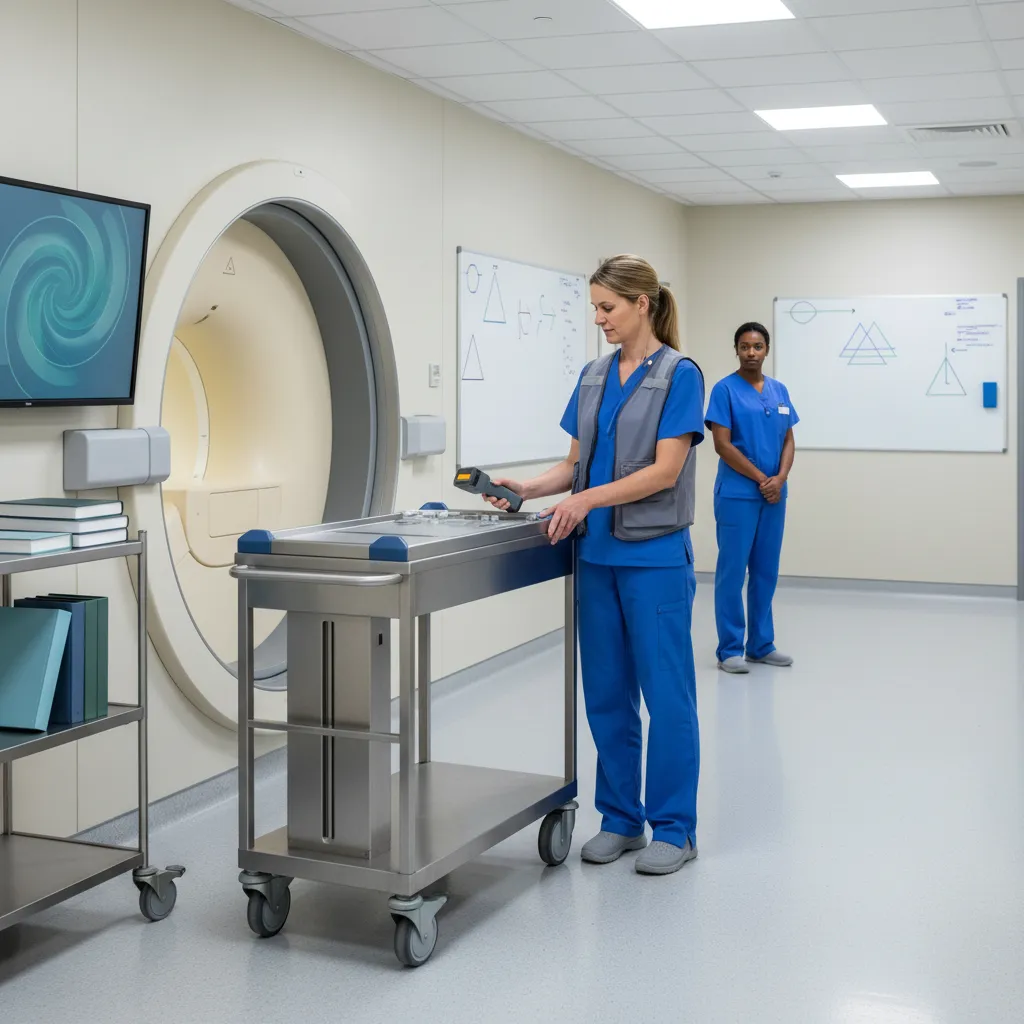
The ACR four-zone model is the backbone of MRSO work. Zone I is freely accessible to the public, Zone II is the supervised interface where screening begins, Zone III is restricted to screened personnel, and Zone IV is the scanner room itself. Test questions frequently ask who may enter which zone, who must supervise, and how to handle an unscreened visitor, a family member, or an emergency responder who arrives unexpectedly.
Device labeling is another foundation. ASTM F2503 defines three terms: MR Safe for items with no known hazards in any MR environment, MR Conditional for items safe only under specified conditions, and MR Unsafe for items that pose hazards in all MR environments. An MRSO must read conditions carefully, comparing field strength, spatial gradient, and specific absorption rate limits against the scanner actually in use rather than assuming a device is universally acceptable.
The hazards you manage extend beyond the static magnetic field. Time-varying gradient fields can cause peripheral nerve stimulation and loud acoustic noise, radiofrequency energy deposits heat measured as specific absorption rate, and superconducting magnets rely on cryogens such as liquid helium. Contrast agents add another layer, particularly gadolinium-based agents in patients with severely reduced kidney function. Strong MRSOs can connect each hazard to a specific control, such as hearing protection, pad placement, or eGFR screening.
Finally, an MRSO needs authority and relationships. The role works with biomedical engineering, vendor service engineers, radiation safety, risk management, security, and the emergency department. When someone proposes bringing in a new infusion pump, renovating the suite, or ramping a magnet, the MRSO should be at the table. Exam questions often hinge on knowing who to call first, which is why practical coordination skills matter alongside technical knowledge.
Magnetic Resonance Safety Officer Roles: MRSO vs MRMD vs MRSE
The Magnetic Resonance Safety Officer is the operational leader of the safety program. This person monitors zone access, reviews screening practices, enforces policies, and acts as the first point of contact when staff have questions about implants, equipment, or emergencies. Most MRSOs are senior technologists, MRI supervisors, nurses, or safety coordinators who already work close to the scanner every day.
The MRSO credential suits professionals who want to formalize that role. It emphasizes practical decision-making: reading device labels, applying ACR zone rules, coordinating quench response, and training coworkers. If your job involves writing procedures, auditing compliance, and answering real-time safety calls, this is usually the most natural certification to pursue first.

Is MRSO Certification Worth It? Pros and Cons
- +Demonstrates verified MR safety knowledge to employers and accreditors
- +Strengthens your resume for MRI lead, supervisor, and safety coordinator roles
- +Gives you credibility when enforcing screening and zone-access rules
- +Supports your facility's documentation of due diligence after incidents
- +Builds confidence in handling implants, quenches, and contrast questions
- +Can open doors to consulting, teaching, and committee leadership
- −Requires meaningful study time on top of a full clinical schedule
- −Exam and application fees may not be reimbursed by every employer
- −The credential adds responsibility and accountability without always adding pay
- −Eligibility and renewal rules require ongoing attention to stay current
- −Broad content spans physics, medicine, regulation, and engineering
- −Some sites lack a dedicated MRSO position, limiting immediate career impact
MRSO Certification Readiness Checklist
- ✓Download and read the current ABMRS candidate handbook.
- ✓Confirm you meet the education and experience requirements listed there.
- ✓Memorize the four ACR zones and who may enter each one.
- ✓Practice reading ASTM F2503 labels and matching conditions to your scanner.
- ✓Review quench steps, cryogen hazards, and emergency responder rules.
- ✓Study gadolinium contrast safety, eGFR screening, and NSF risk groups.
- ✓Learn static, gradient, and RF hazards and the controls for each.
- ✓Take timed practice quizzes and log every missed topic.
- ✓Schedule your exam date with a one-week review buffer.
- ✓Set a calendar reminder for renewal and continuing education tracking.
Think in Controls, Not Just Definitions
The strongest MRSO candidates link every hazard to a concrete control: zones for access, screening forms for implants, labels for equipment, and drills for emergencies. When you meet a scenario question, ask what the hazard is, who is at risk, and which control prevents harm. That habit beats rote memorization every time.
MRSO Exam Content: What You Need to Know
The MRSO examination samples a broad body of MR safety knowledge, so your study plan should mirror the content outline published by the ABMRS rather than your personal comfort zone. Expect multiple-choice questions that blend facts with scenarios. A candidate may need to recall the purpose of a zone, then apply it to a visitor, a stretcher, or an anesthesia cart. Always confirm the current question count, time limit, and domain breakdown on the official site.
Fundamentals of MR physics appear throughout. You should understand the static magnetic field, spatial gradient and its link to translational force, torque on ferromagnetic objects, gradient switching, and radiofrequency pulses. Memorizing formulas is rarely the goal; instead, know why a higher spatial gradient increases projectile risk near the bore entrance, and why a 3T scanner can behave differently from a 1.5T system when evaluating a conditional implant.
Bioeffects and exposure limits form another domain. Radiofrequency heating is expressed as specific absorption rate, and normal operating mode limits whole-body SAR to 2 W/kg under common standards. Peripheral nerve stimulation, acoustic noise, and thermal injury from skin-to-skin contact or looped cables also appear. Know protective measures such as hearing protection, padding and insulation, avoiding conductive loops, and reducing patient exposure when a scanner reports elevated values.
Patient and personnel screening is heavily tested because it prevents most real-world incidents. You should know what belongs on a screening form, how to handle unconscious or non-communicative patients, when imaging or records are needed to verify an implant, and how pregnancy and staff screening differ. Questions often present incomplete information and ask what to do next, rewarding candidates who default to verification and escalation rather than assumption.
Implants and devices require careful reading of labeling. The MRSO must interpret MR Conditional statements: field strength, maximum spatial gradient, maximum SAR, scan duration, and any waiting period after implantation. Expect questions on pacemakers, aneurysm clips, stents, orthopedic hardware, and external equipment such as monitors and IV poles. The correct answer is almost always tied to the documented conditions, not to general reputation or what a coworker remembers.
Contrast safety and cryogens round out the technical content. For gadolinium-based contrast, understand nephrogenic systemic fibrosis, how group I agents differ from lower-risk group II agents, and why eGFR screening matters for patients with severe kidney disease. For cryogens, know that liquid helium boils at about 4 kelvin, can expand roughly 700-fold, and can displace oxygen in an enclosed room if a quench vent fails.
Finally, emergency management and regulation complete the picture. You should know how to remove a patient from Zone IV, why firefighters and responders must be stopped at the door until the magnet is addressed, and why a quench button is not a rescue tool for pinned patients unless life is at risk. Familiarity with FDA, ACR, Joint Commission, and ASTM references helps you justify decisions the way an auditor would.

Eligibility rules, fees, exam length, and renewal cycles are set by the ABMRS and can change. Always check the current candidate handbook and the official website before paying or scheduling. Third-party summaries, including this one, may lag behind policy updates.
MRSO Certification Eligibility, Fees, and Renewal
Eligibility is the first gate, and it is the part of certification that candidates most often assume rather than verify. The ABMRS publishes education and experience expectations for each pathway, along with the documentation needed to prove them. Because requirements can be updated, read the current handbook line by line. If you are unsure whether your background qualifies, contact the board directly and keep any written response with your application records.
Costs generally include an application or examination fee paid to the ABMRS, plus study materials and possibly travel to a testing center. Fees are listed on the official site and may differ for members, retakes, or different pathways. Before you pay, ask your manager about education funds or professional development reimbursement. Many imaging departments cover exam fees for staff who will formally take on the safety officer role, but approval often must be requested in advance.
Scheduling usually works in two steps: your application is reviewed and approved, then you book a seat at an authorized computer-based testing location. Seats can fill during popular periods, so schedule early and choose a time when you are alert. Plan to arrive early with valid identification matching your application name exactly. Mismatched names are a common and avoidable reason for being turned away on test day.
On exam day, expect a secure, proctored environment where personal items are stored outside the testing room. Read each question fully, especially scenario stems that include a patient history, a scanner field strength, and a device label. Mark uncertain questions and return to them if the software allows. Budget your time so that you leave a few minutes at the end to review flagged items rather than rushing the final stretch.
If you do not pass on the first attempt, treat the result as data. Review the score report if one is provided, identify domains where you were weakest, and rebuild your study plan around them. The ABMRS sets retake policies, including waiting periods and fees, so check the handbook before you rebook. Many successful MRSOs needed a second attempt because their daily work covered only part of the outline.
After certification, keep your credential active. Renewal typically involves continuing education or documented activity over a defined cycle, along with a renewal fee. Start a folder on day one, saving certificates from conferences, in-services, vendor trainings, and safety committee work. Waiting until the deadline to reconstruct your records is stressful and risky, whereas steady documentation turns renewal into a simple administrative task.
Finally, think about how the credential fits your career. Some professionals use it to move from staff technologist to MRI lead, others to qualify for safety coordinator or compliance roles, and others to support consulting work. Salary effects vary by region, employer type, and whether the title comes with a formal responsibility stipend. Discuss expectations with your manager before you test so the certification translates into a defined role, not just an added burden.
Final MRSO Exam Prep Tips
Start with a diagnostic. Before you open a textbook, take a mixed set of practice questions and record your results by topic: zones, labeling, screening, bioeffects, contrast, cryogens, and emergencies. This shows you where your daily clinical experience has already prepared you and where it has not. Many technologists discover that they know screening cold but have rarely thought about quench physics or regulatory documentation.
Build a study calendar that fits your actual life. Eight to twelve weeks at four to six hours per week works better than a last-minute cram. Assign one major topic to each week, then reserve the final two weeks for mixed review and timed practice. Short, frequent sessions beat marathon weekends because spaced repetition helps you retain details such as label conditions and numerical limits.
Use primary sources, not just summaries. The ACR Manual on MR Safety, FDA guidance on MR conditional devices, and ASTM F2503 are the references behind many exam concepts. Read the sections on zones, screening, and emergencies carefully, and note the exact language used. When you can explain why a rule exists, you can answer a variation of the question you have never seen before.
Turn your workplace into a study lab. Walk through your own suite and identify the zone boundaries, signage, and access controls. Review your facility's screening form and ask whether each question has a purpose. Read your quench procedure and check where the vent is located. Asking colleagues how they handle an unusual implant provides real stories that stick in memory far better than isolated facts.
Practice scenario reasoning. For each practice question, state the hazard, the person at risk, and the control before reading the answer choices. If a patient is unresponsive and has an unknown implant, the safe answer is rarely to proceed on assumption. Train yourself to favor verification, documentation, and escalation to the appropriate expert. That mindset matches how the exam rewards sound judgment under uncertainty.
Keep a running error log. Each time you miss a practice question, write the topic, the correct reasoning, and the mistake you made, such as confusing MR Safe with MR Conditional or misremembering which zone requires supervision. Review the log weekly. Patterns appear quickly; many candidates repeat the same two or three errors, and fixing those gaps often adds more to a score than learning new material.
In the last week, simulate test conditions. Take a timed set of questions without notes, in a quiet space, and review every answer. Sleep well the night before, eat a real meal, and arrive early with identification. Do not cram obscure facts at the last minute. Trust your preparation, read each stem carefully, and remember that the exam is designed to confirm the judgment you use every day.
MRSO Questions and Answers
About the Author

Educational Psychologist & Academic Test Preparation Expert
Columbia University Teachers CollegeDr. Lisa Patel holds a Doctorate in Education from Columbia University Teachers College and has spent 17 years researching standardized test design and academic assessment. She has developed preparation programs for SAT, ACT, GRE, LSAT, UCAT, and numerous professional licensing exams, helping students of all backgrounds achieve their target scores.
Join the Discussion
Connect with other students preparing for this exam. Share tips, ask questions, and get advice from people who have been there.
View discussion (8 replies)