
MMPI-3 Test 2026: New Scales, Changes from MMPI-2 & Complete Guide
Pass the MMPI exam with confidence. Practice questions with detailed explanations and instant feedback on every answer. ✅

- The MMPI-2 contains 567 true-false items. (University of Minnesota Press; distributed by Pearson Assessments)
- The MMPI-2-RF contains 338 true-false items. (University of Minnesota Press; distributed by Pearson Assessments)
- The MMPI-3 takes approximately 25–35 minutes by computer or 35–50 minutes using paper and pencil. (pearsonassessments.com)
- The MMPI-A has an estimated administration time of approximately 60 minutes. (University of Minnesota Press; distributed by Pearson Assessments)
- The MMPI-2 publisher lists computer, CD, and paper-and-pencil administration. (University of Minnesota Press; distributed by Pearson Assessments)
- The MMPI-2-RF publisher lists computer, CD, and paper-and-pencil administration. (University of Minnesota Press; distributed by Pearson Assessments)
- The MMPI-2 is intended for people aged 18 years and older. (University of Minnesota Press; distributed by Pearson Assessments)
- The MMPI-2-RF is intended for people aged 18 years and older. (University of Minnesota Press; distributed by Pearson Assessments)
Facts verified Oct 20, 2026 against University of Minnesota Press; distributed by Pearson Assessments. Dates that have passed are removed automatically.
MMPI Exam at a Glance
Facts verified Oct 20, 2026 against University of Minnesota Press; distributed by Pearson Assessments. Dates that have passed are removed automatically.

What Is the MMPI-3?
The MMPI-3 is the 2026 revision of the Minnesota Multiphasic Personality Inventory, developed by Yossef Ben-Porath and Auke Tellegen and published by Pearson Assessments through the University of Minnesota. It replaces the MMPI-2 (1989) as the recommended version for new clinical and forensic evaluations, though the MMPI-2 remains in active use in settings that have not yet transitioned. Practice with the free MMPI - Minnesota Multiphasic Personality Inventory practice test on PracticeTestGeeks (7 questions with answer explanations).
The MMPI-3 retains the empirical item-keying tradition of its predecessors while adopting a fully Restructured Clinical (RC) scale framework and extending it with 42 Substantive Scales organized under three Higher-Order domains: Emotional/Internalizing Dysfunction (EID), Thought Dysfunction (THD), and Behavioral/Externalizing Dysfunction (BXD). This hierarchical architecture allows clinicians to move from broad domain-level interpretation down to narrow facet-level descriptions — a major improvement over the MMPI-2's overlapping clinical scale structure.
The normative sample was collected in 2018 and matched to U.S. census data on age, education, race/ethnicity, and geographic region — providing contemporary population norms that address a primary criticism of the MMPI-2's 1989 normative group. For a free online MMPI test, visit the PracticeTestGeeks MMPI practice hub.
Free MMPI - Minnesota Multiphasic Personality Inventory Study Tools
Interactive MMPI - Minnesota Multiphasic Personality Inventory resources on PracticeTestGeeks, free to start:
- MMPI - Minnesota Multiphasic Personality Inventory flashcards — review key terms and concepts card by card
- MMPI - Minnesota Multiphasic Personality Inventory study guide — topic-by-topic overview of what the exam covers
- MMPI - Minnesota Multiphasic Personality Inventory cheat sheet — one-page printable summary for last-minute review
MMPI-3 vs MMPI-2: Key Differences
The shift from MMPI test (MMPI-2) to MMPI-3 is the most structurally significant revision in the instrument's history. While the MMPI-2-RF (2008) was a transitional restructured form, the MMPI-3 is a fully independent instrument — not a subset of the MMPI-2 item pool, but a new 335-item set developed from scratch with updated psychometric methodology.
The most visible change is item count: 335 items vs 567 items (MMPI-2). This reduction eliminates test fatigue that frequently occurred past item 300 in the MMPI-2, improving data quality in cognitively impaired or resistant examinees. The reading level was also lowered to 5th grade (from MMPI-2's 8th grade), expanding clinical applicability to lower-literacy populations.
Normatively, the MMPI-3 uses a 2018 census-matched sample rather than the MMPI-2's 1989 community sample — correcting for three decades of demographic change in the U.S. The new norms produce meaningfully different T-score elevations for the same raw scores, meaning clinicians cannot directly compare MMPI-2 profiles with MMPI-3 profiles for the same patient.
MMPI-3 vs MMPI-2: Side-by-Side
- ▶335 items — 41% shorter
- ▶25–50 minutes administration time
- ▶2018 census-matched norms (N=1,600)
- ▶5th-grade reading level
- ▶42 Substantive Scales in hierarchical structure
- ▶10 validity scales (enhanced Fp-r, RBS, TRIN-r, VRIN-r)
- ▶No K-correction applied
- ▶RC Scales + Higher-Order + Substantive Scales
- ▶3 Higher-Order domains: EID, THD, BXD
- ▶Fully independent item pool — not a subset of MMPI-2
- ▶567 items — longer administration
- ▶60–90 minutes administration time
- ▶1989 community norms (N=2,600)
- ▶8th-grade reading level
- ▶10 original clinical scales + content/supplementary
- ▶9 validity scales
- ▶K-correction on 5 scales
- ▶Original empirically-derived clinical scales
- ▶No formal Higher-Order hierarchy
- ▶Overlapping item pools between scales
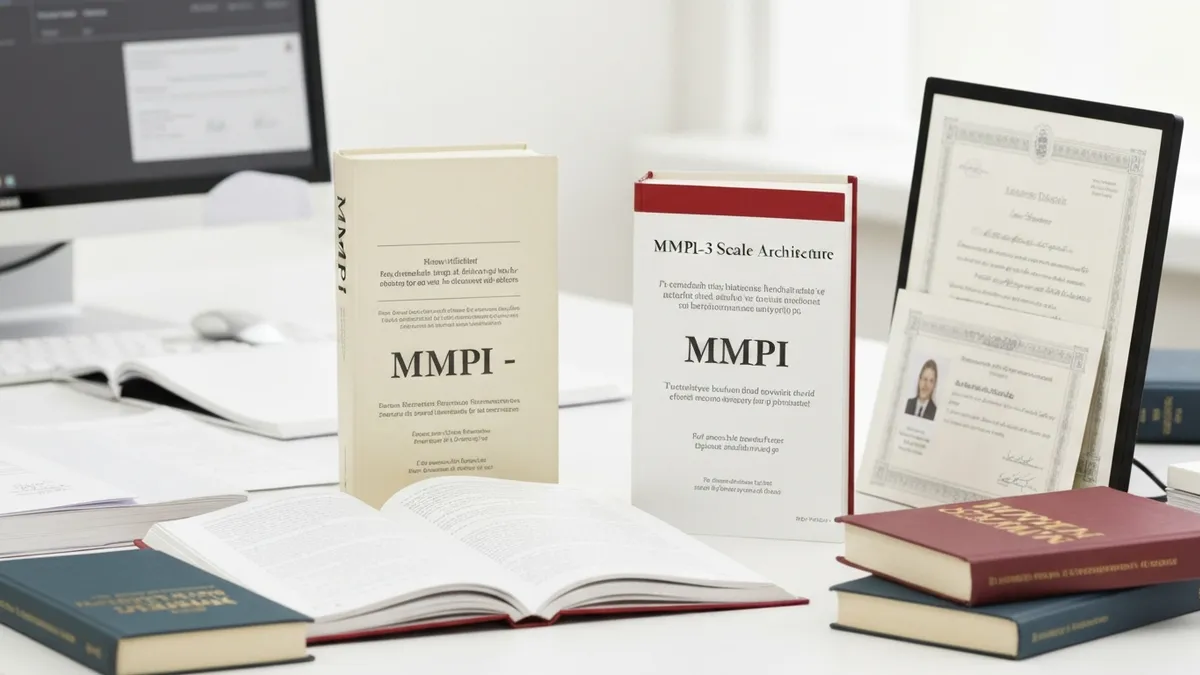
MMPI-3 Scale Architecture: Higher-Order & Substantive Scales
The MMPI-3's scale structure is hierarchical, moving from broad Higher-Order factors down to narrow Specific Problems facets. This replaces the MMPI-2's flat structure of loosely related scales and provides a clearer interpretive roadmap for clinicians. The MMPI personality test now organizes results into three tiers.
At the broadest level, three Higher-Order (H-O) Scales capture general psychopathology domains:
- EID (Emotional/Internalizing Dysfunction) — depression, anxiety, negative emotions
- THD (Thought Dysfunction) — psychosis, paranoia, bizarre experiences
- BXD (Behavioral/Externalizing Dysfunction) — impulsivity, aggression, substance use
Below H-O scales are 9 Restructured Clinical (RC) Scales — retained from the MMPI-2-RF — which decompose each H-O domain into its primary constructs (e.g., RC1 Somatic Complaints, RC2 Low Positive Emotions, RC4 Antisocial Behavior). At the narrowest level, 42 Substantive Scales provide specific facet-level information (e.g., Malaise, Head Pain Complaints, Worry, Ideas of Persecution, Aggression, Substance Abuse).
MMPI-3 Scale Groups: Complete Overview
EID — Emotional/Internalizing Dysfunction: Measures the broad spectrum of internalizing psychopathology. High EID elevations (T ≥ 65) indicate pervasive negative emotional states including depression, anxiety, and demoralization. EID subsumes RC2 (Low Positive Emotions) and RC7 (Dysfunctional Negative Emotions).
THD — Thought Dysfunction: Captures psychotic and paranoid presentations. High THD scores (T ≥ 65) signal significant perceptual disturbances, thought disorganization, and persecutory ideation. Subsumes RC6 (Ideas of Persecution) and RC8 (Aberrant Experiences).
BXD — Behavioral/Externalizing Dysfunction: Reflects externalizing behaviors — acting out, impulsivity, and substance misuse. High BXD elevations predict conduct problems, aggression, and addiction. Subsumes RC4 (Antisocial Behavior) and RC9 (Hypomanic Activation).
MMPI-3 Validity Scales: Detecting Invalid Profiles
The MMPI-3 includes 10 validity scales — the most comprehensive validity scale set of any MMPI version. These scales detect four forms of profile invalidity: non-content-based responding (random or fixed), overreporting psychopathology (faking bad), and underreporting psychopathology (faking good). Valid profiles are a prerequisite for any clinical or forensic interpretation. The MMPI-2 background informs understanding of these scales' historical development.
When interpreting validity scales, clinicians follow a fixed sequence: (1) confirm the examinee was not responding randomly (VRIN-r, TRIN-r); (2) check for overreporting (F-r, Fp-r, Fs, FBS-r, RBS); (3) check for underreporting (L-r, K-r). Only after validity is established do clinical scale elevations carry interpretive weight.
MMPI-3 Scoring and T-Score Interpretation
Like all MMPI versions, the MMPI-3 converts raw item counts to Uniform T-scores (UT-scores) — a non-linear transformation that produces equivalent percentile ranks across scales with different distributions. The 2018 normative sample provides the reference distribution. T-score interpretation follows a standard framework: T ≥ 65 is the primary clinical elevation threshold for Substantive Scales; T ≥ 80 typically indicates marked elevation and heightened clinical significance.
Unlike the MMPI-2, the MMPI-3 does NOT apply K-correction to any clinical or RC scales. K-r (Adjustment Validity) remains as a pure validity indicator. This eliminates the ongoing debate about K-correction utility that persisted through the MMPI-2 era and simplifies the scoring algorithm. A comprehensive MMPI test online can help familiarize you with the format before professional evaluation.
Automated scoring is handled through Pearson's Q-global platform, which generates profile reports including validity scale flags, RC scale profiles, Substantive Scale scores, and PSY-5 scores. Hand-scoring worksheets exist but are rarely used in practice. Qualified Professional (QP) or higher designation is required to purchase and administer MMPI-3 materials.

MMPI-3 Clinical and Forensic Uses
The MMPI-3 is used across a wide range of applied settings. Its updated norms and validity scale arsenal make it particularly well-suited for forensic evaluations — child custody, criminal competency, personal injury, and worker's compensation — where response distortion is common and profile validity is essential. Military and law enforcement pre-employment psychological screening programs are gradually transitioning from MMPI-2 to MMPI-3, though many agencies have not yet completed the transition. For background on the test's history, the MMPI 2 transition articles and MMPI personality test guides provide useful context.
In clinical settings, the MMPI-3 is used for differential diagnosis support, treatment planning, and monitoring treatment progress. It is explicitly NOT a diagnostic instrument — it produces T-score profiles that describe personality and psychopathology dimensions, which clinicians integrate with interview data, records, and other assessment sources. The 42 Substantive Scales provide clinically actionable specificity: for example, distinguishing Suicidal/Death Ideation (SUI) from general demoralization (RCd) has direct triage implications.
The MMPI-3 has been criticized for limited research base compared to the MMPI-2 (which has 50,000+ published studies). As of 2026, the MMPI-3 literature is growing rapidly, but clinicians working in specialized contexts (e.g., chronic pain, military PTSD) may still prefer MMPI-2 or MMPI-2-RF where more context-specific validity data exists. Consider using a MMPI test free practice resource to familiarize yourself with item formats before an actual evaluation.
MMPI-3 Primary Use Contexts
- ✓Forensic evaluations — child custody, criminal competency, personal injury claims
- ✓Law enforcement and military pre-employment psychological screening
- ✓Clinical differential diagnosis support for mood, anxiety, psychotic disorders
- ✓Treatment planning — identifying target symptoms and severity
- ✓Substance abuse evaluation and treatment readiness assessment
- ✓Neuropsychological context — cognitive complaints and somatic symptom verification
- ✓Inpatient and outpatient psychiatric evaluation
- ✓Disability determination examinations
- ✓Academic and research settings — personality and psychopathology research
How to Prepare for the MMPI-3
Unlike academic certification exams, the MMPI-3 cannot be "passed" or "failed" in the traditional sense — there are no correct answers. However, how you approach the test significantly affects the quality and usefulness of your profile. Informed preparation focuses on understanding the test format and approaching items honestly and consistently. For free MMPI test online free practice, use the PracticeTestGeeks practice questions to become comfortable with the true/false format and item style.
The most important principle: respond honestly. The validity scale system (10 scales) is specifically designed to detect both overreporting (exaggerating symptoms) and underreporting (minimizing problems). Profiles with elevated L-r and K-r — the two underreporting scales — provide less useful clinical information because clinicians cannot interpret elevations at face value. Similarly, profiles with elevated F-r or Fp-r may indicate that clinical scale elevations reflect exaggeration rather than genuine symptoms.
MMPI-3: Strengths and Limitations
- +335 items — 41% shorter than MMPI-2, reduces test fatigue dramatically
- +2018 census-matched normative sample — contemporary and demographically representative
- +5th-grade reading level — broader clinical applicability than MMPI-2
- +42 Substantive Scales — more clinically specific than MMPI-2's 10 clinical scales
- +10 validity scales — best overreporting/underreporting detection of any MMPI version
- +No K-correction — eliminates a contested MMPI-2 scoring artifact
- +Hierarchical scale structure — clearer interpretive logic from H-O to facet level
- +Updated PSY-5-r scales — improved personality trait assessment
- −Limited research base compared to MMPI-2 (50,000+ studies vs growing MMPI-3 literature as of 2026)
- −Cannot directly compare MMPI-3 profiles to historical MMPI-2 records from same patient
- −Many law enforcement and military agencies have not yet transitioned from MMPI-2
- −Requires Q-global subscription for automated scoring — ongoing cost to practitioners
- −Limited forensic validity research for specific settings (chronic pain, TBI) compared to MMPI-2
- −Some clinicians prefer MMPI-2 code type interpretation tradition — no equivalent for MMPI-3 yet
- −New normative sample means established 'norms' for specialized populations (inmates, chronic pain) still developing
- −Test materials require Qualified Professional (QP) status — not accessible to all mental health providers
Related MMPI Articles


Sample MMPI - Minnesota Multiphasic Personality Inventory Practice Questions
Try these questions from our free MMPI - Minnesota Multiphasic Personality Inventory practice tests. The correct answer and an explanation follow each question.
When interpreting an MMPI-3 profile for an individual from a non-Western, collectivistic culture, a clinician should exercise particular caution and consider cultural context before concluding that a low score on scales related to interpersonal relations signifies pathology. Which value might lead to response patterns that appear different from the U.S. normative sample?
- A. An emphasis on individual achievement and self-promotion.
- B. A preference for direct and assertive communication.
- C. A high value placed on group harmony and modesty.
- D. A belief in rigid, hierarchical social structures.
Answer: C. A high value placed on group harmony and modesty.
In many collectivistic cultures, there is a strong emphasis on maintaining group harmony, modesty, and avoiding social conflict. This can influence how individuals respond to items about self-importance, social dominance, or interpersonal assertiveness. A culturally-informed clinician would recognize that lower scores on scales tapping these constructs might reflect cultural values rather than a lack of self-esteem or social avoidance, which might be the interpretation in a more individualistic context.
Which of the following RC scales was created to capture the pervasive, non-specific distress component that was removed from the other Restructured Clinical Scales to improve their distinctiveness?
- A. RC1 (Somatic Complaints)
- B. RCd (Demoralization)
- C. RC7 (Dysfunctional Negative Emotions)
- D. RC2 (Low Positive Emotions)
Answer: B. RCd (Demoralization)
RCd (Demoralization) is the scale composed of items reflecting general unhappiness, feeling overwhelmed, and poor morale. This common variance, identified as the 'first factor' in the original clinical scales, was extracted and consolidated into RCd, thereby increasing the discriminant validity of the other RC scales.
Which feature distinguished the MMPI-A from the MMPI-2 in terms of its normative base?
- A. It used adult norms scaled down for age
- B. It established separate norms for adolescents aged 14–18
- C. It relied on school-based convenience samples only
- D. It adopted T-score conversions from the original 1943 norms
Answer: B. It established separate norms for adolescents aged 14–18
The MMPI-A (1992) established distinct normative data based on adolescents aged 14–18, recognizing that adult norms were inappropriate for this population.
The MMPI-3 normative sample differs from MMPI-2's how?
- A. Same 1989 sample
- B. Updated sample better reflecting current U.S. demographics
- C. No normative sample
- D. Census-matched from same year
Answer: B. Updated sample better reflecting current U.S. demographics
The MMPI-3 uses an updated sample better representing current U.S. demographic diversity, addressing MMPI-2 sample criticisms.
Take the full MMPI - Minnesota Multiphasic Personality Inventory practice test
For more details, see our what is mmpi guide. For more details, see our mmpi 2 guide. For more details, see our mmpi scoring guide. For more details, see our mmpi-2 scoring manual pdf guide.MMPI-3 Questions and Answers
How this page was made: written with AI tools and published by Nathan Beja, founder of Practice Test Geeks, who is responsible for its content. Exam facts are checked against the official sources listed below. Not reviewed by a subject-matter expert. Editorial policy
Sources & references
Exam facts on this page (fees, format, dates, passing scores) are checked against these official sources; the date is our last check. Editorial policy
- upress.umn.edu — Test delivery, exam format, time limit, eligibility · verified Oct 2026
- pearsonassessments.com — Time limit · verified Oct 2026