
Mastering the MISA Assessment: Everything You Need to Know 2026
Free Mastering the MISA Assessment: practice test with instant feedback and detailed answer explanations. Prepare for your exam. ❓
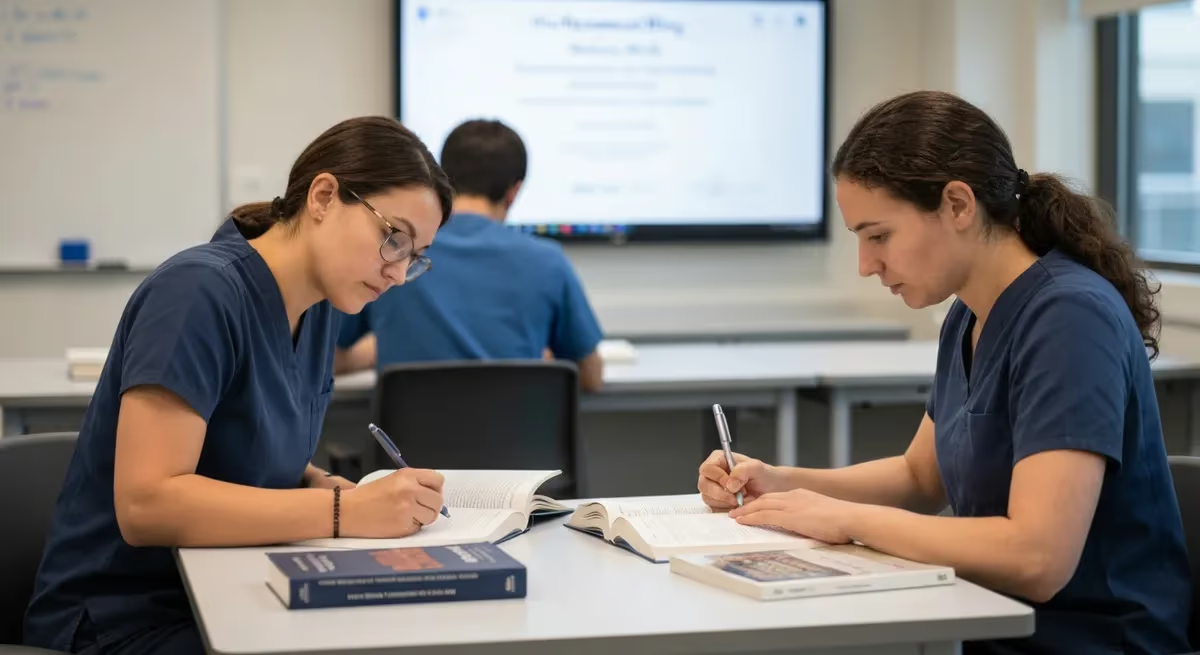
The Maryland Integrated Science Assessment (MISA) is an essential test for high school students in Maryland. It evaluates their understanding of integrated science concepts, with a strong emphasis on environmental science, physics, chemistry, and biology. The MISA test is an important step for students in their academic journey, as it assesses both their conceptual knowledge and their ability to apply scientific principles in real-world scenarios. Practice with the free MISA - Maryland Integrated Science Assessment practice test on PracticeTestGeeks (11 questions with answer explanations).
For students preparing to take the MISA, a well-rounded study strategy is crucial. The test covers a range of topics and can be challenging without the proper preparation. This article will provide a comprehensive guide to help you navigate the MISA exam, including key topics to focus on, effective study tips, and resources to help ensure success.
Test-takers preparing for azsci will find our AzSCI practice test 2026 invaluable for mastering the content and format before exam day.
Free MISA - Maryland Integrated Science Assessment Study Tools
Interactive MISA - Maryland Integrated Science Assessment resources on PracticeTestGeeks, free to start:
- Free MISA Mathematics Questions and Answers — 11 questions with instant scoring and answer explanations
- MISA - Maryland Integrated Science Assessment flashcards — review key terms and concepts card by card
- MISA - Maryland Integrated Science Assessment study guide — topic-by-topic overview of what the exam covers
- MISA - Maryland Integrated Science Assessment cheat sheet — one-page printable summary for last-minute review

What is the MISA Test?
The Maryland Integrated Science Assessment (MISA) is a state-level standardized test for high school students in Maryland. It is designed to assess students' understanding of the scientific concepts taught in their Integrated Science courses, which integrate multiple scientific disciplines into a unified curriculum.
The MISA test is a part of Maryland’s graduation requirements, and passing it is necessary for earning a high school diploma. It measures students' knowledge of key scientific concepts, their ability to think critically, and how well they can apply scientific knowledge in practical situations. The test consists of multiple-choice questions, constructed response items, and real-world scenario-based questions that require students to use their understanding of scientific principles.
Why is the MISA Test Important?
Graduation Requirement: The MISA exam is mandatory for students in Maryland to graduate high school. Successfully passing this test is a crucial step toward earning a diploma.
Comprehensive Science Knowledge: The test covers various scientific disciplines, allowing students to demonstrate their proficiency in multiple areas of science, including biology, chemistry, physics, and earth science.
College and Career Readiness: The MISA test assesses not only content knowledge but also students' ability to apply scientific thinking and problem-solving in real-life scenarios. This is an important skill for future studies and career opportunities.
State and Federal Accountability: The MISA test plays a role in evaluating the performance of schools and districts. High scores on the exam contribute to the overall accountability system in Maryland’s education system.
How to Prepare for the MISA Test
Effective preparation is key to performing well on the MISA test. Here are some tips to help you study for the exam:
One of the most effective ways to prepare for the MISA exam is by taking misa exam prep. Practice tests help you familiarize yourself with the test format and question types. They allow you to assess your knowledge, identify areas of weakness, and improve your time management. Websites offers a variety of practice tests specifically designed for the MISA exam, giving you the opportunity to simulate real test conditions.
Focus on the core topics covered in the exam, such as biology, chemistry, physics, and earth science. Use your textbook, class notes, and online resources to review these concepts thoroughly. Pay extra attention to any areas where you feel less confident.
There are plenty of online resources, including videos, tutorials, and interactive simulations, that can help you better understand difficult scientific concepts. Websites like Khan Academy and YouTube offer free lessons in various scientific topics, which can enhance your understanding and complement your textbooks.
Study groups are a great way to collaborate with your peers and reinforce your understanding of the material. Discussing challenging concepts with others can help you see different perspectives and improve your overall understanding of the subject matter.
The MISA test assesses your ability to use the scientific method and interpret data. Practice solving problems, analyzing data sets, and drawing conclusions from experimental results. This will help you feel more comfortable when faced with these types of questions on the test.

MISA Exam Structure and Key Topics
The MISA test is designed to assess students’ understanding of scientific concepts and their ability to apply scientific methods in various contexts. The exam includes multiple-choice questions, short-answer responses, and scenario-based questions that require critical thinking. Here are the key topics covered in the MISA test:
Cell Structure and Function: Understanding the parts of a cell, their functions, and how they contribute to the overall health of an organism.
Genetics and Evolution: Concepts related to DNA, inheritance patterns, and the principles of evolution.
Ecosystems and Biodiversity: How organisms interact with their environment and the importance of biodiversity.
Atomic Structure and Periodic Table: Understanding atoms, elements, and the organization of the periodic table.
Chemical Reactions: Types of reactions, balancing equations, and the principles of stoichiometry.
Matter and Its Properties: The characteristics of solids, liquids, and gases, as well as phase changes and energy transfer.
Forces and Motion: Newton's laws of motion, force, velocity, and acceleration.
Energy and Work: Forms of energy, the law of conservation of energy, and mechanical work.
Waves and Light: Properties of waves, sound, and light, and their practical applications.
Weather and Climate: The atmosphere, weather patterns, and how climate affects ecosystems.
Earth’s Systems: The interaction between the atmosphere, hydrosphere, geosphere, and biosphere.
Space and Astronomy: Understanding the solar system, the life cycle of stars, and basic concepts in space exploration.
Scientific Method: Understanding how to design experiments, analyze data, and draw conclusions.
Data Analysis and Interpretation: Analyzing scientific data and making predictions based on evidence.
Candidates taking the 7 Dimensions leadership and values assessment can prepare with our free 7D assessment practice test — covering work ethic, interpersonal values, and decision-making dimensions used in organisational hiring.
Candidates taking SHL OPQ assessment can prepare with our free SHL Occupational Personality Questionnaire practice — understanding the 32 personality dimensions measured for leadership, team working, and managing change.
Job seekers facing pre-employment behavioral and cognitive screening may also benefit from the PI Cognitive Assessment 2026, which evaluates the reasoning and learning agility that talent analytics platforms like PeopleAnswers use to benchmark candidate fit.
Common Mistakes to Avoid During MISA Preparation
Procrastination – Waiting until the last minute to study is one of the most common mistakes students make. Start studying well in advance to give yourself ample time to review all key topics.
Focusing Too Much on One Topic – The MISA exam covers a wide range of topics. Don’t spend too much time on one subject at the expense of others. Make sure to allocate time to all areas of the test.
Ignoring the Scientific Method – Many students underestimate the importance of the scientific method in the MISA exam. Make sure to practice how to design experiments, collect data, and interpret results.
Not Using Practice Tests – Practice tests are invaluable in exam preparation. Skipping them can leave you unprepared for the types of questions you’ll encounter.
Additional Resources for MISA Preparation
WCAS Test – A related test that assesses students’ proficiency in science, which may complement your MISA preparation.
NSAA Practice Test – For students seeking additional practice in science assessments, this resource can help hone your skills further.
Exam Day Tips
Get Enough Rest – Make sure to get a good night’s sleep before the exam day. Being well-rested will help you focus and perform better.
Stay Calm – Take deep breaths and stay calm if you come across difficult questions. Remember, you can always move on to the next question and come back later.
Review Your Answers – If time permits, review your answers before submitting the exam. Check for any mistakes or incomplete responses.

Blog: Pros and Cons
- +Blog credential is recognized by employers and industry professionals
- +Higher earning potential compared to non-credentialed peers
- +Expanded career opportunities and professional advancement
- +Structured learning path builds comprehensive knowledge
- +Professional development that stays current with industry standards
- −Preparation requires significant time and study commitment
- −Associated costs for exams, materials, and renewal fees
- −Continuing education needed to maintain credentials
- −Competition for advanced positions can be challenging
- −Requirements and standards may vary by state or region
Pros and Cons at a Glance
| Pros | Cons |
|---|---|
| Blog credential is recognized by employers and industry professionals | Preparation requires significant time and study commitment |
| Higher earning potential compared to non-credentialed peers | Associated costs for exams, materials, and renewal fees |
| Expanded career opportunities and professional advancement | Continuing education needed to maintain credentials |
| Structured learning path builds comprehensive knowledge | Competition for advanced positions can be challenging |
| Professional development that stays current with industry standards | Requirements and standards may vary by state or region |
Sample Blog Practice Questions
Try these questions from our free Blog practice tests. The correct answer and an explanation follow each question.
What is a 'call to action' (CTA) in a blog post?
- A. A headline that tells readers what the post is about
- B. A prompt that encourages readers to take a specific next step
- C. The introductory paragraph of a blog post
- D. A technique for writing more engaging subheadings
Answer: B. A prompt that encourages readers to take a specific next step
A CTA guides readers to take a desired action — such as subscribing, leaving a comment, or making a purchase — after consuming the content.
Which element is most effective for hooking readers in a blog post introduction?
- A. Opening with a dictionary definition of the main topic
- B. Listing every subtopic the post will cover in bullet points
- C. Starting with a compelling question, anecdote, or surprising statistic
- D. Beginning with a lengthy description of the author's credentials
Answer: C. Starting with a compelling question, anecdote, or surprising statistic
A strong hook — such as a question, story, or startling fact — captures the reader's attention and motivates them to keep reading.
Which writing style is generally most effective for blog content?
- A. Formal academic language with complex, discipline-specific vocabulary
- B. Passive voice used consistently throughout the post
- C. Conversational, clear language written in the second person (addressing 'you')
- D. Third-person narrative that avoids any direct address to the reader
Answer: C. Conversational, clear language written in the second person (addressing 'you')
Conversational, second-person writing creates a personal connection with the reader and is easier to understand than formal or passive styles.
What is the purpose of internal linking within a blog?
- A. To redirect readers away to competitor websites for comparison
- B. To connect related posts and help readers and search engines navigate the site
- C. To fully replace the need for a site navigation menu
- D. To inflate page view numbers in analytics dashboards
Answer: B. To connect related posts and help readers and search engines navigate the site
Internal links guide readers to related content, increase time-on-site, and help search engines understand the topical structure and relationships between pages.
Conclusion
The Maryland Integrated Science Assessment (MISA) is a crucial step for high school students in Maryland. By following a structured study plan, using resources, and practicing with sample questions, you can feel confident and prepared on test day.
Remember, success on the MISA test is not just about memorizing facts but also about applying your knowledge to solve real-world problems. Start your preparation today and take the first step toward achieving your academic and career goals. Good luck!
How this page was made: written with AI tools and published by Nathan Beja, founder of Practice Test Geeks, who is responsible for its content. Exam facts are checked against the official sources listed below. Not reviewed by a subject-matter expert. Editorial policy
Sources & references
Exam facts on this page (fees, format, dates, passing scores) are checked against these official sources; the date is our last check. Editorial policy
- news.maryland.gov — Eligibility · verified Oct 2026