
MBLEx Practice Test: Free Practice Questions for the Massage Licensing Exam, Content Areas, and Study Plan
MBLEx practice test guide: 100-question format, 7 content areas, scoring 630/900, study plan, free practice questions, and pass rate data for ✍🏼
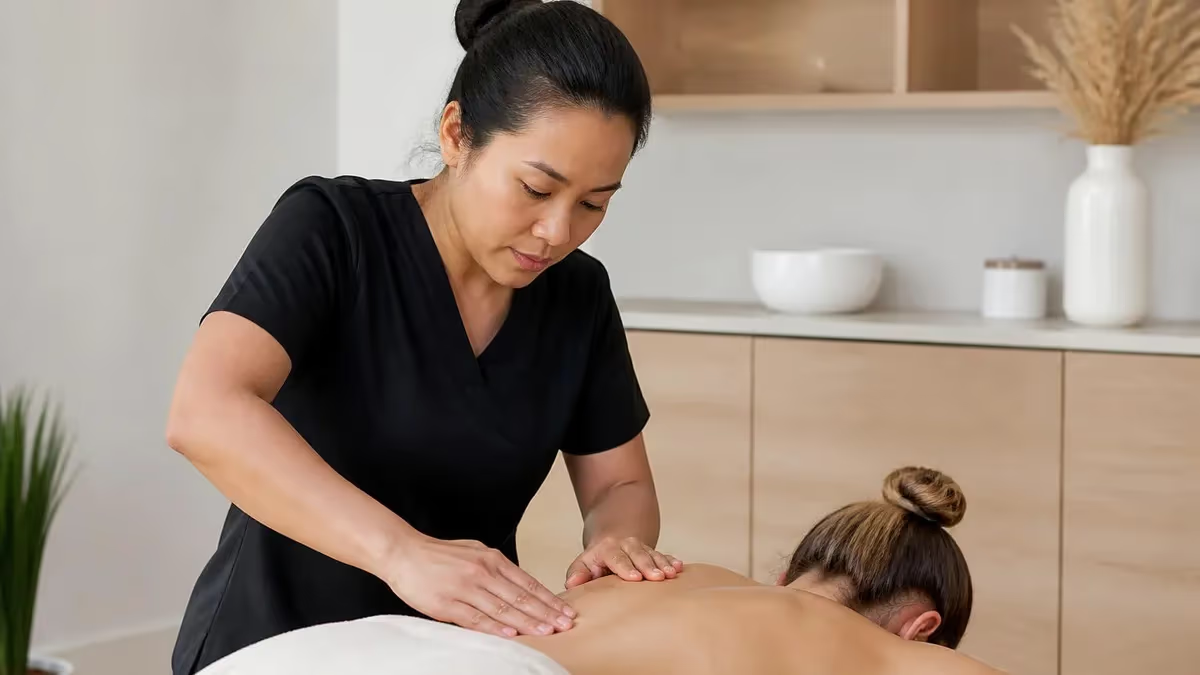
The MBLEx (Massage & Bodywork Licensing Examination) is the standardized licensing exam required for licensed massage therapists in most US states. Administered by the Federation of State Massage Therapy Boards (FSMTB), the exam validates entry-level knowledge across seven content areas: anatomy and physiology, kinesiology, pathology and contraindications, benefits of massage techniques, client assessment and treatment planning, ethics and laws, and guidelines for professional practice. Passing the MBLEx is the gateway to state licensure for massage therapists.
The exam itself: 100 multiple-choice questions, 110 minutes total testing time, computer-based delivery at Pearson VUE testing centers. The passing score is 630 out of 900 (scaled score), which roughly translates to 70% raw correct answers. The exam fee is $265, paid to FSMTB. Most test-takers complete the exam in 70-90 minutes; you have the full 110 minutes if needed.
Pass rates for the MBLEx: First-attempt pass rate is approximately 67% nationally. Some training programs have higher pass rates (75-85%) due to better preparation. Students who use comprehensive practice testing approach see substantially better outcomes than those who rely on textbook study alone.
Practice tests are the single most effective preparation method for the MBLEx. Because the exam draws from a defined content domain, working through hundreds of practice questions builds both knowledge and test-taking pattern recognition. Most successful candidates work through 500-1,000 practice questions before sitting for the exam — typically across multiple study sessions over 2-4 months.
The exam content distribution (approximate weights): Client Assessment, Reasoning & Treatment Planning — 17% (largest single section). Ethics, Boundaries, Laws, Regulations — 16%. Guidelines for Professional Practice — 16%. Benefits and Physiological Effects of Techniques — 15%. Pathology, Contraindications, Areas of Caution, Special Populations — 13%. Kinesiology — 12%. Anatomy and Physiology — 11%.
The relative weighting matters for study planning. Client Assessment, Ethics, and Professional Practice combine to almost 50% of the exam — focusing on these higher-weight sections optimizes study time. Anatomy and Physiology, though foundational, is the smallest section by weight.
This page is your starting point for MBLEx practice testing and preparation. We cover the exam format in detail, content area breakdowns, recommended preparation timeline, practice test resources (free and paid), test-taking strategies, and what to expect on exam day. Whether you're starting your preparation or in the final review phase, this guide provides the framework for systematic exam preparation.

Key MBLEx Information
- Full name: Massage & Bodywork Licensing Examination
- Administered by: FSMTB (Federation of State Massage Therapy Boards)
- Format: 100 multiple-choice questions, 110 minutes
- Passing score: 630 of 900 (scaled), ~70% raw
- Cost: $265
- Delivery: Pearson VUE testing centers
- First-attempt pass rate: ~67% nationally
- License validity: Varies by state (typically 1-2 years, renewable)
- Required in: Most US states for massage therapy licensure
- Recommended prep: 500-1,000 practice questions over 2-4 months
- Largest content area: Client Assessment (17%)
The seven MBLEx content areas in detail. Understanding the relative importance of each section helps focus study time on the highest-impact topics.
Section 1: Client Assessment, Reasoning & Treatment Planning (17%). The largest single content area. Tests: gathering client information through intake forms, assessing client posture and movement, identifying contraindications, choosing appropriate massage techniques, developing treatment plans, documenting sessions, modifying treatment based on client response, communicating with healthcare providers. ~17 questions on the exam.
Section 2: Ethics, Boundaries, Laws, and Regulations (16%). Tests: professional ethics (HIPAA, confidentiality), professional boundaries (appropriate touch, draping, dual relationships), state and federal laws governing massage therapy, sexual misconduct prevention, professional standards, scope of practice limits, mandatory reporting requirements. ~16 questions.
Section 3: Guidelines for Professional Practice (16%). Tests: business practices for massage therapists, marketing and client retention, financial management, insurance billing, business ethics, professional development, mentorship and continuing education, working in different practice settings (spas, clinics, sports). ~16 questions.
Section 4: Benefits and Physiological Effects of Techniques (15%). Tests: physiological effects of massage on body systems (cardiovascular, lymphatic, nervous, muscular), benefits of specific techniques (Swedish, deep tissue, sports, trigger point, myofascial), psychological benefits, when each technique is appropriate, contraindications for techniques. ~15 questions.
Section 5: Pathology, Contraindications, Areas of Caution, Special Populations (13%). Tests: medical conditions and their relevance to massage, absolute and relative contraindications, areas requiring caution (open wounds, recent surgery, etc.), considerations for pregnant clients, elderly clients, children, athletes, clients with disabilities, medications and their effects on massage decisions. ~13 questions.
Section 6: Kinesiology (12%). Tests: body movement and biomechanics, muscle groups and their actions, joint types and movements, body mechanics for therapist (preventing injury, efficient body use), postural analysis, gait analysis. ~12 questions.
Section 7: Anatomy and Physiology (11%). Tests: skeletal system anatomy and function, muscular system (origins, insertions, actions), cardiovascular system, lymphatic system, nervous system, digestive system, immune function, integumentary system. ~11 questions. The smallest section by weight despite being foundational.
MBLEx Content Areas
Largest section. Treatment planning, intake, contraindications, technique selection. ~17 questions.
HIPAA, boundaries, scope of practice, mandatory reporting, professional ethics. ~16 questions.
Business operations, marketing, billing, professional development. ~16 questions.
Physiological effects of techniques, when to use each. ~15 questions.
Medical conditions, contraindications, special populations. ~13 questions.
Body movement, muscle actions, biomechanics. ~12 questions.
Effective practice test strategy for the MBLEx. Approach that produces the best results.
Stage 1: Baseline assessment. Before any focused study, take a full-length practice test cold — without preparation. Most candidates score 30-50% on first attempt. This baseline shows where you stand and which sections need the most work.
Stage 2: Content review. Use a comprehensive study guide (Mosby's Massage Therapy Review, Trail Guide to the Body, Tappan's Handbook of Healing Massage Techniques) to review each content area. Focus more time on weak sections from your baseline test.
Stage 3: Topic-specific practice. Take practice tests focused on specific sections. HamStudy-style platforms allow this. After studying anatomy, take an anatomy-only practice test. This isolates learning gaps and reinforces specific knowledge.
Stage 4: Full-length practice tests. After topic-specific work, take full-length practice tests covering all sections. Aim for 5-10 full-length practice tests before the actual exam. Each test takes ~110 minutes. Track your scores over time.
Stage 5: Weak area drilling. After full-length tests, identify sections where you consistently score below target. Re-study those topics. Take additional practice questions in those areas. Repeat until weak areas reach acceptable level (>75%).
Stage 6: Final review. In the final 2 weeks before exam, take 2-3 full-length practice tests under timed conditions. Aim for 85%+ on practice tests consistently. Review only the topics you continue to miss.
Stage 7: Exam day. Take the actual MBLEx. Follow your established time management. Trust your preparation. Most candidates who consistently score 85%+ on practice tests pass the actual exam.
Total practice questions to target: 500-1,000 questions across all stages. The repetition builds both knowledge and pattern recognition for the exam format.
Time investment: 80-150 hours total preparation typical. Spread over 2-4 months. Some candidates with strong massage education backgrounds may need less; those without recent formal education may need more.
MBLEx Preparation Stats
Key Facts at a Glance
| Item | Value | Details |
|---|---|---|
| Total practice questions target | 500-1,000 | |
| Total prep time | 80-150 hours | |
| Full-length practice tests | 5-10 total | |
| Exam day time used | 70-90 min of 110 | |
| Retake fee | $265 each time |

Practice test resources for MBLEx preparation. Multiple options exist; combining different sources produces the strongest preparation.
FSMTB Official Practice Test ($35 for 100 questions): The most authoritative practice test, written by the organization that administers the actual exam. Same format and difficulty level as real exam. Best representation of the actual test experience. Single 100-question test. Recommended once during preparation, ideally about 2 weeks before your actual exam.
Massage Therapy Examination Online Tests (varies): Several websites offer MBLEx-specific practice tests. Massage Magazine, Massage Therapy Practice Test, MBLExGuide.com, and others provide free and paid practice questions. Quality varies; verify that the test reflects current MBLEx content.
NCBTMB Practice Tests: NCBTMB (National Certification Board for Therapeutic Massage & Bodywork) offers practice tests. NCBTMB and MBLEx are different exams, but the content overlaps substantially. NCBTMB practice can supplement MBLEx prep, particularly for anatomy and pathology.
Mosby's Massage Therapy Review ($65-80): Comprehensive review book with practice questions. Strong on anatomy, kinesiology, pathology. Multiple full-length practice tests included. Most-recommended single resource for MBLEx prep.
Sandy Fritz's MBLEx Test Prep ($30-50): Popular online course with practice tests. Affordable. Specifically MBLEx-focused content.
Massage Magazine's MBLEx Practice ($20-50): Online practice test bank. Quality content. Convenient online format.
Quizlet flashcards (free): User-generated flashcards covering MBLEx topics. Quality varies — verify content accuracy. Useful for terminology and quick review.
YouTube channels (free): Various massage education channels publish MBLEx content. Mosby's massage video series, individual instructors. Useful for visual learning of techniques and anatomy.
Combining resources: Most successful candidates use 2-3 different practice resources. The FSMTB official practice test for ground truth. A comprehensive review book (Mosby's or similar) for content depth. Online practice tests for additional variety. Flashcards or video for specific weak areas.
MBLEx Practice Resources
Cost: $35
Authority: Written by the organization administering the exam
Content: 100 questions, same format as actual exam
Best for: Final assessment 2 weeks before actual exam. Most accurate representation.
What to expect on exam day. Knowing the test-day experience reduces anxiety and helps you perform your best.
Scheduling: Schedule your MBLEx through FSMTB (fsmtb.org). Choose a Pearson VUE testing center near you (most major cities have multiple locations). Select your exam date and time. Scheduling typically requires 2-4 weeks lead time, but earlier appointments may be available.
What to bring: Government-issued photo ID (driver's license, passport). Confirmation email/printout of your exam appointment. Personal water bottle (clear, label-free). No phones, watches, electronic devices, study materials, or notes are permitted in the testing room.
Arrival: Arrive at the testing center 30 minutes before your appointment. The receptionist will verify your identity, check you in, and direct you to a locker for your personal belongings.
The testing area: Computer-based testing in a small cubicle. Standard office chair, monitor, mouse, keyboard. Quiet, focused environment. Other test-takers may be working on different exams. Headphones are available if needed for sound reduction.
The exam: 100 multiple-choice questions, 110 minutes total. Each question has 4 answer options. Mark your best answer; flag questions you want to review. The review screen at the end shows your flagged questions for final review.
Time management: 110 minutes / 100 questions = 66 seconds per question. Generally comfortable. Most candidates spend 30-45 seconds on easy questions and use saved time for difficult ones. Don't spend more than 90 seconds on any single question — move on and flag for later.
Submitting the exam: When ready, click Submit. The exam ends. Your score is calculated and displayed within a few minutes.
Receiving results: Pass/fail result displayed immediately. Detailed score breakdown by content area provided. If you pass, you'll receive an official score report by email and through your FSMTB account.
What happens if you pass: Your state can verify your MBLEx pass directly with FSMTB. Submit any additional state-specific requirements (background check, fee, application) to receive your massage therapy license.
What happens if you fail: You can retake the exam after a 30-day waiting period. Pay another $265 fee. Use the time to address weak areas identified in your score report. Most candidates who fail and retake with focused preparation pass on the second attempt.
MBLEx Preparation and Exam
Months -4 to -3: Begin Preparation
Months -3 to -2: Content Deep-Dive
Months -2 to -1: Practice Tests
Month -1: Schedule Exam
Weeks -2 to -1: Final Review
Day -1: Light Review
Day 0: Take Exam
After Pass: Apply for License

Common reasons candidates fail and how to avoid them. Understanding pitfalls improves your odds substantially.
Cause 1: Insufficient practice testing. Many candidates rely on textbook study without practice testing. While content knowledge matters, the exam tests application — answering questions in the format of the actual exam. 500-1,000 practice questions is the target; relying on textbook study alone typically results in failure.
Cause 2: Imbalanced preparation. Focusing only on familiar areas (often anatomy) while neglecting weaker areas (ethics, professional practice). The exam requires competency across all seven sections. Use practice test results to identify and address weak sections.
Cause 3: Inadequate ethics study. Ethics, boundaries, laws, and regulations represent 16% of the exam. Many candidates underestimate this. The content involves specific knowledge (HIPAA, scope of practice, mandatory reporting) that requires deliberate study. Don't skim it.
Cause 4: Poor test-taking strategy. Spending too long on individual questions, not flagging difficult questions for review, getting flustered by tricky questions. The 110-minute time limit is generous but not infinite. Time management matters.
Cause 5: Inadequate review after practice tests. Taking practice tests is only useful if you review every wrong answer. Understand why it was wrong, what the correct answer is, and why. Track patterns in your mistakes.
Cause 6: Reliance on a single resource. Different practice tests have different writing styles and question patterns. Using only one source leaves you unprepared for the variety on the actual exam. Use 2-3 different sources for breadth.
Cause 7: Insufficient time investment. The 80-150 hour preparation target isn't optional for most candidates. Trying to prepare in 2 weeks at 10 hours per week (20 hours total) typically results in failure unless you already have strong massage therapy training.
Cause 8: Test anxiety. Some candidates know the material but freeze during the actual exam. Strategies: take many full-length practice tests under timed conditions, develop relaxation techniques, eat well and sleep before exam day, focus on each question individually rather than worrying about the overall outcome.
Cause 9: Skipping the FSMTB official practice test. This $35 test most accurately represents the actual exam. Other practice tests may be slightly different in format or difficulty. Taking the official practice test once during preparation provides important calibration.
Cause 10: Misunderstanding exam content. Some candidates spend time on topics that aren't tested (specific massage techniques in detail, complex sciences). Focus on what the exam blueprint says is tested. The FSMTB candidate handbook (free download) clarifies content coverage.
FSMTB publishes a free Candidate Handbook that details: exact content distribution by section, sample questions, scoring methodology, exam day procedures, and what to expect. This is the most authoritative guide to the exam — written by the organization that administers it. Download free from fsmtb.org. Many candidates skip this resource and rely solely on third-party materials, missing important details about the exam they're taking. The handbook is 30-40 pages and well worth reading before deep study.
State licensing after passing the MBLEx. Each state has its own additional requirements.
State licensing structure: MBLEx pass is required by most states for massage therapy licensure, but each state has additional requirements. State requirements typically include: completed massage therapy education (500-1000+ hours typical), MBLEx pass (or equivalent), state-specific application and fee, background check, sometimes CPR/first aid certification, sometimes liability insurance.
State variations: California: 500 hours education required. CAMTC certification required (separate from MBLEx). New York: NY State License required, MBLEx-equivalent NY state exam. Texas: TX State License, 500 hours education, MBLEx required. Florida: FL DOH license, 500 hours education, MBLEx required. Pennsylvania: PA License, 600 hours education, MBLEx required.
States not requiring MBLEx: A handful of states use their own exam or have different requirements. Verify your specific state's requirements with your state's massage therapy board.
License validity: Most state licenses are valid for 1-2 years and require renewal. Renewal typically requires: continuing education hours (12-24 hours typical per renewal period), renewal fee, sometimes proof of liability insurance. Maintain continuing education throughout your career.
Multi-state practice: Each state requires its own license. There's no national massage therapy license. To practice in multiple states, obtain licenses in each. Some states have reciprocity for MBLEx — passing the exam in one state can satisfy that requirement in others, but state-specific application and fees still required.
Working without license: Practicing massage therapy commercially without a license is illegal in most states. Penalties vary by state — fines, criminal charges, civil liability. Don't work as a massage therapist before obtaining your license.
School-to-license timeline: Complete massage therapy school (typically 6-12 months, 500-1000 hours). Apply to take MBLEx through FSMTB. Pass MBLEx. Submit license application to your state. Typical time from school graduation to license issuance: 2-6 months. Plan accordingly.
Cost summary for becoming licensed: Education ($5,000-15,000), MBLEx fee ($265), state license fee ($100-300), background check ($50-100), insurance ($150-300/year), other materials ($300-500). Total cost: $6,000-16,000+ to become a licensed massage therapist.
Post-MBLEx Process
State requires specific education hours (500-1000+). Confirm your school's hours meet your state's requirement.
Apply to your state's massage therapy board. Include MBLEx pass, education transcripts, application fee.
Most states require fingerprinting and background check. $50-100 typically. Processing 4-12 weeks.
Some states require active CPR/first aid certification. Obtain through American Red Cross or AHA.
Get professional liability insurance. $150-300/year typical. Required by some states; recommended in all.
Continuing education (12-24 hours typical), renewal fee, sometimes insurance proof.
For prospective massage therapists, MBLEx success is the gateway to a meaningful and growing career. The exam is challenging but predictable — comprehensive preparation produces strong pass rates. Most successful candidates approach it as a 2-4 month project with daily practice, structured content review, and consistent practice testing across multiple resources.
For maximum success: start with the FSMTB Candidate Handbook (free, authoritative content guide); use Mosby's Massage Therapy Review or equivalent as primary study text; take 5-10 full-length practice tests throughout preparation; address weak content areas with targeted study; take the FSMTB official practice test ~2 weeks before your exam; arrive at the testing center confident from consistent practice. With this systematic approach, the 67% national first-attempt pass rate becomes 85-95% for thoroughly prepared candidates. The MBLEx becomes a milestone celebration, not an obstacle.
MBLEx Pros and Cons
- +MBLEx practice tests reveal knowledge gaps that content review alone can't identify
- +Timed practice builds the pace needed for the real exam
- +Reviewing wrong answers is the highest-ROI study activity
- +Multiple free sources available
- +Score tracking shows measurable readiness
- −Third-party tests vary in quality and exam alignment
- −Taking tests before content review produces misleading scores
- −Memorizing answers without understanding concepts doesn't transfer
- −Authentic official practice material is limited
- −Practice scores don't perfectly predict actual exam performance
Sample Massage and Bodywork Licensing Examination Practice Questions
Try these questions from our free Massage and Bodywork Licensing Examination practice tests. The correct answer and an explanation follow each question.
A massage therapist learns that a colleague is practicing massage without a current license. What is the most appropriate action?
- A. Confront the colleague publicly at a professional meeting
- B. Report the unlicensed practice to the appropriate state licensing board
- C. Do nothing, as it is not their professional responsibility
- D. Warn the colleague privately and take no further action regardless of the response
Answer: B. Report the unlicensed practice to the appropriate state licensing board
Reporting unlicensed practice to the state licensing board protects the public and upholds professional standards.
A client requests that the massage therapist perform a technique outside their scope of practice. What should the therapist do?
- A. Attempt the technique to satisfy the client
- B. Decline and refer the client to an appropriate practitioner
- C. Perform a modified version of the technique
- D. Agree but charge extra for the specialized service
Answer: B. Decline and refer the client to an appropriate practitioner
Practicing outside one's scope of practice is both unethical and illegal, so a referral to a qualified practitioner is appropriate.
What is the appropriate action for a massage therapist if a client reports sudden numbness and tingling radiating down the arm during a neck massage?
- A. Continue with lighter pressure
- B. Immediately stop the technique and assess the client
- C. Apply ice to the area and continue
- D. Increase pressure to release the trigger point
Answer: B. Immediately stop the technique and assess the client
Sudden numbness and tingling during cervical work may indicate nerve compression and the therapist must stop immediately to ensure client safety.
How does massage affect tissue extensibility in areas with chronic fibrosis?
- A. It increases collagen cross-linking, making tissue stiffer
- B. It applies mechanical force that can remodel collagen fibers and improve extensibility
- C. It dissolves fibrous tissue through enzymatic action
- D. It has no effect on collagen structure
Answer: B. It applies mechanical force that can remodel collagen fibers and improve extensibility
Sustained mechanical loading from massage can stress collagen fibers along lines of tension, encouraging realignment and improving the extensibility of fibrotic tissue.
Take the full Massage and Bodywork Licensing Examination practice test
MBLEX Questions and Answers
The MBLEx is the gateway to a rewarding career in massage therapy. With systematic preparation — content review, practice testing, and weak-area focus — most candidates pass on first attempt and join the growing community of licensed massage therapists in the US. The investment of 2-4 months of preparation pays back through a career that combines meaningful client interactions, flexible scheduling, and good income potential ($45K-75K typical for licensed therapists, higher for specialists). Begin preparation today; the exam becomes a milestone, not an obstacle, for those who approach it systematically.
About the Author
Board Certified Massage Therapist & MBLEx Exam Specialist
Pacific College of Health and ScienceChristine Lee is a Board Certified Therapeutic Massage and Bodywork professional (BCTMB) and Licensed Massage Therapist with a Bachelor of Science in Massage Therapy from Pacific College of Health and Science. With 14 years of clinical practice and exam coaching experience, she specializes in helping massage therapy graduates pass the MBLEx, NCBTMB, and state massage therapy licensing examinations.
Join the Discussion
Connect with other students preparing for this exam. Share tips, ask questions, and get advice from people who have been there.
View discussion (6 replies)