
LPN Certification: NCLEX-PN, Programs and State Licensure Guide 2026 September
LPN certification — NCLEX-PN exam format, accredited programs, state licensure rules, fees, renewal, scope of practice and pathways to RN. 💯
What LPN Certification Actually Means
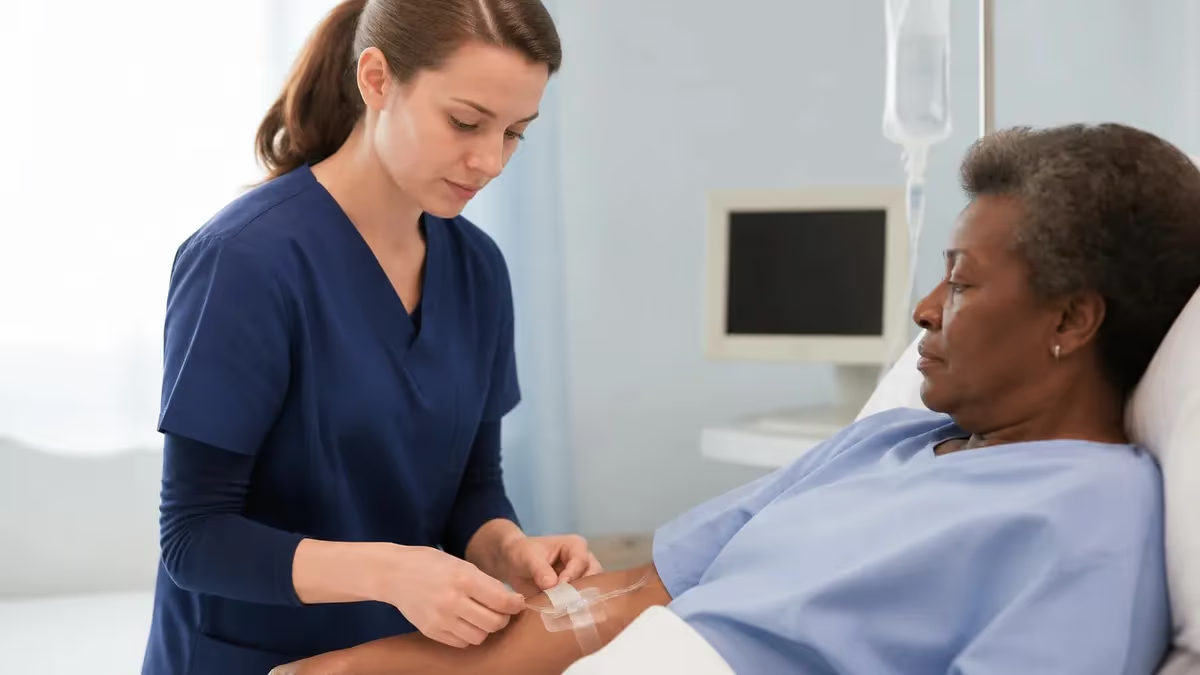
LPN certification is the process by which a practical nurse — known as an LVN in California and Texas, an LPN almost everywhere else — earns the legal authorization to practice nursing under the supervision of a registered nurse or physician. Strictly speaking, what most people call LPN certification is really LPN licensure, because nursing in the United States is regulated state by state through boards of nursing, not through a national certifying body.
The distinction matters when applying for a first job, transferring between states, or moving from an LPN role to an RN bridge program. Knowing what your wallet card actually says you can do, and what the State Board of Nursing in your state requires for renewal, keeps the career on track.
The pathway to LPN licensure has three core ingredients: completion of an approved practical nursing program, a passing score on the National Council Licensure Examination for Practical Nurses (NCLEX-PN), and a clean criminal background check. Layered on top are state-specific quirks — additional jurisprudence exams, fingerprinting fees, IV therapy modules, English proficiency tests for foreign-trained applicants and continuing education requirements that vary by jurisdiction. This guide walks through every part of that pipeline, from program prerequisites to passing the NCLEX-PN to maintaining the license year after year.
Demand for LPNs has been remarkably stable across economic cycles. While hospitals in some metropolitan markets have shifted toward all-RN bedside teams, long-term care facilities, home health agencies and outpatient clinics remain strong LPN employers — and demographic pressures from an aging population are pushing those segments to grow rather than shrink. The Bureau of Labor Statistics projects steady employment growth for LPNs through the rest of the decade, which is why state-funded workforce programs continue to subsidize practical nursing education in many parts of the country.
LPN certification at a glance
Program length: 12–18 months at most accredited schools. Exam: NCLEX-PN, computer-adaptive, 85–150 items (max 150 since the 2023 update), 5-hour limit. Pass rate: ~85% for first-time US-educated candidates. License renewal: every 1–2 years depending on state. Average annual salary: ~$55,000 (BLS). Scope: medication administration, wound care, vitals, basic patient education — under RN supervision.
Choosing an Accredited LPN Program
The first practical step is enrolment in a state-approved practical nursing program. State Boards of Nursing publish lists of approved programs on their websites — check the list before paying any tuition deposit, because graduation from a non-approved program disqualifies a candidate from sitting the NCLEX-PN regardless of how good the curriculum looks on paper. Beyond state approval, national accreditation through the Accreditation Commission for Education in Nursing (ACEN) is a useful quality marker because most RN bridge programs require an ACEN-accredited LPN credential to grant transfer credit.
Programs run for 12 to 18 months at most community colleges and technical schools, though some accelerated formats compress the work into 11 months by skipping summer breaks. Tuition varies enormously — a community college LPN program in the Midwest may cost $6,000 to $10,000 total, while a private vocational school in a coastal metro can charge $25,000 to $35,000. The federal Pell Grant and state-level workforce grants cover a substantial share for eligible students, and many hospitals run earn-while-you-learn programs that pay tuition in exchange for a service commitment after graduation.
Class delivery formats matter too. A traditional LPN program meets in person five days a week with classroom theory in the morning and clinical rotations in the afternoon — and that schedule is intense. Hybrid programs with online theory and in-person labs are becoming more common but face limits because clinical hours cannot be virtualized. Be wary of programs that advertise mostly-online formats; State Boards have rejected applicants from such programs even when the school itself appeared accredited.
Reading reviews and NCLEX-PN first-time pass rates for any program before enrolling is one of the highest-use research steps. State Boards publish first-time pass rates by school, and a program with sub-70 percent pass rates is signalling either weak teaching or weak admissions screening. Either way, it is a poor financial bet for the student.
Prerequisites Before You Apply
Minimum entry requirement at every approved LPN program. GPA expectations vary, but most schools want 2.5 or higher in core academics and proof of biology or anatomy coursework if not part of high school transcripts.
Most programs require the TEAS (Test of Essential Academic Skills) or HESI A2. Reading, math, science and English sections. Most LPN programs accept scores around 60–65th percentile.
Federal and state criminal background checks before clinical placements begin. Some past offences disqualify candidates entirely; others require a board review and waiver before licensure.
Most clinicals start with a panel for hepatitis B, MMR, varicella, Tdap, annual flu and TB testing. COVID-19 vaccination is required by many clinical sites though not all.
Basic Life Support card from the American Heart Association is mandatory before any patient contact. Renewable every two years. Some programs include the course; most do not.
Some schools require a documented physical assessment showing the student can lift, stand and bend at expected nursing levels. Vision and hearing checks are standard.
The NCLEX-PN: What the Exam Actually Tests
The NCLEX-PN is the only exam that matters for licensure. It is delivered by Pearson VUE testing centers, written by the National Council of State Boards of Nursing (NCSBN), and uses computerized adaptive testing — meaning the difficulty of each question adapts to your performance, and the exam ends as soon as the algorithm is statistically confident you are above or below the passing standard.
Since the NCLEX-PN underwent its Next Generation NCLEX update, candidates can expect a minimum of 85 items and a maximum of 150 items, with a five-hour total time limit. Practical performance differs from candidate to candidate — some pass after 85 items in under two hours, others answer all 150 items.
The content is organized into four client needs categories: Safe and Effective Care Environment, Health Promotion and Maintenance, Psychosocial Integrity and Physiological Integrity, with the largest weight assigned to physiological integrity since LPN day-to-day work focuses on direct physical care. Item types include traditional multiple choice, multiple response, fill-in-the-blank calculations, ordered response and the new case studies introduced in the Next Generation update. Case studies present a clinical scenario with progressive information and several linked items, mirroring real patient handoffs more closely than legacy item formats.
One quirk of the NCLEX-PN that surprises many candidates is the lack of an explicit pass-fail score. The exam ends when the algorithm determines with high confidence whether the candidate is above or below the passing standard, and the result is binary rather than a numeric score. The Candidate Performance Report received after a fail provides diagnostic feedback by content area but no overall percentile. This design ensures the test measures clinical readiness rather than ranking, which is the right design philosophy but can feel opaque to test-takers used to a numeric score.
Application Process Step by Step
Complete all coursework, clinicals and final examinations. Confirm the school will release your transcript and program completion attestation to the State Board of Nursing. Programs typically take 12–18 months and end with a comprehensive exit exam such as the HESI Predictor or ATI.
How to Prepare for the NCLEX-PN
Preparation strategies fall into three broad categories. The first is question-bank practice, ideally using a subscription product like UWorld for NCLEX-PN, Kaplan or the NCSBN's own learning extension. Repeated exposure to NCLEX-style items — particularly the case studies and select-all-that-apply formats — builds the test-taking pattern recognition that underpins success more than memorising additional content. Most candidates who pass on the first attempt complete between 1,500 and 3,000 practice questions in the months leading up to the exam.
The second is content review focused on weak areas identified through diagnostic testing. ATI, Hurst Review and Mark Klimek videos all have devoted followings. Burn time on the topics that score poorly on practice exams rather than re-reading textbooks cover to cover. The third is the standard study-skill scaffold: a fixed daily study schedule, regular sleep, exam day rehearsal at the actual test center if possible, and a low-stress travel plan for exam day. Candidates who treat the NCLEX-PN as a marathon rather than a sprint generally outperform those who attempt to cram in the final two weeks.
Mistakes to avoid during preparation are also worth knowing. Studying only one resource creates blind spots — using two question banks plus content review videos covers the territory more thoroughly. Skipping the rationale on each practice question wastes the most valuable learning opportunity. Cramming the last week before the exam is counterproductive because retention drops sharply at high study volumes; protected sleep and exercise in the final 72 hours actually improve test-day performance more than additional review.

State Boards of Nursing take honesty on the application form more seriously than many of the underlying offences. A misdemeanor from years ago is often resolved with a personal letter and supporting documents. The same offence concealed on the application is grounds for permanent denial. If you have any criminal history, request your full record before applying and disclose every item the State Board asks about.
State-by-State Differences That Catch People Out
Although the NCLEX-PN is national, every state writes its own licensure rules around the exam. California and Texas use the title Licensed Vocational Nurse (LVN) instead of LPN, although the scope of practice is essentially identical. Texas additionally requires the Texas Board's own Jurisprudence Examination — a 50-item online test of state nursing law — within six months of licensure.
New York requires the Infection Control Course and a child abuse identification module. Florida has its own two-hour HIV/AIDS course. Each of these add-ons is small individually but cumulatively they extend the time and cost between graduation and that first paycheck.
The Nurse Licensure Compact (NLC) is also relevant. Around 40 states and territories participate in the compact, which allows an LPN licensed in any compact state to practice in any other compact state on a single multistate license. Non-compact states — California, New York, Massachusetts, Hawaii and a few others — require a separate full licensure application for each state. The compact is invaluable for travel nursing, telehealth-adjacent LPN work, and military spouses who relocate frequently.
Foreign-trained nurses face additional steps. The Commission on Graduates of Foreign Nursing Schools (CGFNS) credential evaluation is required by most state boards before a foreign-trained candidate can sit the NCLEX-PN. The process verifies that the home-country nursing program is comparable to a US LPN program, includes English proficiency testing through TOEFL or IELTS, and can take six to twelve months. CGFNS fees and document translation typically add $400 to $700 to the licensure pipeline.
LPN Certification Checklist
- ✓Verify the program is approved by your State Board of Nursing before enrolling
- ✓Complete all clinical hours and graduation requirements on the school's timeline
- ✓Apply for licensure with the State Board immediately after graduation
- ✓Order all required transcripts and program completion attestations
- ✓Submit fingerprints and complete the criminal background check
- ✓Disclose any prior offences honestly — concealment carries the harshest penalties
- ✓Pay the State Board application fee ($100–$200) and Pearson VUE NCLEX-PN fee ($200)
- ✓Wait for the Authorization to Test before scheduling the NCLEX-PN
- ✓Build a 6–12 week study plan focused on practice questions plus targeted content review
- ✓Bring two valid IDs to the test center and arrive 30 minutes early
Scope of Practice: What an LPN Can and Cannot Do
LPN scope of practice is the most state-variable part of the role and the most frequently misunderstood. In every state, LPNs work under the supervision of an RN, advanced practice nurse or physician, and they perform a defined set of bedside care tasks: administering most oral and injectable medications, performing wound care, monitoring vital signs, recording patient observations, providing basic patient education and assisting with activities of daily living. What varies between states is the boundary around tasks like IV therapy, central line management, and supervisory authority over CNAs and unlicensed personnel.
For example, several states require LPNs to complete an IV therapy course and a certifying examination before they can start peripheral IV lines or administer IV medications. Other states allow this on a basic LPN license. Most states forbid LPNs from independent admission assessments, independent care plan development, and most blood product administration — those tasks belong to the RN. Reading the state's Nurse Practice Act before starting a job, and again before changing employer, is the safest way to stay inside scope and avoid disciplinary action by the State Board.
Documentation is also a core LPN responsibility, and one frequently underrated by new graduates. Charting medication administration, vital signs, dressing changes, patient response to interventions and any unusual findings is the legal record that protects both the patient and the nurse. Sloppy or incomplete charting is one of the most common reasons LPN licenses are placed under board investigation, and it is fully avoidable with discipline. Modern electronic health records ease the burden, but the underlying habit of recording what was done and what was observed is non-negotiable in every clinical setting.
Renewal, Continuing Education and Maintaining Your License
LPN license renewal cycles vary by state. Most states renew every two years, a few renew every one or three years. Online renewal portals make the administrative side easy, but each cycle also requires documentation of continuing education hours. Common requirements range from 20 to 30 contact hours per renewal period, with mandated topics that often include child abuse, infection control, opioid awareness or implicit bias depending on the state. Failing to complete CE on time triggers either a delayed renewal or a lapse in licensure that requires reinstatement procedures and additional fees.
Disciplinary actions are also tracked through renewal. Any complaint filed with the State Board, any criminal arrest, any drug screening failure or any positive child or elder abuse finding triggers a board investigation that can result in restrictions, suspensions or revocation. Maintaining the license long term is mostly a matter of keeping up with CE, paying fees on time, and reporting promptly when something does happen — concealment is the surest path to a permanent revocation.
LPN Certification by the Numbers
Key Facts at a Glance
| Item | Value | Details |
|---|---|---|
| Typical LPN program length | 12–18 mo | |
| NCLEX-PN exam registration fee | $200 | |
| Adaptive item count on the NCLEX-PN | 85–150 | |
| Maximum NCLEX-PN test time | 5 hours | |
| Typical CE hours per renewal cycle | 20–30 hr |
Career Paths After LPN Certification
Skilled nursing facilities and assisted living homes employ a substantial share of working LPNs. Heavy on medication passes, charting and care plan execution. Common entry-point employer with predictable shift schedules.
Inpatient units in many hospitals still hire LPNs for med-surg roles under RN supervision. Trend has been toward all-RN staffing in some hospitals, but rural and community hospitals remain strong LPN employers.
Doctor's offices, urgent care clinics and specialty practices use LPNs for triage, injections, EKGs and patient education. Daytime weekday schedules with no nights or weekends. Lower hourly rates than facility work.
Visiting individual patients in their homes for medication, wound care or vital sign monitoring. Independent and rewarding, but requires comfort working without immediate RN backup.
Jails and prisons employ LPNs for inmate health screening, medication administration and chronic disease monitoring. Often pays a premium over civilian LPN work.
Many LPNs use the role as a stepping stone to RN. Bridge programs accept LPN credits and complete the RN curriculum in 12–18 additional months. Career earnings rise substantially after RN licensure.
LPN to RN: The Career Bridge
For LPNs who want to expand scope of practice and earnings, the LPN-to-RN bridge program is the most common path. Most community colleges in the United States offer LPN-to-ADN bridge programs that grant credit for prior LPN coursework and clinical hours. Completion typically takes 12 to 18 months of additional study, after which graduates sit the NCLEX-RN. Many hospitals offer tuition reimbursement for LPNs who commit to bridge programs while continuing to work, which dramatically reduces the financial barrier.
The pay differential is significant. RNs earn a median annual salary roughly 50 to 60 percent higher than LPNs in the same geographic market. RN scope of practice is also substantially broader, including independent assessment, care planning, IV push medications in most states, and supervision of LPNs and unlicensed personnel. Many LPNs who bridge to RN report that they wished they had enrolled sooner — but many also note that working as an LPN first gave them a strong clinical foundation that made the RN program much more manageable.
Salary is one of the practical questions that drives many career decisions. The Bureau of Labor Statistics reports a median annual wage near $55,000 for licensed practical nurses, with the lowest tenth percentile at around $40,000 and the highest tenth above $72,000. Geographic spread is large — California, Massachusetts, Alaska and Rhode Island routinely report median LPN wages above $65,000, while several southern and midwestern states report medians closer to $48,000. Shift differentials, weekend premiums and overtime push real-world earnings substantially above the published medians for full-time facility staff.
Travel LPN agencies offer another path to higher earnings, with assignments paying weekly stipends well above standard staff rates in exchange for short contracts and frequent relocation.
Hospital tuition reimbursement programs continue to be one of the most underused benefits in the field today.
Becoming an LPN: Trade-offs
- +Faster entry to nursing — 12–18 months vs 2–4 years for RN
- +Lower tuition cost than RN programs
- +Strong job availability across long-term care, hospitals and clinics
- +Stable median salary near $55,000 with overtime opportunities
- +Direct pathway into RN bridge programs with credit transfer
- −Scope of practice narrower than RN — limits autonomy in some roles
- −Some hospital systems are phasing LPNs out of acute care
- −State variation makes interstate moves more complicated than for RNs
- −Continuing education and renewal fees recur every 1–2 years
- −Career earnings cap below RN equivalent without bridging
LPN Questions and Answers
About the Author

Registered Nurse & Healthcare Educator
Johns Hopkins University School of NursingDr. Sarah Mitchell is a board-certified registered nurse with over 15 years of clinical and academic experience. She completed her PhD in Nursing Science at Johns Hopkins University and has taught NCLEX preparation and clinical skills courses for nursing students across the United States. Her research focuses on evidence-based exam preparation strategies for healthcare certification candidates.
Join the Discussion
Connect with other students preparing for this exam. Share tips, ask questions, and get advice from people who have been there.
View discussion (7 replies)