
How Many Law Enforcement Officers Are in the United States? A 2026 October Career Overview
How many law enforcement officers in the United States? 2026 October career overview with federal, ⏳ state, local counts, duties, pay, and training paths.
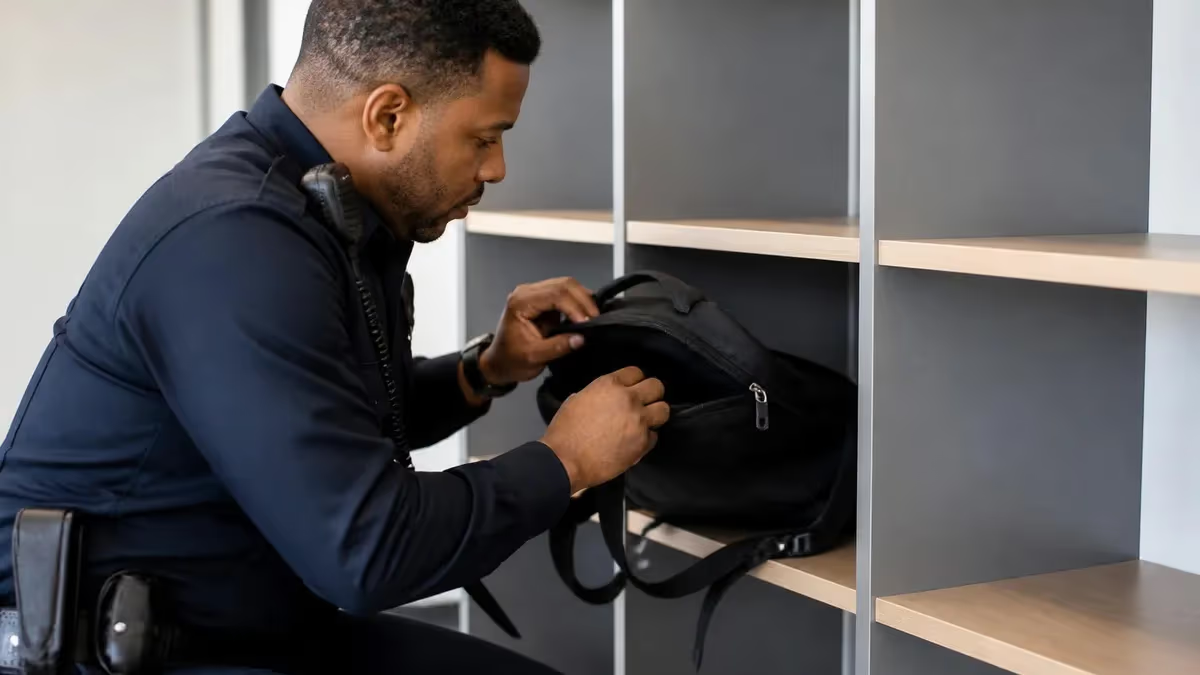
If you have ever wondered how many law enforcement officers in the united states actually patrol our streets, investigate crimes, and staff federal task forces, the latest data points to roughly 800,000 sworn local and state officers plus another 137,000 federal agents with arrest authority. That nearly one-million figure shapes everything from response times to recruitment campaigns, and it is the centerpiece every Law enforcement appreciation day, observed each January 9 to honor officers nationwide.
The exact count shifts year to year because departments hire, retire, lose officers to private security, and sometimes shutter agencies entirely. The Bureau of Justice Statistics counts only sworn personnel with full arrest powers, while the FBI's Crime in the Nation report includes civilian dispatchers and analysts. Understanding which dataset you are reading matters because policymakers, journalists, and aspiring recruits all reference different totals depending on the conversation they want to drive.
This guide breaks down the numbers by jurisdiction, by agency type, and by region so you can see where the workforce actually lives. We will cover the 18,000 local police and sheriffs' departments, the 50 state agencies, the famed alabama law enforcement agency consolidation model, and the federal layer that includes the FBI, DEA, ATF, and U.S. Marshals Service. Each tier recruits, trains, and pays differently.
Beyond the raw headcount, the demographics are changing fast. Women now make up roughly 14 percent of sworn officers, up from 11 percent a decade ago. Officers of color account for nearly 30 percent of the workforce, with the largest gains in metropolitan departments serving diverse communities. The median age has climbed to 40 as Gen X officers stay on the job longer and Gen Z recruits trickle in through expanded cadet programs.
Career seekers should know that the talent pipeline is tight. Departments from Seattle to Miami report 10 to 20 percent vacancy rates, and academy classes routinely run below capacity. That shortage translates into faster promotion timelines, higher starting bonuses, and generous tuition reimbursement for candidates who arrive ready to commit. If you are exploring this field, the next sections will show you exactly where the jobs are and how to qualify.
We will also examine specialized units like the Texas Rangers law enforcement division, the national law enforcement museum that documents the profession's history, and the federal law enforcement training centers (FLETC) that prepare 90 percent of federal agents. Whether you are a high school senior, a transitioning veteran, or a mid-career professional eyeing a second act, the data below will help you make informed decisions about a profession that remains one of America's largest public-sector workforces.
Read on for the numbers, the duties, the salary ranges, and the practical steps to join the next wave of officers protecting communities from rural Warwick, New York to the largest metropolitan corridors in the country.
US Law Enforcement by the Numbers

Officer Count by Jurisdiction Tier
Roughly 468,000 sworn officers serve cities, towns, and villages across more than 12,000 municipal departments. The NYPD alone employs over 33,000, while thousands of small towns operate with fewer than ten officers each.
About 173,000 deputies staff 3,000 sheriff agencies. They run county jails, serve civil process, patrol unincorporated areas, and provide courthouse security alongside their criminal enforcement duties.
Approximately 60,000 troopers operate across all 50 states. Some, like the Texas Rangers law enforcement division, handle major crimes statewide while others focus on interstate traffic enforcement.
Around 137,000 federal officers work for the FBI, DEA, ATF, CBP, ICE, USSS, U.S. Marshals, and dozens of inspector general offices. Customs and Border Protection is the largest federal force.
Nearly 12,000 officers serve tribal nations, transit systems, public schools, parks, and university campuses. These agencies often partner with neighboring departments through joint task forces.
The federal layer makes up the smallest slice of the workforce but receives the most national attention. The FBI employs roughly 13,500 special agents, the DEA fields 4,600, the ATF maintains 2,600, and the U.S. Marshals Service deploys 4,000 deputies. Customs and Border Protection dwarfs them all with more than 45,000 sworn personnel, followed by Immigration and Customs Enforcement at 20,000. Together these federal law enforcement agencies enforce statutes covering everything from tax fraud to terrorism.
State agencies sit in the middle. California Highway Patrol leads the country with about 7,600 officers, followed by the New York State Police, the Pennsylvania State Police, and the Texas Department of Public Safety, which houses the Texas Rangers. State troopers handle interstate traffic, governor protection, statewide investigations, and emergency response. Many states also operate game wardens, alcohol beverage control agents, and motor carrier inspectors who carry full arrest powers and are counted in state totals.
Local policing dominates the headcount. The New York Police Department, Chicago Police Department, and Los Angeles Police Department each employ more sworn officers than most federal agencies. At the same time, more than half of all local departments employ fewer than ten officers, a structural reality that drives mutual aid agreements, regional dispatching, and consolidated training academies. Rural departments often cover thousands of square miles with a handful of deputies who must cross-train as detectives, evidence technicians, and crash investigators.
Sheriffs occupy a unique constitutional position because they are elected officials in 46 states. Their offices typically run the county jail, transport inmates, serve warrants, and provide patrol in unincorporated areas. Larger sheriffs' offices like Los Angeles County employ 10,000 sworn deputies and operate one of the largest jail systems in the world. Smaller offices may have a sheriff, a chief deputy, and three or four road deputies who handle every call.
Tribal law enforcement officers protect 326 federally recognized Indian reservations across the country. Through the Bureau of Indian Affairs and self-governance compacts, tribal departments enforce both tribal codes and federal Major Crimes Act provisions. Officer counts vary from agencies with two officers to the Navajo Nation Police with more than 200 sworn personnel covering an area larger than West Virginia.
Special jurisdiction agencies round out the workforce. Amtrak police, the Federal Reserve Police, the U.S. Capitol Police, the Postal Inspection Service, and hundreds of university and transit forces all employ sworn officers with limited geographic authority. These positions often serve as stepping stones into larger municipal or federal careers, offering federal-style training and benefits without the relocation requirements common in national agencies.
Add it all together and the United States supports one of the densest law enforcement networks in the developed world, with roughly 2.4 officers per 1,000 residents, though local ratios swing widely between dense urban cores and remote frontier counties.

Law Enforcement Practice Test Questions
Prepare for the Law Enforcement exam with our free practice test modules. Each quiz covers key topics to help you pass on your first try.
Law Enforcement Criminal Investigation Fun...
Law Enforcement Exam Questions covering Criminal Investigation Fundamentals. Master Law Enforcement Test concepts for certification prep.
Law Enforcement Criminal Law and Procedure
Free Law Enforcement Practice Test featuring Criminal Law and Procedure. Improve your Law Enforcement Exam score with mock test prep.
Law Enforcement Patrol Operations and Tactics
Law Enforcement Mock Exam on Patrol Operations and Tactics. Law Enforcement Study Guide questions to pass on your first try.
Law Enforcement Professional Conduct and E...
Law Enforcement Test Prep for Professional Conduct and Ethics. Practice Law Enforcement Quiz questions and boost your score.
Law Enforcement Traffic Law and Enforcement
Law Enforcement Questions and Answers on Traffic Law and Enforcement. Free Law Enforcement practice for exam readiness.
Law Enforcement Use of Force Principles
Law Enforcement Mock Test covering Use of Force Principles. Online Law Enforcement Test practice with instant feedback.
Law Enforcement Community Policing and Ethics
Free Law Enforcement Quiz on Community Policing and Ethics. Law Enforcement Exam prep questions with detailed explanations.
Law Enforcement Constitutional and Case Law
Law Enforcement Practice Questions for Constitutional and Case Law. Build confidence for your Law Enforcement certification exam.
Law Enforcement Emergency Response and Cri...
Law Enforcement Test Online for Emergency Response and Crisis Management. Free practice with instant results and feedback.
Law Enforcement Evidence Collection and Cr...
Law Enforcement Study Material on Evidence Collection and Crime Scene Management. Prepare effectively with real exam-style questions.
Law Enforcement Patrol and Investigation D...
Free Law Enforcement Test covering Patrol and Investigation Duties. Practice and track your Law Enforcement exam readiness.
Law Enforcement Practice Test
Law Enforcement Exam Questions covering Practice Test. Master Law Enforcement Test concepts for certification prep.
Roles and Daily Duties Across Federal Law Enforcement Agencies
Patrol is the backbone of American policing. Officers answer calls for service, conduct traffic stops, take initial reports, secure crime scenes, and serve as the visible deterrent presence in neighborhoods. A typical shift may include 12 to 20 calls ranging from domestic disputes to medical assists to suspicious vehicle investigations, all logged into computer-aided dispatch systems for supervisor review.
Beyond reactive calls, patrol officers conduct community policing activities, attend neighborhood meetings, and build relationships with business owners and school staff. Many departments now assign officers to permanent beats so residents know who responds to their block, which has been shown to improve trust, clearance rates, and officer job satisfaction in long-term studies.
Is a Law Enforcement Career Right for You?
- +Strong starting salaries with predictable annual step increases and locality pay
- +Defined benefit pensions, often 50 to 75 percent of salary after 20 to 25 years
- +Tuition reimbursement and college incentive pay in many departments
- +Clear promotion ladder from officer to detective, sergeant, lieutenant, and command staff
- +Meaningful work that directly impacts community safety and crime victim outcomes
- +Federal task force opportunities that open doors to FBI, DEA, and HSI careers
- +Strong post-retirement second-career market in private security, corporate investigations, and federal contracting
- −Shift work including nights, weekends, holidays, and mandatory overtime
- −Physical and psychological stress that can lead to PTSD, hypertension, and divorce
- −Public scrutiny intensified by social media, body camera footage, and 24-hour news
- −Rigorous background checks that disqualify candidates for drug use, credit issues, or social media posts
- −Long hiring timelines of 6 to 18 months between application and academy start
- −Mandatory residency requirements in some cities limit where you can live
- −Risk of injury or death, with about 60,000 assaults on officers reported annually nationwide
Pros and Cons at a Glance
| Pros | Cons |
|---|---|
| Strong starting salaries with predictable annual step increases and locality pay | Shift work including nights, weekends, holidays, and mandatory overtime |
| Tuition reimbursement and college incentive pay in many departments | Physical and psychological stress that can lead to PTSD, hypertension, and divorce |
| Clear promotion ladder from officer to detective, sergeant, lieutenant, and command staff | Rigorous background checks that disqualify candidates for drug use, credit issues, or social media posts |
| Meaningful work that directly impacts community safety and crime victim outcomes | Mandatory residency requirements in some cities limit where you can live |

How to Qualify for Federal Law Enforcement Training Centers and Local Academies
- ✓Confirm minimum age, usually 21 for federal and 20 for most local departments
- ✓Hold US citizenship and a valid driver's license with a clean record
- ✓Earn a high school diploma or GED, with many agencies preferring 60 college credits
- ✓Pass a physical fitness assessment including sit-ups, push-ups, and a 1.5 mile run
- ✓Complete a written civil service exam covering reading, writing, and reasoning
- ✓Submit to a polygraph exam and full background investigation with neighbor interviews
- ✓Clear a psychological evaluation administered by a licensed police psychologist
- ✓Pass a medical exam including vision, hearing, and cardiovascular screening
- ✓Complete the police academy and a 12 to 18 month field training officer phase
- ✓Maintain ongoing in-service training requirements after sworn appointment
Apply to multiple agencies in parallel
Hiring timelines stretch 6 to 18 months, and any single agency can disqualify candidates for reasons outside your control. Smart applicants submit to three to five departments simultaneously, then choose the best offer. Federal background checks complete faster when you keep paperwork, references, and former employers updated continuously.
Salary, benefits, and career growth vary dramatically by region, agency, and rank. According to the Bureau of Labor Statistics, the median annual salary for patrol officers and sheriffs' deputies hit $74,910 in 2025, with the top 10 percent earning more than $122,000. Detectives and criminal investigators earn a median of $91,610. Federal agents in the FBI, ATF, DEA, and U.S. Marshals Service generally start at GL-10 step 1, which translates to about $63,000 plus 25 percent law enforcement availability pay and locality adjustments.
Geography drives massive variation. A first-year officer in San Jose, California earns over $115,000 base salary, while a small town officer in rural Mississippi may start at $34,000. The most lucrative markets in 2026 are California, New Jersey, Washington, Alaska, and Hawaii, where strong public employee unions, high cost of living, and competitive recruiting drive compensation upward. Sign-on bonuses of $5,000 to $25,000 are now common in cities facing acute shortages.
Pensions remain one of the strongest draws. Most state and local plans pay 50 to 75 percent of final average salary after 20 to 30 years of service. Federal officers earn under FERS, which combines a defined benefit annuity, Social Security, and the Thrift Savings Plan with up to 5 percent agency match. Many officers retire in their mid-40s with full benefits and move directly into private sector security, corporate investigations, or federal contracting roles that pay six figures.
Promotion pace depends on department size and union contracts. In small agencies, officers may make sergeant within five years simply because turnover creates openings. In large departments like NYPD or LAPD, the road to sergeant can take 8 to 12 years and require passing a competitive exam against thousands of peers. Beyond sergeant, candidates compete for lieutenant, captain, deputy chief, and chief positions, often through assessment centers that test scenario response, written communication, and command judgment.
Specialized assignments offer career variety without leaving an agency. K-9 handlers, SWAT operators, marine patrol officers, motorcycle units, school resource officers, gang task force members, internal affairs investigators, and training instructors all earn premium pay or specialty stipends. These assignments build resumes that translate into federal task force selections and post-retirement consulting opportunities.
Tuition benefits sweeten the package further. The federal Public Service Loan Forgiveness program forgives remaining student debt after 10 years of qualifying public service. State agencies often add their own loan repayment programs, and many departments cover tuition for officers pursuing bachelor's or master's degrees in criminal justice, public administration, or homeland security while working full time.
The Bureau of Labor Statistics projects 3 percent growth for police and detective jobs through 2033, but that headline understates the opportunity. Retirement waves from Baby Boomer officers, expanded federal hiring under new appropriations bills, and ongoing efforts to diversify the workforce mean qualified candidates often have multiple offers within months of starting their applications.
Past drug use, untreated mental health diagnoses, dishonorable military discharge, dismissed but documented domestic violence allegations, and recent felony arrests can all disqualify you. Polygraph examiners ask detailed questions about social media activity, financial debts, and undocumented immigration assistance. Be honest from day one — admissions are usually survivable, but dishonesty during the background process almost always ends the application permanently.
Training is where careers begin, and the United States operates a remarkably decentralized academy system. Local recruits typically attend a state-certified police academy running 13 to 36 weeks. Federal recruits attend either the FBI Academy in Quantico, the DEA Training Academy on the same Marine Corps Base, the U.S. Secret Service James J. Rowley Training Center, or one of the four federal law enforcement training centers operated by FLETC in Glynco, Artesia, Charleston, and Cheltenham.
FLETC alone trains officers for more than 100 federal partner organizations including Customs and Border Protection, Air Marshals, the Bureau of Prisons, IRS Criminal Investigation, and dozens of inspector general offices. The Criminal Investigator Training Program lasts 13 weeks and covers federal criminal law, courtroom testimony, surveillance, interviewing, firearms, defensive tactics, and emergency vehicle operations. Most agencies then layer agency-specific training on top, extending total academy time to six or seven months.
State academies emphasize state criminal codes, traffic law, and local procedures. Texas, for example, requires a minimum 728-hour Basic Peace Officer Course before licensure through TCOLE. California's POST academy runs 888 hours including extensive force-options simulation and community policing modules. New York maintains regional zones, while smaller states like Vermont and New Hampshire operate single statewide academies serving every department.
Field training begins immediately after academy graduation. Most departments use the San Jose Model with three to four phases lasting 14 to 20 weeks. Recruits ride with a series of field training officers who score them daily on tactics, decision-making, report writing, officer safety, and community interaction. Trainees who fail field training are typically terminated, even after passing the academy, because field performance is the truest test of readiness.
Continuing education never stops. Officers complete annual in-service training in firearms qualification, use of force, legal updates, de-escalation, mental health response, and emergency vehicle operations. Many states now mandate hours of implicit bias, procedural justice, and crisis intervention training. The national law enforcement museum in Washington, D.C. preserves the equipment and stories from generations of officers, and many departments treat a visit as part of their recruit orientation.
Specialty schools build careers. The FBI National Academy is a 10-week leadership program for sergeants and above, with only 1 percent of US officers ever attending. The Northwestern School of Police Staff and Command, the Southern Police Institute, and the Senior Management Institute for Police all build executive pipelines. Smaller specialty courses cover homicide investigation, narcotics interdiction, financial crimes, child exploitation, cyber forensics, and crisis negotiation.
For aspiring officers, the lesson is simple. Pick the agency you want, study their published academy syllabus, train your fitness and study habits to match, and arrive ready to learn. The departments hiring fastest in 2026 are the ones that have invested in modern training, leadership development, and wellness programs that retain officers for full careers.
Practical tips can save aspiring officers months of frustration. Start by mapping the agencies that genuinely interest you and noting their application windows. Some departments hire continuously, while others open hiring lists once every 12 to 24 months. Civil service exams in cities like Chicago, Boston, and Philadelphia are administered on fixed schedules, and missing one window can push your start date back a full year. Build a calendar and set alerts for application deadlines a month in advance.
Physical fitness is the most controllable variable. Most academies require recruits to pass entry-level standards that include push-ups, sit-ups, and a 1.5 mile run. Train progressively for at least 12 weeks before testing, focusing on cardiovascular endurance, core strength, and grip. Many candidates fail academy because they could pass the entrance test but could not maintain the daily demands of defensive tactics, formation runs, and obstacle courses. Aim to exceed the minimum standard by 25 percent.
Clean up your digital footprint before you apply. Background investigators review every social media profile they can find, including ones you forgot you created. Posts that show drug use, racist or sexist content, threats, or extreme political rhetoric routinely disqualify candidates. Delete content that no longer reflects who you are, but do not deactivate accounts entirely because investigators interpret total absence as suspicious. Aim for a profile that demonstrates judgment, community involvement, and stability.
Practice the written exam in advance. Most civil service exams test reading comprehension, written expression, mathematical reasoning, situational judgment, and memorization of visual scenes. Free study guides, official sample tests, and paid prep platforms can boost scores by 10 to 20 points, which often moves candidates from the middle of a hiring list to the top. Top-ranked candidates receive offers months before middle-ranked candidates, and that head start can mean the difference between an academy seat this year and waiting until next.
Develop your story for the oral board. Panels of supervisors and command staff ask scenario-based questions about ethics, judgment, teamwork, and motivation. Strong candidates speak in concrete examples drawn from work, athletics, military service, or volunteer experience rather than hypothetical answers. Practice with friends or hire a coach to record your responses. Watch the playback, refine your delivery, and make sure your nonverbal communication conveys confidence without arrogance.
Talk to officers before you commit. Ride-alongs are free, and most agencies welcome serious applicants. Spend 8 to 12 hours in the back seat asking honest questions about shift work, family life, departmental culture, and promotion paths. Officers respect candidates who do their homework, and a single ride-along often produces references and mentors who will support your application from inside the organization. Avoid agencies where officers seem demoralized, distrustful of leadership, or unable to recommend their own job.
Finally, prepare for the long game. Even ideal candidates wait six to twelve months between application and academy start. Use that time to save money, finish college coursework, complete a personal protection or first responder certification, and continue building your fitness. The officers who thrive in their first five years are the ones who arrived at the academy already physically fit, financially stable, mentally resilient, and clear about why they chose this profession.
Sample Law Enforcement Practice Questions
Try these questions from our free Law Enforcement practice tests. The correct answer and an explanation follow each question.
Which agency manages the National DNA Index System (NDIS) in the United States?
- A. Drug Enforcement Administration (DEA)
- B. Bureau of Alcohol, Tobacco, Firearms and Explosives (ATF)
- C. Federal Bureau of Investigation (FBI)
- D. Department of Homeland Security (DHS)
Answer: C. Federal Bureau of Investigation (FBI)
The FBI manages CODIS (Combined DNA Index System), which includes NDIS, the national-level database used to match DNA profiles.
An officer has probable cause to believe that a vehicle contains evidence of a crime. The vehicle is parked on a public street and is readily mobile. According to the 'automobile exception' established in Carroll v. United States, what is the officer legally permitted to do?
- A. Search the passenger compartment but not the trunk without a warrant.
- B. Impound the vehicle and wait for a search warrant to be issued.
- C. Conduct a warrantless search of any part of the vehicle where the evidence might reasonably be found.
- D. Only search the vehicle if the driver gives explicit consent.
Answer: C. Conduct a warrantless search of any part of the vehicle where the evidence might reasonably be found.
The Carroll Doctrine, or automobile exception, allows for a warrantless search of a readily mobile vehicle if there is probable cause to believe it contains evidence of a crime. The search can extend to any part of the vehicle, including the trunk and containers within it, where the evidence might logically be concealed.
According to a recent report, car thefts are focused primarily in border ____, where thieves can rapidly ship stolen vehicles outside of the United States.
- A. Cities
- B. Town's
- C. Citys
- D. City's
Answer: A. Cities
The sentence requires a plural noun to describe multiple locations along the border where car thefts are concentrated. 'Cities' is the correct plural form of 'city.' 'Town's' and 'City's' are possessive forms, and 'Citys' is an incorrect spelling for the plural.
Officer Smith speaks about drug prevention in public schools. She spends 50 weeks of the year visiting four schools. How many schools does she go to each year?
- A. 200
- B. 350
- C. 250
- D. 450
Answer: A. 200
To find the total number of schools visited in a year, multiply the number of weeks she works by the number of schools she visits each week. Officer Smith visits 4 schools per week for 50 weeks. So, 50 weeks multiplied by 4 schools/week equals 200 schools per year.
Law Enforcement Questions and Answers

Law Enforcement Acronyms: CI, FBI, ATF, DEA, SWAT and 100+ Police Abbreviations Decoded

Law Enforcement Degree: Best Degrees, Pay Bump, Top Schools & Career Impact
Law Enforcement Exam Questions Video Answers: Police Test Prep Guide

Law Enforcement Gear: Complete Equipment Guide for Officers in 2026

Law Enforcement in Spanish: Bilingual Officer Careers, Pay, and Essential Phrases
About the Author

Educational Psychologist & Academic Test Preparation Expert
Columbia University Teachers CollegeDr. Lisa Patel holds a Doctorate in Education from Columbia University Teachers College and has spent 17 years researching standardized test design and academic assessment. She has developed preparation programs for SAT, ACT, GRE, LSAT, UCAT, and numerous professional licensing exams, helping students of all backgrounds achieve their target scores.
Join the Discussion
Connect with other students preparing for this exam. Share tips, ask questions, and get advice from people who have been there.
View discussion (5 replies)