
IICRC WRT Classes: Complete Guide to Certification 2026 October
Prepare for the IICRC WRT Classes: 🎓 Complete Guide to certification. Practice questions with answer explanations covering all exam domains.
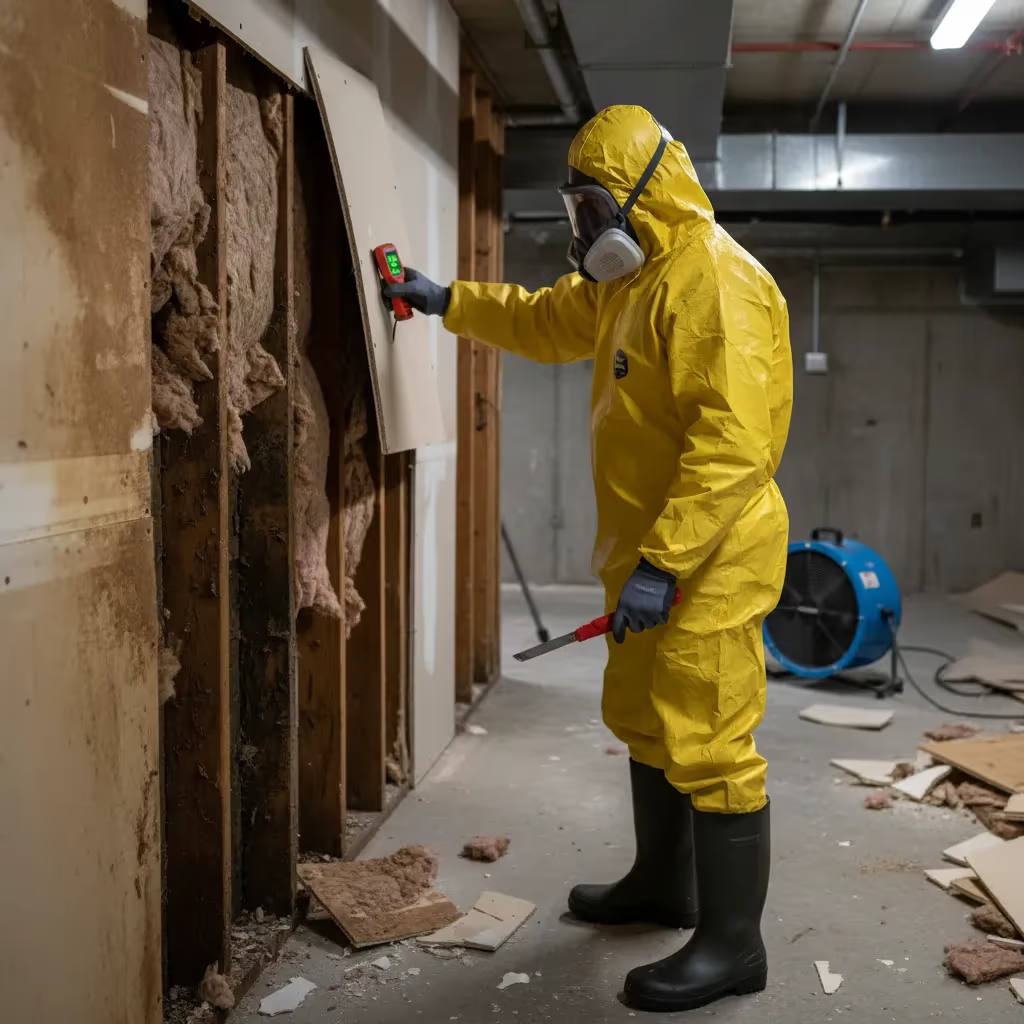
The water damage restoration industry continues to grow as property owners and insurance companies increasingly rely on certified professionals to handle flood and moisture-related emergencies. At the heart of this industry lies the Institute of Inspection Cleaning and Restoration Certification (IICRC), which sets the gold standard for technician qualifications. IICRC WRT classes represent one of the most essential training programs available for anyone seeking to establish or advance their career in water damage restoration.
The Water Restoration Technician (WRT) certification has become a fundamental requirement for professionals working with insurance companies, property management firms, and restoration businesses. This comprehensive guide explores everything you need to know about IICRC WRT classes, from understanding the certification process to preparing for your exam and maintaining your credentials throughout your career.
Whether you are a newcomer to the restoration industry or an experienced technician looking to formalize your expertise, understanding the WRT certification pathway is crucial for professional success. The certification not only validates your technical knowledge but also demonstrates your commitment to industry standards and best practices in water damage restoration.
IICRC WRT Practice Test Questions
Prepare for the IICRC WRT - Institute of Inspection, Cleaning and Restoration Certification Water Damage Restoration Technician exam with our free practice test modules. Each quiz covers key topics to help you pass on your first try.
IICRC WRT Basic
IICRC WRT Exam Questions covering Basic. Master IICRC WRT Test concepts for certification prep.
IICRC WRT Documentation and Industry Stand...
Free IICRC WRT Practice Test featuring Documentation and Industry Standards. Improve your IICRC WRT Exam score with mock test prep.
IICRC WRT Drying Equipment and Procedures
IICRC WRT Mock Exam on Drying Equipment and Procedures. IICRC WRT Study Guide questions to pass on your first try.
IICRC WRT Health and Safety
IICRC WRT Test Prep for Health and Safety. Practice IICRC WRT Quiz questions and boost your score.
IICRC WRT Moisture Inspection and Monitoring
IICRC WRT Questions and Answers on Moisture Inspection and Monitoring. Free IICRC WRT practice for exam readiness.
IICRC WRT Psychrometrics and Drying Science
IICRC WRT Mock Test covering Psychrometrics and Drying Science. Online IICRC WRT Test practice with instant feedback.
IICRC WRT Restoration Health and Safety
Free IICRC WRT Quiz on Restoration Health and Safety. IICRC WRT Exam prep questions with detailed explanations.
IICRC WRT Restorative Cleaning
IICRC WRT Practice Questions for Restorative Cleaning. Build confidence for your IICRC WRT certification exam.
IICRC WRT Water Categories and Classification
IICRC WRT Test Online for Water Categories and Classification. Free practice with instant results and feedback.
- +Validates your knowledge and skills objectively
- +Increases job market competitiveness
- +Provides structured learning goals
- +Networking opportunities with other certified professionals
- −Study materials can be expensive
- −Exam anxiety can affect performance
- −Requires dedicated preparation time
- −Retake fees apply if you don't pass
Pros and Cons at a Glance
| Pros | Cons |
|---|---|
| Validates your knowledge and skills objectively | Study materials can be expensive |
| Increases job market competitiveness | Exam anxiety can affect performance |
| Provides structured learning goals | Requires dedicated preparation time |
| Networking opportunities with other certified professionals | Retake fees apply if you don't pass |
Sample IICRC WRT - Institute of Inspection, Cleaning and Restoration Certification Water Damage Restoration Technician Practice Questions
Try these questions from our free IICRC WRT - Institute of Inspection, Cleaning and Restoration Certification Water Damage Restoration Technician practice tests. The correct answer and an explanation follow each question.
Which of the following is the primary distinction between Water Categories and Water Classes as defined by the IICRC S500?
- A. Categories describe the speed of evaporation, while Classes describe the source of the water.
- B. Categories describe the level of contamination, while Classes describe the expected rate of evaporation and extent of saturation.
- C. Categories are used for insurance claims, while Classes are used for internal company documentation.
- D. Categories apply only to residential structures, while Classes apply to commercial structures.
Answer: B. Categories describe the level of contamination, while Classes describe the expected rate of evaporation and extent of saturation.
The IICRC S500 standard uses Categories (1, 2, 3) to define the level of contamination in the water and Classes (1, 2, 3, 4) to describe the amount of water and the resulting saturation, which helps determine the expected evaporation load.
On a Category 1 water loss, when is the use of Air Filtration Devices (AFDs) recommended according to the IICRC S500?
- A. AFDs are mandatory on all Category 1 water losses to ensure air quality.
- B. Only when visible microbial growth is already present on affected materials.
- C. When preliminary cleaning cannot sufficiently remove particulates or when high-risk occupants are present.
- D. After the drying process is complete to remove any lingering odors.
Answer: C. When preliminary cleaning cannot sufficiently remove particulates or when high-risk occupants are present.
The IICRC S500 states that for Category 1 losses, restorers should first perform preliminary cleaning to reduce aerosolized particulates. If cleaning is insufficient or if high-risk occupants (e.g., elderly, infants, immunocompromised) are in the structure, the standard recommends installing AFDs to control airborne contaminants.
The IICRC S500 Standard for Professional Water Damage Restoration is best described as a:
- A. Federal law that mandates specific drying techniques for all 50 states.
- B. Procedural standard based on reliable restoration principles, research, and practical experience.
- C. Price list that dictates the exact cost for water damage services nationwide.
- D. Comprehensive guide only for cleaning and sanitizing contaminated water losses.
Answer: B. Procedural standard based on reliable restoration principles, research, and practical experience.
The IICRC S500 is not a law but a procedural standard of care. It is based on reliable principles, a review of scientific literature, and practical industry experience to provide a framework for professional water damage restoration.
A restoration project is classified as IICRC Class 4 water damage, involving deeply saturated, low-permeability materials like hardwood and plaster. Which type of dehumidifier is generally most effective in these conditions?
- A. Conventional Refrigerant Dehumidifier
- B. Low-Grain Refrigerant (LGR) Dehumidifier
- C. Desiccant Dehumidifier
- D. Standard Residential Dehumidifier
Answer: C. Desiccant Dehumidifier
Class 4 drying involves materials with very low permeance that hold bound water. To draw this moisture out, a very large vapor pressure differential is required. Desiccant dehumidifiers are capable of producing much lower humidity ratios (GPP) and dew points than refrigerant-based units. This extremely dry air creates the significant pressure differential needed to pull moisture from deep within dense materials, making them most effective for Class 4 situations.
(IICRC WRT) Institute of Inspection, Cleaning and Restoration Certification Water Damage Restoration Technician Questions and Answers
Conclusion
IICRC WRT classes provide the essential foundation for professionals entering or advancing in the water damage restoration industry. The certification demonstrates technical competency, adherence to industry standards, and commitment to professional excellence that insurance companies and clients expect from qualified restoration technicians.
Whether you choose in-person training with hands-on equipment practice or the convenience of online live-stream courses, the WRT certification pathway remains consistent: complete an approved course, pass the examination, and maintain your credentials through annual renewals and continuing education. The investment in certification pays dividends through enhanced job opportunities, professional credibility, and the knowledge necessary to perform restoration work safely and effectively.
As you prepare for your WRT certification, take advantage of practice tests, study guides, and the wealth of resources available through IICRC-approved training providers. Understanding the exam content, practicing with sample questions, and mastering the core concepts covered in the S500 standard will position you for success on exam day and throughout your restoration career.
The IICRC WRT exam uses a multiple-choice format with questions covering all major domains. Most versions allow 2-3 hours for completion.
Questions test both knowledge recall and application skills. A score of 70-75% is typically required to pass.
About the Author

Manufacturing Engineer & Quality Certification Expert
Purdue University School of Industrial EngineeringDr. James Park is a licensed Professional Engineer and Six Sigma Black Belt with a Master of Science in Industrial Engineering from Purdue University. He has 17 years of manufacturing operations and quality management experience across automotive and aerospace industries. Dr. Park coaches manufacturing professionals through Six Sigma, Lean Manufacturing, CPIM, and quality engineering certification exams.
Join the Discussion
Connect with other students preparing for this exam. Share tips, ask questions, and get advice from people who have been there.
View discussion (7 replies)