
ICT Class: What to Expect, How to Succeed, and Why It Matters 2026 September
✍🏼 Everything you need to know about ICT class — topics covered, skills learned, and how to prepare. Includes free practice questions.

An ICT class introduces students to the foundational concepts, tools, and skills that power the modern digital world. Whether you are enrolled in a middle school technology course, a high school TVL-ICT strand, a community college certificate program, or a professional certification track, the core mission is the same: equip learners with the ability to use, manage, and think critically about information and communication technology. From learning how a computer processes data to understanding how networks connect billions of devices, an ict class opens the door to one of the fastest-growing sectors in the global economy.
The demand for ICT-literate workers has never been higher. The U.S. Bureau of Labor Statistics projects that employment in computer and information technology occupations will grow 15 percent through 2031 — more than three times the average for all occupations. Every one of those jobs traces back to skills first introduced in a classroom: hardware troubleshooting, network configuration, software development, cybersecurity awareness, and database management. Students who take ICT courses seriously build a competitive edge that follows them throughout their careers.
ICT classes are not monolithic. The content you encounter depends heavily on the level and institution. A foundational course at the secondary level may focus on digital literacy — keyboarding, office productivity software, internet safety, and basic coding. An advanced high school elective or dual-enrollment course may introduce networking fundamentals, programming logic, or web design. At the post-secondary level, ICT coursework can become highly specialized, covering topics like cloud virtualization, enterprise database administration, or ethical hacking.
One reason ICT education receives increasing attention from policymakers and employers alike is its direct connection to workforce readiness. Unlike some academic subjects where the path from classroom to career can feel abstract, ICT skills map almost one-to-one onto job tasks. A student who learns to configure a local area network in class is practicing the same procedure a network administrator performs daily. A student who writes and debugs Python scripts in a class project is building the same muscles used by a professional data analyst.
Despite its importance, many students enter ICT classes unsure of what to expect or how to prepare. They may assume the course will be easy because they use smartphones every day, only to discover that consumer-level technology use is very different from the technical and conceptual knowledge required to build, secure, and maintain the systems behind those devices. Understanding this gap early — and taking steps to close it — makes a significant difference in outcomes.
This guide is designed to give you a comprehensive picture of what an ICT class covers, how courses are typically structured, what skills and knowledge you need to master, and how to study effectively. Whether you are starting your first technology course or preparing for a high-stakes certification exam, the strategies and information here will help you get more out of every lesson, lab, and practice test.
Throughout this article you will find structured breakdowns of key topics, practical study tips grounded in research on learning and retention, and links to free practice resources. Our goal is not just to describe what ICT education looks like but to show you how to succeed in it — from the first day of class through the final exam and beyond.
ICT Education by the Numbers
ICT Class Structure and Course Formats
Introductory courses covering basic computer operations, productivity software (word processing, spreadsheets, presentations), internet safety, and digital citizenship. Typically offered at the middle school level or as a required freshman elective in high school.
Intermediate and advanced courses aligned with industry certifications such as CompTIA IT Fundamentals, CompTIA A+, or Cisco CCNA. Students practice hands-on labs covering hardware, networking, and operating systems. Common in high school CTE and community college programs.
Deep-dive courses focusing on a single ICT domain — cybersecurity, web development, programming, database management, or cloud computing. Students who complete foundational courses often take two or three specialized electives to build a defined career pathway.
College-credit courses offered at the high school level, allowing students to earn transferable credits while still in secondary school. These courses follow community college or university syllabi and are graded accordingly, with expectations matching post-secondary standards.
ICT coursework delivered fully or partially online through learning management systems like Canvas or Google Classroom. Lab simulations using platforms such as Cisco Packet Tracer or VirtualBox replace physical hardware, making professional-level practice accessible from any device.
The content covered in an ICT class spans an impressive breadth of knowledge areas, which is one reason students sometimes feel overwhelmed in the first few weeks. Understanding the major topic clusters — and how they relate to each other — helps you build a mental map of the curriculum before diving into individual lessons.
Hardware is always among the first areas addressed because physical components form the foundation on which everything else runs. You will learn to identify the key parts of a desktop, laptop, and mobile device: the central processing unit, random access memory, storage drives, motherboard, power supply, and peripheral interfaces.
Once hardware fundamentals are established, most ICT courses turn to operating systems. Students learn how an OS manages resources, runs applications, and provides an interface between the user and the hardware. Windows, macOS, and Linux distributions each receive attention, with particular emphasis on file management, user account administration, and command-line utilities. Understanding the OS layer is critical because nearly every other ICT skill — networking, security, database work — depends on a working knowledge of how operating systems function.
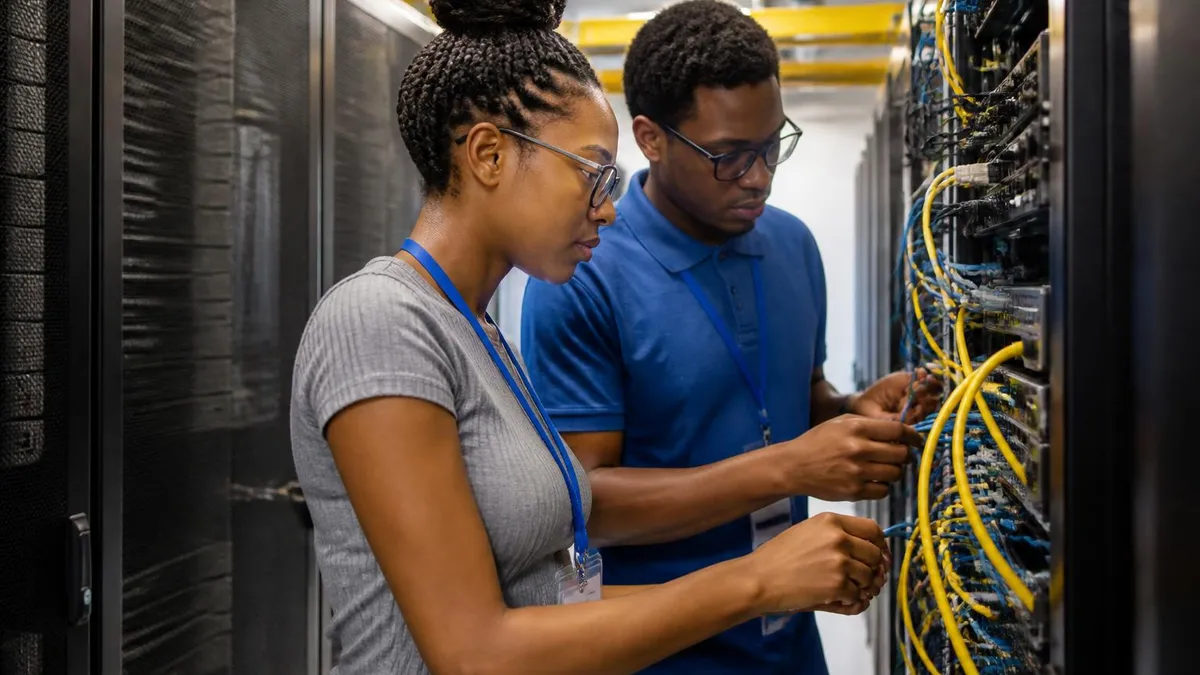
Networking concepts represent one of the most extensive and practically important areas in any ICT class. Topics include the OSI model and TCP/IP protocol suite, IP addressing and subnetting, the function of routers, switches, and access points, and the configuration of both wired and wireless networks. Students also study the differences between LAN, WAN, and cloud-based network architectures. Network troubleshooting labs — where students diagnose and repair simulated connectivity issues — are a staple of the classroom experience and an area where thorough practice pays significant dividends on exams.
Cybersecurity is no longer an optional add-on in ICT education; it is woven throughout the curriculum at every level. Even foundational courses address password hygiene, phishing recognition, and safe browsing habits. More advanced courses examine threat categories in depth: malware types (viruses, ransomware, spyware, trojans), social engineering attacks, denial-of-service techniques, and man-in-the-middle exploits. Students also learn defensive strategies: firewalls, intrusion detection systems, encryption protocols, and access control models including role-based and mandatory access control.
Database management concepts appear in most intermediate and advanced ICT courses because data is the currency of the modern digital economy. Students learn the difference between relational and non-relational database models, how to write basic SQL queries (SELECT, INSERT, UPDATE, DELETE), and how to design normalized table structures. Understanding foreign keys, primary keys, and join operations enables students to work with real-world datasets rather than treating data as an abstract concept. Many instructors assign projects where students build and query their own small databases using MySQL or SQLite.
Cloud computing has moved from an advanced elective topic to a mainstream component of ICT education. Students learn the three primary service models — Infrastructure as a Service (IaaS), Platform as a Service (PaaS), and Software as a Service (SaaS) — along with deployment models including public, private, hybrid, and multi-cloud environments. Virtualization concepts underpin cloud technology: students study hypervisors, virtual machines, and containerization tools like Docker. These concepts connect directly to the job market, as cloud skills consistently rank among the most requested qualifications in IT job postings.
Programming and scripting rounds out the core curriculum in most comprehensive ICT programs. Python is the dominant language in introductory courses due to its readable syntax and versatility across domains including automation, data analysis, and web development. Students write scripts to automate file operations, parse data from text files, and interact with APIs. Even students who do not intend to pursue software development careers benefit from learning to code: the logical thinking and systematic problem-solving developed through programming transfer directly to network troubleshooting, database design, and security analysis.
Learning Strategies by ICT Topic Area
Mastering hardware and networking in your ICT class requires combining visual learning with hands-on practice. Start by drawing and labeling diagrams of computer components and network topologies without looking at notes — retrieval practice strengthens memory more than re-reading. Use free simulators like Cisco Packet Tracer to build virtual networks and test your configurations. When you encounter a concept like subnetting, work through at least ten numerical examples until the arithmetic becomes automatic rather than effortful.
For troubleshooting labs, always follow a structured methodology: define the problem, gather information, establish a theory, test the theory, and verify the solution. This approach mirrors real-world IT workflows and impresses instructors who evaluate lab write-ups. Flashcard sets covering OSI layers, common port numbers (80 for HTTP, 443 for HTTPS, 22 for SSH), and IP address classes build the vocabulary you need to answer exam questions quickly and accurately.

Taking an ICT Class: Benefits and Challenges
- +Directly builds skills employers list in real job postings, from networking to cybersecurity
- +Provides a pathway to industry certifications (CompTIA, Cisco, Microsoft) that boost hiring prospects
- +Develops transferable critical-thinking and problem-solving skills applicable across all STEM fields
- +Hands-on labs and simulations make abstract concepts concrete and memorable
- +Opens access to high-paying career paths without requiring a four-year college degree
- +Curriculum stays current with industry changes, exposing students to cloud, AI, and modern security threats
- −Curriculum breadth can feel overwhelming, especially in first-year courses covering six or more topic areas
- −Rapidly evolving technology means some course materials may lag behind current industry practices
- −Lab equipment availability varies widely between well-funded and under-resourced schools
- −Abstract concepts like subnetting and OSI layers have steep learning curves for non-technical beginners
- −Certification exam prep requires significant self-study outside classroom hours
- −Online and hybrid formats may limit hands-on hardware experience for students without home lab equipment
ICT Class Preparation Checklist
- ✓Review the full course syllabus before the first day and identify the heaviest topic areas.
- ✓Install free simulation software (Cisco Packet Tracer, VirtualBox) before networking and virtualization units begin.
- ✓Create a dedicated notebook or digital folder organized by topic for lecture notes and lab reports.
- ✓Complete all assigned lab exercises even when they are ungraded — hands-on practice is non-negotiable.
- ✓Use flashcard apps like Anki to memorize port numbers, OSI layers, and hardware component specifications.
- ✓Take at least one full-length practice test before every major unit exam to identify knowledge gaps.
- ✓Join an online ICT study community (Reddit r/CompTIA, Discord servers) for peer support and resource sharing.
- ✓Schedule weekly review sessions to revisit material from previous units before it fades from memory.
- ✓Align your study topics with a relevant certification (CompTIA ITF+, A+) so effort serves multiple goals.
- ✓Track your practice test scores over time to measure improvement and adjust study priorities accordingly.
Certification-Aligned Study Multiplies Your Return on Effort
Students who align their ICT class study plan with a recognized industry certification — such as CompTIA IT Fundamentals+ or CompTIA A+ — effectively study for two outcomes simultaneously. The certification validates your skills to employers with a credential they recognize immediately, while the structured exam blueprint ensures you cover every topic your course requires. Many schools even offer vouchers that reduce or eliminate the certification exam fee for enrolled students.
The skills you develop in an ICT class extend well beyond the ability to name hardware components or recite networking protocols. The most valuable competencies are the cognitive habits the coursework builds: systematic troubleshooting, logical decomposition of complex problems, attention to detail in configuration tasks, and the discipline to follow documented procedures even when shortcuts seem tempting. These habits distinguish professionals who are reliable and promotable from those who remain in entry-level roles.
Troubleshooting is perhaps the most transferable skill the course teaches. When a network connection fails or an application crashes, experienced technicians do not guess randomly — they work through a structured diagnostic process. They isolate variables by testing one change at a time. They document what they observe so that if the problem persists, the next person has useful information to build on. They verify that a fix actually solved the original issue rather than masking it. ICT classes that include lab troubleshooting exercises are explicitly training this discipline, often more than students realize in the moment.
Documentation skills receive less attention in discussions of ICT education but are enormously valuable in professional settings. Every IT department relies on accurate, up-to-date documentation: network diagrams, configuration records, change logs, incident reports, and runbooks. Students who practice writing clear lab reports — describing what they did, what they observed, and what conclusions they drew — are building professional documentation habits that separate competent technicians from outstanding ones. Instructors who assign written lab reports are giving students a gift, even if the assignment feels burdensome at the time.
Collaboration and communication skills develop naturally in ICT courses that include team projects and pair programming exercises. Real-world IT roles almost always involve working with colleagues who have different specializations: a network engineer coordinates with a security analyst; a database administrator communicates requirements to a software developer. Being able to explain a technical problem clearly to someone who does not share your exact background is a high-value competency that ICT group projects begin to develop.
Adaptability is the meta-skill that ICT education fosters above all others. Technology changes faster than any curriculum can fully keep pace with. Students who learn how to learn — who understand the underlying principles well enough to figure out how new tools work — are far more resilient to career disruption than those who have only memorized the specifics of today's software and hardware. ICT classes that emphasize conceptual understanding alongside procedural skill are preparing students not just for their first job but for a forty-year career through multiple technological generations.
Information security awareness is a skill that benefits every person in modern society, not just technology professionals. ICT class graduates who understand phishing tactics, recognize social engineering attempts, create strong unique passwords, and practice safe data handling are better protected in their personal digital lives and are less likely to become the human vulnerability that attackers exploit within organizations. The economic value of security awareness is difficult to quantify but genuinely enormous: the average data breach in the United States costs organizations $9.44 million, and human error or deception is a contributing factor in the majority of incidents.
Project management fundamentals often appear in capstone or advanced ICT courses. Students who plan, execute, and document a complete technical project — building a small network, developing a simple web application, or designing a database — experience the full lifecycle of technical work: requirements gathering, design, implementation, testing, and handoff. This experience is directly analogous to what employers expect from junior IT staff and provides concrete material to discuss during job interviews. The ability to say, 'I designed and built a functional system from scratch in my ICT class' is a compelling differentiator in a competitive job market.

Many ICT courses are designed to prepare students for industry certifications that carry real weight with employers. CompTIA IT Fundamentals+ (ITF+) is ideal after a foundational course, while CompTIA A+ suits students who complete a hardware and operating systems track. Cisco's CCNA is the standard credential for networking-focused programs. Earning even one certification before graduation significantly improves hiring outcomes for ICT students entering the workforce.
Succeeding in exams and maintaining strong grades throughout an ICT class requires more than reviewing notes the night before a test. Research on learning and memory consistently shows that spaced repetition — reviewing material at increasing intervals over time — produces far better long-term retention than massed practice (cramming). For ICT students, this means returning to networking diagrams, hardware specs, and security concepts multiple times across a semester rather than treating each unit as self-contained once the test is over. The cumulative nature of ICT knowledge means foundational concepts recur constantly in advanced topics.
Practice testing is the single most effective study strategy for ICT courses with multiple-choice or scenario-based exams. When you take a practice quiz and get a question wrong, you receive targeted feedback about exactly where your understanding breaks down. This is more efficient than re-reading an entire chapter looking for gaps. The PracticeTestGeeks platform offers free ICT practice questions organized by topic area, allowing you to focus practice sessions on your weakest subjects rather than reviewing material you already know well.
For students preparing for official certification exams in addition to class tests, the volume of practice questions matters significantly. Certification exams are designed to test not just factual recall but the ability to apply knowledge to realistic scenarios. A question might describe a network symptom and ask you to identify the most likely cause; another might present a security incident and ask which countermeasure would be most appropriate. These application-level questions require a depth of understanding that only comes from extensive practice combined with thorough conceptual study.
Time management during exams is a skill worth practicing explicitly. Many ICT exams include a large number of questions in a relatively short window — 90 questions in 90 minutes is a common format for certification practice. Students who pause too long on difficult questions risk running out of time before reaching easier ones they would answer correctly. The recommended approach: mark difficult questions and move on, complete all the questions you are confident about, then return to flagged items with any remaining time. This discipline requires deliberate practice during timed mock exams.
Lab practicals, when included in ICT assessment, demand a different preparation approach than written tests. The best preparation for a practical exam is doing the procedure repeatedly until each step is automatic. If your practical covers cable crimping, subnetting calculation, or setting up a Windows user account, you should perform the complete procedure from memory at least five times before the assessment. Instructors evaluating practicals look for accuracy, speed, and the confidence that comes from genuine familiarity — not the tentative performance of someone who has read about the task but never practiced it under pressure.
Grades in ICT classes are typically weighted across several assessment categories: written tests, lab assignments, homework, participation, and projects. Students who focus exclusively on test preparation sometimes neglect lab reports and project documentation, where consistent points accumulate over the semester. Maintaining a high average on lower-stakes assignments creates a cushion that protects your grade even if a major exam goes poorly. Treating every assignment as an opportunity to build understanding — not just to accumulate points — also ensures that exam day is not the first time you have deeply engaged with the material.
For students pursuing the TVL-ICT strand or similar career-technical education pathways, understanding how classroom assessments map to real industry evaluations helps calibrate effort appropriately. The skills assessed in your ict class midterm directly correspond to competencies that employers verify through skills tests and certification requirements. When you frame class assignments as professional skill-building rather than academic obligations, motivation and engagement tend to increase — and so do grades.
Building a personal home lab is one of the most effective ways to supplement what you learn in an ICT class and accelerate your development as a technology professional. A home lab does not require expensive equipment. A used computer purchased for under $100, a free hypervisor like VirtualBox or VMware Workstation Player, and downloaded ISO images of Linux distributions and Windows trial versions give you a functional environment for practicing virtually every skill your course covers. Students who experiment at home between classes show measurably faster skill acquisition than those who only practice during scheduled lab time.
Community resources for ICT learners are more abundant than many students realize. YouTube channels like Professor Messer (known for CompTIA exam preparation content), NetworkChuck, and John Hammond cover nearly every ICT topic in engaging video formats that complement textbook explanations. The Cisco Learning Network, CompTIA's CertMaster Learn platform, and free MOOC platforms like Coursera and edX offer structured courses aligned with industry certifications. Reddit communities including r/CompTIA, r/networking, and r/sysadmin connect students with experienced professionals who answer questions and share study resources.
Participating in competitions and extracurricular programs accelerates ICT skill development in ways that regular coursework cannot fully replicate. CyberPatriot, sponsored by the Air Force Association, challenges high school and middle school teams to secure virtual networked systems against simulated attacks. SkillsUSA holds regional and national competitions in network infrastructure, cybersecurity, and IT service. These programs provide authentic challenge, peer benchmarking, and recognition that carries genuine weight on college applications and résumés.
Internships and job shadowing opportunities, even unpaid ones, provide context that transforms abstract classroom concepts into concrete professional reality. Seeing how a real IT department functions — how tickets are triaged, how changes are approved, how incidents are escalated — gives ICT students a professional frame of reference that makes every subsequent lesson more meaningful. Many high school CTE programs have formal partnerships with local employers specifically to facilitate these experiences. If your school has such a program, pursue it aggressively.
Keeping a learning journal or portfolio throughout your ICT class creates a valuable long-term asset. Document every lab you complete: what the objective was, what steps you followed, what problems arose, and how you solved them. Screenshot configurations, annotate network diagrams, and save your SQL queries. Over a semester, this portfolio becomes a concrete record of your skills that you can show to employers or college admissions evaluators. It also serves as a review resource: before an exam, flipping through your own documented lab work is one of the most targeted review strategies available.
Staying current with the technology industry during your ICT class deepens the relevance of what you are learning. Follow technology news sources like Ars Technica, The Verge, and Krebs on Security (for cybersecurity). When a major breach occurs or a new technology platform launches, try to connect the news story to concepts you have studied. This habit builds a mental model of how ICT knowledge applies in the real world and prepares you for scenario-based exam questions that describe realistic situations rather than abstract hypotheticals.
Finally, do not underestimate the value of teaching others as a learning strategy. Forming a study group and taking turns explaining concepts to each other — what is the difference between TCP and UDP, how does public-key cryptography work, what steps do you follow to subnet a network — forces you to identify and fill gaps in your understanding.
If you cannot explain a concept clearly enough for someone else to understand it, that is a precise signal that your own understanding needs deepening. Peer teaching is widely recognized in educational research as one of the highest-impact study techniques, and it works especially well for the kind of procedural and conceptual knowledge that ICT courses require.
ICT Questions and Answers

What Is ICT? A General Knowledge Guide to Types, Uses, and the TVL-ICT Strand

ICT Tester: Complete Practice Test Guide for Information and Communication Technology
ICT Practice Test PDF (Free Printable 2026)

What ICT in Education Really Means: Tools, Special-Ed Use and 2026 Guide

Duties of ICT Manager: Complete Career Guide to Roles, Skills, Salary & Career Path
About the Author

Educational Psychologist & Academic Test Preparation Expert
Columbia University Teachers CollegeDr. Lisa Patel holds a Doctorate in Education from Columbia University Teachers College and has spent 17 years researching standardized test design and academic assessment. She has developed preparation programs for SAT, ACT, GRE, LSAT, UCAT, and numerous professional licensing exams, helping students of all backgrounds achieve their target scores.
Join the Discussion
Connect with other students preparing for this exam. Share tips, ask questions, and get advice from people who have been there.
View discussion (7 replies)