
What Is ICT? A General Knowledge Guide to Types, Uses, and the TVL-ICT Strand
What is ICT? Definition, types of ICT, data types, ⏳ ICT diffusion, TVL-ICT strand, and uses in education, health, business, and government.

You hear the acronym every day. School announcements, government budgets, NGO reports, job ads asking for “strong ICT skills.” But ask five different people what ICT actually is and you'll get five different answers — some technical, some vague, some quietly wrong. So let's settle it.
ICT stands for Information and Communication Technology. It's the umbrella term for every technology that handles information — creating it, storing it, processing it, moving it from one place to another — and every technology that lets people communicate using that information. That's a wide umbrella on purpose. A landline phone is ICT. A satellite is ICT. The supercomputer at a national weather agency is ICT, and so is the cheap Android handset a farmer in rural Kenya uses to check market prices. Same family, very different members.
Why does the term exist at all when we already had “IT” (information technology)? Because IT, as the phrase was originally coined, leaned hard on the information side — computing, software, databases, the back-office machinery. When the internet, mobile networks, and broadband arrived in the 1990s, communication couldn't be separated from computation anymore.
A new umbrella was needed. The European Commission and UNESCO started using “ICT” in policy documents during the late 1990s, and it stuck. Today most international bodies — the World Bank, UN, ITU — use ICT as the preferred term. IT still appears in narrower contexts, especially in North American corporate language, but ICT is the broader, more inclusive label.
That broader scope matters. When a country writes an “ICT policy,” it usually means everything from rural broadband rollout to digital literacy in schools to data-protection law. When a hospital talks about its “ICT department,” it means the people who keep the network running, the electronic health records online, and the telemedicine kiosks talking to specialists in the capital.
ICT is the connective tissue. This guide walks through what counts as ICT, the different types, the data forms it handles, the digital divide it has created, and — since the search term that brought a lot of Filipino senior-high students here — what the TVL-ICT strand actually covers.
Let's slow down on the definition for a second, because what is ICT is one of the most-searched questions on this topic and the wording in textbooks doesn't always help. The cleanest working definition runs like this: ICT is the combined set of tools, infrastructure, and services that people use to capture, store, process, and exchange information. Tools means the hardware. Infrastructure means the cables, satellites, towers, and data centers that connect them. Services means the applications, platforms, and human-facing systems built on top.
So a smartphone, by itself, is a tool. The 4G network it connects to is infrastructure. WhatsApp running on the phone is a service. Together — phone plus network plus app — you have a working ICT system. Strip out any one of the three and the system stops working. That's why ICT discussions almost always cover all three layers at once. A country with great phones but terrible networks isn't “ICT-ready.” Neither is a country with great networks but no localized services people can actually use.
Understanding ICT also means accepting how broad the category really is. A wall-mounted analog clock is not ICT (no information processing, no communication channel). A digital clock that syncs to a network time server is. A printed newspaper isn't, but the same newspaper delivered through a tablet app is. The dividing line is usually whether digital signals are involved — ICT in the modern sense is digital ICT — although purists will point out that the radio, the telegraph, and the original landline phone were all ICT before “digital” entered the conversation.
ICT vs IT: What's Actually Different
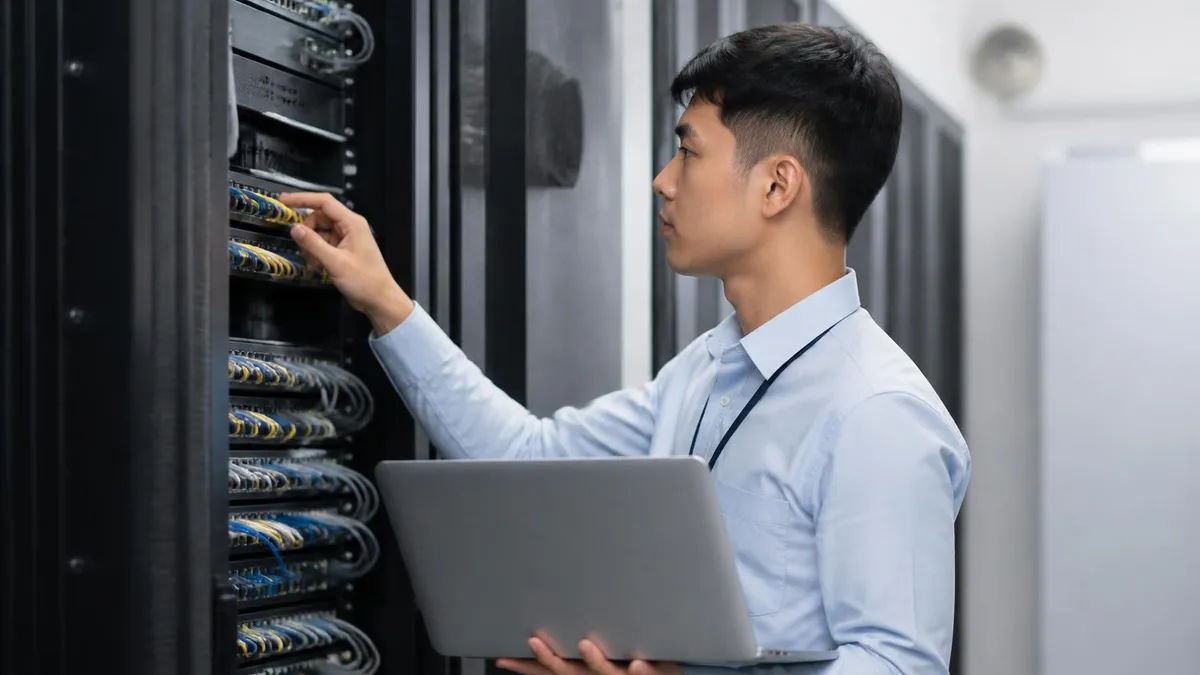
The shorthand: IT is a subset of ICT. IT historically meant the computing side — servers, databases, internal software, the back office. ICT adds the communication layer: networks, telecoms, broadcasting, internet services, mobile, plus all the people-facing platforms built on top. In international policy and education contexts, ICT is the dominant term. In US corporate language, “IT department” still appears more often. They're not exact synonyms, but in everyday writing you can usually swap one for the other without losing meaning — just don't do it in a UNESCO grant application.
Now let's split ICT into types. There's no single official taxonomy — different textbooks slice it differently — but a useful working breakdown has five categories: hardware, software, networks and communications, data and information, and services and applications. Each layer depends on the ones below it.
Hardware covers the physical kit. Computers (desktops, laptops, tablets), mobile devices, servers, storage drives, peripherals like printers and scanners, sensors, IoT devices, networking gear like routers and switches, and the underlying chips and processors that drive them all. Without hardware, none of the higher layers exist. The cost of hardware has fallen dramatically — a basic smartphone today has more compute than a 1990s supercomputer — which is why ICT has spread into places it couldn't reach twenty years ago.
Software is the instruction layer. Operating systems (Windows, macOS, Linux, Android, iOS), application software (browsers, productivity suites, games, design tools), system software, programming environments, and the firmware embedded in hardware itself. Software is what turns generic hardware into something useful. Two laptops with identical hardware can do very different things depending on the software running on them.
Networks and communications connect everything. Wired networks (Ethernet, fiber), wireless networks (Wi-Fi, Bluetooth, cellular 3G/4G/5G), satellite links, undersea cables, the internet itself as a network of networks, plus the protocols (TCP/IP, HTTP, DNS) that make traffic flow. This layer is the “C” in ICT — the communication. It's also the most invisible layer to end users. People notice when their Wi-Fi is slow, but rarely think about the chain of routers, ISPs, peering agreements, and fiber lines that carry their data.
Data and information is what flows through everything else. We'll cover the three main types of data in ICT in detail below, but the short version: structured (databases, spreadsheets), semi-structured (JSON, XML), and unstructured (images, video, free-text documents). Without data, the rest of the stack has nothing to do.
Services and applications sits at the top. This is what users actually interact with — web platforms, mobile apps, cloud services, video-conferencing tools, e-commerce sites, search engines, e-learning portals, e-government services, telemedicine, banking apps. Services depend on every layer below them. When a banking app fails, the problem is rarely the app itself — it's usually the server, the network, the database, or the integration between them.
The Five Types of ICT
Every physical device that creates, stores, processes, or transmits information. Computers, mobile devices, servers, sensors, IoT gadgets, peripherals, and the networking equipment that ties them together.
- ▸Computers, mobiles, tablets
- ▸Servers and storage
- ▸Peripherals and sensors
The instructions and programs that make hardware useful. Operating systems, application software, embedded firmware, and the programming languages and frameworks used to build them.
- ▸Operating systems
- ▸Applications
- ▸Firmware and dev tools
The infrastructure that moves data between devices. Wired and wireless networks, the internet, mobile cellular networks, satellite, and the protocols that govern data flow across all of them.
- ▸Wired and wireless
- ▸Internet and cellular
- ▸Protocols and routing
The actual content that flows through ICT systems. Structured records, semi-structured exchanges, and unstructured media. Without data, there is nothing to compute, store, or send.
- ▸Structured (databases)
- ▸Semi-structured (JSON)
- ▸Unstructured (media)
User-facing platforms built on the lower layers. Cloud services, web platforms, mobile apps, e-commerce, e-government, e-learning, telemedicine — the visible end of ICT.
- ▸Web and mobile apps
- ▸Cloud platforms
- ▸Sector-specific services
Cybersecurity, data governance, accessibility, and human-computer interaction sit across the stack — not really a sixth type, but issues that touch every layer and need attention at each one.
- ▸Security and privacy
- ▸Governance and policy
- ▸Accessibility and UX
Now to types of data ICT handles — a question that comes up almost as often as the definition itself. Data in ICT systems comes in three main forms, and the distinctions matter because each form needs different storage, different processing, and different analysis tools.
Structured data is data that fits neatly into rows and columns. Think of a spreadsheet or a relational database. Each row is a record, each column is a field, and every field has a defined type — number, date, short text. A list of bank transactions, a student grade book, a company's customer table: all structured. This form is easy to query. SQL was designed for it. Most business reporting still leans on structured data because the constraints — fixed schema, predictable types — make analysis straightforward and predictable.
Semi-structured data has some organization but breaks the strict row-column rules. JSON documents, XML files, email messages with headers and body, log files. There's a recognizable structure — keys, tags, fields — but the structure can vary between records. One JSON document might have a field that the next one doesn't. NoSQL databases like MongoDB were built around this flexibility. The trade-off: queries are more flexible, but performance and consistency need more attention.
Unstructured data doesn't fit a pre-defined model at all. Photos, videos, audio recordings, free-text documents, social-media posts, sensor streams. The information is there, but you can't put it in a column and expect to query it with SQL. Working with unstructured data needs different tools — image-recognition models, natural-language processing, speech-to-text, vector search. The proportion of new data being created that's unstructured has grown sharply over the last decade. By most estimates, somewhere between 80% and 90% of new digital data is unstructured, which is why machine learning and AI have become such a big part of the ICT conversation.
A fourth category, metadata, sits across all three. Metadata is data about data — the filename, the timestamp, the file size, the author, the location it was created. Metadata is often structured even when the data it describes is not. A photo (unstructured) has metadata (structured) that records when it was taken, on what device, at what GPS coordinates. Search engines, recommendation engines, and forensic analysis lean heavily on metadata because it's queryable in ways the underlying content often isn't.

ICT in education covers everything from interactive whiteboards in primary classrooms to MOOC platforms serving millions of learners. The visible side: digital textbooks, learning-management systems (Moodle, Canvas, Google Classroom), educational apps, video lectures, online assessments, virtual labs. The less visible side: student information systems, attendance tracking, parent-teacher communication apps, school finance and HR systems.
The pandemic of 2020-2022 forced most education systems globally to lean on ICT in ways they hadn't before. Schools that had invested in ICT infrastructure adapted faster. Schools that hadn't — especially in low-income and rural settings — struggled. The digital divide in education became a national-level concern in dozens of countries. Recovery is uneven, but the long-term trajectory is clear: blended learning, where in-person and online elements mix, is now the default in most well-resourced education systems.
Critical caveats: ICT in education is not a silver bullet. Studies consistently show that introducing technology without teacher training, curriculum redesign, and reliable infrastructure produces minimal learning gains. The technology is the easy part. The pedagogy and the policy are the hard parts.
Now the strand that brought a lot of Philippine senior-high students searching for TVL ICT meaning to this page. TVL stands for Technical-Vocational-Livelihood, one of the four academic tracks in the K-12 senior-high program. Within TVL, students pick from several strands — Home Economics, Agri-Fishery, Industrial Arts, and ICT. The TVL-ICT strand is specifically for students who want to leave senior high with employable digital skills.
The TVL-ICT curriculum is built around TESDA (Technical Education and Skills Development Authority) competency standards, so what you learn in school can be assessed and certified the same way a TESDA training-center graduate would be. Common specialisations within TVL-ICT include Computer Hardware Servicing (now called Computer Systems Servicing under the newer NC II framework), Computer Programming, Animation, and Technical Drafting. Each specialisation maps to a TESDA National Certificate — NC I or NC II — which is a recognized vocational credential in the Philippine job market.
Practically, a TVL-ICT student spends roughly half their senior-high hours on academic core subjects (English, math, science, social studies) and the other half on track-specific and strand-specific competencies. The strand-specific subjects include hands-on lab work — assembling and troubleshooting computers, configuring networks, writing code, building basic websites, producing digital animations — alongside the underlying theory. Graduates who pass TESDA assessment leave senior high with both their high-school diploma and a vocational certificate.
Quick clarification: TVL-ICT is not the same as the ABM (Accountancy, Business, Management) or STEM (Science, Technology, Engineering, Mathematics) tracks. STEM students might also take some ICT subjects, but their track is geared toward university-level computing or engineering pathways. TVL-ICT is geared toward direct workforce entry or technical college after graduation. Both are valid — the choice depends on what comes after high school.
Both tracks involve computers, but they aim at different destinations. TVL-ICT is workforce-oriented — hands-on technical skills, TESDA certification, ready for entry-level employment or short technical college programs immediately after senior high. STEM is university-pathway oriented — stronger emphasis on math, physics, and theoretical foundations, designed for students heading to a four-year engineering or computer science degree. Some students bridge both worlds, but the curriculum, assessments, and intended outcomes differ. Choose based on your post-high-school plan, not on which strand sounds more impressive.
The uses of ICT stretch into every sector worth listing, but a few recurring themes show up no matter where you look. ICT extends reach — a teacher in one city can serve students in twenty rural barangays through a video platform. ICT speeds processes — a tax return that took six weeks on paper takes six minutes online.
ICT lowers transaction costs — a farmer who used to drive two hours to find a market price can now check it from a $40 handset. ICT also generates data — every transaction, click, and sensor reading becomes a record that can be analysed, often in ways that produce uncomfortable trade-offs around privacy.
A useful frame is to think of ICT use cases in three layers: productivity (doing existing tasks faster or cheaper), access (reaching people or services that were previously out of reach), and transformation (doing things that weren't possible before). A factory installing ERP software is productivity. A rural clinic adopting telemedicine is access. A farmer in Kenya using satellite imagery and machine learning to time planting is transformation. The same technology stack can play in all three modes depending on context.
Who uses ICT? Everyone. But the users of ICT divide into rough categories worth naming. Individual end users — the consumers of services. Small businesses — typically light users of cloud services and SaaS platforms. Large enterprises — heavy users with custom systems and dedicated ICT teams. Government — the largest single category by spending in most countries.
Educational institutions, hospitals, and non-profits — organisational users with sector-specific needs. Researchers and developers — who build the next generation of ICT services. The user mix shapes the design priorities. Consumer apps optimise for speed and delight; enterprise systems optimise for reliability and compliance; government systems optimise for accountability and audit trails.
- ✓An operating system you can navigate without panic (Windows, macOS, Linux, Android, iOS)
- ✓A productivity suite — documents, spreadsheets, presentations (Microsoft 365, Google Workspace, LibreOffice)
- ✓Email plus basic calendar and contacts management
- ✓A web browser with bookmark, password manager, and tab discipline
- ✓Cloud storage for file backup and sharing (Google Drive, OneDrive, Dropbox, iCloud)
- ✓A video-conferencing tool for remote meetings (Zoom, Teams, Google Meet)
- ✓Instant messaging or team chat (WhatsApp, Telegram, Slack, Microsoft Teams)
- ✓Basic cybersecurity hygiene — strong passwords, 2FA, recognising phishing
- ✓Mobile-payment or digital-banking literacy
- ✓Awareness of one programming or no-code tool, even at a basic level
So far so good. But no honest ICT overview can skip the digital divide. The phrase describes the gap between people who have meaningful access to ICT and people who don't. Meaningful access isn't just about owning a device — it's about reliable connectivity, affordability, digital literacy, and content in a language and form people can actually use.
The divide has several axes. There's a geographic divide: urban areas have faster, cheaper internet than rural areas in almost every country. There's an income divide: lower-income households spend a larger share of disposable income to stay connected, and many drop offline when budgets tighten. There's an age divide: older users tend to lag younger users in adoption. There's a gender divide: in many low-income countries, women have meaningfully lower mobile-phone ownership and internet use than men. And there's a skills divide: just owning a smartphone doesn't make someone digitally literate.
ICT diffusion is the academic term for how technologies spread through a population. The classic model — Everett Rogers's Diffusion of Innovations, first published in 1962 and updated through several editions — divides adopters into innovators, early adopters, early majority, late majority, and laggards.
The shape of the curve and the speed of spread depend on five factors: relative advantage (is the new thing clearly better than what it replaces), compatibility (does it fit existing habits and values), complexity (how hard is it to use), trialability (can people try it before committing), and observability (can people see others using it). The diffusion model still drives a lot of ICT policy thinking, especially in development economics.
ICT diffusion in practice is uneven and non-linear. Mobile phones diffused across Africa faster than landlines ever did, leapfrogging the fixed-line stage entirely. Mobile money (M-Pesa, GCash) diffused in some countries within years and in others, with similar economic conditions, barely at all. The factors aren't only technological. Regulation, trust, network effects, and local champions all shape who adopts what, how fast, and how durably.
- +Extends access to education, healthcare, banking, and government services into rural and underserved areas
- +Lowers transaction costs across nearly every economic sector
- +Creates new categories of employment in software, digital services, and data work
- +Enables real-time coordination across distance — critical during emergencies and pandemics
- +Democratises information access — a smartphone user has more reference material than a university library of 1990
- +Generates data that improves planning, forecasting, and resource allocation when used responsibly
- −Reinforces existing inequalities when infrastructure rollouts skip poorer regions
- −Creates new dependencies — systems failures cascade across sectors that used to be independent
- −Generates privacy and surveillance risks, both corporate and state
- −Cybersecurity threats grow alongside adoption — ransomware, phishing, identity theft
- −Misinformation spreads faster and reaches more people than ever before
- −Skills gaps widen when education systems can't keep up with technology change
Pros and Cons at a Glance
| Pros | Cons |
|---|---|
| Extends access to education, healthcare, banking, and government services into rural and underserved areas | Reinforces existing inequalities when infrastructure rollouts skip poorer regions |
| Lowers transaction costs across nearly every economic sector | Creates new dependencies — systems failures cascade across sectors that used to be independent |
| Creates new categories of employment in software, digital services, and data work | Generates privacy and surveillance risks, both corporate and state |
| Enables real-time coordination across distance — critical during emergencies and pandemics | Cybersecurity threats grow alongside adoption — ransomware, phishing, identity theft |
| Generates data that improves planning, forecasting, and resource allocation when used responsibly | Misinformation spreads faster and reaches more people than ever before |
A few terms from the ICT dictionary turn up so often they're worth defining clearly. Bandwidth: the capacity of a network connection, usually measured in bits per second. Cloud computing: delivery of computing resources — storage, compute, applications — over the internet, typically on a pay-as-you-go basis. API (Application Programming Interface): a defined way for two pieces of software to talk to each other. Latency: the delay between a request and a response in a network, measured in milliseconds.
A few more. Big data: data sets too large or complex for traditional processing tools, usually characterised by volume, velocity, and variety. IoT (Internet of Things): the network of physical objects with sensors and connectivity — smart meters, connected cars, wearables. Open source: software with publicly available source code that anyone can use, modify, and redistribute.
Encryption: scrambling data so only people with the key can read it — the foundation of nearly all secure communication. Digital literacy: the skills needed to use ICT effectively for everyday life and work, ranging from basic device use to evaluating online sources critically.
Knowing the vocabulary matters because ICT policy debates often hinge on definitions. “Broadband” in one country might mean 4 Mbps download; in another, 100 Mbps. “Access” might mean households with any internet connection, or households with reliable connections fast enough to do video calls. When you read ICT statistics or reports, check the definitions first. Two countries with identical headline numbers can have very different lived realities for users.
For students preparing for ICT exams or general knowledge tests, an honest tip: the ICT field changes fast enough that any specific tool you memorise will be replaced or renamed within five years. What endures is the conceptual framework — the layers (hardware, software, networks, data, services), the data types (structured, semi-structured, unstructured), the diffusion patterns, the policy trade-offs. Build the framework and the specific tools become easy to slot in as they appear.
One last frame worth sitting with. ICT is, at its core, a set of tools. Tools can be used well or badly. They can extend opportunity, or they can widen gaps. They can give people privacy, or they can strip it away. The technology itself doesn't make the choice. People do — through policy, through design, through the everyday decisions of users and providers. That's why ICT education isn't just about learning to operate devices. It's also about understanding the social, ethical, and economic consequences of how ICT is deployed.
If you're a student writing about ICT for a class, a parent trying to make sense of the senior-high tracks your child is choosing between, a professional wondering whether to take a TESDA NC II course, or just someone curious about why this acronym shows up in every government document — you now have the working map.
ICT covers hardware, software, networks, data, and services. It powers education, healthcare, business, and government. It generates both progress and problems. And the people who understand it best aren't the ones who memorise the most specs — they're the ones who can see all the layers at once.
Sample ICT - Information Communication Technology Practice Questions
Try these questions from our free ICT - Information Communication Technology practice tests. The correct answer and an explanation follow each question.
A company uses NAT on its router. What is the primary benefit of NAT?
- A. It encrypts all outbound traffic
- B. It allows multiple private IP addresses to share a single public IP address
- C. It speeds up routing decisions
- D. It prevents unauthorized inbound connections by default
Answer: B. It allows multiple private IP addresses to share a single public IP address
NAT (Network Address Translation) maps many private IP addresses to one or a few public IP addresses, conserving the IPv4 address space.
A user's keyboard types the wrong characters (e.g., pressing 'a' produces 'q'). What is the MOST likely cause?
- A. Malware infection
- B. Incorrect keyboard language/layout is selected
- C. Faulty USB port
- D. RAM failure
Answer: B. Incorrect keyboard language/layout is selected
An incorrect keyboard layout setting (e.g., QWERTY vs AZERTY) causes keys to produce different characters than labeled.
An attacker intercepts and alters communication between two parties without their knowledge. What type of attack is this?
- A. Replay attack
- B. Man-in-the-Middle (MitM) attack
- C. Denial of Service attack
- D. Eavesdropping attack
Answer: B. Man-in-the-Middle (MitM) attack
A Man-in-the-Middle attack occurs when an attacker secretly intercepts and potentially alters communications between two parties who believe they are communicating directly.
A smart home hub uses Z-Wave to control devices. What frequency band does Z-Wave primarily operate on in the US?
- A. 2.4 GHz
- B. 5 GHz
- C. 908.42 MHz
- D. 433 MHz
Answer: C. 908.42 MHz
Z-Wave in the US operates at 908.42 MHz, which provides better wall penetration than 2.4 GHz and avoids Wi-Fi congestion.
Take the full ICT - Information Communication Technology practice test
ICT Questions and Answers
About the Author

Educational Psychologist & Academic Test Preparation Expert
Columbia University Teachers CollegeDr. Lisa Patel holds a Doctorate in Education from Columbia University Teachers College and has spent 17 years researching standardized test design and academic assessment. She has developed preparation programs for SAT, ACT, GRE, LSAT, UCAT, and numerous professional licensing exams, helping students of all backgrounds achieve their target scores.
Join the Discussion
Connect with other students preparing for this exam. Share tips, ask questions, and get advice from people who have been there.
View discussion (7 replies)