
Home Inspector License: Requirements, Cost, and How to Get Licensed 2026 October
🧠 How to get a home inspector license: state-by-state requirements, training hours, NHIE exam, costs, insurance, and continuing education explained.
Becoming a Licensed Home Inspector
A home inspector license proves you have completed the training, supervised practice, and examination required to inspect residential properties for sale. The licensing path varies by state — about 36 states require a license; the rest allow inspection work without state licensing but typically expect professional certification through ASHI or InterNACHI. The states that do license inspectors set their own training hour requirements, supervised inspection minimums, exams, and insurance rules. Knowing exactly what your state requires before starting training prevents wasted time and money on a path that does not match your state's rules.
The typical licensed home inspector path takes four to nine months from starting training to receiving the license. Training programs run 60 to 100 classroom or online hours. Supervised inspection requirements range from 25 to 250 inspections depending on the state. The National Home Inspector Examination (NHIE) is required in most licensing states and costs $225 to take. State-specific exams add to the requirement in some states. Total upfront cost runs $1,500 to $4,500 depending on state, training provider, and how many supervised inspections you need to complete.
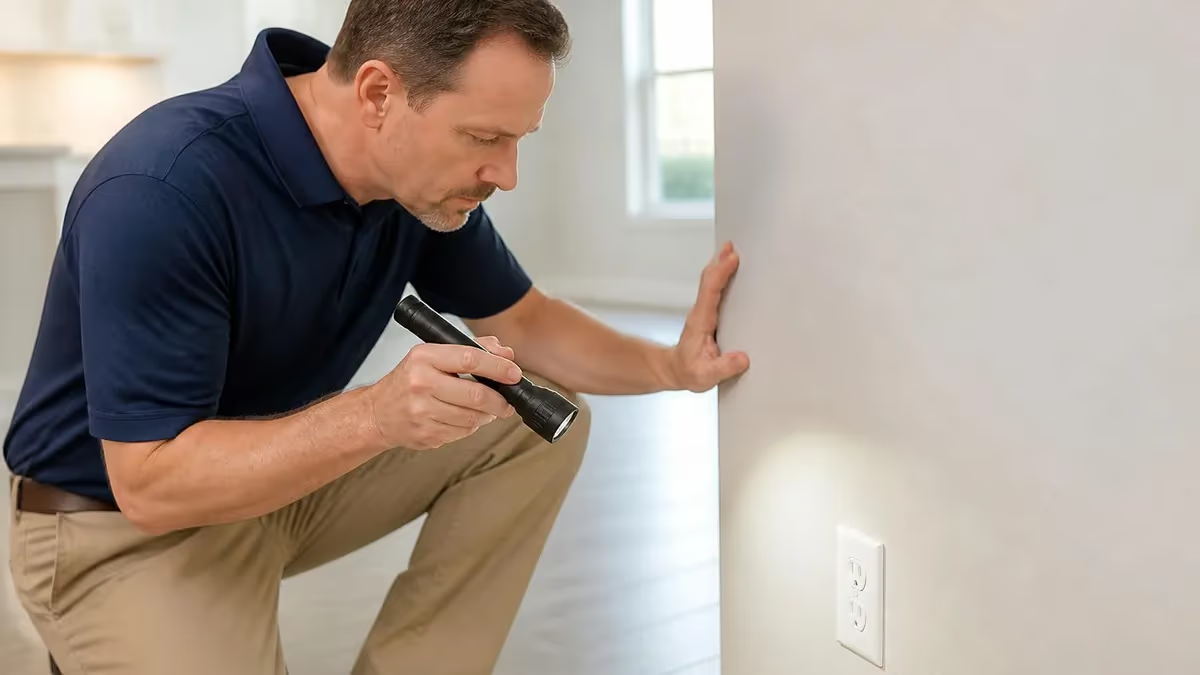
The role itself involves visual, non-invasive inspection of homes during real estate transactions. Inspectors evaluate roofing, structural elements, electrical systems, plumbing, HVAC, insulation, ventilation, and appearances of damage or deferred maintenance. The inspector writes a detailed report documenting findings; the report does not pass or fail the home but provides buyers, sellers, and lenders information for negotiation. The work suits people with construction backgrounds, mechanical aptitude, attention to detail, and comfortable with independent self-employed work.
Home inspector work has grown alongside the broader real estate industry, with steady demand for licensed inspectors in active housing markets. The Bureau of Labor Statistics groups home inspectors with construction and building inspectors generally, which makes precise career data less obvious in published statistics, but professional surveys from ASHI and InterNACHI suggest U.S. inspector population around 35,000-50,000 active inspectors. New entrants find the most opportunity in growth markets and during periods of high real estate transaction volume.
Quick Snapshot of the Licensing Path
Time: 4–9 months from start to license. Training: 60–100 hours required in licensing states. Supervised inspections: 25–250 typical (varies wildly by state). Exam: National Home Inspector Examination (NHIE) — 200 questions, 4 hours, $225 fee, ~70% passing score. Insurance: Errors & Omissions (E&O) plus General Liability typically $1,200–$2,500 per year. Total upfront cost: $1,500–$4,500 including training, exam, license fee, insurance first year. Income: $300–$500 per inspection typical, established inspectors earn $60K–$100K+.
State-by-State Licensing Variation
Licensing requirements differ enormously between states, so general advice misses the specific rules that govern your jurisdiction. Illinois requires 60 hours pre-license education, the Illinois state exam (in addition to or instead of NHIE depending on the year), and 8 hours continuing education annually. The Illinois home inspector license must be renewed every two years.
Illinois has one of the more rigorous licensing schemes including required parallel inspections during training. New York requires 140 hours of pre-license education plus 40 hours of field training and the NHIE. NY home inspector license renewal happens every two years with 24 hours of continuing education.
California licensing is more permissive at the state level — there is no mandatory state license for home inspectors as of 2026, though the California Real Estate Inspection Association (CREIA) and ASHI/InterNACHI certifications carry significant weight in the market. California home inspector certification typically involves 80 to 120 hours of training plus practical experience requirements set by the certifying organisation. Indiana home inspector license requires 64 hours of pre-license education, completion of a state-approved training program, the NHIE, and passing the Indiana state exam. Indiana renews licenses every two years with 16 hours of continuing education.
The unlicensed states (Alabama, Colorado, Georgia, Hawaii, Idaho, Iowa, Kansas, Maine, Michigan, Minnesota, Missouri, Montana, Nebraska, New Hampshire, New Mexico, North Dakota, Pennsylvania, Rhode Island, South Dakota, Utah, Vermont, Wyoming) follow market-driven credentialing through ASHI, InterNACHI, or other professional organisations. Even without state licensing, inspectors in these states almost always carry national certification because real estate agents will not refer uncredentialed inspectors. The practical difference between licensing and non-licensing states is more about who issues the credential than whether one is needed.
State requirements also change periodically. Several states have tightened requirements in the past five years (added field training requirements, increased training hour minimums, expanded continuing education); others have streamlined application processes. Subscribing to your state licensing board's email list catches regulatory changes that affect renewal, fee increases, and new continuing education topics. Surprised inspectors who learn about new requirements after their renewal expires lose the ability to work until they catch up.

Key State Requirements at a Glance
60 hours pre-license education, parallel inspections during training, Illinois state exam, $400 license fee, biennial renewal with 8 hours CE annually. Illinois Office of Banking and Real Estate regulates the profession. Among the most structured licensing programs in the country.
140 hours pre-license education plus 40 hours field training under licensed inspector, NHIE required, $250 application fee, $100 license fee, biennial renewal with 24 hours CE. NY Department of State licenses inspectors. The 140-hour requirement is among the highest in the country.
No mandatory state license. Certification through CREIA, ASHI, or InterNACHI typically required by clients. CREIA certification requires 80 hours training plus 100 paid inspections. Most California inspectors carry both ASHI/InterNACHI national certification and CREIA state recognition.
64 hours pre-license education, Indiana state exam plus NHIE, $200 license fee, biennial renewal with 16 hours CE. Indiana Department of Homeland Security licenses inspectors. Application requires fingerprinting and background check.
194 hours pre-license education (highest in country), Texas state exam (no NHIE required separately), $410 first-year application fee, biennial renewal with 32 hours CE. Texas Real Estate Commission licenses through tiered apprenticeship system: real estate inspector, then professional inspector.
120 hours pre-license education, NHIE required, $310 application fee, biennial renewal with 14 hours CE. Florida Department of Business and Professional Regulation licenses inspectors. Florida exam is open-book for portions related to specific Florida statutes.
Training Course Requirements
Pre-license education is the longest piece of the licensing process. Training providers fall into three categories: in-person classroom programs (typically 1-3 weeks intensive), online self-paced programs (8-12 weeks typical), and hybrid programs combining online theory with in-person field training. Pricing ranges from $500 for online-only programs to $2,500 for full in-person classroom programs with field components included. Major national training providers include InterNACHI, ASHI, AHIT, ICA, and ICR. Most state regulators publish a list of approved training providers on the licensing board website.
The training curriculum covers building components systematically: roofing (asphalt, tile, metal, defects, life expectancy), exterior (cladding, drainage, grading, foundation visible elements), structural (load paths, foundation types, framing, settling, defects), electrical (service entrance, panel, branch circuits, GFCI, AFCI, safety hazards), plumbing (water service, distribution, drain-waste-vent, water heater, fixtures), HVAC (furnaces, boilers, air conditioning, heat pumps, ductwork, ventilation), insulation and ventilation, interior (rooms, doors, windows, fixtures), and the standards of practice and code of ethics for the profession.
Field training matters substantially. Classroom or online theory teaches you what to inspect; field training teaches you how to inspect efficiently in real conditions. The supervised inspection requirement (25 to 250 inspections depending on state) bridges this gap. New inspectors often partner with established inspectors who supervise their first inspections in exchange for shadow work, ride-along learning, or sometimes a fee. Building a working relationship with a senior inspector during training pays off for years afterward when you need referrals or coverage during heavy weeks.
Online versus in-person training is a substantive choice with real trade-offs. Online programs offer flexibility, lower cost, and self-paced study. They work well for self-disciplined learners with construction or trades backgrounds who can absorb theory independently. In-person programs offer hands-on practice, immediate instructor feedback, and natural networking with classmates who become future referral partners. They suit learners new to construction concepts and those who prefer structured pacing. Hybrid programs combining online theory with in-person field training often produce the strongest outcomes for new inspectors.
What the National Home Inspector Examination (NHIE) Covers
Roofing systems, exterior cladding, attached structures, vegetation grading and drainage. About 13% of NHIE questions. Tests recognition of common defects and standard methods of evaluation. Memorise typical lifespans for roofing materials, common defects in different cladding types, and standard drainage requirements.
Insurance Requirements for Licensed Inspectors
Most licensing states require Errors and Omissions (E&O) insurance plus General Liability coverage. E&O insurance covers claims arising from professional mistakes — missed defects, incorrect findings, omitted issues. General Liability covers physical damage to property during the inspection (knocked over vases, accidental damage to systems, etc.) and bodily injury to clients or third parties. Combined annual cost typically runs $1,200 to $2,500 for sole proprietors with minimum coverage. Higher coverage limits and added riders increase the cost.
Coverage limits vary by state. Common minimums are $300,000 per claim for E&O and $300,000 to $1,000,000 per occurrence for general liability. Some states require higher minimums; some real estate franchises require coverage above state minimums. Reading the actual coverage exclusions matters more than the headline limit. Common exclusions include mould, radon, lead paint, asbestos (these often require separate riders or completely separate inspections by certified specialists), and pre-existing defects discovered after the inspection.
Specialty inspection riders deserve consideration even when not strictly required. Mould assessment rider, radon testing rider, sewer scope rider, infrared thermography rider, and pool/spa inspection rider all add coverage for services that expand revenue per inspection. The cost of additional riders ($200-500 each annually) usually pays back within a few months of offering the additional services. Inspectors who limit themselves to base inspections without specialty add-ons leave significant revenue on the table compared to peers offering integrated multi-service inspections.
Claims history affects insurance pricing significantly. Claim-free inspectors with 5+ years of experience often see premiums 30-50% lower than new inspectors. Inspectors with claim history (whether the claim was successful or not) sometimes see substantial premium increases or coverage difficulties. Documenting inspections thoroughly with photographs, narrative descriptions, and standardised reporting reduces successful claims and supports lower long-term insurance costs.

Working as a licensed home inspector without E&O insurance is illegal in most licensing states and financially catastrophic in non-licensing states. A single missed major defect — failed roof system, foundation issue, electrical hazard — can produce a claim in the $20,000 to $250,000 range. Without insurance, the claim hits your personal assets directly. Add E&O coverage on day one of practice. Premium discounts apply for inspectors who complete additional certifications, maintain claim-free histories, and use professional inspection software with documentation features.
The Application Process Step by Step
The typical sequence: complete pre-license training, pass NHIE and any state-specific exam, complete supervised inspection requirements (sometimes done in parallel with training), submit application with proof of education, exam pass certificates, fingerprinting and background check results, proof of insurance coverage, and the application fee. Most state boards process complete applications within 2-6 weeks. Incomplete applications get rejected and require resubmission, sometimes with additional fees. Following the state board's published checklist exactly prevents the most common rejection reasons.
Background checks vary in scope. Most states check criminal history (felonies in particular), some check credit history, some check professional license history in other states. Felony convictions related to fraud, theft, or violent crimes can disqualify applicants in many states. Past felonies more than 7-10 years old with documented rehabilitation sometimes pass review. Discussing your specific situation with the licensing board before submitting application materials prevents wasted application fees if your situation requires a hearing or special review.
Application timing matters during high-application periods. Spring and summer (March through August) typically produce the highest application volume because new inspectors want to be licensed before fall real estate activity peaks. Application processing during peak periods sometimes runs 6-8 weeks rather than the typical 2-4 weeks. Submitting applications in October through January often produces faster processing because licensing boards are working through lower volume.
Documentation organisation matters more than most applicants expect. Submitting all required documents in the order the application checklist specifies, with clear labelling and indexing, speeds processing because licensing board staff do not need to sort through disorganised submissions. Including a cover letter that summarises the contents of the application package is unusually effective even though most application instructions do not require it.
Home Inspector Licensing Checklist
- ✓Confirm your state's specific licensing or certification requirements
- ✓Choose state-approved pre-license training program (60-194 hours depending on state)
- ✓Complete all required classroom or online education hours
- ✓Complete supervised inspection requirement (25-250 inspections depending on state)
- ✓Pass National Home Inspector Examination (NHIE) — $225 fee
- ✓Pass state-specific exam if your state requires one
- ✓Submit fingerprints and pass background check
- ✓Obtain Errors & Omissions and General Liability insurance
- ✓Submit application with all documentation and license fee
- ✓Plan continuing education for first renewal cycle
Costs You'll Encounter
Total first-year licensing cost runs $1,500 to $4,500 depending on state and training program. Pre-license training: $500 (online) to $2,500 (premium classroom). NHIE exam: $225. State exam (where required): $50 to $250. License application fee: $100 to $500 depending on state. Background check and fingerprinting: $40 to $80. E&O and General Liability insurance first year: $1,200 to $2,500. Inspection software and report writing tools: $300 to $700 first year. Tools and equipment (flashlights, ladders, moisture meters, infrared cameras): $1,000 to $5,000 depending on what you bring versus buy.
The vehicle and mobile office costs deserve mention beyond the licensing fees. A reliable vehicle (typically a small SUV or crossover for ladder transport) is essential. Some inspectors use leased vehicles with business write-offs; others use owned vehicles with mileage tracking. Either approach works; the choice depends on tax circumstances and personal preferences. Inspection software subscriptions ($30-100 per month for professional packages) and mobile devices for on-site report generation round out the typical mobile office setup.
Continuing Education Requirements
Most licensing states require 14 to 40 hours of continuing education per renewal cycle, with renewal happening every one to two years. CE topics typically include code updates, new technologies (radon testing, infrared imaging, drone roof inspection), business practice and ethics, and state-specific regulatory changes. CE providers must be approved by the state licensing board. CE hours from one state usually count in another state if both accept the same provider, but each state's specific requirements should be verified before assuming portability.
CE topics evolve as the profession evolves. Drone roof inspection certification has emerged as a valuable specialty in recent years; infrared thermography certification adds value across all property types; radon testing certification is increasingly required by clients; and electrical safety certifications (covering AFCI requirements, GFCI placement, and modern panel evaluation) appear regularly in CE curriculum. Selecting CE topics that expand revenue capability rather than just satisfying hour requirements compounds value across multiple renewal cycles.
Online CE has become standard since 2020. State boards generally accept online CE from approved providers, sometimes with a cap on the percentage of total CE hours that can come from online sources. Hybrid CE combining online theory with in-person workshops or conference attendance often produces stronger learning outcomes than pure online for technical topics. Budgeting CE time across the renewal cycle, rather than cramming all hours in the final month, produces both better learning and lower stress at renewal time.

Home Inspector Licensing Numbers
How to Get Home Inspector License: Strategic Path
Visit your state licensing board website and download the specific checklist. Confirm training hour requirement, supervised inspection requirement, exam requirements, and insurance minimums. State requirements change periodically; assume the most recent published version is current rather than what you may have heard from earlier inspectors.
State-approved providers list on the licensing board website. Pick programs that meet or exceed your state's hour requirement and that include field training components if practical. National brand training (InterNACHI, ASHI, AHIT) often meets multiple state requirements simultaneously, useful if you might relocate or work across state lines.
Most states require completed supervised inspections before license issuance. Lining up a senior inspector willing to supervise during your training period speeds the licensing timeline substantially. Some training programs include arranged supervised inspections; others leave it to you. Asking specifically before enrolment prevents surprise after.
Take the NHIE after completing the bulk of training but before working through the supervised inspection requirement. This timing produces the best balance: enough theory to pass, enough field experience to apply theoretical knowledge to real questions. Booking the test 2-4 weeks ahead allows focused exam preparation without postponing the overall timeline.
Building the Inspection Business After Licensing
Getting the license is the start, not the finish. Licensed home inspectors typically operate as independent contractors or solo business owners. Building a consistent client base usually involves networking with real estate agents (the primary referral source), real estate attorneys, mortgage brokers, and home buyers directly. New inspectors often work with two to four real estate offices as their main referral pipeline; established inspectors typically have relationships with 10 or more offices plus repeat referrals from past clients. Charging $300 to $500 per inspection is typical, with regional variation.
Marketing strategy matters substantially in the early years. Real estate agent referrals dominate the typical inspector's pipeline, but agents are slow to refer to new inspectors without clear differentiation. Strategies that work include: offering free or discounted inspections during your first 30 days for agents to test your work, providing exceptional report quality with photo documentation that buyers find compelling, responding to inquiries within hours rather than days, and maintaining consistent communication with referring agents about completed inspections. The first 5-10 referring agents typically generate the bulk of an established inspector's business.
Specialty add-ons increase per-inspection revenue significantly. Standard inspection at $400 plus radon test at $150 plus sewer scope at $175 plus pool inspection at $125 produces $850 per visit rather than $400. Bundling services that buyers commonly want creates pricing flexibility — discounted bundle pricing still produces higher total revenue than base inspection alone. Building specialty certifications during the first 1-2 years of practice positions the inspector for higher revenue without proportionally more work.
Becoming a Home Inspector: Honest Pros and Cons
- +Six-figure income possible for established inspectors with strong referral networks
- +Independent self-employed work with control over schedule
- +Outdoor and indoor work, varied properties, no two days identical
- +Construction and trades knowledge transfers directly to higher income work
- +No four-year degree required; total training time 4-9 months in most states
- +Strong demand in active real estate markets
- −Income volatility tied directly to real estate market activity
- −Self-employment means no benefits, paid time off, or guaranteed income
- −E&O insurance costs and liability exposure substantial
- −Marketing and business development takes 6-18 months for new inspectors
- −Physical demands: ladders, attics, crawlspaces, varied weather conditions
- −Continuing education and licensing renewal ongoing costs
Pros and Cons at a Glance
| Pros | Cons |
|---|---|
| Six-figure income possible for established inspectors with strong referral networks | Income volatility tied directly to real estate market activity |
| Independent self-employed work with control over schedule | Self-employment means no benefits, paid time off, or guaranteed income |
| Outdoor and indoor work, varied properties, no two days identical | E&O insurance costs and liability exposure substantial |
| Construction and trades knowledge transfers directly to higher income work | Physical demands: ladders, attics, crawlspaces, varied weather conditions |
| Strong demand in active real estate markets | Continuing education and licensing renewal ongoing costs |
Sample Home Inspector Test Practice Questions
Try these questions from our free Home Inspector Test practice tests. The correct answer and an explanation follow each question.
What is creosote, and why does a home inspector flag its presence as a concern?
- A. A chimney liner material that degrades with age
- B. A combustible tar-like deposit from incomplete combustion that can ignite and cause chimney fires
- C. Moisture condensation that accumulates on the flue walls
- D. A masonry sealant applied to prevent water infiltration
Answer: B. A combustible tar-like deposit from incomplete combustion that can ignite and cause chimney fires
Creosote is a highly flammable tar-like substance that forms from incomplete combustion and accumulates on flue walls, posing a serious chimney fire risk.
During an inspection, a home inspector notices that a cantilevered deck ledger is attached to the house rim joist with only 3/8-inch lag screws spaced 24 inches apart. What is the PRIMARY concern?
- A. The ledger connection is likely undersized to resist the horizontal shear and withdrawal forces from deck loads
- B. Lag screw size and spacing are aesthetic choices with no structural implication
- C. 3/8-inch lags are adequate as long as they penetrate at least 1.5 inches into the rim joist
- D. The concern is only relevant in high-wind coastal areas
Answer: A. The ledger connection is likely undersized to resist the horizontal shear and withdrawal forces from deck loads
Deck ledger connections must be sized and spaced per code to resist both vertical shear from deck loads and potential uplift, and undersized connections are a leading cause of deck collapses.
An online inspector is evaluating a home's HVAC system remotely. What is the best method for the homeowner to demonstrate the system's operation?
- A. Run the system through a full heating and cooling cycle while filming the registers and thermostat
- B. Show the inspector the equipment brand label only
- C. Point the camera at the outdoor condenser unit only
- D. Read the HVAC manual aloud to the inspector
Answer: A. Run the system through a full heating and cooling cycle while filming the registers and thermostat
Observing airflow at registers, thermostat response, and audible operation during a full cycle provides the inspector with functional performance data.
A home inspector tests the furnace and notices it cycles on and off very frequently without reaching the setpoint temperature. This is called:
- A. Short cycling
- B. Delayed ignition
- C. Rollout
- D. Downfiring
Answer: A. Short cycling
Short cycling occurs when the furnace turns on and off more frequently than normal, often due to overheating, a dirty filter, or a faulty limit switch.
Home Inspector Questions and Answers
About the Author

Licensed Real Estate Broker & Licensing Exam Specialist
University of Wisconsin School of BusinessSandra Taylor is a Graduate Realtor Institute (GRI) and Accredited Buyer's Representative (ABR) designee with an MBA in Real Estate from the University of Wisconsin School of Business. She has 18 years of residential and commercial real estate brokerage experience and coaches real estate license candidates through state salesperson and broker pre-license examinations across multiple states.