
FCC HAM Radio License: Complete Guide to Getting Licensed in 2026 October
Get your FCC ham radio license fast. Learn Technician, General, and Extra class requirements, exam costs, study tips, and renewal rules. 📗
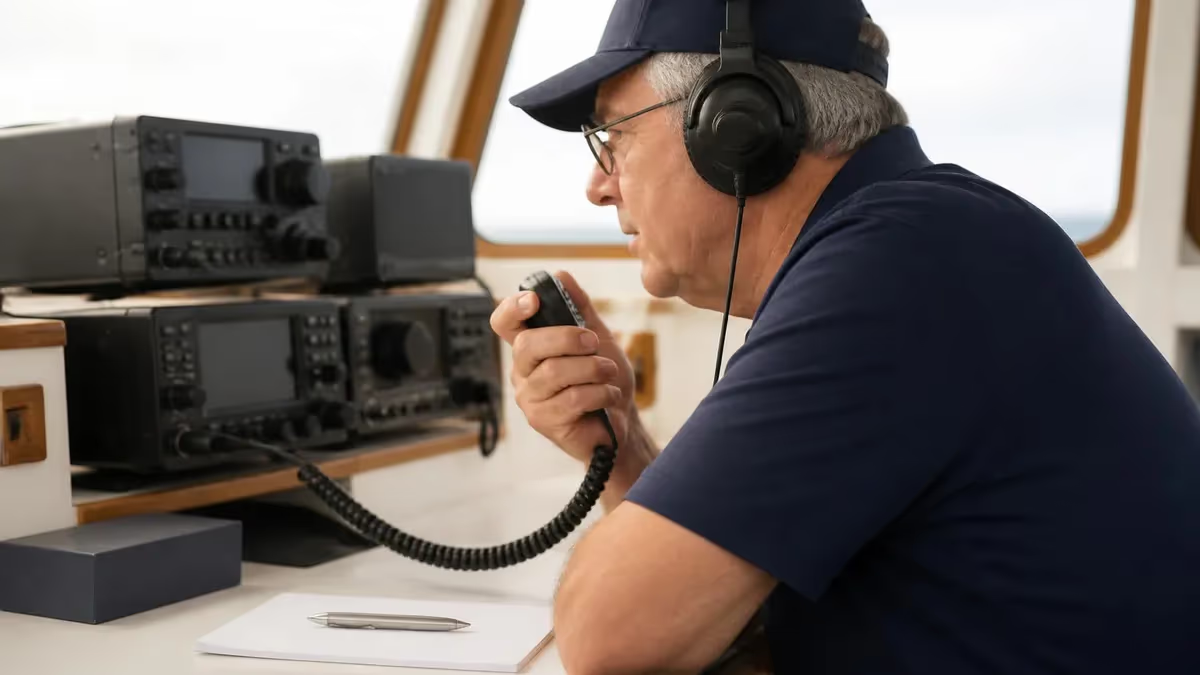
Getting an FCC ham radio license is your gateway to one of the most rewarding technical hobbies on the planet. Whether you want to chat with operators around the world, help your community during emergencies, or just tinker with radio gear in your basement, the Federal Communications Commission requires you to pass a written exam first. Don't worry though—the process is more straightforward than most people think, and millions of Americans have done it before you.
The FCC issues three classes of amateur radio licenses: Technician, General, and Amateur Extra. Each opens up more frequencies and privileges. You'll start with the Technician license, which requires passing a 35-question multiple-choice exam. There's no Morse code requirement anymore (that was dropped back in 2007), and the test itself draws from a public question pool you can study word-for-word. We've helped thousands of aspiring hams pass their exams.
By the time you finish reading, you'll understand the application process, fee structure, study resources, and exam day logistics. You'll also know how to navigate the FCC Universal Licensing System, what your call sign means, and how to renew or upgrade. Ready? Let's get you on the air.

FCC Ham Radio License By the Numbers
Key Facts at a Glance
| Item | Value | Details |
|---|---|---|
| Questions on Technician exam | 35 | |
| Passing score required | 74% | |
| FCC application fee | $35 | |
| License validity period | 10 yrs |
Those numbers tell you a lot. The Technician exam isn't trivial, but it's beatable with a few weeks of focused study. Most candidates spend 10 to 20 hours preparing, working through practice tests until they consistently score in the 85-90% range. Once you pass, your license is good for a decade before renewal—and renewal is free if you do it before expiration.
The $35 application fee was introduced by the FCC in April 2022. Before that, ham radio licenses were free to apply for, which understandably caused some grumbling in the community. That said, $35 every ten years works out to $3.50 per year, which is still one of the cheapest licenses you can hold from a federal agency.
Volunteer Examiners (VEs) who administer the test also charge a session fee, typically $15, though some clubs run free exam sessions for newcomers. Many local clubs sponsor monthly testing sessions in libraries, community centers, or club shacks. If you can't find a local session, online remote testing has expanded dramatically since 2020, and you can find a slot almost any day of the week.
The FCC eliminated the Morse code (CW) requirement for all amateur radio license classes on February 23, 2007. You no longer need to demonstrate any code proficiency to get any class of license—Technician, General, or Extra. Morse code is still hugely popular in the hobby, but it's now entirely optional. Many newcomers learn it later because it cuts through noise and weak signals better than voice modes.
This is one of the most common questions newcomers ask, so let's get it out of the way early. You will not be tapping out dits and dahs to pass your exam. The test is multiple choice, taken on paper or computer, and covers electronics theory, FCC regulations, operating practices, and basic radio safety. If you're worried about the technical content, take a deep breath.
The math involved is basic algebra, and the electronics questions stick to fundamentals like Ohm's Law, antenna basics, and how repeaters work. You don't need an engineering background. Plenty of teenagers, retirees, and folks who haven't cracked open a science book in decades pass the Technician exam every month. The trick is repetition with the actual question pool, not deep theoretical understanding.
That said, the General and Extra exams ramp up in difficulty. General introduces high-frequency (HF) operating privileges and more complex propagation theory. Extra dives into advanced topics like Smith charts, digital signal processing, and detailed FCC Part 97 regulations. Each class requires passing the lower-class exams first, so you can't skip Technician and jump straight to Extra. Well—you actually can take all three in one sitting if you're ambitious, but you have to pass them in order.
The Three FCC Amateur Radio License Classes
Entry-level license. 35-question exam. Grants all amateur privileges above 30 MHz (VHF/UHF) plus limited HF privileges on 10 meters. Perfect for local repeater operation, emergency communications, and digital modes like FT8.
Mid-tier license. Additional 35-question exam. Opens up most HF frequencies, allowing worldwide voice and digital communication. About 83% of the question pool is publicly available for study, so preparation is straightforward.
Top-tier license. 50-question exam covering advanced electronics, antenna theory, and complex regulations. Grants every amateur privilege the FCC allows. Required for some short, exclusive call sign formats and DXCC contesting at the highest levels.

Most new hams start with Technician and stay there for months or even years before upgrading. There's nothing wrong with that. The Technician class gives you access to 2-meter and 70-centimeter bands where most local repeater traffic happens, plus all the digital VHF/UHF modes.
You can talk through repeaters, run APRS for vehicle tracking, work satellites, and even bounce signals off the moon if you have the right gear. That last one—EME, or earth-moon-earth—does take serious antennas, but it's perfectly legal on Technician class privileges. The point is, Technician is not a starter license to outgrow. It's a full-featured ticket that thousands of hams happily use their entire lives.
That said, if you want to talk to operators in Japan, Argentina, or South Africa using just a wire antenna and 100 watts, you need General class privileges. HF (3-30 MHz) propagation lets signals travel thousands of miles by bouncing off the ionosphere. Many hams describe their first HF contact as the moment they truly fell in love with the hobby.
Extra class adds the final slivers of HF spectrum and is more about pride and contest advantage than practical capability for most operators. Whichever class you target first, the FCC treats each exam element as separate. Element 2 is Technician, Element 3 is General, and Element 4 is Extra. Pass Element 2 today, and you have one year to take Element 3 without retaking Element 2. Many exam sessions let you attempt multiple elements in a single sitting for one session fee, which is a great deal if you're well-prepared.
Exam Topics by License Class
The Technician exam covers ten subelements drawn from a question pool of about 425 questions. You'll see questions on FCC rules and regulations, operating procedures, radio wave propagation, amateur radio practices, electrical principles, circuit components, station equipment, modulation modes, antennas and feedlines, and electrical safety. None of it is heavy math, but you do need to memorize specific frequencies, power limits, and station identification rules.
One thing worth knowing: the question pools rotate on a four-year cycle. The Technician pool is currently valid through June 30, 2026, after which a revised pool takes effect. If you're studying now, make sure your materials match the current pool. Pools are published by the National Conference of Volunteer Examiner Coordinators (NCVEC) and are free to download from their website.
Practice tests are your best friend. Sites like ours generate randomized exams from the official pool so you see new combinations every time. Drill until you're consistently scoring above 85%. When you hit the actual exam, the questions will look familiar because they're literally pulled from the same pool you've been studying. This is one of the few standardized tests where memorization is officially encouraged.
A common study schedule looks like this: week one, read through a study guide chapter by chapter. Week two, start hitting practice tests, missing about 30-40% of questions. Week three, focus on the topics where you keep failing. Week four, take full-length timed practice exams. By the end of that fourth week, you should be passing 8 out of 10 mock exams with 85%+ scores. That's when you book your real test.
Since April 19, 2022, the FCC charges a $35 application fee for new amateur radio licenses, upgrades that change call sign, and renewals. The fee is paid through the FCC's CORES system after you receive an email from the FCC linking to your application. You have 10 days to pay or your application is dismissed. The fee is separate from any session fee charged by the Volunteer Examiners administering your test.
The fee structure tripped up a lot of newcomers when it first launched. Here's the flow. You take your exam, pass it, and the VE team submits your results to a Volunteer Examiner Coordinator (VEC). The VEC files your application with the FCC, which then emails you a link to pay the $35 fee.
Until you pay, your license isn't granted. Most people get their call sign within 7-10 business days after payment. Some VEs collect a session fee upfront, typically $15, which goes to the VEC organization (like ARRL or W5YI) to cover administrative costs.
Free exam sessions exist too, especially through ham radio clubs that want to grow the hobby. Check your local club's website or look up exam sessions on the ARRL website to find one near you. Online remote testing has also exploded in popularity since 2020, with sessions running daily through various VECs. Online sessions typically cost $15-$25, run on flexible schedules including evenings and weekends, and use webcam proctoring to monitor the exam environment.
Steps to Get Your FCC Ham Radio License
- ✓Register for an FCC Registration Number (FRN) through the CORES system
- ✓Download the current Technician question pool from NCVEC
- ✓Study using free practice tests and a study guide like the ARRL manual
- ✓Take practice exams until you consistently score above 85%
- ✓Find a local or online exam session via ARRL or W5YI VEC
- ✓Bring your FRN, photo ID, and session fee to the exam
- ✓Pass the 35-question exam with at least 26 correct answers
- ✓Wait for the FCC email and pay the $35 application fee within 10 days
- ✓Look up your new call sign in the FCC ULS database
- ✓Get on the air legally and have fun
The FRN (FCC Registration Number) is one step a lot of newcomers skip and then scramble for on exam day. You absolutely must have an FRN before you take your exam. The good news is that registration is free and takes about five minutes through the FCC's COmmission REgistration System (CORES).
You'll create a username, link a Social Security Number (required by federal law for amateur radio licensing), and receive your ten-digit FRN immediately. Write that number down somewhere safe. You'll use it again at every renewal, upgrade, and address change.
Some people are uncomfortable handing over their SSN. Unfortunately, the FCC requires it—there's no workaround. The agency uses it solely for licensee identification and doesn't share it publicly. Your call sign, name, and address are public records, but your SSN is not. If privacy is a serious concern, you can also use a Tax Identification Number (TIN) if your situation qualifies, but for the vast majority of applicants, SSN is the path of least resistance.
Getting Your FCC Ham Radio License: Pros and Cons
- +Legal access to over 1,300 amateur frequencies
- +License is valid for 10 years before renewal
- +Free renewal if filed before expiration date
- +No Morse code requirement for any license class
- +Question pools are public—you can study the exact questions
- +Emergency communications privileges during disasters
- +Worldwide community of over 750,000 US hams
- −$35 FCC application fee every 10 years
- −Equipment costs can run from $30 to thousands of dollars
- −Initial study time of 10-30 hours required
- −SSN must be provided for FCC registration
- −Tower and antenna restrictions in some HOA neighborhoods
- −Technician class limited HF privileges—General upgrade needed for DX
Once you have your license in hand, you're authorized to transmit on amateur frequencies anywhere in the United States and its territories. Your call sign identifies you on every transmission. The FCC requires station identification at least once every 10 minutes during a contact and at the end of each contact.
Call signs follow a structured format: one or two letters, a number indicating the call district (0-9), and one to three letters. For example, KE9XYZ is a Technician or General class call sign issued in the 9th call district, which covers Illinois, Indiana, and Wisconsin. The letters at the start hint at when the call sign was issued—older calls tend to start with W or K, while newer ones often begin with KE, KF, or KG.
You can also apply for a vanity call sign once licensed. Vanity call signs let you choose a specific format. Maybe your initials, a memorable sequence, or a call sign with personal meaning. Extra class licensees get access to the shortest 1x2 and 2x1 formats (like K1A or AB1A), which are highly coveted and often have years-long waiting lists. The vanity application also costs $35, just like a new license application.
Renewing your license is one of the easiest interactions you'll have with the FCC. About 90 days before expiration, log into the ULS, find your license, and submit a renewal application. The renewal fee is $35, payable through CORES. If you let your license expire, you have a two-year grace period during which you can still renew without retaking the exam. But you cannot transmit during that grace period. After two years past expiration, your call sign returns to the available pool and you have to start over with a new exam.
FCC Ham Radio License Questions and Answers
Getting an FCC ham radio license opens up a lifelong hobby that combines technology, community, and public service. The exam isn't a barrier. It's a starting line. Once you have that call sign, doors open to local repeaters, weekly nets, contests, satellite work, emergency communications volunteering through ARES and RACES, and a worldwide community of operators who'll talk to you on day one.
We've seen newcomers go from never having touched a radio to running their own DX expeditions within a couple of years. The hobby rewards curiosity and persistence, and the FCC license is your ticket to all of it. There are clubs in every major city, online forums full of friendly experts, and YouTube channels dedicated to every imaginable specialty—from QRP low-power operating to digital modes to building your own antennas from scrap wire.
Start by registering for your FRN, grab a study guide that matches the current Technician question pool, and commit to 30 minutes of practice tests a day for two weeks. You'll be amazed how quickly the material sinks in. The questions repeat by design, and your brain starts pattern-matching after a few sessions.
When you feel ready, book an exam session and take it. Worst case, you don't pass and you try again next month. But with focused study, most candidates pass on their first attempt. Good luck, and we'll see you on the air.
Equipment costs are another common worry for new hams. The good news: you can get on the air for less than $40 with a basic Baofeng handheld radio. These Chinese-made HTs aren't fancy, but they work fine for local repeater contacts and getting your feet wet. Once you decide you love the hobby, you can upgrade to better radios from Yaesu, Icom, or Kenwood for $150-$500. Full HF transceivers run $700-$3,000 for new units, though the used market is strong and friendly to newcomers.
Antennas are where many hams spend the most time tinkering. A simple dipole made from $20 of wire and coax can outperform a $500 commercial antenna if it's mounted well. Repeater clubs often have club shacks with antennas you can use, and many hams happily mentor newcomers on antenna design. That mentorship culture—known in the hobby as 'Elmering'—is one of the things that sets ham radio apart from other technical hobbies.
Emergency communications is one of the most compelling reasons to get licensed. When cell networks fail during hurricanes, wildfires, or earthquakes, ham radio keeps working. Organizations like ARES (Amateur Radio Emergency Service) and RACES (Radio Amateur Civil Emergency Service) coordinate with local emergency management to provide backup communications. Hospitals, Red Cross chapters, and county emergency operations centers all rely on ham radio volunteers during disasters. Your Technician license is enough to start volunteering on day one.
One final tip for newcomers: join a local club before you even sit for the exam. Most clubs have weekly meetings, monthly testing sessions, and members who love nothing more than helping a brand-new ham get on the air. The American Radio Relay League (ARRL) maintains a club finder on its website. Type in your zip code and you will find hams within a few miles of your home ready to welcome you to the hobby.
About the Author

Educational Psychologist & Academic Test Preparation Expert
Columbia University Teachers CollegeDr. Lisa Patel holds a Doctorate in Education from Columbia University Teachers College and has spent 17 years researching standardized test design and academic assessment. She has developed preparation programs for SAT, ACT, GRE, LSAT, UCAT, and numerous professional licensing exams, helping students of all backgrounds achieve their target scores.
Join the Discussion
Connect with other students preparing for this exam. Share tips, ask questions, and get advice from people who have been there.
View discussion (8 replies)