
General Knowledge MCQ: Master Multiple-Choice Questions for the GKT 2026 October
Master general knowledge MCQ questions for the FTCE GKT. 🧠 Learn formats, top topics, and proven strategies to pass Florida's teacher certification exam.

If you are preparing for the Florida Teacher Certification Examination, understanding how to approach general knowledge mcq questions is one of the most important skills you can develop. The General Knowledge Test, commonly called the GKT, relies heavily on multiple-choice questions across its four subtests, and your ability to read, analyze, and eliminate answer choices efficiently will directly determine your score. Thousands of aspiring Florida teachers sit for this exam each year, and those who invest time in targeted MCQ practice consistently outperform those who only review content without practicing the format itself.
Multiple-choice questions on the GKT are not simply recall exercises. Each question is carefully constructed to test your reasoning as much as your factual knowledge. The distractors — the incorrect answer choices — are written to reflect common misconceptions and partial understandings, which means that a surface-level grasp of the material often leads you straight into a trap. Understanding why wrong answers are wrong is just as valuable as knowing why the correct answer is right, and this distinction separates high-scoring candidates from those who just miss the passing threshold.
The GKT covers four broad areas: English Language Skills, Reading, Essay, and Mathematics. Each of the first three content areas includes multiple-choice sections where you must demonstrate command of grammar, reading comprehension, and analytical thinking. The Mathematics subtest is entirely multiple-choice and covers everything from basic algebra and geometry to data interpretation and measurement. Together, these sections require a wide-ranging preparation strategy that balances content review with question-format fluency.
One reason general knowledge MCQ preparation matters so much for Florida teacher candidates is that the passing standards are fixed and non-negotiable. You must earn a minimum scaled score of 200 on each subtest, and there is no partial credit on individual questions. Every point comes from correctly answered multiple-choice items, which means your test-taking strategy — how you pace yourself, how you handle uncertainty, and how you use process of elimination — is as critical as the knowledge you carry into the room.
Many candidates underestimate how much time they will spend on the Mathematics subtest. The GKT Math section includes 45 scored multiple-choice questions, and the content spans a wide range of topics that some candidates have not reviewed since high school. Fractions, ratios, linear equations, geometric relationships, and statistical reasoning all appear. If you have been out of a math classroom for several years, targeted MCQ practice is the fastest way to identify your weak areas and rebuild your problem-solving confidence before test day.
Practice tests designed around the GKT's actual format give you more than content exposure — they train your brain to work under the specific time constraints and question structures of the real exam. When you sit down with a timed practice set of 45 mathematics questions or a 40-question reading section, you are not just reviewing knowledge.
You are building the mental stamina, pacing instincts, and decision-making habits that will carry you through exam day. This article walks you through everything you need to know about the GKT's MCQ structure, top-scoring strategies, and the most efficient study approaches available to Florida teacher candidates today.
GKT Multiple-Choice Questions by the Numbers

GKT Exam Format and MCQ Breakdown
This subtest includes 40 multiple-choice questions covering grammar, sentence structure, punctuation, and word usage. You have 40 minutes to complete the section. Questions test your ability to identify errors and select the most effective revision for standard academic writing.
The Reading subtest contains 40 multiple-choice questions based on passages you read during the exam. You are given 55 minutes and tested on main idea, supporting detail, inference, vocabulary in context, and the author's purpose across both literary and informational texts.
The Math subtest is the largest MCQ section with 45 scored questions and a 100-minute time limit. Topics include number sense, algebra, geometry, measurement, statistics, and probability. A four-function on-screen calculator is available for some items but not all.
While the Essay subtest requires a written response rather than MCQ answers, strong essay performance depends on many of the same grammar and reasoning skills tested in the multiple-choice sections. It is scored separately and requires a minimum score of 8 out of 12.
Approaching GKT multiple-choice questions effectively starts before you read a single answer choice. Your first step on every question should be to read the question stem carefully and formulate your own answer before looking at the options. This technique — called pre-answering or stem isolation — prevents the distractors from hijacking your thinking. The test writers craft wrong answers to sound plausible, especially to candidates who are slightly uncertain about the material. If you generate your own response first, you are much less likely to be seduced by a tempting but incorrect choice.
Process of elimination is your second most powerful tool on any MCQ exam, and the GKT is no exception. Even when you are unsure of the correct answer, you can almost always identify one or two choices that are clearly wrong. Eliminating those options immediately improves your odds from 25 percent to 50 percent or better, and it reduces the cognitive load of making your final decision. On the Mathematics subtest in particular, estimation and number sense can help you rule out unreasonable answers even when you cannot solve a problem precisely.
Time management on GKT MCQ sections requires deliberate practice before exam day. The English Language Skills section gives you exactly one minute per question on average, while the Reading section allows slightly more time per item given the passage-reading overhead. Math gives you a generous two-plus minutes per question, but complex multi-step problems can easily consume four or five minutes if you are not careful. During your study sessions, always practice with a timer to internalize what a comfortable pace feels like and to identify which question types consistently slow you down.
Flagging and returning to difficult questions is a legitimate and recommended strategy on the GKT. The exam interface allows you to mark questions for review and come back to them at the end of a section. Many test-takers make the mistake of spending too long on hard questions early in a section, running out of time before they reach easier questions near the end. A better approach is to move through the section at a steady pace, answer everything you can confidently, flag the uncertain ones, and then return with whatever time remains.
Reading comprehension MCQs on the GKT require a particular kind of active engagement with the passage. Rather than reading every word at the same speed, train yourself to read for structure first: identify the main idea, spot the topic sentences of each paragraph, and note any shifts in tone or argument. Then when you return to answer specific questions, you know exactly where in the passage to look. This targeted approach is far more time-efficient than re-reading entire passages for each question and is a skill that improves rapidly with deliberate practice.
For the English Language Skills MCQs, a large percentage of questions ask you to identify the version of an underlined phrase or sentence that is grammatically correct and stylistically clean. The most common errors tested include subject-verb agreement, pronoun-antecedent agreement, comma splices, dangling modifiers, and faulty parallelism.
If you review these six or seven grammar concepts in depth and practice recognizing them in context, you will have the tools to handle the vast majority of English Language Skills questions correctly. The GKT does not test obscure or highly technical grammar rules — it focuses on the clear, functional errors that matter in real professional writing.
One underappreciated aspect of MCQ preparation for the GKT is building your vocabulary for the reading section. Questions that ask about the meaning of a word as used in context do not require you to know every definition of a word — they require you to read surrounding sentences carefully and use context clues to determine which meaning applies. Practice this skill explicitly by reading academic articles and newspaper editorials and stopping on unfamiliar words to infer their meaning before checking a dictionary. This habit will serve you well both on the GKT and throughout your teaching career.
GKT MCQ Topics: What You Need to Know
The GKT Mathematics subtest covers six broad content domains in its multiple-choice questions. Number sense and operations questions ask you to work with fractions, decimals, percentages, ratios, and proportions in real-world contexts. Algebraic reasoning questions require you to solve linear equations, interpret expressions, and recognize patterns. Geometry and measurement items test your understanding of area, perimeter, volume, angle relationships, and the coordinate plane.
Data analysis questions, which appear regularly on the GKT Math MCQ section, ask you to read tables, bar graphs, line graphs, and pie charts and draw accurate conclusions from them. Statistics and probability items may ask you to calculate mean, median, or mode, or to determine the likelihood of a simple event. These applied questions often trip up candidates who know the formulas but struggle to transfer them to realistic scenarios like classroom budgets, student data comparisons, or science experiment results — exactly the contexts a practicing teacher would encounter.

Multiple-Choice Format: Advantages and Challenges for GKT Candidates
- +The answer is always present — you never have to generate it from scratch, which reduces test anxiety.
- +Process of elimination allows you to score correct answers even when you are not fully certain of the material.
- +Multiple-choice questions are faster to answer than constructed-response items, giving you more attempts per minute.
- +Consistent question formats across GKT subtests make it easier to develop transferable test-taking strategies.
- +Practice tests mirror the exact difficulty and style of real exam questions, so preparation directly translates to performance.
- +Objective scoring means your answers are either right or wrong — there is no penalty for a difference of opinion with a grader.
- −Well-crafted distractors are designed to trap candidates who have partial or surface-level understanding of the material.
- −No partial credit means a careless mistake on a question you almost knew costs you as much as a question you never studied.
- −The format can reward test-taking skill over deep understanding, which may not reflect actual teaching competence.
- −Time pressure on the Math subtest can prevent candidates from working through complex multi-step problems carefully.
- −Guessing without strategy provides only a 25% chance of success per question, which is not enough to rescue a poorly prepared candidate.
- −Reading comprehension MCQs require sustained attention — fatigue in a long sitting can cause careless misreading of answer choices.
GKT MCQ Study Checklist: 10 Steps Before Exam Day
- ✓Complete at least three full-length timed GKT practice tests to build pacing and endurance.
- ✓Review your incorrect answers on every practice test and write down why each correct answer is right.
- ✓Study the six most common grammar error types tested on the English Language Skills subtest.
- ✓Practice reading academic passages and answering inference-based questions without re-reading unnecessarily.
- ✓Memorize key geometry formulas (area, perimeter, volume) and the order of operations for algebra problems.
- ✓Practice data interpretation by reading graphs and tables from news sources and answering your own questions.
- ✓Time yourself on individual question types to identify which categories consistently slow you down.
- ✓Use process of elimination deliberately on every practice question, even when you know the answer.
- ✓Review GKT scoring requirements and confirm you understand the 200-point minimum for each subtest.
- ✓Schedule your final full-length practice test at least one week before exam day to allow for final review.
Why Wrong Answers Are Your Best Study Tool
Research on high-stakes test preparation consistently shows that reviewing incorrect answers in detail — not just noting which questions you missed — produces the greatest score gains. When you study a wrong answer, you force your brain to confront the specific misconception that led you astray. On the GKT, this process is especially powerful because the distractors are carefully designed to exploit the most common gaps in candidate knowledge. Every wrong answer you analyze is a targeted lesson in exactly what the exam is testing.
One of the most common mistakes GKT candidates make is treating every multiple-choice question as equally important and spending equal time on each one. In reality, some questions are straightforward recall items that you can answer in fifteen seconds, while others involve multi-step reasoning that might legitimately require two minutes. Developing the judgment to recognize which type of question you are dealing with — and allocating your time accordingly — is a skill that develops through repeated timed practice, not through content review alone.
Another widespread mistake involves misreading question stems under time pressure. Questions that include the words NOT, EXCEPT, or LEAST are especially dangerous because candidates in a hurry often skip those qualifier words and answer the opposite of what is being asked. If you miss the word NOT in a reading comprehension question, you will select an answer that is directly supported by the passage — which is exactly what the test wants you to avoid. Train yourself to underline or mentally flag negatives in question stems every single time, even when you are racing against the clock.
On the Mathematics subtest, one of the most costly errors is failing to re-read what the question is actually asking after you have completed your calculation. Many math MCQ questions ask for something slightly different from the most obvious computation — they might ask for the perimeter when you computed the area, or the probability that an event does NOT occur when you found the probability that it does.
These finish-line errors are heartbreaking because they represent questions where you did all the hard mathematical work correctly and then lost the point on the last step. Re-reading the question stem before selecting your answer is a thirty-second habit that can easily save you three or four points per exam.
Candidates who struggle with reading comprehension MCQs often do so because they try to answer questions from memory rather than returning to the passage. Even experienced readers misremember details from a dense academic passage under time pressure. Always locate the relevant section of the passage before confirming your answer, especially on detail questions. For inference questions, find the sentences in the passage that most directly support your reasoning and check that your inference does not go further than what the text actually implies. The GKT Reading section rewards conservative, text-based reasoning over creative interpretation.
The English Language Skills subtest trips up many candidates on pronoun reference questions. These items present sentences where a pronoun — typically it, they, this, or which — has an ambiguous or incorrect antecedent. The correct answer almost always replaces the ambiguous pronoun with a specific noun. When reviewing your grammar, spend extra time on pronoun agreement and reference rules because these errors appear in real teacher writing with troubling frequency, and the GKT is specifically designed to ensure Florida's teachers can identify and correct them.
Test anxiety affects a significant number of GKT candidates, particularly on retake attempts after an initial failure. Multiple-choice format can actually help manage anxiety because it limits open-ended uncertainty — there is always a correct answer visible on the screen, and your job is simply to identify it. Reframing the exam as a recognition task rather than a recall task can reduce the pressure significantly. Remind yourself during practice sessions and on exam day that you do not need to know everything from memory — you need to read carefully, reason systematically, and trust your preparation.
Finally, do not underestimate the value of sleep and physical preparation in the forty-eight hours before your GKT exam. Research in cognitive psychology consistently shows that sleep consolidates declarative memory — exactly the kind of knowledge that MCQ questions test.
Candidates who stay up late cramming the night before an exam often perform worse than those who reviewed moderately and slept well. Build your knowledge base steadily over weeks of preparation, and treat the final two nights as recovery time rather than last-minute study sessions. Show up to the exam rested, fed, and confident in the work you have already done.
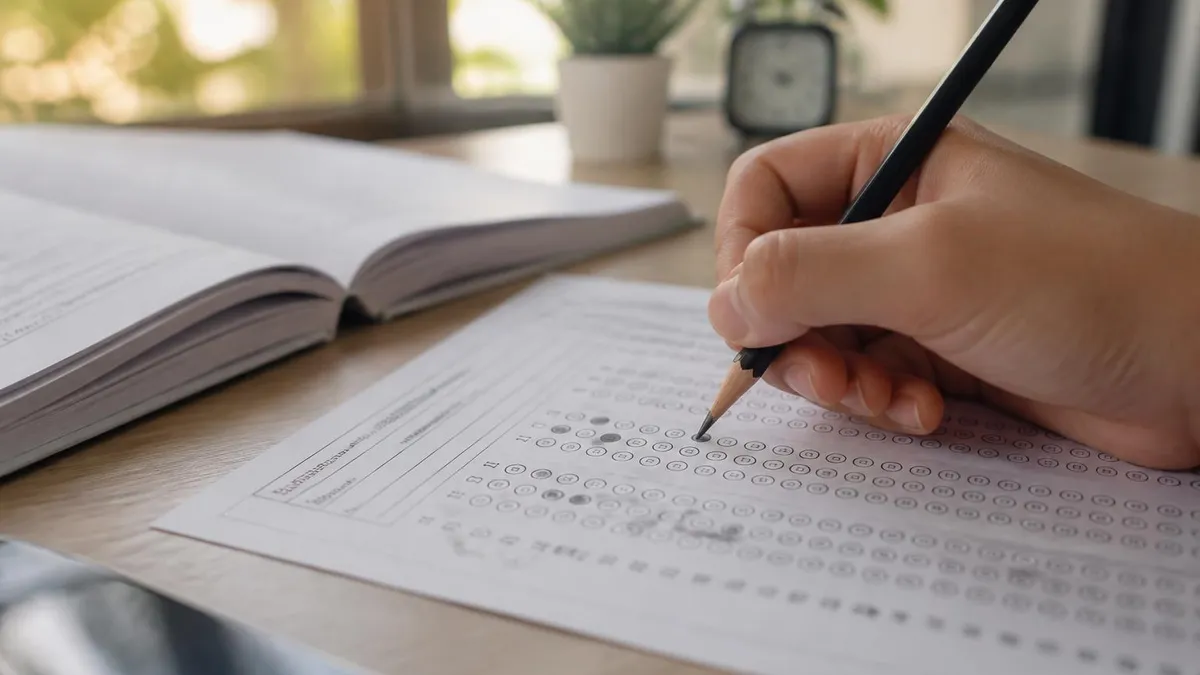
Each GKT subtest is scored independently, and you must achieve a minimum scaled score of 200 on each one separately. If you pass three subtests but fail Mathematics, you must retake only the Math subtest — but you must still pay the full exam fee. There is a mandatory waiting period between retake attempts, and Florida's educator certification office requires valid scores on all four subtests before issuing your certificate. Plan your preparation timeline so that you are genuinely ready for every subtest before your scheduled exam date.
Building an effective long-term study plan for GKT MCQ preparation begins with an honest diagnostic assessment. Before you open a study guide or review a single grammar rule, take a full-length practice test under realistic timed conditions and score it honestly. This baseline assessment will reveal exactly which subtests and which question types are your strongest and weakest areas. From there, you can build a prioritized study schedule that devotes the most time to your lowest-scoring areas while maintaining your strengths through periodic review.
For most candidates, the GKT Mathematics subtest requires the most dedicated study time. If your diagnostic reveals significant gaps in algebra, geometry, or data analysis, plan for six to eight weeks of focused daily math practice. Work through the core content topics systematically, then switch to timed MCQ practice sets that mirror the actual exam format. Use your mistakes as a diagnostic tool: if you are consistently missing geometry questions, return to the content level before attempting more timed practice. Trying to improve your score through test-taking strategy alone will not work if your content knowledge has real gaps.
The Reading subtest typically improves fastest with volume and variety of practice. Read widely — academic articles, editorial pieces, literary excerpts, and scientific summaries — and practice answering your own comprehension questions as you read. The GKT Reading passages are drawn from a broad range of academic and professional contexts, and candidates who read diversely are rarely surprised by passage content on exam day. The more types of writing you encounter in your preparation, the more readily you will be able to orient yourself quickly to a new passage under time pressure.
For the English Language Skills subtest, a targeted grammar review is more efficient than broad rereading of style manuals. Focus on the error categories that appear most frequently on the GKT: subject-verb agreement, comma usage, pronoun reference, parallel structure, and commonly confused words. Use official practice materials and GKT-aligned question sets rather than generic grammar workbooks, because the GKT tests grammar in the context of actual sentences and paragraphs, not through isolated exercises. The goal is to recognize error patterns in context, not to memorize abstract rules.
Study groups can be surprisingly effective for GKT MCQ preparation, particularly for the Reading and English Language Skills subtests. Working through practice questions with other candidates forces you to articulate your reasoning, which deepens your understanding and exposes logical errors in your thinking. When you explain why a particular answer choice is wrong, you are consolidating that knowledge in a way that silent individual study cannot match. If you can find two or three other GKT candidates at a similar preparation level, regular group study sessions can accelerate everyone's progress significantly.
Online resources and official FTCE materials are your most reliable study tools. The Florida Department of Education publishes competencies and skills documents for each GKT subtest that list exactly which knowledge areas are tested. These documents should guide your content review — if a topic does not appear on the official competencies list, it will not appear on your exam. Supplementing these official materials with high-quality practice tests from reputable test prep providers gives you both content knowledge and format familiarity. Always prioritize sources that are specifically aligned to the current GKT format over generic test prep materials.
As your exam date approaches, shift the balance of your preparation from content review to timed practice. In the final two to three weeks, aim to complete at least one full-length timed practice test per week and review every question — right and wrong — in detail afterward. Track your scores across practice tests to confirm that you are improving and to identify any persistent weak areas that need one final targeted review. Walking into the GKT with recent evidence of consistent practice-test performance in the passing range is the most reliable source of exam-day confidence available to any candidate.
The final weeks of GKT preparation are about consolidation and confidence-building, not learning entirely new material. At this stage, you should be spending most of your study time on full-length timed practice tests and detailed answer review, not on reading new content or memorizing fresh concepts. If a topic keeps appearing in your wrong answers during these final practice sessions, do a focused thirty-minute content review on that specific area and then immediately apply what you reviewed through five to ten targeted practice questions. This tight review-and-apply loop is far more efficient than broad re-reading at this late stage.
On exam day itself, your physical and mental state matters more than any last-minute content review. Arrive at the testing center early enough to get settled without rushing. Bring valid identification as required by your registration confirmation. Take advantage of any scheduled breaks between subtests to stand up, breathe, and reset your focus before the next section.
Many candidates front-load their anxiety on the first subtest and then find that their performance improves as the exam progresses and their nerves settle — knowing this pattern in advance can help you stay calm even if your first subtest feels harder than expected.
During the exam, use the full time available on each subtest. Many candidates finish early and leave without reviewing their flagged questions, only to realize later that they answered a flagged question carelessly or misread a question stem.
If you finish a section with ten or fifteen minutes remaining, return to your flagged questions first, then scan your entire answer set for any responses that feel uncertain. Do not change an answer unless you have a specific reason to — research consistently shows that first instincts on MCQ exams are correct more often than second-guessed revisions, but a genuinely new insight is worth acting on.
After your exam, your score report will arrive within a few weeks and will show your scaled score for each subtest. If you pass all four on your first attempt, congratulations — you have cleared one of the most important hurdles on the path to Florida teacher certification.
If you need to retake a subtest, use your score report to guide your next preparation cycle. The score report does not show you which specific questions you missed, but it does indicate your performance by content domain, which is enough to identify your most productive areas for focused study before your retake.
Many GKT candidates find that their confidence on multiple-choice questions grows dramatically between their first and second practice test, and again between their second and third. This progression is not just familiarity with the material — it reflects a genuine improvement in test-taking skill, pattern recognition, and time management that comes only from deliberate practice in the actual MCQ format. The investment in that practice pays dividends not just on the GKT but on the subject area exams that follow it in the Florida teacher certification process, where multiple-choice questions remain the dominant format.
If you are just beginning your GKT preparation, the most important action you can take today is to start. Take a diagnostic practice test, review your results honestly, and build a study schedule that is specific enough to hold you accountable but flexible enough to adapt as your strengths and weaknesses evolve. The GKT is a manageable exam for candidates who prepare systematically — it is not designed to trick brilliant minds, but to confirm that Florida's teachers have the foundational academic skills their students will need them to model. That mission is entirely achievable with focused, consistent preparation.
The resources available to GKT candidates today are better than at any previous point in the exam's history. High-quality online practice tests, targeted content review materials, and detailed explanations for every question type make it easier than ever to prepare effectively without expensive in-person tutoring. The most successful candidates combine these digital resources with a disciplined personal study schedule, regular practice test reviews, and honest self-assessment. Treat your GKT preparation as a professional investment — because that is exactly what it is — and you will arrive at your exam date ready to perform at your best.
GKT Questions and Answers

History General Knowledge: What the GKT Tests and How to Prepare

General Knowledge Questions: Topics, Formats & How to Study

General Knowledge Book: Your Complete GKT Study Resource Guide

Define General Knowledge: What It Means for the GKT and Your Teaching Career

General Knowledge Test Florida: Complete Guide to the FTCE GKT
About the Author

Educational Psychologist & Academic Test Preparation Expert
Columbia University Teachers CollegeDr. Lisa Patel holds a Doctorate in Education from Columbia University Teachers College and has spent 17 years researching standardized test design and academic assessment. She has developed preparation programs for SAT, ACT, GRE, LSAT, UCAT, and numerous professional licensing exams, helping students of all backgrounds achieve their target scores.