
Can I Be My Own General Contractor? Owner-Builder Guide 2026 September
Free Can I Be My Own General Contractor? practice test with questions and answer explanations. 🗨️ Prepare for the 2026 September exam with instant scoring.
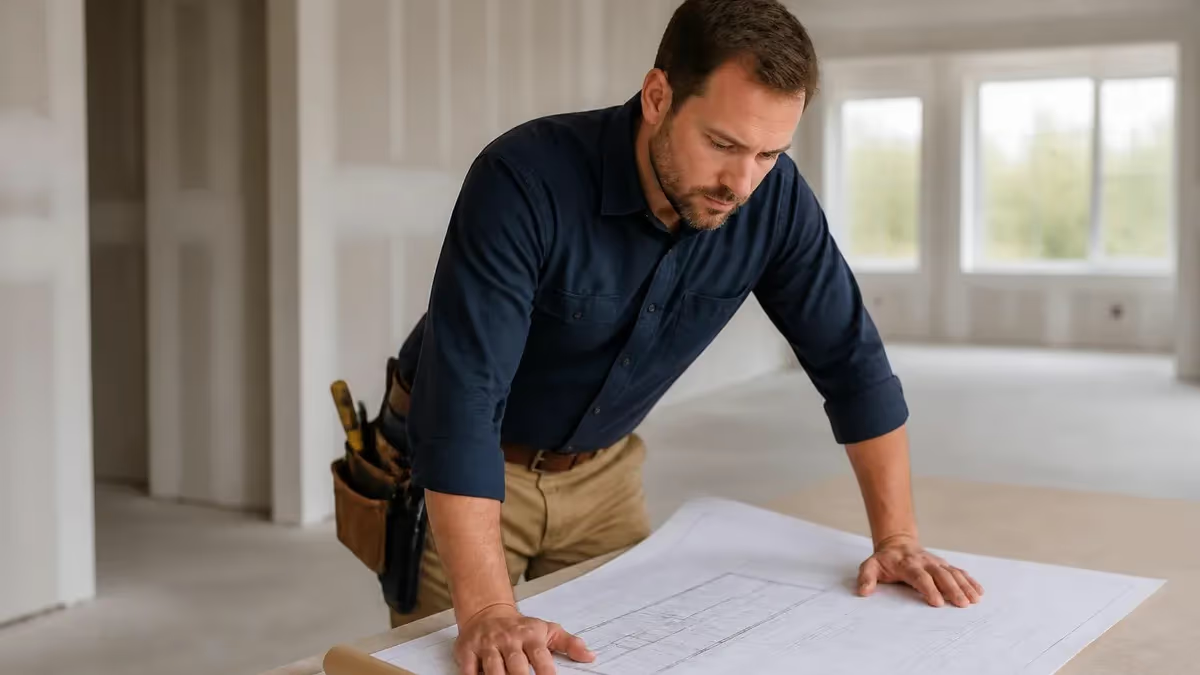
Can You Legally Be Your Own General Contractor?
In most U.S. states, the answer is yes — with conditions. State contractor licensing laws include an 'owner-builder exemption' that allows homeowners to act as their own general contractor on construction projects involving their own home. This exemption exists because the purpose of licensing laws is to protect the public from unqualified contractors, and a homeowner building or remodeling their own residence is not 'the public' in the same sense — they're taking on personal risk for their own property.
The exemption typically requires that the home is your primary residence, that you don't intend to sell the property immediately after construction (states vary on how long you must own it), and that you personally manage the project rather than hiring an unlicensed person to act as a de facto GC on your behalf. The 'personal management' requirement is important — if you hire a friend to run the project for pay while you stay hands-off, most states consider that an unlicensed contracting arrangement regardless of your technical ownership of the property.
Understanding your state's specific owner-builder exemption rules is essential before you commit to this approach. While the general principle is consistent across most states, the details vary significantly. Some states require you to file an owner-builder disclosure with the permit office. Some limit how many owner-builder permits you can pull within a certain period to prevent investors from abusing the exemption for spec homes. A few states have no exemption at all and require a licensed contractor for all permitted work regardless of who owns the property.
Checking your state's specific exemption rules is as simple as calling your local building department or reviewing the state contractor licensing board's FAQ. Most boards publish clear guidance on the owner-builder exemption, including any disclosure forms you're required to file. Some states post this information prominently because misunderstandings about the exemption are a common source of permit violations — homeowners who didn't realize a licensed contractor was required for their specific project type find out after the permit is denied or the work fails inspection.
One question that comes up frequently is whether a homeowner can use an owner-builder permit to supervise their adult family members who are doing the physical work. In most states, yes — you can have family members help with construction labor without requiring them to be licensed, as long as you're the managing owner and the work is genuinely on your personal residence. What you cannot do is pay non-family members for unlicensed trade work that requires a license, or use the owner-builder status to effectively run a contracting operation disguised as personal construction.
Municipal regulations can add requirements on top of what state law mandates. Some cities and counties require owner-builders to pass a brief examination or attend an orientation before issuing an owner-builder permit. Some jurisdictions require more frequent inspections on owner-built projects than on licensed GC projects, essentially compensating for the reduced professional oversight with more regulatory oversight. When you pull your first owner-builder permit, ask the building department what additional local requirements apply in your jurisdiction — don't assume the state-level rules are the only rules you need to follow.
The Real Challenges of Being Your Own General Contractor
Acting as your own GC is genuinely viable for homeowners with relevant construction experience or strong project management skills, but it's routinely harder than it looks from the outside. The challenges that trip up owner-builders most often are not technical knowledge of the trades — they're the coordination and administrative demands that experienced GCs handle as second nature.
Subcontractor scheduling is the single biggest operational challenge. A licensed GC has working relationships with reliable subcontractors they call regularly — the GC's volume of business makes them a priority customer, and subs show up on time because they want to stay on the GC's regular call list.
An owner-builder on a single project has no leverage with busy subcontractors, and scheduling conflicts — the plumber who can't come until next week after you've already framed around where the pipes need to go — cascade through every phase of the project. Every delay in one trade pushes back the trades that follow.
Permit and inspection sequencing is another area where owner-builders commonly struggle. Building inspectors approve work at specific stages of construction — you can't pour the concrete until the foundation inspection clears, you can't close the walls until the rough electrical and plumbing inspections pass. An experienced GC knows exactly when to call for inspections and how to sequence work so nothing sits idle waiting for an inspector. Owner-builders often learn these sequences by trial and error, which means delays and occasionally having to redo work that was done out of order.
Lien exposure is a legal risk that owner-builders need to understand before they start writing checks to subcontractors. In most states, subcontractors and material suppliers have the right to file a mechanic's lien against your property if they're not paid — even if you paid your GC (or if the GC paid a supplier who didn't pass payment along). When you're the GC, you interact directly with subcontractors and suppliers, and you need to use lien releases and payment practices that protect your property title.
This is standard practice for experienced GCs; owner-builders often don't know about it until they receive a lien notice after paying everyone they thought they had to pay.
Cost savings from owner-building are real but often overstated. A licensed GC typically marks up subcontractor labor 15-25% and materials with similar margins. Eliminating that markup sounds like a big saving, but an experienced GC also negotiates better sub pricing from their preferred trade relationships, catches costly mistakes before they become expensive fixes, and manages the project timeline efficiently. Owner-builders frequently find that delays, rework, and mistakes absorb more than the margin they saved. The savings are most reliable for homeowners who have genuine construction experience and are realistic about how much of their own labor they can contribute.
Material procurement is another area where owner-builders often underestimate the complexity. Licensed GCs have accounts with lumber yards, plumbing supply houses, and electrical distributors that provide contractor pricing — often 15-30% below retail. An owner-builder buying materials without contractor accounts pays retail pricing unless they can negotiate a contractor account in their own name, which requires some volume to justify.
On a large project, the difference between contractor and retail pricing on materials alone can be significant. Some owner-builders work around this by having subcontractors supply their own materials within the bid price, though this means giving up direct control over material quality and timing.

Before You Act as Your Own General Contractor
- ✓Confirm your state's owner-builder exemption rules — call your local building department or check the state contractor licensing board's website
- ✓Verify that the project type qualifies — some states restrict the exemption to primary residences or limit project value
- ✓Research whether your state requires an owner-builder disclosure form at permit application
- ✓Get bids from at least three subs for each trade before committing to a project budget — GC markup is real but so is subcontractor price variance
- ✓Understand your state's mechanic's lien laws before writing your first check — use conditional and unconditional lien releases at each payment
- ✓Check your homeowner's insurance — construction projects often require a builder's risk policy that your standard policy doesn't cover
- ✓Build a 20-30% contingency into your budget — owner-builder projects routinely run over due to unforeseen conditions and learning curve costs
- ✓Talk to your lender before you start — some construction loans require a licensed GC as a condition of financing
State-Specific Owner-Builder Rules
While the owner-builder exemption is broadly available, a few state-specific variations are worth knowing if you're planning a significant owner-builder project.
Florida has one of the most detailed owner-builder disclosure processes in the country. Florida law requires owner-builders to sign an affidavit acknowledging they understand the owner-builder responsibilities, that they will not sell the home within one year of completion (otherwise the sale triggers contractor licensing requirements), and that they understand the work must still comply with all Florida Building Code requirements.
Florida also restricts owner-builders from using unlicensed workers for work that requires a license, and the state has active enforcement against homeowners who use unlicensed contractors under the cover of owner-builder status. Understanding Florida general contractor license law helps you understand what work requires a licensed professional even on an owner-builder project.
California requires owner-builders to sign a disclosure on the permit application that they understand the risks and will not sell the home within one year of completion. California also has an unusually broad licensed contractor requirement — many types of work that are unregulated in other states require a licensed contractor in California. Owner-builders in California who do roofing, structural work, or certain specialty installations may need licensed contractors for portions of their project that could be self-performed in other states.
States like Alabama, North Carolina, and South Carolina — each with active contractor licensing boards — still provide owner-builder exemptions, but these boards also enforce aggressively against unlicensed contractors who claim to be working for owner-builders when they're effectively running an unlicensed contracting operation. If you're in a state with an active licensing board for general contractors, expect the permit process to include scrutiny of your owner-builder status and potentially questions about who is actually managing the project.
Texas, by contrast, has no statewide general contractor licensing requirement at all, which makes the owner-builder question moot for most residential work in the state — there's no GC license to hold in the first place, and any homeowner (or anyone else) can manage a residential construction project in Texas without a state license. Texas relies on local jurisdictions and the market to regulate contractor quality rather than state licensing, which means permit and inspection requirements through local building departments still apply, but the ownership question has no legal licensing consequence.
New York is worth calling out for its complexity. New York City has its own contractor licensing requirements entirely separate from upstate county and municipal rules. The city requires a licensed GC (licensed by the NYC Department of Buildings) for most permitted construction work, and the owner-builder exemption that applies in many other states has very limited applicability in New York City construction.
Homeowners in NYC who want to manage their own renovation should research NYC DOB requirements specifically, not general New York State rules. Upstate New York follows a different pattern where state licensing is less centralized and local rules vary significantly by county and municipality.

Owner-Builder: By Project Type
Building a new home as your own GC is the highest-commitment version of owner-building — it involves coordinating all trades from foundation through finish, managing dozens of inspections, and maintaining a project schedule over many months. This is most viable for homeowners who have prior construction experience or who are building in stages. New home financing through construction loans often requires a licensed GC or a very experienced owner-builder to qualify, so check lender requirements early. The savings potential is highest for new construction, but so is the risk of costly mistakes.
When to Hire a Licensed GC Instead
Acting as your own general contractor makes sense in specific circumstances — and makes much less sense in others. Recognizing when to hire a professional is as important as understanding your owner-builder rights.
Projects that involve significant structural work, complex building systems, or tight deadlines are generally better managed by a licensed GC. If you're adding a structural addition, underpinning a foundation, doing significant roof work, or installing complex mechanical, electrical, and plumbing systems in a coordinated sequence, an experienced GC's project management skills and trade relationships pay for themselves many times over compared to the learning curve costs of an inexperienced owner-builder. The Arizona general contractor license requirements and those in other states reflect the depth of knowledge these professionals are expected to bring to complex projects.
Financing considerations are another reason to hire a licensed GC. Many construction lenders require a licensed GC on the project as a condition of the construction loan — they want the underwriting certainty that comes with a licensed professional who carries their own insurance and bond. If your project requires a construction-to-permanent loan, check lender requirements before committing to the owner-builder approach. Some lenders will work with experienced owner-builders who can demonstrate relevant skills and experience; others won't.
Time constraints matter significantly. Acting as your own GC is essentially a second job during the construction period — you need to be available to meet subcontractors, handle inspections, make material decisions, and manage the inevitable problems that arise on every project.
Homeowners who work full-time demanding jobs and don't have significant flexibility in their schedules often find that the owner-builder experience becomes overwhelming. A project that should take six months stretches to eighteen months because the owner-builder can't be available when the subs are ready to work, and every delay costs money in extended carrying costs, storage, and temporary living arrangements.
Warranty and liability exposure is a long-term factor owner-builders need to think through before committing. A licensed GC carries general liability insurance, workers' compensation for their employees, and in most states a license bond. When something goes wrong — a subcontractor's employee gets injured on site, a structural defect appears three years after completion, or water intrusion damages the structure — the licensed GC and their insurance are the first line of financial response.
As an owner-builder, you are that first line. Your personal assets and your homeowner's insurance are the backstop for construction defects and site liability. Some owner-builders purchase owner's protective liability insurance specifically for this exposure; others aren't aware of the gap until something goes wrong.
The decision to hire a licensed GC or act as your own ultimately comes down to an honest assessment of your skills, time, risk tolerance, and the complexity of the specific project. For a straightforward renovation where you have relevant experience and adequate time, owner-building is a legitimate and financially rewarding option. For a complex new construction or a project with a hard deadline, a licensed professional's management expertise and subcontractor relationships are worth the markup many times over. The goal is the right outcome for the project — not the cheapest approach regardless of context.

Standard homeowner's insurance typically does not cover construction in progress. As an owner-builder, you need builder's risk insurance (also called course of construction insurance) that covers the structure, materials, and sometimes liability during the construction period. Owner-builders who skip this coverage and suffer a fire, vandalism, or weather event during construction typically find their standard policy won't cover the loss. Get builder's risk coverage before construction starts, confirm it covers your subcontractors' work as well as your materials on-site, and verify that it provides liability protection if someone is injured on the construction site.
Owner-Builder: Honest Tradeoffs
- +Eliminates GC markup (15-25%) — real cost savings on labor-intensive projects where you can contribute your own time
- +Full control over subcontractor selection, material choices, and project decisions — no middleman filtering your preferences
- +On-site daily oversight means you catch quality issues faster than a GC who visits periodically
- +Valuable learning experience for homeowners who want to understand their home's systems and construction
- −Full liability for project outcomes — no licensed GC to hold accountable if something fails structurally or legally
- −Subcontractor scheduling leverage is minimal — owner-builders get deprioritized behind GCs who send regular work
- −Lien exposure requires active management — mechanic's liens can cloud your title if you don't use proper payment procedures
- −Resale complications — buyer financing and insurance may be affected by owner-builder disclosure requirements for years after completion
Owner-Builder General Contractor Questions and Answers
About the Author

Educational Psychologist & Academic Test Preparation Expert
Columbia University Teachers CollegeDr. Lisa Patel holds a Doctorate in Education from Columbia University Teachers College and has spent 17 years researching standardized test design and academic assessment. She has developed preparation programs for SAT, ACT, GRE, LSAT, UCAT, and numerous professional licensing exams, helping students of all backgrounds achieve their target scores.
Join the Discussion
Connect with other students preparing for this exam. Share tips, ask questions, and get advice from people who have been there.
View discussion (7 replies)