
What Is a General Contractor? Duties, Licensing, and Career Guide 2026 September
Pass the What Is a General Contractor? Duties, exam with confidence. 🔎 Practice questions with detailed explanations and instant feedback on every answer.
What Is a General Contractor? Role, Licensing, and Career Path
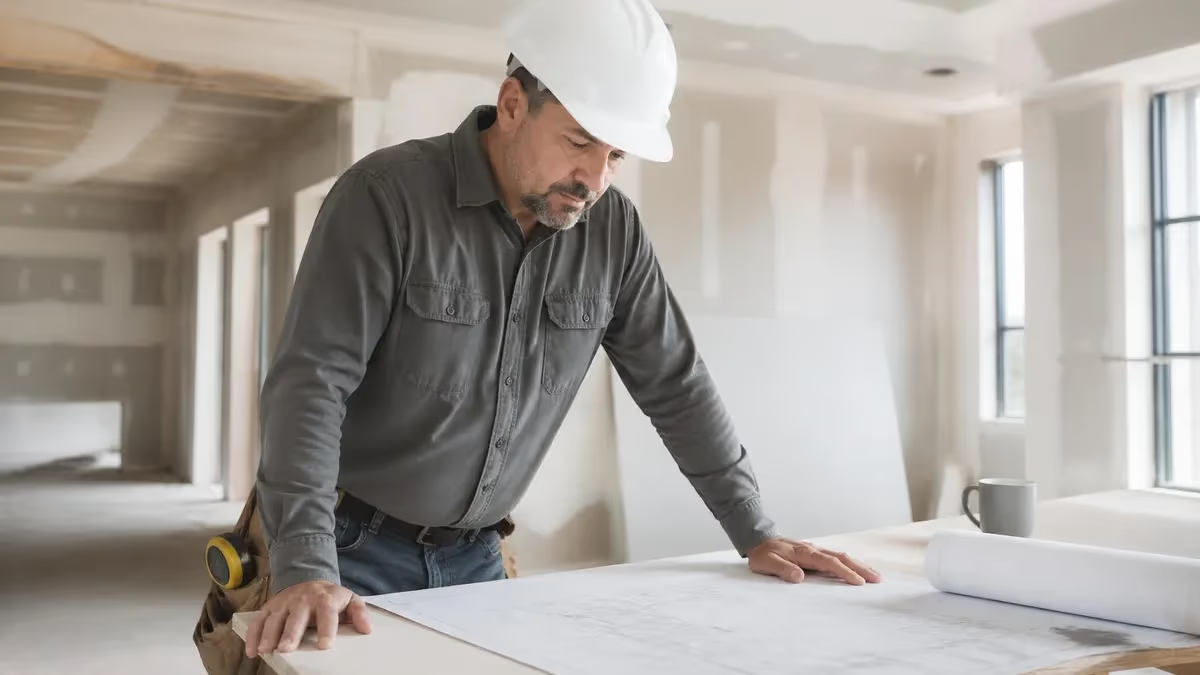
A general contractor (GC) is the person responsible for the overall execution of a construction project. They don't necessarily build the work themselves — they organize and oversee everyone who does. That means hiring and managing subcontractors (electricians, plumbers, framers, concrete workers), coordinating schedules so each trade is on-site when the project is ready for them, pulling the required permits, managing the project budget, and ensuring everything is built to code and to the specifications in the contract. On larger projects, a GC is essentially a project manager with specialized construction knowledge and contractual accountability to the project owner.
The GC's accountability is what distinguishes the role from a subcontractor. When you hire a general contractor to build a home or commercial space, the GC is the single point of contact and legal responsibility. If the electrical subcontractor does substandard work, it's the GC's license and bond that are at risk. If a project runs over budget or behind schedule, the GC bears the contractual exposure. This accountability structure is why states require general contractors to be licensed — the license is the state's way of verifying that a GC has the knowledge and financial standing to take on that responsibility. Practicing with a general contractor license business law and finance questions and answers quiz covers the contract law, lien rights, and financial management content that all GC licensing exams test — the legal and business knowledge that separates a licensed contractor from an unlicensed one.
The day-to-day work of a general contractor varies depending on project size and whether they're running a residential or commercial operation. Residential GCs manage home building, renovations, additions, and remodels. They often work directly with homeowners who may have limited construction knowledge, which means communication and expectation-setting are a significant part of the job. Commercial GCs manage office buildings, retail spaces, warehouses, and similar projects — these typically involve larger teams, more complex permitting processes, and longer timelines. Some GCs specialize in niche areas: historic renovation, green building, tenant improvements, or infrastructure work. Specialty GCs often earn more than generalist GCs because their expertise commands a premium and reduces competition.
Working through a general contractor license project management questions and answers practice test targets the scheduling, resource management, and contract administration knowledge that the project management component of GC licensing exams tests. Reviewing a general contractor license construction safety and osha questions and answers quiz covers the OSHA regulations and jobsite safety requirements that show up on GC licensing exams in virtually every state and that GCs must apply in actual operations.
How to Get a General Contractor License
Licensing requirements for general contractors are set at the state level and vary considerably. Florida is one of the more structured states: it distinguishes between a Certified General Contractor (licensed statewide by the state) and a Registered General Contractor (licensed locally by a county or city). To become a Certified GC in Florida, you need at least four years of experience as a foreman, supervisor, or contractor, must pass the Florida Contractor Licensing Exam (which includes a Business and Finance exam and a Trade Knowledge exam), provide proof of insurance and a surety bond, and pass a financial review. Florida's GC licensing exam is among the most comprehensive in the country, which is part of why Florida-licensed GCs can work throughout the state without needing additional local approvals.
Other states have different structures. Some states have reciprocity agreements with Florida or other states — a Florida Certified GC can obtain a license in certain reciprocal states without retaking the full exam. Some states license through a single state agency; others delegate licensing to counties or municipalities. A few states (notably Texas, among others) don't have a statewide GC license requirement, though local jurisdictions often require registration. Practicing with a general contractor license building codes and standards questions and answers practice test covers the International Building Code and state-specific code content that licensing exams test in Florida, North Carolina, and other heavily regulated states.
The exam itself — in states that require one — typically covers four main areas: business and finance (contract law, lien law, workers' compensation, insurance requirements, financial statements), project management (scheduling, estimating, subcontractor management), trade knowledge (construction methods, materials, building systems), and safety (OSHA regulations, fall protection, excavation safety, hazardous materials). Some states administer their own exam; others use third-party exams from testing providers like PSI or Prometric. Reviewing a general contractor license planning and estimating questions and answers quiz targets the cost estimation, takeoff methods, and project planning content that makes up a significant portion of GC licensing exams in most states.
- ✓Review the official General Contractor License exam content outline
- ✓Take a diagnostic practice test to identify weak areas
- ✓Create a study schedule (4-8 weeks recommended)
- ✓Focus on your weakest domains first
- ✓Complete at least 3 full-length practice exams
- ✓Review all incorrect answers with detailed explanations
- ✓Take a final practice test 1 week before exam day
What Is Overview
- Subcontractor management: Hiring, vetting, scheduling, and paying specialty contractors — electrical, plumbing, HVAC, framing, concrete, roofing
- Permitting: Pulling all required building permits and scheduling inspections at each project phase
- Budget management: Tracking project costs against estimates, managing change orders, handling lien waiver documentation
- Code compliance: Ensuring all work meets local building codes, zoning requirements, and the contract specifications
- Client communication: Regular updates to the project owner on schedule, budget, and any issues requiring decisions
- Safety oversight: OSHA compliance on all jobsites, including subcontractor crews

Preparing for the General Contractor License Exam
The GC licensing exam is where many experienced contractors hit an unexpected wall. You can have 20 years of jobsite experience and still struggle on the Business and Finance portion of the exam if you haven't studied the specific content it covers. Lien law is a common example: most contractors understand in practice that clients can withhold payment and that subs can lien a project — but the exam tests specific statutory procedures. In Florida, the Notice to Owner must be served within a specific number of days after first furnishing materials or labor. The Notice of Commencement must be recorded before work begins on most projects. The timeline for filing a claim of lien after last performing work has specific deadlines. These aren't things you learn from doing construction — they're things you learn from studying the statute or a study guide organized around the exam content.
The same pattern holds for OSHA regulations. Most experienced GCs understand job safety in practical terms — you know not to leave trenches unsupported and to require fall protection at heights. But the exam tests specific regulatory numbers: fall protection at 6 feet in construction (different from general industry's 4 feet), excavations over 5 feet requiring protective systems, the specific requirements for competent persons in various hazard categories. Passing the exam requires knowing the regulatory specifics, not just the principles.
Preparation for the GC licensing exam typically takes 6 to 12 weeks of structured study. The business and finance component usually takes the most study time for candidates who come from the field — it covers contract law, insurance, bonding, and financial management that field experience doesn't automatically teach. The trade knowledge component is easier for experienced tradespeople but may require reinforcement on areas outside your specialty. Someone who has spent 15 years doing residential framing needs to review commercial structural systems, concrete formwork, and mechanical system coordination even if they won't use that knowledge every day once licensed. The exam tests the breadth of a general contractor's responsibility, not just their depth in their primary specialty.
One aspect of the GC role that surprises people entering the field from a trade background is how much of the job is administrative. On a typical project day, a GC might spend the morning on a jobsite walkthrough and the afternoon handling subcontractor payment applications, reviewing RFIs (requests for information) from the architect, tracking outstanding permit inspections, and responding to a change order request from an HVAC sub who found unexpected conditions in the ceiling. The construction knowledge matters enormously for making good decisions in all of these tasks, but the ability to manage documentation, track costs, and communicate clearly is what separates GCs who build profitable businesses from those who do great work but struggle financially.
For people transitioning from a trade background into general contracting, the business development component is often the steepest learning curve. Getting your first projects as a new GC typically means starting with smaller work through referrals, building a track record, and gradually taking on larger projects as your financial capacity and workforce grow. Most successful GCs recommend starting with project sizes you can comfortably finance through your own working capital rather than borrowing, because cash flow problems in construction can cascade quickly when subcontractors need payment before the owner pays the GC. Building financial reserves and establishing relationships with a commercial lender early in your GC career creates the cushion that lets you pursue larger, more profitable projects.
What Is Pros and Cons
- +High earning potential — successful GCs who run their own operations earn significantly more than employees in any single trade
- +Professional autonomy — licensed GCs choose their projects, clients, and work mix rather than being assigned work by an employer
- +Growing demand — construction activity continues to increase across residential and commercial sectors, with licensed GC demand exceeding supply in most US markets
- +State reciprocity — many states have reciprocity agreements with Florida and California, allowing licensed GCs to work across state lines without retaking full exams
- +Transferable skills — the project management, contract, and business skills of a licensed GC have value beyond construction in facilities management, real estate development, and construction consulting
- −Licensing exam is challenging — the Business and Finance portion fails many experienced contractors who haven't studied the specific statutory and regulatory content tested
- −Financial risk — GCs carry the contractual and financial risk of projects; cash flow problems, subcontractor failures, or scope disputes can create significant losses
- −License maintenance burden — continuing education requirements, license renewal fees, and insurance maintenance add ongoing administrative work and cost
- −High liability exposure — GCs are the first target of litigation when construction defects, injuries, or contract disputes arise, requiring ongoing insurance and legal attention
- −Irregular income — project-based work means income can vary significantly from month to month and year to year depending on project pipeline and economy
General Contractor License Questions and Answers
About the Author

Educational Psychologist & Academic Test Preparation Expert
Columbia University Teachers CollegeDr. Lisa Patel holds a Doctorate in Education from Columbia University Teachers College and has spent 17 years researching standardized test design and academic assessment. She has developed preparation programs for SAT, ACT, GRE, LSAT, UCAT, and numerous professional licensing exams, helping students of all backgrounds achieve their target scores.
Join the Discussion
Connect with other students preparing for this exam. Share tips, ask questions, and get advice from people who have been there.
View discussion (7 replies)