
GCOR Practice Test PDF – General Code of Operating Rules Questions & Answers
Pass the GCOR exam with confidence. 🔎 Practice questions with detailed explanations and instant feedback on every answer.
Preparing for the General Code of Operating Rules (GCOR) exam requires mastering a broad set of railroad safety and operational standards used by Class I railroads across North America. Our free GCOR practice test PDF gives you printable questions and answers covering every major rule category—so you can study offline, highlight key concepts, and arrive at your exam with confidence. Whether you're a new hire completing qualification or a seasoned railroader refreshing your knowledge, this resource is built to match the real exam format.
The GCOR governs everything from track authority and signal interpretation to employee on-track safety and hazardous materials handling. Because the rulebook is dense and version-specific, targeted practice questions are the most efficient way to pinpoint gaps in your understanding before test day.
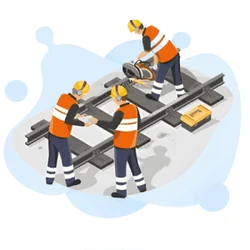
Track Authority and Signal Rules
Understanding track authority is the foundation of GCOR compliance. The rulebook defines how trains receive permission to occupy a block—through direct authority such as a track warrant or Form B, or indirect authority conveyed by signal indication. Absolute signals require a complete stop before proceeding when displaying a stop aspect, while permissive signals allow movement under restricted speed after a stop. Sidings and controlled points each carry specific rules about how crews must protect themselves and communicate with the dispatcher. Practice questions on this topic test your ability to distinguish authority types, identify correct signal responses, and apply block limits accurately under time pressure.
Train Handling and Speed Regulations
GCOR train handling rules address speed limits tied to signal aspects, track conditions, and territory class. Crews must calculate maximum allowable speeds when approaching restrictive signals, descending steep grades, or operating through slow orders. Braking distance calculations factor into how early a locomotive engineer must begin an application to stop safely within the limits of authority. Grade operation rules specify how helpers must be coupled and controlled, and how dynamic braking interacts with air brakes on descending territory. Questions on this section frequently combine signal aspects with territorial speed restrictions to simulate real decision-making scenarios that operators face every shift.
On-Track Safety and Blue Flag Protection
Employee safety on and near tracks is among the most tested areas of the GCOR exam. On-track safety rules require that every employee who may be fouling the track must have a designated form of protection—whether that is a lookout, a train approach warning system, or an exclusive track occupancy. Blue flag protection is a specific and non-negotiable rule: blue flags and blue lights placed by mechanical department employees cannot be removed by anyone other than the employee or crew that placed them. No train or engine may move against a blue flag, regardless of any other instruction. Understanding the hierarchy of protection methods and the responsibilities of each role—employee in charge, lookout, and train crew—is critical for passing this section.
Hazmat, Radio Communication, and Rule Applications
Rail hazardous materials transportation follows DOT and AAR requirements that GCOR integrates into its operating rules. Train crews must be able to identify required placards, recognize emergency response guide numbers, and know their immediate notification duties when a hazmat incident occurs. Radio communication rules specify correct phraseology for reporting locations, receiving warrants, and repeating back track authority. Because miscommunication is a leading cause of rail incidents, the exam tests crews on proper read-back procedures and prohibited radio practices. Finally, GCOR versions differ subtly between Class I railroads—BNSF, UP, and others have adopted different editions with local rules. Questions may reference version-specific changes, so knowing the edition applicable to your railroad is essential for a passing score.
- ✓Review all signal aspects in your railroad's GCOR edition before the exam
- ✓Memorize the difference between absolute and permissive signal rules
- ✓Practice filling out Form B track warrants and identifying their limits
- ✓Study blue flag placement and removal authority in detail
- ✓Know the on-track safety hierarchy: exclusive occupancy, train approach warning, lookout
- ✓Review hazmat placard tables and emergency response notification steps
- ✓Practice radio read-back procedures for track warrants and clearances
- ✓Identify the maximum speed for each signal aspect in your territory
- ✓Understand how grade operation and dynamic braking rules interact
- ✓Compare your railroad's local rules with the base GCOR edition to find differences
Download the GCOR practice test PDF above and work through the questions section by section. Focus extra time on any topic where you miss more than one question—those gaps often reflect rulebook language you've read but haven't fully internalized. Pair the PDF with our online GCOR practice tests to get immediate feedback and timed simulation. Consistent practice with realistic questions is the proven path to first-time exam success.
- +Industry-recognized credential boosts your resume
- +Higher earning potential (10-20% salary increase on average)
- +Demonstrates commitment to professional development
- +Opens doors to advanced career opportunities
- −Exam preparation requires significant time investment (4-8 weeks)
- −Certification fees can be $100-$400+
- −May require continuing education to maintain
- −Some employers may not require certification
Sample GCOR - General Code of Operating Rules Practice Questions
Try these questions from our free GCOR - General Code of Operating Rules practice tests. The correct answer and an explanation follow each question.
A train is operating in CTC territory and stops at a control point with an absolute signal displaying 'Stop'. The crew needs to make a reverse movement just inside the block they came from to set out a car. According to GCOR, what is the first required action?
- A. Obtain permission from the control operator before making any reverse movement.
- B. Immediately begin the reverse movement at restricted speed, as it's within the same block.
- C. Proceed through the stop signal, then initiate the reverse movement.
- D. Wait for a more favorable signal indication before reversing.
Answer: A. Obtain permission from the control operator before making any reverse movement.
GCOR Rule 6.4.2 states that if a movement stops while the trailing end is between the outer opposing absolute signals of a control point, it must not change direction without permission from the control operator. Since the train is at a control point, permission is mandatory before reversing, even if the movement is within the same signaled block.
Under GCOR, what must a crew do when operating on a track where the speed limit is reduced due to a slow order and the slow order location is not clearly marked?
- A. Estimate the location and begin reduction 500 feet early
- B. Reduce speed before reaching the slow order location to ensure compliance
- C. Contact the dispatcher for exact milepost location
- D. Proceed at normal speed until the track condition is observed
Answer: B. Reduce speed before reaching the slow order location to ensure compliance
GCOR requires crews to reduce speed in advance of the slow order location to ensure the train is at the restricted speed when it reaches that point.
Under GCOR, when a train is operating in a dark territory, what is the maximum speed permitted when approaching a switch that is not within a signaled territory?
- A. The train may proceed at normal speed if the switch is lined correctly
- B. The train must reduce to restricted speed while prepared to stop short of the switch
- C. The train must stop 1,500 feet from the switch
- D. The train must obtain verbal authority before passing the switch
Answer: B. The train must reduce to restricted speed while prepared to stop short of the switch
In dark territory, trains must approach switches at restricted speed, prepared to stop short of any obstruction.
An employee notices a defective section of track that could potentially affect safe train operations. Under GCOR rules for reporting unusual conditions, what is the employee's IMMEDIATE responsibility?
- A. Wait until the end of the shift to file a written report.
- B. Report it by the first available means of communication.
- C. Only report it if a train is currently approaching the defect.
- D. Fix the defect personally if the tools are available.
Answer: B. Report it by the first available means of communication.
GCOR Rule 1.1.3 mandates that employees must 'Report by the first means of communication any... defects in tracks, bridges, or signals; or any unusual condition that may affect the safe and efficient operation of the railroad.' This ensures that potential hazards are addressed as quickly as possible.
Take the full GCOR - General Code of Operating Rules practice test
Join the Discussion
Connect with other students preparing for this exam. Share tips, ask questions, and get advice from people who have been there.
View discussion (9 replies)