
How Long Is the Gaokao? Exam Duration and Schedule Explained 2026
✏️ Pass your How Long Is the Gaokao? exam on the first attempt. Practice questions with detailed answer explanations, hints, and instant scoring.
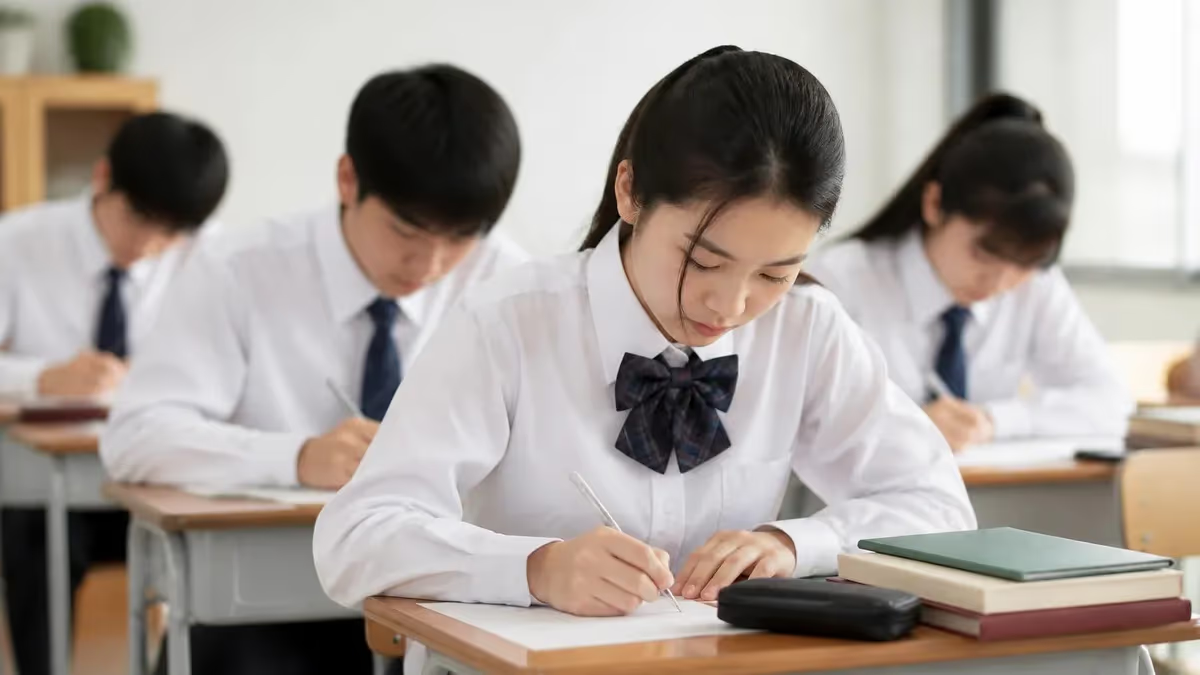
The Gaokao's two-day format is standardized across China, though the specific subjects tested and minor scheduling details vary by province. All students nationally take Chinese language (语文) and Mathematics (数学) as core required subjects. The third and fourth examination slots vary depending on the province and the student's chosen subject track — either the sciences track or the liberal arts track in traditional provinces, or from a menu of elective subjects in provinces using the new Gaokao reform model. Practice with the free Gaokao practice test on PracticeTestGeeks (7 questions with answer explanations).
Understanding the exam schedule matters for preparation strategy. The Chinese language exam always opens the Gaokao on the morning of June 7, and many students and families treat this first test as particularly significant — it sets the psychological tone for the entire examination period. The structure of the remaining tests, including their timing relative to meals and sleep, affects physical performance in ways that test preparation guides sometimes underemphasize.
Provincial variations in the Gaokao schedule exist because not all provinces administer exactly the same examination. Some provinces use nationally unified papers (全国卷), while others use their own provincial papers or a hybrid format. The subject lineup and time allocation generally follow the national standard, but students preparing for the Gaokao should verify their specific provincial schedule and subject requirements rather than assuming the national standard applies exactly to their situation.
For international students, researchers, and parents seeking to understand the Gaokao system, the exam's structure reflects China's educational priorities: Chinese language and mathematics are universal requirements, and the remaining subjects test either breadth (humanities and sciences together) or depth (specialized tracks or elective combinations). The time allocated to each subject signals how the exam weights different types of thinking.
The Gaokao's timing is also culturally significant. The examination period has traditionally begun on June 7 because it's the seventh day of the sixth month — a date chosen in 2003 when China moved the exam from July to June to avoid summer heat. Parents, teachers, entire communities, and even municipal governments coordinate around the June 7-8 dates each year. Traffic restrictions near testing centers, reduced construction noise, and special meal preparations all reflect the national significance of these two days.
For international observers, the Gaokao's two-day format contrasts with Western standardized examinations in ways that reflect different educational philosophies. The Gaokao compresses enormous weight into 9 hours because Chinese college admissions have historically relied almost entirely on this single examination score. The all-or-nothing stakes of the format intensify both the preparation culture and the collective anxiety that surrounds the examination period.
Gaokao: upcoming dates and official changes
- Updated Oct 19, 2026: Delivery is now In-person examination centers (previously In-person examination centers).
- Updated Oct 19, 2026: Score release is now Announced by each province after the exam (previously Release dates and channels announced provincially).
Facts verified Oct 19, 2026 against Ministry of Education of the People's Republic of China (national policy owner). Each provincial examination authority r. Dates that have passed are removed automatically.
- The Gaokao is taken in person at designated examination centers (考点) and rooms, with identity checks on entry. (moe.gov.cn)
- Each provincial examination authority announces the Gaokao score release time and official lookup channel after the exam. (moe.gov.cn)
Facts verified Oct 19, 2026 against Ministry of Education of the People's Republic of China (national policy owner). Each provincial examination authority r. Dates that have passed are removed automatically.
Free Gaokao Exam Study Tools
Interactive Gaokao Exam resources on PracticeTestGeeks, free to start:
- Gaokao Exam flashcards — review key terms and concepts card by card
- Gaokao Exam study guide — topic-by-topic overview of what the exam covers
- Gaokao Exam cheat sheet — one-page printable summary for last-minute review
The standard Gaokao schedule runs across June 7 and June 8 in most of China. June 7 typically begins with the Chinese language examination in the morning and a Foreign Language (usually English) examination in the afternoon. June 8 typically features Mathematics in the morning and the comprehensive examination (or elective subjects in reformed provinces) in the afternoon.
On June 7, the Chinese language exam starts at 9:00 AM and runs for 150 minutes, ending at 11:30 AM. Students typically have a lunch break before the afternoon foreign language exam, which starts at 3:00 PM and runs for 120 minutes. The foreign language test includes a listening component, which is administered during the first portion of the examination period.
On June 8, the mathematics exam runs in the morning from 9:00 AM to 11:00 AM (120 minutes). In the afternoon, the comprehensive examination (文综 for liberal arts students covering History, Geography, and Politics, or 理综 for science track students covering Physics, Chemistry, and Biology) runs from 3:00 PM to 5:00 PM (150 minutes).
The two-hour midday break between morning and afternoon exams is significant. Test preparation guides routinely advise students to use this period carefully — a light meal, minimal mental exertion, and a brief rest. Students who try to review material intensively during the lunch break often report fatigue affecting their afternoon performance. Understanding this rhythm is part of Gaokao preparation.
The overall testing window across both days — approximately 9 hours of actual examination time — is substantially longer than most standardized tests students encounter before the Gaokao. Stamina is a genuine factor. Students who train for sustained concentration across multiple consecutive high-stakes examinations perform better than those who only prepare content without considering the physical demands of the format.
Many families treat examination logistics as seriously as examination content. The choice of accommodation for students whose schools are far from their assigned testing centers, transportation planning, meal preparation on exam mornings, and even what students wear on examination days are all subjects of careful family deliberation. The two-day schedule creates a clear framework around which these logistics are organized, and familiarity with the exact timing eliminates avoidable uncertainty on examination days.
The Chinese language examination's 150-minute duration is worth examining in terms of what it demands. Students face classical Chinese passages requiring literary analysis, modern reading comprehension passages, language usage questions covering grammar and vocabulary, and the writing section — typically a personal essay or argumentative essay requiring 800 or more characters. Pacing across these components is a learnable skill distinct from content knowledge.
The listening examination within the foreign language test deserves specific preparation attention. Unlike the rest of the Gaokao, the listening component cannot be reviewed in the final minutes before the exam — it's administered under controlled audio conditions and depends on real-time comprehension. Students who prepare for the listening section separately, through dedicated audio practice at exam pace, typically perform better than those who focus exclusively on reading and writing components.
If you want more targeted practice, the gaokao past papers page covers the same material with additional questions and explanations.

Subject-by-Subject Time Breakdown
Day 1, Morning (9:00–11:30 AM). Duration: 150 minutes. The Chinese language exam (语文) is the longest individual exam in the Gaokao. It includes classical Chinese reading, modern prose reading, language knowledge questions, and a required writing component. The essay portion alone typically accounts for 60 out of 150 total marks. The Chinese language exam is considered by many students to be the most difficult to score highly on because of the interpretive nature of many questions.
While the June 7-8 standard is used across most of China, a small number of provinces and autonomous regions have historically extended their Gaokao to three days to accommodate additional required subjects or local variations. Tibet, Inner Mongolia, and a few other regions have at times administered additional examinations beyond the national two-day standard.
Students in Shanghai and Beijing have historically used local papers rather than the national unified papers, with their own provincial scoring systems and sometimes slightly different subject arrangements. However, even these provinces generally follow the June 7-8 two-day format with the same morning/afternoon structure as the national standard.
The foreign language examination is one area where significant provincial variation exists. Most students take English, but the infrastructure for administering other foreign language options varies. In provinces near Japan or Russia, Japanese and Russian options may be more widely available. Students choosing a foreign language other than English should verify that their specific testing center and province offer that examination option and confirm the schedule is identical to the English examination session.
Students who are applying to universities in provinces different from where they take the Gaokao — a situation that occasionally arises for students of ethnic minority backgrounds or students whose hukou (household registration) is in a different province — should be aware that score cutoffs and exam papers used by different provinces vary. Their Gaokao score is associated with their registration province, not the province of the university they're applying to.
An underappreciated feature of the Gaokao provincial variation system is that admission to universities in other provinces is governed by different cutoff scores based on the provincial examination taken. A student from a province known for rigorous examination standards may find that the same raw score translates to different admission outcomes compared to a student from a province with different examination papers. This provincial variation in examination standards has been a source of ongoing debate in Chinese education policy.
For students who are considering applying to universities in major cities like Beijing or Shanghai, understanding that those institutions maintain provincial enrollment quotas adds another layer of strategic consideration to the examination preparation and score interpretation process. The duration of the examination is fixed and standardized; what varies is how scores are used differently across provinces and institutions.
Tibet, Xinjiang, and Inner Mongolia have historically had slightly different Gaokao implementations, including minority language examination options and some scheduling adaptations. Students from ethnic minority backgrounds who elect to take examinations in their native language rather than Mandarin face additional language challenges but also have access to policies that account for educational resource disparities in their regions. These variations make the Gaokao's geographic diversity a genuinely complex topic beyond the standard two-day format that most students experience.
Since around 2017, China has been implementing Gaokao reform in a growing number of provinces. The new model — sometimes called the "3+1+2" system — replaces the traditional science track / liberal arts track binary with a more flexible subject selection system. Students still take the three required subjects (Chinese, Math, and Foreign Language), plus choose one mandatory subject from Physics or History, and two additional subjects from a menu of Chemistry, Biology, Geography, and Politics.
Under the new model, the schedule extends slightly because the elective subjects are taken on separate examination sessions. In reformed provinces, the Gaokao extends to three days to accommodate this structure — typically June 7, 8, and either additional sessions or a June 9 for elective subjects. The total examination time is longer under the reform model because more individual subject tests are administered.
Students in reformed provinces should obtain the specific examination schedule from their provincial education authority well in advance. The subject order and timing differ from the traditional format in ways that can affect preparation and logistics — particularly for students whose highest-priority subjects fall on the final examination day, when fatigue may be a greater factor.
The three-day schedule in reformed provinces creates a different psychological challenge compared to the traditional two-day format. Students must sustain peak examination performance across three consecutive days — a demand that places greater emphasis on sleep management, nutrition strategy, and psychological resilience than the two-day format. Some students find the three-day format less concentrated and thus slightly less intense per day; others find the cumulative fatigue more difficult to manage. Neither format is universally easier; they reward different types of examination stamina.
A practical implication of the new reform model's elective subject selection is that students now choose their subject combinations based partly on their academic strengths and interests, not just a binary science/humanities track assignment. This makes preparation more personalized but also means that understanding the exact schedule for your specific elective combination is essential — the timing of elective examinations varies more under the new model than under the traditional format.
The reform model's three-day schedule represents the most significant change to the Gaokao's duration since the 2003 timing shift from July to June. As more provinces adopt the new model over the next several years, a growing proportion of Chinese students will experience a three-day Gaokao rather than the traditional two-day format. Students currently preparing for the Gaokao should confirm whether their province has adopted the new model — the scheduling and subject selection implications are significant enough to affect preparation planning.
Day-of Preparation Checklist for Gaokao
- ✓Arrive at the testing center at least 30 minutes before the exam start time
- ✓Bring your admission ticket (准考证) and valid ID — entry is denied without both
- ✓Plan meals strategically: light breakfast before morning exam, light lunch during break
- ✓Avoid heavy review sessions during the lunch break between morning and afternoon tests
- ✓Bring permitted stationery: 2B pencils, black ballpoint pens, ruler, compass as required
- ✓No electronic devices, mobile phones, or smartwatches in the exam room
- ✓Plan transportation conservatively — traffic delays near testing centers are common on exam days
- ✓Prepare for the listening component in the foreign language exam (verify headphones if provided)
Knowing the Gaokao schedule in detail allows students to structure their preparation around the actual testing sequence. Chinese language and mathematics — the most heavily tested subjects — appear at the highest-intensity moments of the schedule: first thing on day one (Chinese) and first thing on day two (Mathematics). This means your peak performance windows on both mornings need to be tuned for these subjects.
Mock exam practice sessions conducted at the exact times of the actual Gaokao are among the most effective preparation strategies available. Taking a full Chinese language mock test from 9:00 to 11:30 AM trains both your content knowledge and your physical rhythm for the actual examination. Students who only practice during their preferred study hours — late at night, for example — may find the 9:00 AM start time unfamiliar in terms of their mental state and alertness level.
The afternoon examination sessions on both days require sustained attention after the mental effort of the morning exam. This is a real physiological challenge. The most prepared students build stamina specifically for this sequence — not just practicing each exam type in isolation, but practicing the morning-to-afternoon sequence across both days to simulate the full Gaokao experience.
The subjects in the comprehensive examination on day two afternoon — whether the 文综 or 理综 format — require switching cognitive modes multiple times within a 150-minute window. Students who practice timed comprehensive exam sessions under realistic conditions generally perform better than those who only practice individual subject components in isolation. The context-switching demand is a skill in itself.
Rest and recovery between the two days of examination is a preparation element that receives less attention than content review but can meaningfully affect performance. Experienced Gaokao coaches consistently advise students to treat the evening of June 7 as a recovery period — a light dinner, no examination review, and early sleep. Students who spend June 7 evening reviewing mathematics content for June 8 often report that the review didn't improve their math score but the accumulated fatigue did hurt their performance. The two-day schedule rewards discipline during the exam period itself, not just during the preparation months.
Simulating the full two-day Gaokao sequence at least twice during preparation is an investment that pays dividends in performance. Many students practice individual examinations in isolation without ever experiencing the cumulative fatigue of the actual sequence. A full simulation — four exams across two days at the actual examination times — reveals how your performance changes from morning to afternoon and from day one to day two. Adjusting your preparation based on those observations is far more precise than preparing without that data.
Students who arrive late to a Gaokao examination are not permitted to enter the testing room after the examination has begun. This is strictly enforced. If a student misses an examination session due to illness or emergency, they may apply to their provincial education authority for special consideration in documented exceptional circumstances — but such exceptions are rare and the standard rule is that the missed examination receives a score of zero. Plan transportation with significant time margins built in.
Two-Day Compressed Format: Advantages and Challenges
- +Compressed format limits the number of days families must arrange logistics
- +Clear examination sequence is known months in advance for scheduling preparation
- +National simultaneous administration creates strong fairness in testing conditions
- +Morning peaks of alertness used for most critical examinations (Chinese, Math)
- −Limited recovery time between examinations — fatigue accumulates across the two days
- −Single high-stakes window per year leaves no room for poor performance days
- −Afternoon examination performance may suffer due to morning examination fatigue
- −Logistics pressure (travel, accommodation for out-of-district students) intensifies around the two-day window
Pros and Cons at a Glance
| Pros | Cons |
|---|---|
| Compressed format limits the number of days families must arrange logistics | Limited recovery time between examinations — fatigue accumulates across the two days |
| Clear examination sequence is known months in advance for scheduling preparation | Single high-stakes window per year leaves no room for poor performance days |
| National simultaneous administration creates strong fairness in testing conditions | Afternoon examination performance may suffer due to morning examination fatigue |
| Morning peaks of alertness used for most critical examinations (Chinese, Math) | Logistics pressure (travel, accommodation for out-of-district students) intensifies around the two-day window |
Sample Gaokao Exam Practice Questions
Try these questions from our free Gaokao Exam practice tests. The correct answer and an explanation follow each question.
In a Gaokao cloze test, the blank reads: 'The team's success was largely _____ to their excellent teamwork and dedication.' Which option is correct?
- A. attributed
- B. contributed
- C. distributed
- D. substituted
Answer: A. attributed
'Attributed to' means credited to or caused by — 'the success was attributed to teamwork' is the correct collocation. 'Contribute to' means help produce, not the same structure.
The 2023 Gaokao National Paper I essay prompt involved 'good with technology' (技术好的人). What type of essay prompt structure is this?
- A. Material-based argumentative essay (材料作文)
- B. Personal narrative (记叙文)
- C. Descriptive essay about technology
- D. Comparative essay
Answer: A. Material-based argumentative essay (材料作文)
Modern Gaokao essay prompts are almost exclusively '材料作文' (material-based): the student is given a text/scenario and must write an argumentative essay based on it, rather than freely chosen topics.
The Gaokao essay prompt '改变,从那一刻开始' ('Change Began at That Moment') most directly asks students to demonstrate which narrative skill?
- A. Arguing a philosophical thesis through logical deduction
- B. Anchoring a personal transformation to a specific pivotal incident
- C. Comparing two historical figures whose lives changed society
- D. Summarising the plot of a canonical Chinese novel
Answer: B. Anchoring a personal transformation to a specific pivotal incident
The prompt centres on a singular turning-point moment, so the essay must ground a broader personal or emotional transformation in one concrete, well-rendered scene — the hallmark of incident-anchored narrative writing.
The Gaokao writing topic '读书改变命运' ('Reading Changes Destiny') falls into which recognised Chinese high-school essay genre?
- A. 议论文 (argumentative essay)
- B. 记叙文 (narrative essay)
- C. 说明文 (expository/explanatory essay)
- D. 应用文 (practical/functional writing)
Answer: A. 议论文 (argumentative essay)
The prompt presents a thesis-like claim ('reading changes destiny') that demands the student marshal evidence, reasoning, and refutation — all defining features of 议论文 (argumentative essay), which requires the writer to defend a position rather than simply recount an experience.
Gaokao Questions and Answers
How this page was made: written with AI tools and published by Nathan Beja, founder of Practice Test Geeks, who is responsible for its content. Exam facts are checked against the official sources listed below. Not reviewed by a subject-matter expert. Editorial policy
Sources & references
Exam facts on this page (fees, format, dates, passing scores) are checked against these official sources; the date is our last check. Editorial policy
- moe.gov.cn — Test delivery, score release · verified Oct 2026
- sdzk.cn — Fees · verified Oct 2026