
FAFSA Not Working Today? How to Fix It and What to Do Next 2026 September
FAFSA not working today? 🎯 Find out why the site goes down, how to fix it, key 2026 September deadlines, and what to do while you wait.
If FAFSA is not working today, you are not alone — millions of students and parents encounter access problems with StudentAid.gov every year, especially during peak filing periods in the fall and early spring. The FAFSA, or Free Application for Federal Student Aid, is the single most important financial aid form in the United States, unlocking federal grants, subsidized loans, and work-study funds for eligible students. When the site goes down at a critical moment, it can feel like a crisis — but there are concrete steps you can take right now while you wait for access to be restored.
Technical outages on the FAFSA website are more common than most people realize. The Department of Education periodically performs scheduled maintenance, which is usually announced in advance on the StudentAid.gov homepage and on the official Federal Student Aid social media accounts. Unscheduled outages, however, can strike at any time — often during the busiest filing windows, when hundreds of thousands of applicants are trying to log in simultaneously. Understanding the difference between a site-wide outage and a problem specific to your account or browser can save you hours of frustration.
One of the first things to verify when FAFSA is not loading is whether the problem is on your end or the government's end. Tools like Downdetector.com and IsItDownRightNow.com can show you real-time reports from other users. If these sites show a spike in FAFSA-related complaints, the issue is almost certainly a server-side problem and the only remedy is patience. If reports are low, the issue is more likely local — your internet connection, browser cache, outdated software, or account-specific settings may be the culprit.
Browser compatibility is a surprisingly frequent cause of FAFSA login failures. The StudentAid.gov platform is optimized for current versions of Chrome, Firefox, Edge, and Safari. Using an older browser, an unsupported browser like Internet Explorer, or a heavily extension-laden browser session can trigger login errors, blank screens, or infinite loading wheels. Clearing your browser cache and cookies, disabling extensions, or switching to a fresh incognito window resolves the problem for a large percentage of users who think they are experiencing a site outage.
Your FSA ID — the username and password combination that grants access to federal student aid systems — is another frequent source of access problems. If you recently created your FSA ID or linked it to your Social Security number for the first time, there is a mandatory one-to-three business day verification window before the account becomes fully active.
Trying to log in before that window closes will always result in an error, even if the FAFSA website itself is working perfectly. Keeping a note of when you created your FSA ID helps you track whether you are still inside that verification period.
For students who need help troubleshooting fafsa site not working issues and understanding the broader financial aid picture, knowing when to call for help is equally important. The Federal Student Aid Information Center operates a dedicated phone line at 1-800-433-3243 (1-800-4-FED-AID), and trained representatives can walk you through account resets, identity verification errors, and form submission problems. Chat support is also available through the StudentAid.gov help portal during business hours, and response times are generally faster than the phone queue during peak filing season.
Even when the FAFSA site is fully functional, the application itself requires careful preparation. You will need your or your parents' most recent tax return information, Social Security numbers, bank account balances, investment records (excluding retirement accounts), and school codes for each institution you want to receive your financial aid information. Having these documents ready before you sit down to file means that a brief outage does not derail your entire session — you can pick up exactly where you left off the moment access is restored, without scrambling to locate documents under time pressure.
FAFSA by the Numbers

Why FAFSA Is Not Working: Common Causes Explained
Scheduled Maintenance Windows
High Traffic Overload
FSA ID Verification Delays
Browser or Device Compatibility
Account Security Locks
When FAFSA refuses to load or throws an error message, your first practical move is to perform a quick three-step diagnosis before calling for help. Open a new incognito or private browsing window, navigate directly to StudentAid.gov, and attempt to log in without any browser extensions running. If this succeeds, a browser extension is almost certainly the root cause. Common culprits include privacy-focused extensions like Privacy Badger, ad blockers, script blockers, and password managers that auto-fill fields in ways the FAFSA form does not support.
Clearing your browser cache is the second most effective local fix and takes less than two minutes in any modern browser. Cache files can become corrupted or stale over time, causing web applications to behave unpredictably. In Chrome, press Ctrl+Shift+Delete (or Cmd+Shift+Delete on a Mac), select "All time" as the time range, check the boxes for cached images and files and cookies, and click Clear Data. Reload StudentAid.gov after clearing and attempt login again. This single step resolves the issue for a meaningful share of users experiencing blank screens or perpetual loading spinners.
If browser fixes do not work, the next diagnostic step is to check whether the problem is network-related. Switching from a home Wi-Fi connection to a mobile hotspot — or vice versa — can instantly reveal whether your ISP or network configuration is blocking access to federal government servers. Some workplace and school networks apply content filters that inadvertently block access to .gov domains or certain SSL certificates. If switching networks resolves the problem, contact your network administrator or IT department and ask them to whitelist StudentAid.gov.
Password and FSA ID issues deserve their own focused approach. If you have forgotten your FSA ID username, navigate to StudentAid.gov and click "Forgot Username." You will need to verify your identity using your Social Security number and date of birth.
If you have forgotten your password, the "Forgot Password" flow allows you to reset via email or by answering your security questions. Important: if you have recently changed your email address and have not updated it in your FSA ID profile, the password reset email will go to your old address — so you may need to use the security questions route instead.
For issues related to identity verification — particularly situations where your Social Security number is not being recognized — the problem may require a phone call to the Federal Student Aid Information Center. Representatives at 1-800-433-3243 can manually verify your identity and unlock your account. Have your Social Security card, a government-issued photo ID, and your date of birth ready before you call, as the representative will need to confirm these details before making any changes to your account. Wait times are longest on Mondays and during the first two weeks of October and January.
Two-factor authentication (2FA) is now required for FSA ID accounts as of the 2024-25 processing cycle. If you are not receiving your verification code via text or email, first check that your mobile number on file is correct by attempting to log in and selecting the email verification option instead.
If neither is working, you can request a code by phone call rather than text message — an option available on the verification screen. If you have lost access to both your phone number and email address associated with the account, identity verification by phone with a federal student aid representative is your only option.
It is worth noting that certain FAFSA errors are not outages at all but rather form-level validation issues. Error codes like "SBJ-0009" or "ISIR-0002" indicate problems with the data you entered — a Social Security number that does not match records, a tax ID discrepancy, or a school code that has changed.
These errors will persist regardless of which browser you use or when you try to access the site. Reading the specific error code in your browser or in the rejection email from Federal Student Aid will point you to exactly which field or document needs correction, saving you significant time compared to general troubleshooting.
FAFSA 2025 Deadlines You Cannot Afford to Miss
The federal FAFSA deadline for the 2025-26 academic year is June 30, 2026 — but filing by this date gives you access only to federal aid and leaves state and institutional money on the table. The federal deadline is a hard cutoff: applications submitted after midnight Eastern Time on June 30 are not processed for that award year under any circumstances, regardless of the reason for the delay.
Most financial aid experts recommend treating any state deadline as your personal hard deadline, since federal funds are available right up to June 30 but state grant programs close months earlier. For the 2025-26 year, if you are counting on a federal Pell Grant — the flagship need-based grant worth up to $7,395 — your Expected Family Contribution (now called the Student Aid Index) must be calculated and processed well before the end of the spring semester to ensure disbursement before summer bills are due.

Filing FAFSA Early vs. Waiting: Pros and Cons
- +Access state grant funds before they run out on a first-come, first-served basis
- +Receive your financial aid award letter earlier, giving you more time to compare school offers
- +Avoid peak-traffic website congestion that causes the FAFSA to run slowly or crash
- +Gives time to correct errors or request missing documents before deadlines hit
- +Earlier processing means faster disbursement of funds for summer session bills
- +Reduces stress of scrambling to file during busy tax season and finals periods
- −Must use prior-prior year tax data (2023 taxes for 2025-26), which may not reflect current income
- −Families with income changes may need to request a professional judgment review after filing early
- −Early filers may need to update their FAFSA if tax data changes after using the IRS Data Retrieval Tool
- −Divorced or separated parent situations can be more complex to document in October
- −Some scholarships require a current-year EFC that is not available until taxes are filed in spring
- −Students who filed early and experienced income drops may miss additional aid they could have received
FAFSA Troubleshooting Checklist: 10 Steps to Regain Access
- ✓Check StudentAid.gov for a maintenance banner or scheduled downtime notice before troubleshooting.
- ✓Visit Downdetector.com and search for 'FAFSA' to see if other users are reporting an outage.
- ✓Open an incognito or private browser window and attempt login without any extensions running.
- ✓Clear your browser cache and cookies completely, then reload StudentAid.gov from scratch.
- ✓Switch to a different browser (Chrome, Firefox, or Edge) and try logging in again.
- ✓Test your internet connection by switching from Wi-Fi to a mobile hotspot or a different network.
- ✓Confirm your FSA ID was created at least three business days ago if you are a new user.
- ✓Use the 'Forgot Password' tool on StudentAid.gov if you have had multiple failed login attempts.
- ✓Check your spam or junk folder for the two-factor authentication verification code email.
- ✓Call the Federal Student Aid Information Center at 1-800-433-3243 if all self-service steps fail.
Call 1-800-433-3243 for FSA ID Lockouts and Account Errors
The Federal Student Aid Information Center at 1-800-433-3243 (1-800-4-FED-AID) is staffed by trained representatives who can unlock accounts, reset FSA IDs, and manually verify your identity when online tools fail. Hours are Monday through Friday 8 a.m. to 10 p.m. EST and Saturday 11 a.m. to 5 p.m. EST. For fastest service, call on a Wednesday or Thursday morning — Tuesday and Monday mornings have the longest average hold times during peak filing periods.
When the FAFSA website is down and a deadline is approaching, your most important move is to contact your school's financial aid office directly and document the outage. Most financial aid administrators are well aware that the StudentAid.gov platform experiences periodic technical problems, and they maintain internal policies for granting short extensions to students who can demonstrate they were affected by a verified outage. Ask specifically for a deadline extension in writing, attach any screenshots you have of the error, and reference any official Federal Student Aid social media posts acknowledging the problem.
The Federal Student Aid Information Center at 1-800-433-3243 — often called simply the FAFSA phone number — is your primary federal contact point when self-service troubleshooting fails. Representatives can see your account status in real time, identify whether your FSA ID has a verification hold, and escalate truly complex issues to a specialized team. If you are calling about an FSA ID problem, have your Social Security number, date of birth, and the email address associated with your account ready before dialing. The automated system will ask for some of this information before connecting you to a live agent.
Live chat is available through the StudentAid.gov Help Center during business hours and is often faster than the phone line for straightforward questions like password resets and form status checks. You can access the chat widget by clicking the blue chat bubble in the lower-right corner of most StudentAid.gov pages. Chat sessions are limited to one topic per session, so have your specific question ready. If your issue cannot be resolved via chat, the representative will provide a case number you can reference when calling the phone line, which can cut down wait time.
For filers who are helping a dependent student complete the FAFSA — typically parents of dependent undergraduate students — it is important to understand that both the student and the contributing parent need their own separate FSA IDs. A common cause of FAFSA submission failures is a parent attempting to sign using the student's FSA ID credentials, or vice versa.
Each FSA ID must be created independently, verified separately, and linked to a unique Social Security number. If the parent's FSA ID is the one experiencing the access problem, the student cannot substitute their own credentials to complete the contributor section.
The StudentAid.gov help center also maintains a robust written knowledge base at studentaid.gov/help-center/answers, where you can search for specific error codes, form sections, and account management issues. This resource is available 24 hours a day, seven days a week — unlike phone and chat support — making it particularly useful during weekend or late-night filing sessions when live support is unavailable. The articles are written in plain English, frequently updated to reflect current-year processing rules, and often contain screenshots that make troubleshooting easier.
Social media can be a surprisingly effective resource when the FAFSA website is not working. The official Federal Student Aid Twitter/X account (@FAFSA and @FederalStudentAid) posts real-time updates about outages, maintenance windows, and system restoration. The Facebook page for Federal Student Aid similarly posts outage notices and often fields individual questions from frustrated filers. If you are experiencing what appears to be a widespread outage and cannot find official confirmation, checking these channels takes less than a minute and can tell you immediately whether to wait it out or pursue alternative help channels.
Email is not a practical option for urgent FAFSA access problems because Federal Student Aid does not maintain a direct public-facing email address for technical support inquiries. However, if your school's financial aid office has contacted you about missing FAFSA data, responding to that email with documentation of a verified outage creates a written paper trail that supports any request for a deadline extension. Attach screenshots of error messages with timestamps, links to any Federal Student Aid social posts acknowledging the outage, and your student ID number in every correspondence.

Filing on or near a state or school priority deadline dramatically increases your exposure to outage risk. Server traffic spikes on deadline days, and even a two-hour outage can cause you to miss a cutoff that costs thousands of dollars in grant money. Plan to complete and submit your FAFSA at least one full week before any institutional or state deadline — and save your confirmation number the moment you submit.
While the FAFSA site is down, the most productive thing you can do is gather and organize every document you will need to complete the form. This preparation phase is often skipped by first-time filers, leading to mid-session panics when a Social Security card cannot be found or a bank statement is out of date. Use any downtime as a forced preparation opportunity — by the time access is restored, you will be able to complete the form in a single uninterrupted session, reducing the risk of timeout errors that can cause partially completed forms to be lost.
Tax information is the most critical document category. For the 2025-26 FAFSA, you will use your 2023 federal tax return. If you filed electronically, your return data may be available through the IRS Data Retrieval Tool (DRT), which automatically populates the FAFSA with confirmed IRS data and reduces the likelihood of verification flags or correction requests from your school. If you filed on paper or have not yet filed taxes, you will need your most recent W-2 forms and a completed tax return before you can accurately fill out the FAFSA income sections.
Bank and investment account balances must reflect the date you are completing the FAFSA, not the end of the prior year. Log into your accounts and write down current checking, savings, money market, and brokerage balances. Note that 529 college savings plans owned by a parent are reported as parent assets, while those owned by a student are reported as student assets — each category is treated differently in the financial aid formula. Retirement accounts (401k, IRA, pension) are not reported as assets on the FAFSA and should be excluded from your calculations.
School codes — the six-digit Federal School Codes that identify each institution you want to receive your FAFSA data — should be looked up in advance using the Federal School Code search tool at studentaid.gov/fafsa/school-search. You can list up to 20 schools on the FAFSA at one time. If you need to send your information to more than 20 schools, you can remove schools after your initial submission and add new ones. Knowing your school codes before logging in means you spend zero time searching during a session that might have a strict timeout window.
If you or your parents are undocumented or have a mixed-status household, the FAFSA process has important nuances. Undocumented students are generally not eligible for federal student aid, but may be eligible for state aid in certain states that have extended eligibility to DACA recipients or state residents regardless of immigration status.
Parents who do not have Social Security numbers can still contribute to a dependent student's FAFSA by entering a specific code in the SSN field and completing the rest of their section. The FSA ID creation process for non-SSN filers requires identity verification through an alternative process — something worth investigating well before a deadline arrives.
Understanding how the information you provide on the FAFSA flows through to your financial aid package can help demystify why the process matters so much. Once your FAFSA is submitted and processed — typically within three to five business days for electronic submissions — each school you listed receives your Student Aid Index (SAI), which they use to calculate your financial need.
Schools then build an aid package that may include Pell Grants, subsidized and unsubsidized loans, work-study assignments, and institutional grants. If you want to fully understand the repayment obligations for any loans included in your package, reviewing information about FAFSA-linked loans is a smart next step in parallel with resolving any access issues you are experiencing today.
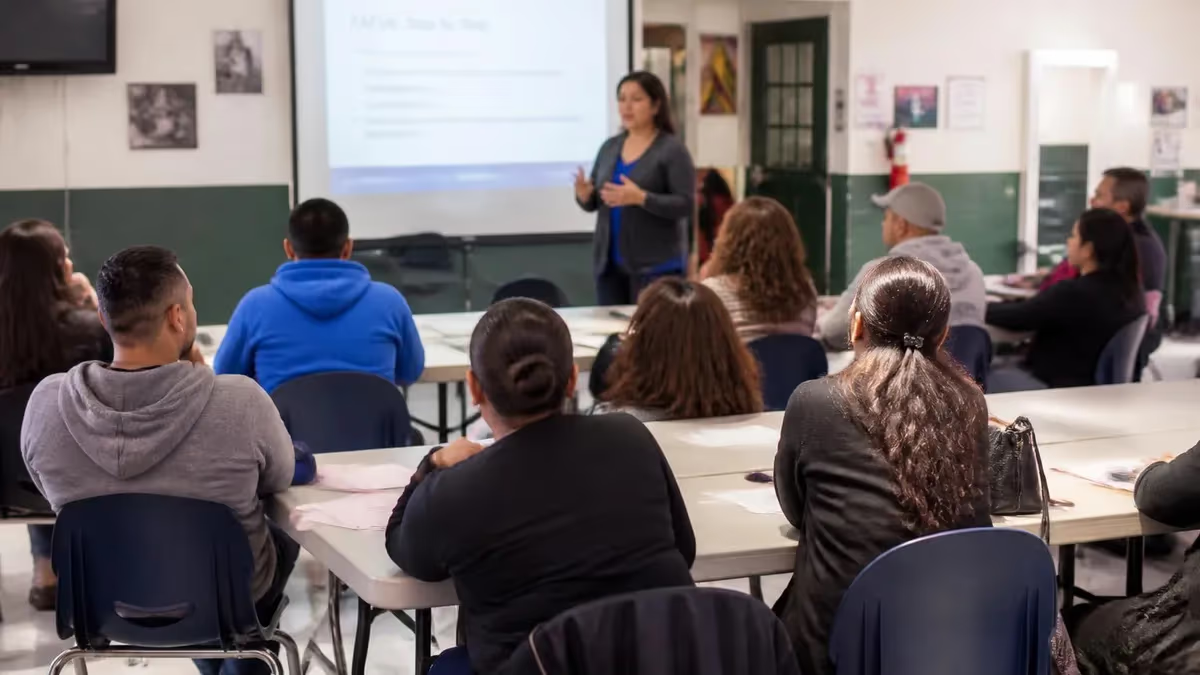
One final consideration when the FAFSA is not working is whether to seek in-person assistance. Many public libraries, community colleges, and high schools host FAFSA completion workshops, often called FAFSA Frenzy events, where trained college access advisors help students and families complete the form on-site. These events typically have reliable, high-speed internet connections and access to technical support staff who know how to work around common FAFSA submission errors. Searching for a FAFSA workshop near you at nasfaa.org or your state's higher education agency website can turn a frustrating digital roadblock into a productive in-person filing session.
Completing the FAFSA successfully requires both the right information and the right mindset. Students who treat the FAFSA as a one-time task to rush through often end up with errors that trigger the verification process — a much more labor-intensive follow-up where your school requests physical copies of tax documents, bank statements, and other records to confirm that what you reported on your FAFSA matches your actual financial situation. Verification can add six to eight weeks to your financial aid timeline, so accuracy on the initial submission is genuinely worth the extra time it takes.
One of the most impactful practical tips is to use the IRS Data Retrieval Tool whenever possible. This feature, available directly within the FAFSA form, connects to IRS records and automatically imports your tax data with a single click. Not only does it save you from manually transcribing numbers (and the transcription errors that inevitably follow), but it also significantly reduces your chances of being selected for verification. Schools and the Department of Education treat DRT-imported data as pre-verified, which streamlines your entire financial aid process from submission through disbursement.
Saving your FAFSA progress frequently is critical, especially during peak traffic periods when the site may be slow or experience brief interruptions. The FAFSA form auto-saves your progress when you click the Save button at the bottom of each section page, but it does not continuously auto-save in the background.
If your browser crashes or your internet connection drops mid-session, any unsaved progress on the current page will be lost. Get in the habit of clicking Save after completing each major section, even if you plan to continue immediately — this takes two seconds and can save 20 minutes of re-entry work.
Understanding the difference between submission and processing is another practical tip that prevents unnecessary panic. The moment you click Submit on the FAFSA, you receive a confirmation page with a confirmation number — save this immediately by taking a screenshot or writing it down.
However, your FAFSA is not instantly processed; it enters a queue that typically takes three to five business days for electronic submissions. During this time, the form status on your StudentAid.gov dashboard will show as Processing. This is normal and does not indicate a problem. Your Student Aid Report (SAR) will arrive by email when processing is complete.
If your Student Aid Report contains errors — either information you entered incorrectly or data that does not match IRS records — you have the ability to correct and resubmit your FAFSA through your StudentAid.gov account. Common corrections include income figures, household size, and number of family members currently enrolled in college. Corrections typically take an additional three to five days to process. Schools receive an updated ISIR (Institutional Student Information Record) each time you make a correction, so your financial aid office is automatically notified of any changes without you having to contact them separately.
Setting a personal FAFSA deadline that is at least two weeks before any official deadline gives you a meaningful buffer for troubleshooting. Two weeks is enough time to resolve most FSA ID problems, browser issues, missing document situations, and even brief website outages without missing the actual cutoff. Students who set personal deadlines of just one or two days before the official date leave themselves no margin for the technical and logistical obstacles that affect a significant percentage of filers every year. Write your personal deadline on your calendar with a reminder three days before it arrives.
Finally, remember that the FAFSA is not a one-time event but an annual requirement. You must complete a new FAFSA for every academic year in which you want to receive federal financial aid. Many returning students are surprised to learn that financial aid does not renew automatically, and missing a renewal filing — even after successfully filing in previous years — results in a complete loss of federal aid for that year.
Mark October 1 on your calendar every year as FAFSA opening day, set a personal filing deadline of November 1 at the latest, and treat the annual FAFSA as a recurring appointment as important as filing your taxes.
FAFSA Questions and Answers

Do I Have to Pay FAFSA Back? Understanding Loan Repayment vs. Grants

Why Is the FAFSA Website Not Working? Fixes, Deadlines & What to Do

How Long Is FAFSA Good For? Complete 2025-26 Validity and Renewal Guide

FAFSA Parent PLUS Loan: Eligibility, Rates, Risks and Alternatives

FAFSA Completion Help: Your Step-by-Step Guide to Applying for Federal Aid
About the Author

Educational Psychologist & Academic Test Preparation Expert
Columbia University Teachers CollegeDr. Lisa Patel holds a Doctorate in Education from Columbia University Teachers College and has spent 17 years researching standardized test design and academic assessment. She has developed preparation programs for SAT, ACT, GRE, LSAT, UCAT, and numerous professional licensing exams, helping students of all backgrounds achieve their target scores.