
FAFSA PDF 2026 September-25: Complete Guide to Downloading, Printing, and Filing the Paper Form
Complete guide to the FAFSA PDF 2026 September-25: where to download, how to print, mailing addresses, processing time, and tips to avoid delays. ✅

The fafsa pdf 2024 25 is the printable paper version of the Free Application for Federal Student Aid, the gateway form that unlocks federal grants, work-study, subsidized loans, and most state and institutional aid. While the online portal at StudentAid.gov processes the overwhelming majority of submissions, the U.S. Department of Education still publishes a downloadable PDF every award year for households without reliable internet, students with accessibility needs, and counselors who prefer to walk applicants through the questions on paper before transferring answers online.
If you are searching for the fafsa form for the 2024-25 award year, the official document is a 17-page color PDF titled "Free Application for Federal Student Aid." The form was overhauled under the FAFSA Simplification Act, cutting the question count from 108 to roughly 36 for most filers and replacing the old Expected Family Contribution with the new Student Aid Index. Even on paper, the new structure still requires contributors—student, spouse, and parents—to consent to IRS data sharing once the form is transferred into the federal processing system.
This guide walks through where to find the official PDF, how to print it correctly, what supporting documents to gather, how long paper FAFSAs take to process compared with online submissions, and the most common errors that send paper forms back to applicants. We also cover the new fafsa launch date october 1 shift, mailing instructions, signature requirements, and what to do if you started on paper but want to finish online.
The paper FAFSA is not a shortcut. The Department of Education estimates a paper application takes seven to ten weeks longer to process than an online submission, which can push your Student Aid Index past state and institutional priority deadlines. If you have any access to a smartphone, library computer, or school workstation, the online filing route at StudentAid.gov will reach colleges faster and let you correct mistakes in real time. The PDF exists as a safety net, not a preferred channel.
That said, the paper form has legitimate uses. Mixed-status families sometimes prefer to draft answers on paper first. Students in correctional facilities, on tribal lands without broadband, or in households recovering from natural disasters often rely on the print version. School counselors use the PDF as a teaching tool. And applicants who hit technical errors on the online form can sometimes resolve their situation by mailing in a completed paper FAFSA with a cover letter.
Throughout this article we use "fafsa 2024-25" and "fafsa 2025" interchangeably to describe the award year that covers the fall 2024 through summer 2025 academic terms. For the next cycle—fall 2025 through summer 2026—you would download the 2025-26 PDF instead, which the Department typically releases on or near October 1 of the prior year. Always confirm the award year printed in the upper right corner of page one before you start writing answers.
By the end of this guide you will know exactly which PDF to download, how to print it on the correct paper size, how to fill in every section, who must sign, where to mail it, how to track it, and how to switch to the online form if processing stalls. Let us start with the official numbers behind paper FAFSA use.
FAFSA Paper Form by the Numbers

Where to Download the Official FAFSA PDF
The primary source is the Federal Student Aid forms library at studentaid.gov/apply-for-aid/fafsa/filling-out. Always download from the .gov domain to avoid scam sites that charge fees for the free form.
High school counselors, TRIO advisors, and financial aid officers can pull bulk PDFs and Spanish-language editions from the Federal Student Aid Partner Connect portal for distribution to students.
Call 1-800-433-3243 to request a paper FAFSA mailed to your home address at no cost. Allow 7-10 business days for delivery, longer during peak filing season.
Many public libraries print FAFSA PDFs on request and provide quiet workspace, calculators, and reference librarians who can answer general filing questions for free.
The Department of Education publishes a complete Spanish-language PDF titled FAFSA en EspaƱol, identical in structure to the English form but with translated instructions and field labels.
Once you locate the PDF, printing it correctly matters more than most applicants realize. The 2024-25 form is designed for standard US Letter paper (8.5 x 11 inches) printed single-sided in color. Two-sided printing is acceptable but can cause OCR scanning errors at the federal processor in Mt. Vernon, Illinois. Always set your printer to "actual size" or 100% scaling, never "fit to page," because shrinking the form moves answer fields out of alignment with the scanner. Black-and-white printing is permitted but reduces the contrast that guides the scanner across colored question blocks.
Use a fresh black or blue ink pen to complete the form. Pencil, erasable ink, and felt-tip markers all cause scanning failures. Print one capital letter per box and leave a blank box between words in name and address fields. Numbers should be right-justified inside their boxes—for instance, an income of $48,750 fills the rightmost five boxes, with leading boxes left blank. Do not write outside the answer grids, do not use commas in dollar amounts, and do not write a dollar sign because the form already includes one.
Gather supporting documents before you start writing. You will need Social Security numbers for the student and every contributor, the student's driver's license number if available, 2022 federal tax returns (the prior-prior year), W-2s and 1099s, current bank statements, records of untaxed income such as child support received, and investment statements excluding the family home and retirement accounts. If you are unsure how long does it take for fafsa to process for your state's priority window, gather these documents at least four weeks before the earliest deadline that applies to you.
Decide on your dependency status before filling out the form. Most undergraduates under 24 are considered dependent and must provide parent information, even if their parents do not claim them on taxes or contribute financially. Independence requires meeting specific criteria such as being married, having dependents of your own, being a veteran, being an emancipated minor, or being an unaccompanied homeless youth. The paper form includes a dependency questionnaire on page 6 that walks through each test.
Identify your contributors. Under the simplified FAFSA, a contributor is anyone whose information must appear on the form: the student, the student's spouse if applicable, biological or adoptive parents, and a parent's spouse. Each contributor signs the paper form by hand and provides their Social Security number and date of birth. If a contributor refuses to participate, the student may still file but loses eligibility for federal need-based grants and subsidized loans, retaining access only to unsubsidized loans.
Set aside roughly two hours to complete the paper form for a first-time filer with one parent contributor. Add 30 minutes per additional contributor. Renewal filers typically finish in 45 to 60 minutes because tax and demographic information rarely changes year to year. Build in extra time if your family has small business income, farm income, custodial parent rules from divorce, or rollovers reported on 2022 tax returns that need manual adjustment.
Finally, photocopy the completed form before mailing it. The federal processor does not return originals, and if your form is lost in transit you will have no record of the answers you submitted. Store the photocopy with your tax documents for at least three years in case the school selects your application for verification, which happens to roughly 18 percent of FAFSA filers each year.
FAFSA Practice Test Questions
Prepare for the FAFSA - Free Application for Federal Student Aid exam with our free practice test modules. Each quiz covers key topics to help you pass on your first try.
FAFSA Dependency Status
FAFSA Exam Questions covering Dependency Status. Master FAFSA Test concepts for certification prep.
FAFSA Deadlines and Renewal
Free FAFSA Practice Test featuring FAFSA Deadlines and Renewal. Improve your FAFSA Exam score with mock test prep.
FAFSA Verification Process
FAFSA Mock Exam on FAFSA Verification Process. FAFSA Study Guide questions to pass on your first try.
FAFSA Federal Aid Types
FAFSA Test Prep for Federal Aid Types. Practice FAFSA Quiz questions and boost your score.
FAFSA Federal Aid Types and Eligibility
FAFSA Questions and Answers on Federal Aid Types and Eligibility. Free FAFSA practice for exam readiness.
FAFSA Financial Aid Eligibility
FAFSA Mock Test covering Financial Aid Eligibility. Online FAFSA Test practice with instant feedback.
FAFSA Income and Asset Reporting
Free FAFSA Quiz on Income and Asset Reporting. FAFSA Exam prep questions with detailed explanations.
FAFSA Practice Test
FAFSA Practice Questions for Practice Test. Build confidence for your FAFSA certification exam.
What Is FAFSA and How to Complete Each Section
Pages 3 through 5 of the paper PDF cover student demographics: legal name as it appears on your Social Security card, date of birth, mailing address, citizenship status, marital status, and state of legal residence. Answer the citizenship question carefully because eligible non-citizens including permanent residents and certain refugees qualify for federal aid, but undocumented students do not and should explore state-level alternatives such as the California Dream Act application instead.
The student section also asks about high school completion, college plans, and grade level for the 2024-25 year. Selecting the wrong grade level can change your loan limits, so first-year undergraduates should mark "never attended college and 1st year undergraduate" while transfer students who have attended any prior institution should mark "attended college before and 1st year undergraduate" if they have not yet earned 30 credits.
Paper FAFSA vs Online FAFSA
- +No internet connection required to fill out the form
- +Allows offline review by counselors or family before submission
- +Useful backup when StudentAid.gov has outages or login issues
- +Available in print-friendly Spanish edition
- +Can be completed in correctional facilities and rural areas
- +Provides a physical paper trail for verification audits
- +Helpful teaching tool for high school financial aid nights
- −Processing takes 7-10 weeks vs 3-5 days online
- −Limited to 10 school choices vs 20 online
- −No IRS Direct Data Exchange to auto-fill tax info
- −Higher error rate due to handwriting and OCR issues
- −Cannot make instant corrections after submission
- −Risk of lost mail or scanning errors at the processor
- −May miss state and institutional priority deadlines
Pros and Cons at a Glance
| Pros | Cons |
|---|---|
| No internet connection required to fill out the form | No IRS Direct Data Exchange to auto-fill tax info |
| Allows offline review by counselors or family before submission | Higher error rate due to handwriting and OCR issues |
| Useful backup when StudentAid.gov has outages or login issues | Cannot make instant corrections after submission |
| Available in print-friendly Spanish edition | Risk of lost mail or scanning errors at the processor |
| Can be completed in correctional facilities and rural areas | May miss state and institutional priority deadlines |
FAFSA Deadline 2025 Paper Submission Checklist
- ✓Download the correct award year PDF from studentaid.gov
- ✓Verify your printer is set to 100 percent actual size
- ✓Gather Social Security numbers for all contributors
- ✓Collect 2022 federal tax returns, W-2s, and 1099s
- ✓List current balances for checking, savings, and investments
- ✓Complete each section in blue or black ink only
- ✓Choose up to 10 schools using Federal School Codes
- ✓Have student and one parent contributor sign by hand
- ✓Photocopy the completed form for your records
- ✓Mail to Federal Student Aid Programs in Mt. Vernon, Illinois
Mail your paper FAFSA at least 10 weeks before any deadline
Paper FAFSAs are scanned and keyed by hand in Mt. Vernon, Illinois, with a typical turnaround of seven to ten weeks during peak season. State grants such as Cal Grant, TAP, and many institutional scholarships use first-come-first-served funding pools that can exhaust before your processed FAFSA arrives. If you must file on paper, mail it the day it is signed and follow up by phone after week six.
Once your paper FAFSA is mailed, the federal processor opens the envelope, scans the form, and converts the handwritten answers into digital data using optical character recognition combined with human verification of any field the scanner flags as uncertain. The Department of Education contracts this work through the Common Origination and Disbursement system. During peak filing months—January through April—turnaround stretches to ten weeks. During slower months such as July or November, paper forms can clear in five to six weeks.
To check the status of a mailed paper FAFSA, wait at least four weeks after the postmark date and then call the Federal Student Aid Information Center at 1-800-433-3243. Have the student's Social Security number, date of birth, and FSA ID ready if you have one. Representatives can confirm receipt, identify any rejection reason, and walk you through corrections. You can also log in to StudentAid.gov once an FSA ID is created and view your processed Student Aid Report in your account dashboard.
Every processed FAFSA generates a Student Aid Report, called the FAFSA Submission Summary under the new naming convention. This document confirms the data you submitted, your calculated Student Aid Index, your Pell Grant eligibility indicator, and any items the processor could not validate. Review the summary line by line within two weeks of receipt. Errors discovered during verification can delay aid disbursement by an entire semester if not corrected promptly.
If you submitted on paper but want to track status more easily, create an FSA ID at studentaid.gov after mailing. The FSA ID links to your processed record once the federal system ingests your paper form, giving you online access to the same dashboard online filers use. Creating an FSA ID also lets you correct mistakes electronically rather than mailing a paper correction, which cuts another five to six weeks off the resolution timeline.
Each college on your list receives your processed FAFSA data via the Institutional Student Information Record. Schools typically take two to six additional weeks to package your aid offer after receiving the ISIR. The fastest schools are large state universities with automated aid systems; the slowest are small private colleges that manually review each file. If you have not received a financial aid offer within eight weeks of confirmed processing, contact each school's financial aid office directly with your Data Release Number.
For students wondering when is fafsa open for 2025-26, the federal launch date typically falls on October 1 each year, though the 2024-25 cycle saw a delayed December opening due to the Simplification Act rollout. Plan your timeline accordingly. If you file paper in October, expect aid offers in January. If you wait until April, aid offers may not arrive until summer, after many institutional scholarships are committed.
Keep your photocopy of the original FAFSA, all supporting tax documents, and any correspondence with the federal processor in a single folder for at least three years. Schools selected for verification will request these documents, and IRS audits or financial aid appeals frequently reference FAFSA data from prior years. A clean paper trail dramatically shortens both verification and appeal timelines.
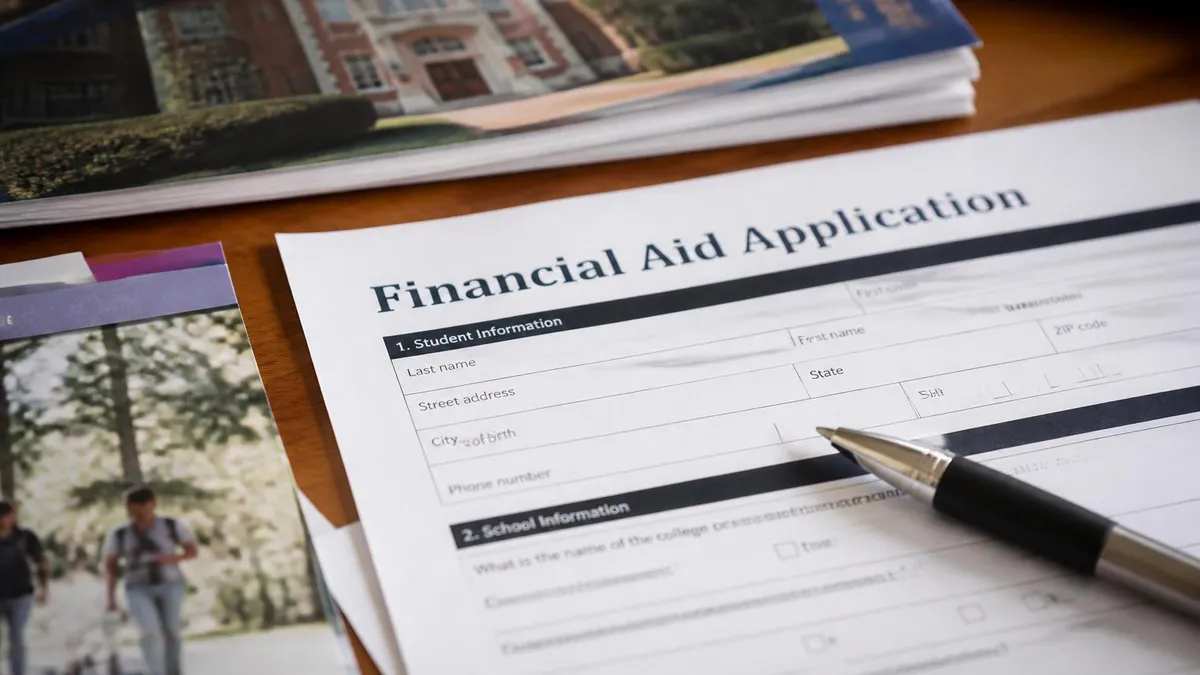
The FAFSA is always free. Any website that charges a fee to file, download, or review the FAFSA is operating outside Department of Education authorization. Look for the .gov domain ending in studentaid.gov before entering personal information. The acronym FAFSA literally begins with the word "Free," and the federal processor never accepts payment.
The most common reason paper FAFSAs are rejected is a missing signature. Both the student and at least one parent contributor must sign in ink on the signature page for dependent applicants. Independent students need only their own signature plus, if applicable, their spouse's signature. Photocopied or stamped signatures are not accepted. If you mail an unsigned form, the processor returns it with a signature request that adds four to six weeks to your timeline.
The second most common error involves dollar amounts. Applicants frequently include cents, commas, or dollar signs in income and asset fields. The scanner expects a clean whole number right-justified in the answer boxes. An entry like "$48,750.00" can be misread as 4,875,000 or zero. Round to the nearest dollar, omit punctuation, and double-check totals against the 2022 tax return line items the form references.
The third major pitfall is reporting the wrong tax year. The 2024-25 FAFSA uses 2022 income data—the so-called prior-prior year—not 2023. Many families mistakenly pull current tax returns and end up with inflated or deflated income that does not match IRS records when the school conducts verification. Always confirm the tax year label printed above each income question before transcribing numbers.
Dependency status mistakes also delay processing. Undergraduate students under age 24 who are unmarried, have no dependents, are not veterans, and are not legally emancipated must report parent information. Skipping the parent section because parents "refuse to pay" or because the student is financially independent does not change federal rules and results in an automatic rejection. Review the dependency questionnaire on page 6 carefully before deciding which sections to complete. If you remain uncertain about your fafsa due date or eligibility status, contact your school's financial aid office for a written determination.
Mismatched names and Social Security numbers cause silent failures—the form processes but the federal database cannot verify the applicant's identity. Use the student's full legal name exactly as printed on the Social Security card, including hyphens, suffixes, and middle names. A married student who has not updated their SSA record should use their maiden name. Mismatches trigger a verification hold that blocks all aid disbursement until resolved through the Social Security Administration.
Asset reporting errors are particularly costly because they directly increase the Student Aid Index. Do not report the value of the family's primary residence, retirement accounts such as 401(k)s and IRAs, life insurance cash value, or personal possessions. Do report checking, savings, money market accounts, non-retirement brokerage holdings, 529 plans owned by the parent, and the net value of investment real estate. Misreporting retirement accounts as assets is one of the most expensive mistakes families make.
Finally, do not use white-out or correction tape on the paper form. The scanner reads the obscured field as suspicious and routes the entire form to manual review, adding weeks to processing. If you make a mistake, draw a single line through the error, write the correction above it, and initial the change. For major errors, reprint the affected page from the original PDF and complete it fresh.
For applicants weighing whether to file the paper FAFSA or switch to the online version, a few practical tips can help you decide. First, if you have any FSA ID created in a prior year, log in at StudentAid.gov before printing the PDF. Renewal filing online takes 20 minutes for most returning students because demographic data and school lists carry forward. Paper renewal requires re-entering everything from scratch.
Second, use the IRS Direct Data Exchange whenever possible. The simplified FAFSA pulls income and tax data directly from IRS records once contributors consent during the online filing flow. Paper filers cannot use this feature and must transcribe every line by hand, which dramatically increases the risk of verification selection. About 18 percent of all FAFSAs are pulled for verification each year, and paper filers face roughly double that rate due to higher error frequency.
Third, plan around the new launch calendar. Historically the FAFSA opened October 1, but the 2024-25 cycle launched in late December after the Simplification Act rebuild. Subsequent cycles are expected to return to the October 1 launch date. Whichever date applies to your award year, mail your paper form within the first two weeks of availability to maximize your chances of meeting state and institutional priority deadlines.
Fourth, contact the financial aid office at each school on your list to confirm they have received your processed ISIR. Schools occasionally lose records during system updates, and your federal record may be processed correctly while the school file remains incomplete. A five-minute phone call to verify receipt can save an entire semester of aid delays.
Fifth, if you cannot complete the paper form alone, free help is available. The Federal Student Aid Information Center answers questions at 1-800-433-3243 Monday through Friday. Nonprofit organizations such as the National College Attainment Network, uAspire, and college access programs in many cities host FAFSA completion events with trained volunteers. Your high school counselor and your future college's financial aid office both offer free filing assistance.
Sixth, save every confirmation. After mailing your paper FAFSA, keep the certified mail receipt or USPS tracking number, your photocopy of the completed form, the signed contributor pages, and any subsequent correspondence in one folder. When the FAFSA Submission Summary arrives, file it alongside the originals. This single folder will resolve 90 percent of verification questions and aid disputes that arise later.
Finally, build a backup plan. Even with perfect paperwork, mail can be lost and federal systems can experience outages. If you have not received confirmation within six weeks of mailing, call Federal Student Aid immediately and ask whether your record has been received. If not, the representative can either trace the original or instruct you to mail a fresh copy. Being proactive about follow-up is often the difference between receiving a Pell Grant and missing the funding window entirely.
FAFSA Questions and Answers

FAFSA Deadline 2025-2026: Federal and State Dates You Cannot Miss

State FAFSA Deadlines: 2025-26 Priority Dates Guide

StudentAid.gov FAFSA: Complete 2025-26 Guide to Filing, Deadlines, and Aid

FAFSA Qualifications 2025-26: Complete Eligibility Requirements Guide

Do Retirement Accounts Count as Assets for FAFSA? Complete 2025-26 Guide
About the Author

Educational Psychologist & Academic Test Preparation Expert
Columbia University Teachers CollegeDr. Lisa Patel holds a Doctorate in Education from Columbia University Teachers College and has spent 17 years researching standardized test design and academic assessment. She has developed preparation programs for SAT, ACT, GRE, LSAT, UCAT, and numerous professional licensing exams, helping students of all backgrounds achieve their target scores.