
MOHELA FAFSA: Understanding Federal Loan Servicers and How They Affect Your Aid
🗨️ Learn how MOHELA and other FAFSA loan servicers work, 2026 October deadlines, repayment options, and how to manage your federal student aid effectively.
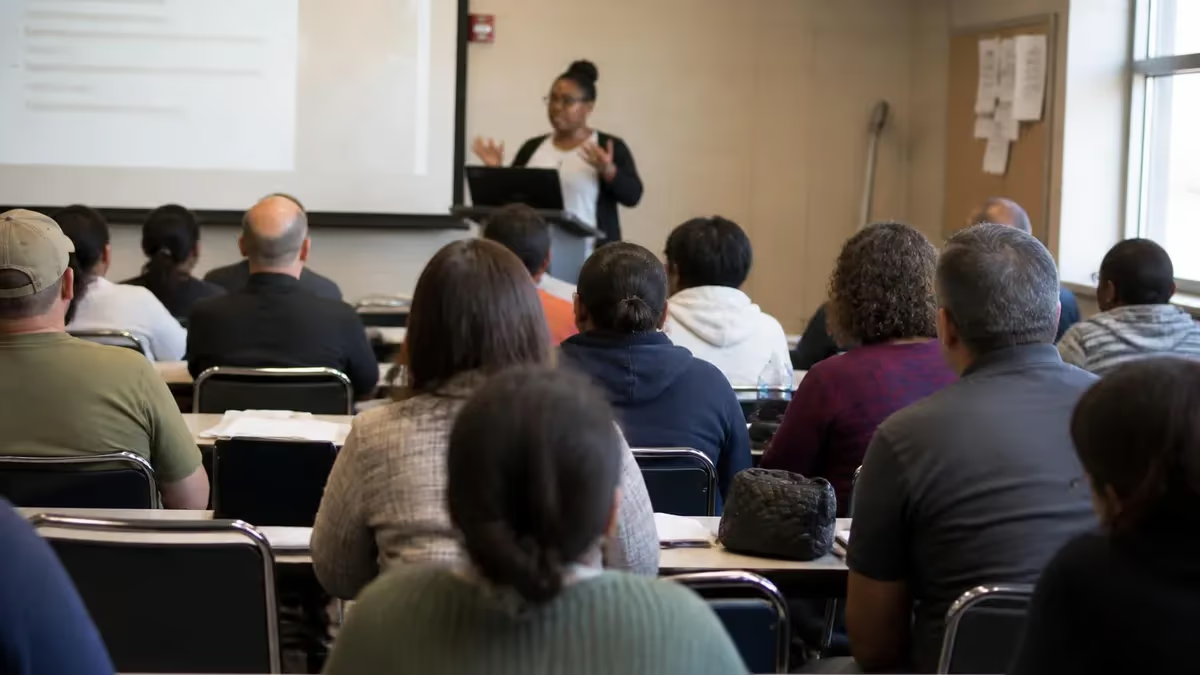
When you submit your FAFSA and receive federal student loans, you quickly discover that the U.S. Department of Education does not manage your loan repayment directly — that responsibility falls to a loan servicer.
MOHELA FAFSA borrowers represent one of the largest groups in the federal student loan system today, as MOHELA (Missouri Higher Education Loan Authority) became the primary servicer for millions of accounts following major federal contracting changes in recent years. Understanding which company handles your loans, how to contact them, and what your repayment options are is just as important as completing your FAFSA application in the first place.
The FAFSA, or Free Application for Federal Student Aid, is the starting point for accessing federal grants, work-study funds, and loans every academic year. For the 2025-26 award year, the FAFSA deadline at the federal level is June 30, 2026, but most states and schools have much earlier cutoff dates — sometimes as early as February or March. Knowing the fafsa deadline 2025 for your specific state can mean the difference between receiving maximum aid and missing out on thousands of dollars in grant funding that never has to be repaid.
Once your FAFSA is processed and your school packages your aid, any federal loans you accept are assigned to a servicer. This assignment happens automatically — you do not choose your own servicer. MOHELA, Aidvantage, Edfinancial, ECSI, and Default Resolution Group are among the active federal loan servicers as of 2025. Each company operates under a federal contract and must follow Department of Education guidelines, but they differ in their customer service quality, online portal features, and responsiveness to borrower inquiries, so knowing how to work with yours is critical.
Many borrowers first encounter their loan servicer when their six-month post-graduation grace period ends and repayment begins. At that point, if MOHELA is your servicer, you will receive communications about enrolling in a repayment plan, setting up auto-pay (which typically earns a 0.25% interest rate reduction), and managing due dates. Borrowers who completed the FAFSA process and took out Direct Subsidized or Unsubsidized Loans will find all of their account details accessible through the MOHELA online portal, as well as through the federal StudentAid.gov website using your FSA ID credentials.
Understanding the relationship between FAFSA, the Department of Education, and your loan servicer protects you from confusion and missed payments. When you want to know "when is fafsa due" for upcoming academic years, that information comes from StudentAid.gov and your school's financial aid office. When you need to manage repayment, submit income documentation, or request deferment, that conversation happens with your loan servicer — MOHELA or otherwise. Keeping both relationships organized is the hallmark of a borrower who successfully navigates federal student aid without costly mistakes or credit damage.
This article provides a comprehensive breakdown of how fafsa loan servicers operate within the broader federal aid ecosystem, what MOHELA borrowers specifically need to know, how 2025 FAFSA deadlines interact with loan disbursement timelines, and what repayment strategies are available to help you minimize long-term costs. Whether you are a first-time college student, a graduate student, or a borrower returning to school after a break, understanding these systems enables you to make smarter financial decisions from day one of your academic journey.
Throughout this guide, we will cover the key differences between major servicers, walk through step-by-step processes for common borrower tasks, explain income-driven repayment plans that can dramatically reduce your monthly payment burden, and highlight the most common mistakes borrowers make when dealing with servicers — so you can avoid them entirely. Bookmark this page and return to it each time your loan situation changes, whether that means starting school, graduating, changing jobs, or exploring loan forgiveness programs.
Federal Student Loans by the Numbers

Major Federal Loan Servicers in 2025
Missouri Higher Education Loan Authority became one of the largest federal servicers after absorbing Public Service Loan Forgiveness (PSLF) accounts and millions of general borrower accounts. MOHELA handles PSLF tracking, income-driven repayment enrollment, and standard repayment for a significant share of the borrower population.
Aidvantage, operated by Maximus, took over accounts previously managed by Navient when Navient exited the federal servicing market in 2021. It services millions of Direct Loan borrowers and offers an online portal, mobile app, and standard customer service channels for managing payments and plan changes.
Edfinancial primarily services Federal Family Education Loan (FFEL) Program loans as well as some Direct Loan accounts. It is known for its smaller borrower base compared to MOHELA or Aidvantage, which some borrowers find results in more responsive customer service and shorter hold times.
ECSI specializes in Perkins Loans and some institutional loan programs, making it less common among typical FAFSA borrowers. If your school awarded Perkins Loans before the program expired in 2017, ECSI may be your servicer for those specific accounts while another company handles your Direct Loans.
The Default Resolution Group handles accounts that have fallen into default status — meaning payments are 270+ days overdue. Borrowers assigned here need to pursue loan rehabilitation or consolidation to exit default, restore eligibility for future federal aid, and protect their credit from continued damage.
The FAFSA deadline structure in 2025 is more nuanced than most students realize, and missing the right deadline can cost you thousands of dollars in grant aid. The federal FAFSA deadline for the 2025-26 academic year is June 30, 2026 — but this cutoff is largely symbolic for most applicants.
States distribute their own grant funds on a first-come, first-served basis, and many states exhaust their grant budgets well before the federal deadline arrives. States like Illinois, Tennessee, and North Carolina have among the earliest deadlines in the nation, sometimes requiring FAFSA submission as early as October 1 of the prior year.
Colleges and universities layer their own institutional aid deadlines on top of state cutoffs. A school's priority financial aid deadline — often in November, December, or February — determines whether you are considered for the maximum available institutional grants and scholarships.
Submitting your FAFSA after the priority deadline does not mean you receive zero aid, but it does mean you may only be offered loans rather than the free money that earlier applicants already claimed. When students ask "when is fafsa due for 2025-26," the honest answer depends entirely on which state you live in and which school you plan to attend.
After FAFSA processing is complete — typically within three to five business days for online submissions — your Student Aid Report (SAR) is generated and sent to the schools you listed. Your school's financial aid office then packages your aid, which may include Pell Grants, institutional scholarships, work-study awards, and federal loans. Only after you accept the loan portion of your award and complete entrance counseling does the loan actually disburse to your school account. This timeline means that submitting your FAFSA early is not just about deadlines — it directly accelerates when money arrives in your account.
One frequently overlooked deadline nuance involves corrections to your FAFSA. If your family's financial situation changes significantly after initial submission — due to job loss, divorce, or a medical emergency — you can request a Professional Judgment review from your school's financial aid office. This process allows aid administrators to adjust your Expected Family Contribution (now called the Student Aid Index under the FAFSA Simplification Act) based on current circumstances rather than prior-year tax data. Initiating this process early gives the financial aid office time to complete the review before the semester begins.
For borrowers who already have federal loans in repayment, the annual FAFSA cycle has a different significance. Each time you return to school at least half-time, your existing loans may qualify for an in-school deferment, pausing repayment without accruing interest on subsidized loans. Notifying your loan servicer — whether that is MOHELA or another company — of your enrollment status is your responsibility. Schools report enrollment to the National Student Clearinghouse, which servicers use to process deferments, but processing delays happen regularly and it is always wise to contact your servicer directly when you re-enroll.
The fafsa phone number for the Federal Student Aid Information Center is 1-800-433-3243, available weekdays from 8 a.m. to 11 p.m. Eastern and Saturdays from 11 a.m. to 5 p.m. Eastern. This line handles questions about FAFSA submission, processing status, SAR corrections, and FSA ID issues — but it cannot help you with loan repayment questions, which must go directly to your servicer. Having both numbers saved in your phone — the FSA helpline and your servicer's customer service line — saves significant time when you have an urgent question about your aid or loan status.
Understanding when to act on FAFSA-related deadlines is a skill that compounds over time. Students who learn the system as freshmen tend to submit renewals on October 1 each year (the earliest possible date), claim maximum grant eligibility, and enter repayment with a clear understanding of their loan balances. Those who treat FAFSA as an afterthought often miss state grants, lose access to subsidized loans, and begin repayment confused about who their servicer is and what they owe. The earlier you build good FAFSA habits, the better your financial outcomes across all four or more years of your education.
FAFSA 2025 Repayment Plans: What MOHELA Borrowers Need to Know
Income-driven repayment (IDR) plans cap your monthly federal loan payment at a percentage of your discretionary income — typically 5% to 20% depending on the specific plan. The SAVE plan (Saving on a Valuable Education), which replaced REPAYE, was designed to offer the lowest payments of any IDR option for most borrowers, calculating payments at just 5% of discretionary income for undergraduate loan balances. MOHELA borrowers can apply for IDR plans directly through StudentAid.gov or by calling MOHELA's customer service line, and processing generally takes 30 to 60 days.
Borrowers on IDR plans who have balances remaining after 20 to 25 years of qualifying payments — depending on the specific plan and loan type — are eligible for loan forgiveness of the remaining balance. This forgiveness was historically treated as taxable income, but the American Rescue Plan Act of 2021 made IDR forgiveness tax-free through 2025, and legislative efforts to extend this exemption are ongoing. Choosing the right IDR plan depends on your income trajectory, loan balance, and whether you plan to pursue Public Service Loan Forgiveness, so comparing options with MOHELA's counselors or a nonprofit student loan advisor is strongly recommended.

Working with MOHELA: Advantages and Challenges
- +Exclusive PSLF processing authority means all forgiveness-track borrowers are centralized in one place
- +Strong online portal with income recertification, payment history, and IDR application tools
- +Auto-pay enrollment earns 0.25% interest rate discount on all qualifying loans
- +SAVE plan enrollment available online without requiring a phone call to customer service
- +Transparent PSLF payment tracker showing qualifying payment count in real time
- +Multiple contact channels including phone, secure message, and callback request options
- −Customer service hold times can exceed 60 minutes during peak periods like September and January
- −Processing delays for IDR applications and PSLF certifications can stretch beyond 60 days
- −Website outages have been reported during high-traffic periods following policy announcements
- −Borrowers transferred from other servicers sometimes experience temporary data discrepancies
- −Phone representatives vary widely in knowledge depth, requiring persistence for complex questions
- −Mail correspondence is significantly slower than online channels, creating risk for time-sensitive requests
Pros and Cons at a Glance
| Pros | Cons |
|---|---|
| Exclusive PSLF processing authority means all forgiveness-track borrowers are centralized in one place | Website outages have been reported during high-traffic periods following policy announcements |
| Strong online portal with income recertification, payment history, and IDR application tools | Borrowers transferred from other servicers sometimes experience temporary data discrepancies |
| SAVE plan enrollment available online without requiring a phone call to customer service | Phone representatives vary widely in knowledge depth, requiring persistence for complex questions |
| Transparent PSLF payment tracker showing qualifying payment count in real time | Mail correspondence is significantly slower than online channels, creating risk for time-sensitive requests |
FAFSA Borrower Action Checklist: From Application to Repayment
- ✓Submit your FAFSA as close to October 1 as possible to maximize state and institutional grant eligibility
- ✓Verify your FSA ID login credentials work correctly before the FAFSA opens each award year
- ✓Check your Student Aid Report for errors within one week of FAFSA submission and correct immediately
- ✓Review your financial aid award letter carefully and distinguish grants from loans before accepting
- ✓Complete required entrance counseling and the Master Promissory Note before your first loan disburses
- ✓Log into StudentAid.gov to identify which servicer holds your loans before repayment begins
- ✓Set up online account access with your servicer (MOHELA, Aidvantage, or other) during your grace period
- ✓Compare repayment plan options using the Loan Simulator at StudentAid.gov before your first payment
- ✓Enroll in auto-pay to secure the 0.25% interest rate reduction and avoid missed payment risk
- ✓Submit an Employment Certification Form annually if you are pursuing Public Service Loan Forgiveness
PSLF Requires MOHELA — Request a Servicer Transfer If Needed
If you work for a qualifying public service employer and your loans are not currently serviced by MOHELA, submitting your first Employment Certification Form automatically triggers a transfer of your account to MOHELA. Do not wait — every qualifying payment made before your account transfers still counts toward your 120-payment total, but MOHELA must verify and certify them. Submit your ECF as early as possible to ensure your payment history is accurately tracked from the start.
Loan forgiveness programs represent one of the most significant financial opportunities available to federal student loan borrowers, but they also carry some of the most complex eligibility requirements in the entire student aid system. Public Service Loan Forgiveness is the largest and best-known program, offering complete forgiveness of remaining Direct Loan balances after 120 qualifying payments under an income-driven repayment plan while employed full-time at a qualifying public service organization.
As of early 2025, the Department of Education has approved PSLF forgiveness for more than 870,000 borrowers, discharging more than $62 billion in federal student loan debt — a dramatic increase from fewer than 10,000 approvals before the PSLF Waiver program launched in 2021.
Income-driven repayment forgiveness operates on a longer timeline than PSLF but is available to all federal Direct Loan borrowers regardless of employer type. Under the SAVE plan, borrowers with only undergraduate loan debt may qualify for forgiveness after as few as 20 years of qualifying payments if their original loan balance was $12,000 or less, with the forgiveness timeline extending by one year for each additional $1,000 borrowed, capping at 20 years for balances under $12,000 and 25 years for higher balances or borrowers with graduate school debt.
This graduated forgiveness timeline was designed to benefit lower-balance borrowers who might otherwise spend decades in repayment on small amounts they have effectively already repaid in interest.
Teacher Loan Forgiveness is a separate program that awards up to $17,500 in forgiveness to teachers who complete five consecutive years of full-time teaching in a low-income school or educational service agency. This program is separate from PSLF and cannot be pursued simultaneously for the same period of teaching — though borrowers can pursue Teacher Loan Forgiveness first, then pivot to PSLF for any remaining balance after the five-year teaching period concludes.
Mathematics and science teachers at the secondary level, and special education teachers at any level, qualify for the maximum $17,500 benefit, while all other qualifying teachers receive up to $5,000.
Total and Permanent Disability (TPD) discharge eliminates federal student loan balances entirely for borrowers who are totally and permanently disabled, as certified by a physician, the Social Security Administration, or the Department of Veterans Affairs. Unlike forgiveness programs tied to repayment milestones, TPD discharge can be granted at any point in a borrower's repayment timeline. Borrowers who qualify are monitored for three years after discharge, during which they must not exceed income thresholds — but as of 2021, the Department of Education eliminated annual income monitoring for most TPD recipients, significantly reducing the administrative burden on disabled borrowers.
Borrower Defense to Repayment is a lesser-known forgiveness pathway available to borrowers whose school engaged in fraud, misrepresentation, or serious violations of state law related to their enrollment. Students who attended for-profit schools that subsequently closed — institutions like Corinthian Colleges, ITT Technical Institute, and certain campuses of the Art Institutes chain — have submitted Borrower Defense claims in large numbers, with the Department of Education granting blanket discharges to entire groups of affected borrowers in recent years.
If you attended a school that closed or that has been investigated for deceptive practices, you may qualify for this relief even if your loans are currently being serviced by MOHELA or another company.
Closed School Discharge automatically cancels federal loans for students who were enrolled when their school closed, or who withdrew within 180 days before the closure, without receiving a comparable education elsewhere. This discharge does not require filing a formal application in most cases — the Department of Education works with servicers to identify and discharge eligible loans automatically.
Borrowers who received a closed school discharge have 100% of their qualifying loan balance eliminated and receive a refund of any payments made on those loans after the closure, making it one of the most complete forms of relief available in the federal loan system.
Navigating forgiveness programs requires careful recordkeeping, proactive communication with your servicer, and sometimes the assistance of a nonprofit student loan counselor or attorney. Organizations like the Student Borrower Protection Center, the National Consumer Law Center, and the Institute of Student Loan Advisors offer free resources and guidance for borrowers pursuing forgiveness. Given the complexity of these programs and the frequency with which federal policy changes affect eligibility, verifying your current standing annually — especially if you are close to any forgiveness milestone — is a non-negotiable part of responsible loan management.

Many state grant programs award funds on a first-come, first-served basis and exhaust their entire budget weeks or months before the official state deadline. Submitting your FAFSA on October 1 — the first day it opens — gives you the best possible chance of receiving state grant money. Waiting until December, January, or later may mean only loans are left, even if your income fully qualifies you for grants worth thousands of dollars per year.
Contacting your loan servicer effectively is a skill that can save you hours of frustration and potentially protect you from costly errors in your loan account. MOHELA's primary customer service phone number is 1-888-866-4352, available Monday through Friday from 7 a.m. to 10 p.m. Central Time.
Call volume is highest on Mondays and at the beginning of each month, so scheduling calls for mid-week mornings — Tuesday through Thursday between 8 and 10 a.m. Central — typically results in the shortest hold times. The fafsa phone number for the Federal Student Aid Information Center (1-800-433-3243) handles FAFSA and FSA ID questions, but all loan management questions must go to your servicer directly.
Before calling MOHELA or any federal loan servicer, prepare the following information: your full Social Security number, your servicer account number (found on your billing statement or online portal), the specific loan IDs you are inquiring about, your current mailing address and phone number, and a clear statement of what you need — whether that is switching repayment plans, requesting a deferment, asking about your PSLF payment count, or disputing an error on your account.
Having this information ready at the start of the call allows the representative to locate your account quickly and spend more time addressing your actual question rather than collecting identifying information.
Secure messaging through your servicer's online portal is often the most effective channel for non-urgent questions that require a written record. When you submit a secure message through the MOHELA portal, the interaction is documented with timestamps, and you retain a copy of both your question and the representative's response.
This documentation becomes critically important if a dispute arises later about what a servicer told you — verbal agreements or advice given over the phone can be difficult to prove, while written correspondence is far easier to reference. Always request confirmation numbers or written follow-up for any phone conversation involving a significant account change.
If you encounter an error in your loan account — such as payments not posting correctly, a repayment plan change that was not processed, or an incorrect PSLF payment count — escalate the issue promptly through formal channels. MOHELA has a dedicated escalation process for borrowers who cannot resolve issues at the front-line representative level.
If MOHELA is unable to resolve your complaint, you can file a complaint with the Consumer Financial Protection Bureau (CFPB), the Federal Student Aid Ombudsman, or your state's Attorney General office. These agencies have authority to investigate servicer misconduct and compel corrective action, and the threat of a formal complaint often motivates servicers to resolve disputes they might otherwise dismiss.
For borrowers who are struggling to make payments, the most important first call to make is to your servicer before you miss a payment — not after. Servicers have multiple tools available to help borrowers avoid default, including income-driven repayment enrollment, forbearance, deferment for unemployment or economic hardship, and graduated repayment adjustments. Once a loan enters default (270+ days overdue for most Direct Loans), your options narrow considerably, your credit takes a significant hit, and the government gains collection powers including wage garnishment and tax refund seizure. Proactive communication is always the right move when financial difficulty arises.
Understanding your fafsa id and its relationship to your loan servicer account is another area where confusion commonly arises. Your FSA ID — the username and password combination you use to sign the FAFSA electronically and access StudentAid.gov — is separate from your servicer login credentials. Your FSA ID is issued and managed by the Department of Education, while your MOHELA login is created independently on the MOHELA website.
Both accounts are necessary: StudentAid.gov shows your overall loan summary, disbursement history, and servicer assignment, while your servicer portal shows your specific account balance, payment history, repayment plan, and billing information. Losing access to either account requires different recovery steps, so store both sets of credentials securely.
Finally, staying informed about changes to federal student loan policy — which has shifted significantly in recent years following the FAFSA Simplification Act, COVID-19 payment pauses, and various forgiveness initiatives — requires reliable information sources. StudentAid.gov is the authoritative source for FAFSA and loan policy information. Your servicer's website and email communications are the right place for account-specific updates.
News from sources like NerdWallet, The Institute for College Access and Success, and the Student Borrower Protection Center can help contextualize policy changes. Combining these sources gives you a complete picture of how national policy decisions translate into changes in your individual loan account managed by fafsa loan servicers like MOHELA.
Building a proactive strategy for managing your federal student loans from the moment you first complete the FAFSA pays dividends throughout your entire repayment life. Students who treat loan management as an afterthought — something to deal with after graduation — consistently end up paying more interest, missing forgiveness opportunities, and experiencing more stress than those who engage with the system early and often. The good news is that the federal student loan system, while complex, is highly documented and relatively navigable once you understand its structure and the role your loan servicer plays within it.
One of the most powerful strategies for minimizing total loan cost is aggressive early repayment of unsubsidized loans while you are still enrolled in school. Unlike subsidized loans — which the government covers interest on while you are enrolled at least half-time — unsubsidized loans begin accruing interest immediately upon disbursement.
A student who borrows $10,000 in unsubsidized loans at 6.53% interest (the 2024-25 rate for undergraduates) and makes no payments during four years of school will owe approximately $12,900 by graduation before a single required payment is made. Paying even $50 per month toward unsubsidized loan interest during school significantly reduces this capitalization effect and lowers the principal balance entering repayment.
Annual FAFSA renewal is another habit that separates financially savvy students from those who miss aid opportunities. The FAFSA must be submitted every academic year — it does not automatically renew. Returning students who submitted a FAFSA the prior year can use the IRS Data Retrieval Tool to pre-populate most financial information automatically, making the renewal process much faster than the initial application. Setting a calendar reminder for October 1 each year — the earliest FAFSA opening date — ensures you never miss the first-come, first-served window for state grant funds.
Monitoring your credit report is a loan management practice that too many borrowers overlook. Federal student loans are reported to all three major credit bureaus — Equifax, Experian, and TransUnion — and any missed payments, defaults, or errors in servicer reporting can damage your credit score significantly. Under federal law, you are entitled to one free credit report annually from each bureau at AnnualCreditReport.com.
Reviewing these reports allows you to catch errors — such as payments incorrectly marked as late — before they cause lasting credit damage. If you find an error, disputing it directly with the credit bureau and providing documentation from your servicer's payment records is the fastest path to resolution.
Borrowers who receive a large income increase should revisit their repayment plan promptly, as IDR plans recertify annually and a significant income change can substantially raise monthly payment amounts. If your income rises above the level where IDR payments would equal or exceed what the Standard Plan requires, the IDR plan no longer offers a payment benefit — though it still allows access to the forgiveness pathway for borrowers with high balances relative to income.
Using the Loan Simulator at StudentAid.gov when major life changes occur — new job, marriage, children, graduate school enrollment — ensures you are always on the plan best suited to your current financial reality.
Refinancing federal student loans with a private lender is an option some borrowers consider, particularly those with high incomes and strong credit who qualify for significantly lower interest rates in the private market. However, refinancing federal loans into a private loan permanently eliminates access to income-driven repayment plans, PSLF eligibility, federal deferment and forbearance options, and any future federal forgiveness programs — a trade-off that is appropriate for some borrowers but catastrophic for others.
Before refinancing, model both scenarios over the full repayment period using your servicer's tools and independent calculators, and factor in the value of federal protections you would be giving up, not just the interest rate differential.
Finally, if you are considering graduate school or returning to undergraduate study, understanding how existing loans interact with new aid eligibility is essential planning before you re-enroll. Borrowers already in repayment who return to school at least half-time automatically qualify for in-school deferment on their existing loans, pausing required payments — though interest continues to accrue on unsubsidized and PLUS loans during deferment.
New federal borrowing is subject to annual and aggregate loan limits that may restrict how much you can borrow if you are close to the federal maximum. Planning your graduate school financing strategy before you apply — not after admission — gives you the clearest picture of true total cost and allows for the most strategic use of available aid types.
Sample FAFSA Practice Questions
Try these questions from our free FAFSA practice tests. The correct answer and an explanation follow each question.
What interest rate feature applies to all federal student loans regardless of when they were taken out?
- A. Variable rates that adjust monthly
- B. Fixed interest rates set at the time of disbursement
- C. Rates tied to the federal funds rate
- D. Rates set individually by each school
Answer: B. Fixed interest rates set at the time of disbursement
Federal student loans have fixed interest rates that are set by Congress and apply for the life of the loan, providing payment predictability.
If a student is incarcerated, what federal aid might they still qualify for?
- A. Pell Grants (restored in 2023-24)
- B. Federal Direct Subsidized Loans
- C. Federal Work-Study
- D. PLUS Loans
Answer: A. Pell Grants (restored in 2023-24)
Starting with the 2023-24 award year, incarcerated students in eligible prison education programs can receive Pell Grants again.
What is the annual borrowing limit for a first-year dependent undergraduate student for federal Direct Loans?
- A. $3,500
- B. $5,500
- C. $7,500
- D. $9,500
Answer: A. $3,500
First-year dependent undergraduates can borrow a maximum of $3,500 in subsidized loans plus additional unsubsidized loans for a combined limit of $5,500 per year.
What is the maximum amount of Federal Stafford Loans a freshman can receive?
- A. $5500, (3500 subsidized, 2000 unsubsidized)
- B. $9500 (3500 subsidized, 4000 unsubsidized)
- C. $3000
- D. $4000
Answer: B. $9500 (3500 subsidized, 4000 unsubsidized)
The maximum amount of Federal Stafford Loans a freshman can receive depends on their dependency status. For an independent freshman student, the maximum annual limit is $9,500. This amount typically comprises $3,500 in subsidized loans and an additional $6,000 in unsubsidized loans, allowing for greater borrowing capacity to cover educational costs.
FAFSA Questions and Answers





About the Author

Educational Psychologist & Academic Test Preparation Expert
Columbia University Teachers CollegeDr. Lisa Patel holds a Doctorate in Education from Columbia University Teachers College and has spent 17 years researching standardized test design and academic assessment. She has developed preparation programs for SAT, ACT, GRE, LSAT, UCAT, and numerous professional licensing exams, helping students of all backgrounds achieve their target scores.