
FAA-Approved Aviation Maintenance Technician Schools 2026 September
Compare FAA-approved aviation maintenance technician schools, Part 147 program structure, costs, and how to pick the right A&P training program. 🗨️
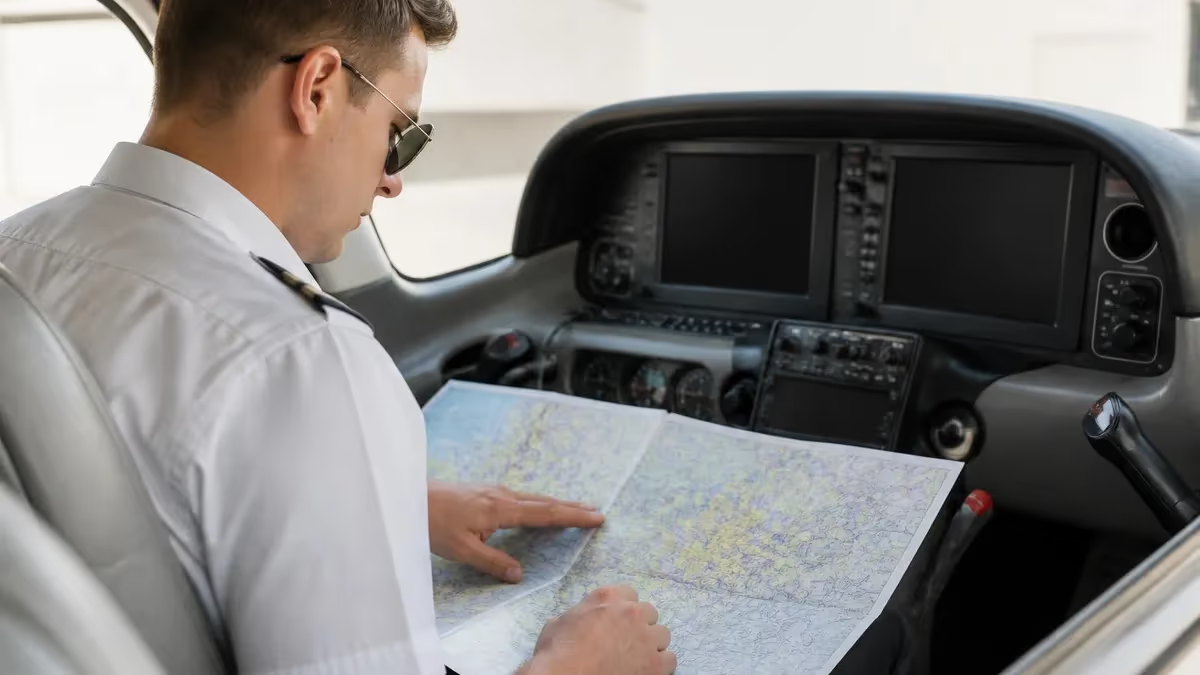
Choosing the right path to become a certified aviation maintenance technician starts with a single, non-negotiable step: enrolling at an FAA-approved school. These institutions, formally called Part 147 Aviation Maintenance Technician Schools (AMTS), are the only training programs the Federal Aviation Administration recognizes as fully sufficient preparation for the Airframe and Powerplant (A&P) certification exams. Without that approval stamp, your classroom hours do not count toward the experience requirement, and you cannot test directly after graduation. That single fact reshapes the entire decision tree for anyone considering aviation maintenance as a career.
The landscape of FAA-approved aviation maintenance technician schools has changed substantially over the past decade. New Part 147 regulations went into effect in 2022, modernizing curriculum requirements, removing rigid clock-hour mandates, and giving schools far more flexibility in how they deliver instruction. Distance learning, hybrid programs, and competency-based assessments are now part of the conversation in ways they never were before. For prospective students, that means more options, but also more questions about which programs actually deliver on the promise of FAA certification readiness.
This guide walks through what FAA-approved schools are, how to verify a program's status, what the curriculum looks like in practice, how long training takes, what it costs, and how to evaluate a school based on factors that matter for your career. You will also find answers to the questions students ask most often before committing to a program, plus practice resources to help you start preparing for the FAA written exams even before your first day of class.
FAA Aviation Maintenance Training by the Numbers
These numbers tell a useful story. The number of FAA-approved schools has been relatively stable for years, but the variety among them has grown. Some are large community colleges with industry partnerships; others are private aviation institutes with deep ties to specific airlines or repair stations. Tuition swings widely depending on whether the school is public, private, or operated by a manufacturer. The salary figure reflects Bureau of Labor Statistics data and is rising faster than the national average for skilled trades, driven by an industry-wide mechanic shortage that most major airlines have publicly acknowledged.
What the stats do not capture is the gap between programs in terms of placement rates, hands-on shop time, and access to current-generation aircraft. Two schools with similar tuition can produce graduates with very different starting positions. A school operating out of a hangar at a busy regional airport, with active maintenance contracts and partnerships with carriers like SkyWest, Republic, or PSA, gives students exposure that a classroom-only program simply cannot match. The credential is the same, but the resume that comes with it is not.
An FAA-approved aviation maintenance technician school holds a current Part 147 certificate issued by the Federal Aviation Administration. To earn and keep that certificate, the school must meet specific standards for curriculum content, instructor qualifications, training equipment, facilities, and student records. The school must also pass periodic FAA surveillance inspections. Only graduates of Part 147 schools can sit for the A&P knowledge, oral, and practical exams without first documenting 18 months (Airframe or Powerplant) or 30 months (combined A&P) of supervised hands-on experience under a certificated mechanic. That shortcut to certification is the single biggest reason students choose Part 147 over the experience route.
The distinction between a Part 147 school and a general aviation program is more than paperwork. Approval signals that the FAA has examined the school's curriculum line by line and confirmed it covers every subject area required by the airman certification standards. It also means the school maintains records the FAA can audit at any time, including student attendance, project completion, instructor credentials, and equipment maintenance logs.
Schools that lose approval, either voluntarily or through enforcement action, have their certificates suspended, and any students still enrolled lose the ability to use that training as a basis for the A&P exams. That is a rare outcome, but it has happened, and it is why the first step in any school search should always be confirming current certificate status directly with the FAA.
You can verify a school's Part 147 certificate through the FAA's online schools directory. The directory lists every active Aviation Maintenance Technician School in the country, along with location, certificate number, and contact information. If a program is not on that list, it is not FAA-approved, no matter what marketing language the school uses. Some career schools offer aviation-adjacent training, such as avionics, drone maintenance, or aircraft electronics, that does not require Part 147 approval. Those programs can be valuable on their own, but they do not lead directly to A&P certification.
How FAA-Approved Programs Are Structured
Foundational coursework covering mathematics, physics, basic electricity, aircraft drawings, weight and balance, fluid lines, materials, processes, and ground operations. This module is required for both Airframe and Powerplant ratings.
Covers airframe structures, systems, and components: sheet metal, composites, hydraulics, landing gear, fuel systems, ice and rain control, fire protection, and inspection procedures. Required for the Airframe certificate.
Focuses on engines and engine systems: reciprocating engines, turbine engines, propellers, induction, exhaust, lubrication, ignition, fuel metering, and engine inspection. Required for the Powerplant certificate.
Most schools offer a combined Airframe and Powerplant track that runs General, Airframe, and Powerplant in sequence. This is the most common option and qualifies graduates to test for both ratings.
Under the older Part 147 rules, every school had to deliver a strict number of clock hours per subject area, typically totaling around 1,900 hours for the combined A&P program. The updated regulations removed those minimums and replaced them with curriculum standards tied directly to the airman certification standards.
In practice, most schools still run programs in the 1,800 to 2,000 hour range because that is what it takes to cover the material thoroughly, but the path through that material is now more flexible. Some programs front-load General Subjects into a single intensive block; others integrate it throughout the program. Some run Airframe and Powerplant simultaneously in alternating blocks; others run them back to back. The end credential is identical either way.
One of the more significant changes since 2022 is the explicit permission for distance learning components in Part 147 programs. Before the rule update, the FAA generally required in-person instruction for most subject areas. Now, schools can deliver theoretical content, including lectures, computer-based testing, and self-paced reading, online or asynchronously, provided the hands-on practical components remain in-person and properly supervised.
A few schools now offer fully hybrid models where students complete classroom theory remotely and travel to campus only for laboratory and shop work. Whether that model fits your situation depends on access to a campus and your own learning style.
School Types Compared
Public community colleges offer FAA-approved A&P programs at the lowest tuition rates, typically under $15,000 for the full combined program when paying in-state. These schools usually award an Associate of Applied Science alongside the A&P eligibility, which can transfer toward a bachelor's in aviation management or related fields. The trade-off is sometimes larger class sizes, older training aircraft, and less aggressive job placement assistance than dedicated aviation institutes.

The four pathways above are not mutually exclusive in terms of outcome. A graduate of a community college program and a graduate of Embry-Riddle hold the same A&P certificate. What differs is the journey, the cost, the credential beyond the certificate, and the network that comes with the school.
A 22-year-old planning to spend their career on the hangar floor as a line mechanic might be best served by the fastest, cheapest path to certification, which often means a private institute or community college. A 22-year-old planning to eventually run a maintenance department for a regional carrier might find more long-term value in the bachelor's-plus-A&P combination.
Money matters in this decision more than most prospective students initially realize. The combined A&P program at a private institute can carry a sticker price approaching $45,000, and that is before tools, books, fees, and the costs of FAA written, oral, and practical exams. Federal financial aid, including Pell Grants and Stafford loans, is available at most accredited Part 147 schools, but availability varies.
GI Bill, Workforce Innovation and Opportunity Act funding, and state-level aviation workforce grants can substantially reduce out-of-pocket cost for those who qualify. It is worth applying early and aggressively to every funding source available before committing to a program.
Always confirm a school's current Part 147 certificate status before signing enrollment paperwork or paying tuition. Visit the FAA's official Aviation Maintenance Technician Schools directory and search by state or school name. A school can lose certification between the time it publishes marketing materials and the time you start classes, particularly if it has had recent compliance issues. Schools occasionally market themselves using outdated or misleading language about FAA approval. If the school cannot show you a current certificate, walk away.
Verification matters because the consequences of attending an unapproved program are severe. Without Part 147 certification, your training does not count toward the experience requirement for the A&P exams, you cannot test directly, and you would need to accumulate at least 18 months of supervised work experience under a certificated mechanic before being eligible. That essentially means starting over.
Worse, some unapproved programs charge tuition comparable to legitimate Part 147 schools, leaving students with debt and no credential to show for it. The FAA does not maintain a blacklist of bad schools, but its directory of approved ones is comprehensive and updated regularly, so the burden is entirely on the prospective student to verify before enrolling.
Beyond verifying approval, dig into the school's history with the FAA. The Aviation Maintenance Technician School certificate is renewed and surveilled periodically, and surveillance reports occasionally surface enforcement actions, equipment deficiencies, or curriculum gaps. While most schools resolve issues quickly, a pattern of repeat findings is a yellow flag worth asking about during your campus visit. Reputable schools are transparent about their FAA relationship and happy to walk prospective students through their compliance record.
Evaluating an FAA-Approved School
- ✓Confirm current Part 147 certificate on FAA's official schools directory
- ✓Ask for the school's most recent FAA surveillance inspection summary
- ✓Tour the shop and verify training aircraft are current-generation and operational
- ✓Check instructor credentials and average years of industry experience
- ✓Request graduation rate and A&P exam pass rate data for the last three years
- ✓Get job placement statistics and a list of partner employers
- ✓Confirm total cost including tools, books, fees, and FAA exam costs
- ✓Verify financial aid eligibility, GI Bill acceptance, and scholarship availability
- ✓Ask about night, weekend, or hybrid scheduling if you need flexibility
- ✓Talk to current students and recent graduates about their actual experience
Choosing a school is half of the equation. Preparing for the FAA exams that come after is the other half. The Airframe and Powerplant certification process involves three distinct exams: a written knowledge test, an oral examination, and a practical examination. Graduates of Part 147 schools are typically prepared for all three by the end of their program, but pass rates are not universal.
Some schools graduate students with first-attempt pass rates above 90 percent; others hover closer to 70 percent. The difference usually comes down to how aggressively the school integrates exam preparation into its curriculum rather than treating it as something to figure out after graduation.
Smart students start practicing FAA-style questions early, often within the first few months of their program. The General Subjects knowledge test is the first hurdle, and it covers a wide range of foundational topics that build on every subsequent module. Mastering general subjects early makes the Airframe and Powerplant material easier to absorb. Practice tests, sample oral exam questions, and project rehearsals are widely available and should be part of any serious student's weekly routine. Schools that build this into the curriculum tend to produce confident, well-prepared candidates who finish the certification process quickly after graduation.
FAA-Approved School vs Experience Route
- + —
- + —
- + —
- + —
- + —
- + —
- − —
- − —
- − —
- − —
- − —

For most prospective mechanics, the Part 147 school route is the faster, more efficient path to certification. The experience route, while still legitimate, requires finding a willing employer who will hire someone without a certificate, supervise their work for 18 to 30 months under a certificated mechanic, and provide documentation strong enough to satisfy the FAA's airman certification standards. That arrangement is becoming harder to find as the industry tightens up on liability and as more repair stations require certified mechanics at every level. Schools also provide structure, peer learning, and exam preparation that self-directed study cannot replicate.
That said, the experience route still works for the right candidate. Someone already employed at a repair station as a helper or ground crew member, who can be supervised and signed off by a certificated mechanic, can build toward A&P eligibility while earning a paycheck. The catch is documentation: the FAA expects detailed records of every type of task performed, total hours, and supervisor sign-offs. Anyone considering this route should download the FAA's experience route guidance and start the documentation process from day one of qualifying employment.
FAA Questions and Answers
Career Outcomes After FAA-Approved Training
Graduates leave Part 147 schools with more than a certificate. They leave with a network of instructors, classmates, and employer contacts built over 18 to 24 months of intensive shop time. That network matters. A surprising share of first jobs in aviation maintenance come through direct referrals from instructors who themselves spent decades in the industry.
The most common first jobs include line maintenance positions at regional airlines, MRO technician roles at repair stations like AAR or StandardAero, and corporate aviation slots at fixed-base operators servicing private jets. Starting salaries typically land between $45,000 and $60,000 depending on region, employer, and shift differential. Major carriers pay more, but they often require additional experience or specific airframe type training before hiring directly out of school.
Within three to five years, certified mechanics commonly move into specialized roles. Some pursue Inspection Authorization (IA), which expands the scope of work they can sign off. Others specialize in avionics, sheet metal, or specific engine types. The career ceiling for someone with an A&P certificate and several years of experience is high: senior mechanics, leads, inspectors, and maintenance supervisors at major airlines routinely earn $90,000 to $120,000, and Director of Maintenance roles at corporate operators or repair stations can exceed $150,000.
The industry shortage continues to drive aggressive recruiting. Boeing's 2023 Pilot and Technician Outlook projected a need for over 690,000 new aviation maintenance technicians globally over the next 20 years. North America alone needs more than 130,000. That shortage is why signing bonuses of $5,000 to $15,000 for new A&P graduates are increasingly common at regional carriers and repair stations.
Learn more in our guide on faa jobs near me. Learn more in our guide on FAA Cracking Down on Carry-On Bags: New 2026 Enforcement Rules Explained. Learn more in our guide on faa web scheduler. Learn more in our guide on faa n registration. Learn more in our guide on faa tfr map.
A&P Mechanic Career Outlook
Common Mistakes Students Make Choosing a School
The most common mistake is choosing based on tuition alone. A school that costs $10,000 less but produces graduates with weaker placement records and lower pass rates is not a bargain. Total cost of ownership matters more than sticker price. Factor in time to certification, exam pass rate, placement assistance, and starting salary of recent graduates.
The second common mistake is overlooking shop equipment. Some Part 147 schools train students on aircraft that have not flown in decades. While foundational skills transfer, students who learn on current-generation systems start their careers with an immediate advantage. Ask to see the training fleet. Walk the shop floor. If most aircraft look museum-ready, ask harder questions about how the school keeps curriculum current.
The third mistake is ignoring the financial aid timeline. Federal aid processing takes weeks. Workforce grants can take months. Schools occasionally fill their cohorts before slow-to-apply students finalize their funding. Apply early, follow up aggressively, and have backup plans in case primary funding sources fall through.
Common Mistakes Choosing a School
A cheaper program with weaker placement and lower pass rates is rarely the bargain it appears. Calculate total cost including exam fees, tools, and time-to-employment.
Some Part 147 schools train on aircraft that have not flown in decades. Foundational skills transfer, but current-generation systems give graduates a head start.
Federal aid takes weeks; workforce grants can take months. Cohorts fill before slow-to-apply students secure funding. Apply early and aggressively.
Brochures show the best angles. Walking the shop, meeting instructors, and talking to current students reveals what marketing cannot.
The decision to enroll at an FAA-approved aviation maintenance technician school is one of the most consequential career choices in aviation. Done right, it leads to a stable, well-paying career in an industry facing a real and persistent shortage of skilled mechanics. Done carelessly, it can leave students with debt, time lost, and no credential. The difference comes down to research: verifying certificate status, comparing program structures, calculating true total cost, and visiting campuses before committing.
Start with the FAA directory. Build a shortlist of three to five approved schools that fit your geographic and financial situation. Visit each one. Talk to current students, walk the shop floor, ask hard questions about pass rates and placement. Run the numbers including tools, books, and exam fees, not just tuition.
Apply for every form of financial aid available. And start practicing FAA-style exam questions now, before you even enroll, so that the curriculum reinforces what you are already building rather than teaching it cold. The mechanics who finish strongest are almost always the ones who started preparing long before their first day of class.
About the Author
Commercial Pilot & FAA Certification Specialist
Embry-Riddle Aeronautical UniversityCaptain Jennifer Walsh graduated with honors in Aerospace Engineering from Embry-Riddle Aeronautical University and holds FAA Airframe & Powerplant and Airline Transport Pilot certificates. With 11 years of commercial aviation experience and 6 years as a ground school instructor, she guides aviation mechanics and student pilots through FAA written exams and practical tests.