
Where to Take EPA 608 Certification: Complete Testing Guide 2026 October
Find out where to take EPA 608 certification: 💡 online proctored exams, in-person testing centers, and trade school courses. Costs, requirements, and
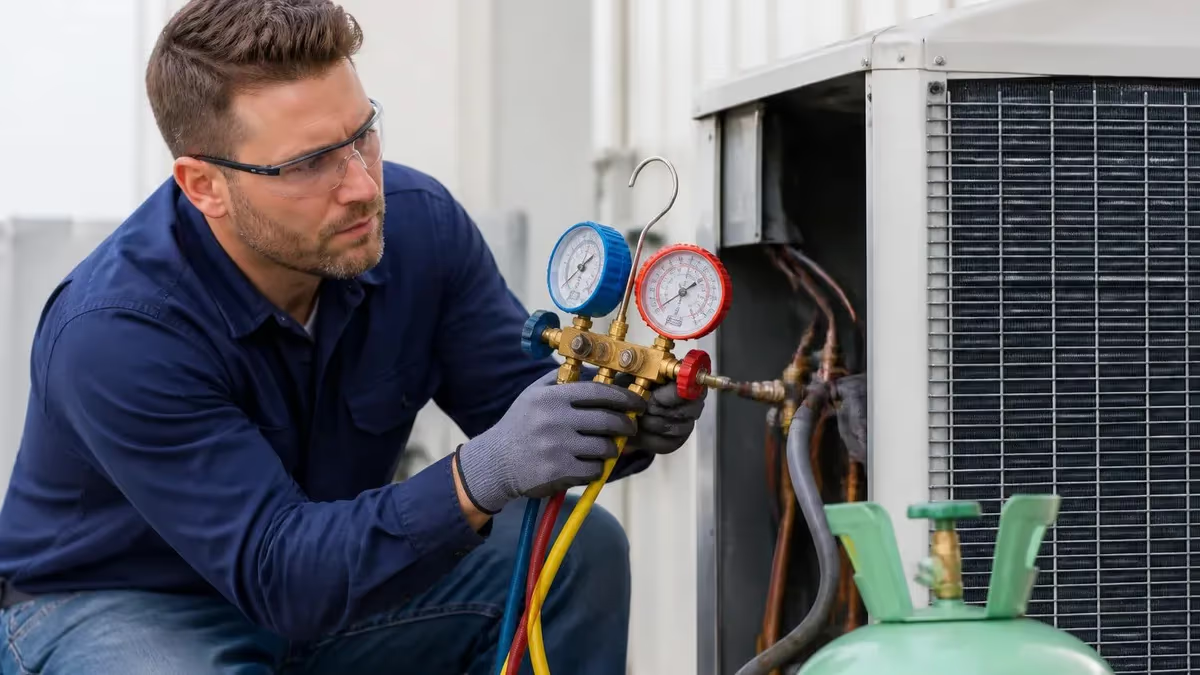
Figuring out where to take EPA 608 certification is the first real hurdle for anyone who wants to legally service stationary refrigeration or air conditioning equipment in the United States. The Environmental Protection Agency (EPA) does not run a single national testing center the way the DMV runs license offices.
Instead, the agency approves third-party organizations to write, proctor, and grade the Section 608 exam. That means you have options, and the right option depends on whether you want to test in person, online with a remote proctor, or as part of a longer HVAC training course.
This guide walks you through every legitimate pathway.
You will see which approved organizations issue the EPA 608 card, how to pick between Type I, Type II, Type III, and Universal certification, what to expect when you walk into a testing room or log into a webcam-monitored session, and how much each route typically costs. We also cover the common pitfalls technicians run into, like accidentally taking a proctored exam without a valid government ID or assuming a community college course automatically includes the certification fee.
Whether you are an apprentice trying to land your first HVAC job, a homeowner who wants to top off a window unit legally, or a returning service tech who let your card lapse decades ago, the same federal rule applies.
You need a passing score on an EPA-approved Section 608 exam before you can buy, handle, or recover any regulated refrigerant. Pick your testing pathway carefully, because some are faster, some are cheaper, and some give you study time that pays off when you start working with real equipment.
Learn more in our guide on epa 608 practice test pdf. Learn more in our guide on epa 608 certification. Learn more in our guide on epa 608 study guide.

EPA 608 Testing at a Glance
The Section 608 exam was created under the Clean Air Act and has been required since 1992. Over three decades, the testing landscape has matured into a stable ecosystem of accredited organizations, online platforms, and brick-and-mortar training centers.
Some providers focus on convenience and let you finish the entire process in a single afternoon from your kitchen table. Others bundle the exam into a multi-week HVAC fundamentals course, which is the better choice if you have never opened a service manifold or read a pressure-temperature chart.
Pricing varies more than people expect. A bare-bones online proctored exam with no study material can run as low as twenty dollars. A guided course with textbooks, practice tests, instructor support, and the certification fee bundled in often crosses one hundred fifty dollars. Trade schools sometimes charge several hundred for the certification module of a longer diploma program, though that price usually includes hands-on lab time you cannot get sitting at a laptop.
You can take the EPA 608 certification exam in three main places: online with a live remote proctor (fastest, cheapest), at an in-person testing center run by an approved organization like ESCO or Mainstream Engineering, or through an HVAC training program at a community college or trade school. All three routes lead to the same federally recognized card.
Before you book anything, it helps to understand what the EPA actually controls. The agency does not write the test questions itself. It approves outside organizations that meet specific psychometric and security standards. Those organizations then design their own version of the Section 608 exam, run the testing logistics, and report passing scores back to the EPA. Once you pass, your name goes into a national database, and your certification card is issued by whichever organization administered your exam.
This is important because your card does not expire. A Section 608 certification is permanent.
There is no renewal, no continuing education requirement, and no annual fee. The card you receive today is valid for the rest of your career, even if you switch employers, move states, or step out of the trade for ten years. The only reason to retest is if you lose your card and the original organization cannot reissue it, or if you originally certified at a lower type and want to upgrade.
The Four EPA 608 Certification Types
Covers sealed systems with five pounds or less of refrigerant. Window AC units, household refrigerators, vending machines, and water coolers. The certification process is well-documented and verified through the official EPA database for legal authorization to handle regulated refrigerants.
Covers high and very high pressure equipment. Residential split-system air conditioners, heat pumps, supermarket refrigeration, and most commercial HVAC. The certification process is well-documented and verified through the official EPA database for legal authorization to handle regulated refrigerants.
Covers low pressure systems that use refrigerants like R-11, R-123, and R-1233zd. Large chillers found in hospitals, hotels, and office buildings. The certification process is well-documented and verified through the official EPA database for legal authorization to handle regulated refrigerants.
Awarded when you pass all three type-specific sections plus the core section. The most flexible card and the one most employers expect to see. The certification process is well-documented and verified through the official EPA database for legal authorization to handle regulated refrigerants.
The exam itself is structured around four sections. The first is the Core section, which covers general environmental science, the history of refrigerant regulation, montreal protocol basics, recovery requirements, and safety.
Every certification candidate has to pass Core regardless of which type they want. The next three sections, Type I, Type II, and Type III, focus on the specific equipment and refrigerants associated with each category. You can take just Core plus one type, or you can take all four sections in a single sitting to earn Universal certification.
Each section contains twenty-five multiple choice questions. You need at least seventy percent correct on each section to pass that section.
If you fail a section, you can usually retake just that section without retaking the ones you passed. Most testing organizations allow unlimited retakes, though they charge a smaller retake fee each time. This makes a strong argument for taking Universal in one sitting if you feel prepared, because passing all four sections on the first attempt is the cheapest way to end up with the most flexible card.
Three Ways to Take the EPA 608 Exam

For technicians who already understand refrigeration concepts and just need the card to satisfy a hiring requirement, online proctoring is almost always the right choice. The software is straightforward, the scheduling is flexible, and you can often book a session for the same day. Mainstream Engineering, which runs the popular EPATest.com platform, is one of the longest-running online providers and is widely accepted by employers and supply houses across the country.
For someone brand new to the trade, the calculus changes. Memorizing pressure-temperature charts and recovery requirements long enough to pass an exam does not teach you how to braze a copper line, evacuate a system to five hundred microns, or diagnose a failed thermal expansion valve.
A real HVAC course gives you those skills, and the certification fee gets folded into tuition. Most apprentices who take the trade school route never need to think about EPA 608 again because their employer covers continuing training in heat pumps, mini-splits, and newer A2L refrigerants.
Several websites sell EPA 608 study materials and practice tests, then offer what looks like an exam. Some of these are not on the EPA-approved list. If you pay for an exam from an unapproved provider, your score will not be recognized and no card will be issued. Always verify your testing organization appears on the official EPA-approved certifying programs list before paying any fee.
The EPA publishes its current list of approved certifying organizations on the agency's stationary refrigerants webpage.
Major names that have been on that list for years include the ESCO Institute, Mainstream Engineering, the Refrigeration Service Engineers Society, Ferris State University, the National Assessment Institute, and Universal Technical Institute. Most of these organizations partner with local trade schools and HVAC supply houses to expand their reach, so you might end up testing at a Johnstone Supply branch even though the certification card itself comes from ESCO.
When you research a provider, look for three things. First, confirm they appear on the EPA approved list. Second, check whether they offer the specific certification type you want, because not every provider offers Type III.
Third, look at their identification requirements. Some online proctored services require both a government photo ID and a second form of identification, which can trip you up if you only have a passport or only have a driver license. Reading the fine print before you pay saves you from rescheduling fees.
What You Need Before Testing Day
- ✓A valid government-issued photo ID such as a driver license, passport, or state ID card.
- ✓A reliable internet connection with at least 5 Mbps download speed if testing online. This step is part of every certified technician's standard preparation routine.
- ✓A webcam and microphone for online proctored exams. This step is part of every certified technician's standard preparation routine.
- ✓A quiet, private room with no other people and no books or notes visible. This step is part of every certified technician's standard preparation routine.
- ✓A scratch pad and pencil for working out pressure-temperature calculations. This step is part of every certified technician's standard preparation routine.
- ✓Payment method ready for the exam fee and any optional study materials. This step is part of every certified technician's standard preparation routine.
- ✓A printed or saved copy of your confirmation email with your appointment time. This step is part of every certified technician's standard preparation routine.
Cost matters, and the difference between providers is bigger than most candidates realize. The cheapest path is an online proctored Type I exam, which can be done for around twenty dollars on Mainstream Engineering's platform.
If you want Universal certification done online in a single sitting, expect to pay between thirty and seventy dollars depending on the provider and whether you bundle in study material. In-person testing through ESCO at a supply house usually runs between thirty and fifty dollars for the exam itself.
Trade school certification is a different financial conversation entirely. A community college HVAC fundamentals course that includes EPA 608 certification can range from three hundred to over a thousand dollars, but you walk away with classroom hours, lab experience, and often a certificate of completion that opens doors with hiring managers.
Some employers reimburse this tuition for new hires, so ask about that benefit before paying out of pocket. Union apprenticeship programs almost always cover certification fees, which is one of many reasons the union route remains popular for new technicians.
Online vs In-Person Testing
- + —
- + —
- + —
- + —
- + —
- − —
- − —
- − —
- − —
- − —
The Section 608 exam content has been stable for years, which makes preparation straightforward. Focus on the Clean Air Act amendments of 1990, ozone depletion potential, montreal protocol phaseout schedules, recovery requirements for different equipment categories, and the specific evacuation levels you must reach before opening a refrigerant circuit. The Core section asks general questions about all of these topics. The type-specific sections drill deeper into the equipment you would actually service in that category.
Practice exams are widely available, and most candidates pass with twenty to thirty hours of focused study. If you are testing online, do at least one full timed practice run on the same computer you plan to use for the real exam.
This helps you spot bandwidth issues, identify camera angle problems, and get comfortable with the testing software before the live session. Many candidates fail their first attempt not because they did not know the material but because they got flustered by the proctoring environment.

EPA 608 Questions and Answers
Once you have decided where to take EPA 608 certification, the rest of the process moves quickly. Book your session, gather your ID, study the four core topic areas, take at least one timed practice exam under realistic conditions, and show up rested.
Most candidates who put in twenty to thirty hours of focused preparation pass on their first attempt. If you do not pass, the retake process is simple and inexpensive, so do not let test anxiety push you toward overstudying.
The card you earn at the end of this process opens real doors. It is a federal legal requirement for buying refrigerant, servicing regulated equipment, and working independently on HVAC systems.
It is also a baseline credential that employers expect to see on every resume in the trade. Take the time to pick the right testing pathway for your situation, whether that is a fast online session at home or a deeper community college course with hands-on lab time, and you will have a credential that quietly works for you for the rest of your career.
Approved EPA 608 Providers by Format
One question that comes up constantly in HVAC forums is whether you can take the EPA 608 exam at Home Depot or Lowes. The short answer is no, but the longer answer is more interesting.
Big-box hardware stores do not run testing programs themselves. They do, however, sometimes partner with ESCO Institute or other approved providers to host exam sessions in their pro-desk areas during slow weekday mornings. These pop-up testing days are advertised through local HVAC supply chains rather than the store websites.
A more reliable place to find scheduled in-person exams is your local HVAC wholesale supply house. Companies like Johnstone Supply, Ferguson, and Munch's Supply routinely host certification days as a service to their contractor customers.
Walk in and ask the counter staff when the next testing day is scheduled. Many supply houses email a monthly schedule to their account holders, so even if you are not a regular customer, you can usually get added to that list with a quick phone call.
Other Common Testing Locations
Johnstone Supply, Ferguson, Munch's Supply host monthly testing days for account holders and walk-ins. The certification process is well-documented and verified through the official EPA database for legal authorization to handle regulated refrigerants.
UA Local apprenticeship halls run EPA 608 sessions for members and applicants, often free of charge. The certification process is well-documented and verified through the official EPA database for legal authorization to handle regulated refrigerants.
Most community colleges with HVAC programs offer the exam as part of their refrigeration fundamentals course. The certification process is well-documented and verified through the official EPA database for legal authorization to handle regulated refrigerants.
Active duty and veteran technicians can test at on-base education centers through ESCO partnerships. The certification process is well-documented and verified through the official EPA database for legal authorization to handle regulated refrigerants.
Geography plays a smaller role than you might think. Because online proctoring is universally accepted, candidates in rural states without nearby supply houses are not at a disadvantage. A technician in the Alaska bush country can earn the same Universal certification as one in downtown Chicago, and both cards carry exactly the same legal authority. The only practical geography concern is time zone scheduling, which providers handle gracefully by listing exam slots in your local time.
For international candidates, the story is a little more complex. The EPA 608 certification is a United States federal credential.
It is not required for work in Canada, the European Union, or any other country. However, US-based employers occasionally recruit refrigeration technicians from overseas and ask them to certify before starting work. In those cases, candidates can take an online proctored exam from anywhere in the world, provided they have a valid passport for identification and a US-based mailing address for the physical card.
If you live outside the United States and need EPA 608 certification for US-based employment, online proctored exams are your only practical option. You will need a valid passport, a US mailing address for the physical card, and a payment method accepted by the testing provider. The certification is valid only for US-based work.
Military veterans transitioning into civilian HVAC work get a small head start. Several branches train their own refrigeration specialists, and the Department of Defense has reciprocity agreements with certain civilian credentialing bodies.
If you served as an HVAC technician in the Navy, Air Force, Army, or Coast Guard, contact the ESCO Institute about credit toward the Section 608 exam. You will still need to pass the exam, but study time often shrinks significantly because much of the material overlaps with what you already learned in military training.
High school students enrolled in career and technical education programs sometimes take the EPA 608 exam before graduation. This is a great move because it lets them apply for HVAC apprenticeships with a federal credential already in hand.
Many vocational high schools partner with ESCO or HVAC Excellence to administer the exam on campus, often at no cost to the student. If you are still in school and considering the trades, ask your guidance counselor whether your district offers this opportunity.
After You Pass the Exam
- ✓Save your printed certificate or PDF in cloud storage as a backup. This step is part of every certified technician's standard preparation routine.
- ✓Wait for the physical wallet card to arrive in the mail (2-6 weeks). This step is part of every certified technician's standard preparation routine.
- ✓Verify your name is correctly entered in the EPA's national certification database. This step is part of every certified technician's standard preparation routine.
- ✓Add EPA 608 Universal Certification to your resume and LinkedIn profile. This step is part of every certified technician's standard preparation routine.
- ✓Start applying for HVAC helper, apprentice, or technician roles immediately. This step is part of every certified technician's standard preparation routine.
- ✓Keep a digital copy of the card on your phone for quick reference at supply houses.
Choosing where to take EPA 608 certification ultimately comes down to balancing speed, cost, and how much hands-on learning you actually need. A technician with prior experience can complete the entire process in a single evening through an online proctored session. A complete beginner who invests in a community college course will spend more money and weeks of time, but will leave with practical refrigeration skills that translate directly into early career success on real job sites.
No matter which pathway you pick, the destination is the same federally recognized card that opens the door to legal refrigerant work across the United States.
About the Author

NATE Certified HVAC Technician & Licensing Exam Trainer
Universal Technical InstituteMike Johnson is a NATE-certified HVAC technician and EPA 608 universal-certified refrigerant handler with a Bachelor of Science in HVAC/R Technology. He has 19 years of commercial and residential HVAC installation and service experience and specializes in preparing technicians for NATE certification, EPA 608, A2L refrigerant safety, and state HVAC contractor licensing examinations.
Join the Discussion
Connect with other students preparing for this exam. Share tips, ask questions, and get advice from people who have been there.
View discussion (9 replies)