
Civics EOC Quizlet: Free Practice Test & Study Guide for the End-of-Course Exam
Master the civics EOC with free practice questions, study guides & tips. 🎯 Covers government, rights, and civic participation.
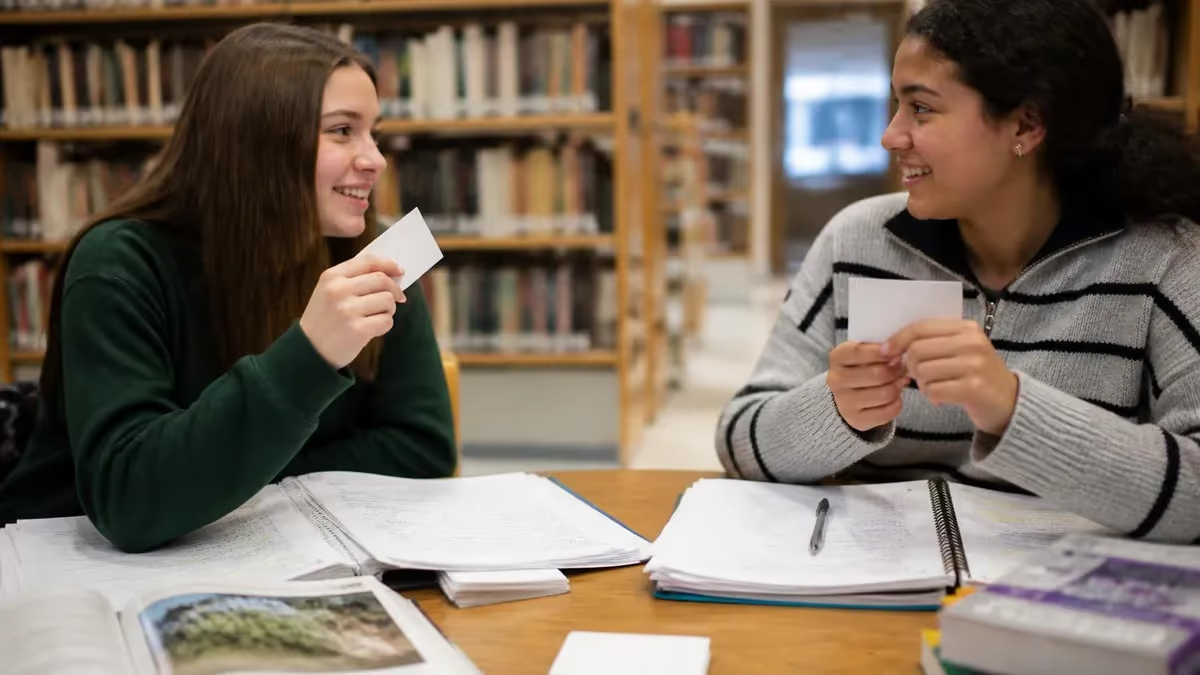
If you have been searching for quizlet civics eoc resources to help you pass Florida's Civics End-of-Course exam, you are in exactly the right place. The Civics EOC is a state-mandated assessment that every Florida seventh-grade student must pass as a requirement for middle school promotion. Understanding what is on the test, how it is structured, and which study strategies work best can mean the difference between a passing score and having to retake the exam during the summer.
The Florida Civics EOC evaluates students on three major strands: the origins and purposes of law and government, roles, rights, and responsibilities of citizens, and government policies and political processes. Each strand carries a specific weight on the exam, and questions are drawn from the Florida Standards for Civics Education. Students who treat this test casually and rely only on classroom notes rarely achieve the scores needed for advancement, while those who engage in structured practice consistently outperform their peers.
One of the most popular ways students currently prepare is by turning to flashcard platforms and online practice tools — and that is exactly the gap that PracticeTestGeeks.com fills. Rather than scrolling through disconnected flashcard decks, our platform delivers full-length, timed practice tests that replicate the real EOC experience. You can track your progress by strand, identify weak spots instantly, and focus your remaining study time on the content areas where you need the most improvement before test day.
Many students wonder how many questions the Civics EOC contains and how much time they will be given. The exam includes 55 multiple-choice questions and students typically have 160 minutes to complete it. That works out to nearly three minutes per question, which sounds generous until you realize that certain government-process and constitutional-analysis questions require careful reading of source documents, maps, charts, or political cartoons embedded in the question stem. Timed practice is therefore essential, not optional.
Florida's Civics EOC is scored on a scale of 325 to 475. To pass, students must earn a score of 397 or higher, which places them at Achievement Level 3 or above. Students who score at Level 1 or Level 2 must complete additional instruction and can face consequences for grade promotion. Understanding the scoring scale helps students set realistic goals and measure practice-test results against a concrete target rather than guessing whether their preparation level is sufficient.
Another critical piece of context is that the Civics EOC score counts for 30 percent of a student's final course grade in seventh-grade civics. This makes the exam particularly high-stakes compared to other assessments students encounter in middle school. A strong EOC performance can raise a borderline grade, while a weak score can drag down months of classroom work. Treating your EOC preparation with the same seriousness you would give a final exam in any core subject is the smartest academic decision you can make right now.
For a comprehensive breakdown of all the topics covered, organized by Florida Standard and strand, explore our civics eoc quizlet companion resource, which pairs perfectly with the practice tests on this page. Together, these tools give you everything you need to walk into the testing room with genuine confidence rather than exam-day anxiety.
Florida Civics EOC by the Numbers
Key Facts at a Glance
| Item | Value | Details |
|---|---|---|
| Total Questions | 55 | All multiple choice |
| Testing Time | 160 min | ~3 min per question |
| Passing Score | 397 | On a 325–475 scale |

Civics EOC Exam Format & Structure
| Section | Questions | Time | Weight | Notes |
|---|---|---|---|---|
| Strand A: Origins & Purposes of Law and Government | 18 | ~53 min | 33% | Founding documents, constitutions, branches of government |
| Strand B: Roles, Rights & Responsibilities of Citizens | 19 | ~55 min | 34% | Bill of Rights, civic duties, landmark court cases |
| Strand C: Government Policies & Political Processes | 18 | ~52 min | 33% | Elections, political parties, public policy, media |
| Total | 55 | 160 minutes | 100% |
The Florida Civics EOC is built around three strands that together cover everything a seventh-grader is expected to understand about American government and civic participation. Strand A focuses on the origins and purposes of law and government, meaning students must understand the philosophical underpinnings of democratic government, the Articles of Confederation, the Constitutional Convention, and how the three branches of the federal government interact through the system of checks and balances. Questions in this strand often present students with excerpts from founding documents and ask them to draw conclusions about the intent of the framers.
Strand B is the largest in terms of breadth and requires students to understand the rights and responsibilities that come with American citizenship. This includes mastery of the first ten amendments — the Bill of Rights — as well as later amendments that expanded voting rights and addressed civil liberties.
Students must also be able to explain landmark Supreme Court cases such as Tinker v. Des Moines, which established student free speech rights in public schools, and Gideon v. Wainwright, which guaranteed the right to counsel. These cases appear regularly on the exam in question stems that describe a fictional scenario and ask students to identify which constitutional right is relevant.
Strand C covers government policies and political processes, which is often the strand students underestimate. It includes understanding how a bill becomes a law, how elections are organized at the federal, state, and local levels, the role of political parties, how media and public opinion influence policy, and the differences between various levels and types of government. Students should be able to read a political cartoon or chart showing voter turnout data and answer analysis questions based on what they observe rather than what they have memorized.
Beyond the three strands, the Civics EOC incorporates a range of item types that go beyond simple recall. Approximately 40 percent of questions require higher-order thinking — analysis, evaluation, or synthesis — rather than just identification. For example, a question might present two different historical perspectives on the power of the federal government and ask students to compare them, or it might show a scenario where a citizen's rights conflict with a government regulation and ask students to predict how a court might rule. These items reward students who understand concepts deeply rather than those who only memorize definitions.
Florida's statewide data shows that students who focus exclusively on vocabulary flashcards — the classic Quizlet approach — without practicing full-length question sets tend to plateau around Achievement Level 2. The reason is that vocabulary recognition and conceptual application are different cognitive skills. You might know the definition of "due process" perfectly but still struggle to apply it to a novel fact pattern under timed conditions. That is why combining vocabulary review with full practice tests is the superior preparation strategy, and it is the approach this site is designed to support.
It is also worth noting that the Civics EOC draws from both the United States and Florida state government. Students are expected to understand the structure of Florida's government — the Governor, Cabinet, State Legislature, and Florida Supreme Court — in addition to the federal structure. Many students are surprised by the volume of Florida-specific content on the exam because classroom instruction sometimes emphasizes the federal level more heavily. Make sure your practice tests include questions about Florida's constitution and state governmental structure to avoid leaving points on the table.
Finally, the exam includes questions that reference primary sources such as the Declaration of Independence, the Preamble to the Constitution, the Federalist Papers, and speeches from key historical figures. Students should practice reading and interpreting these documents rather than simply memorizing quotes from them. If you want a complete topic-by-topic breakdown with answer explanations, our civics eoc quizlet study guide provides exactly that level of detail for every Florida Standard tested on the exam.
Best Study Strategies for the Civics EOC by Strand
To master Strand A, begin by drawing a diagram of the three branches of the federal government and listing the specific powers granted to each branch by the Constitution. Focus especially on the checks and balances between branches — for example, the President's veto power versus Congress's override authority, and the Supreme Court's power of judicial review established in Marbury v. Madison. Exam questions frequently test whether students can identify which branch holds a specific power or explain how one branch limits another.
Next, read the Preamble to the Constitution and the Articles of the Constitution carefully, paying attention to the differences between the powers of the federal government and those reserved to the states under the Tenth Amendment. Practice questions in this strand often present a scenario where a state law conflicts with a federal law and ask students to explain which law prevails under the Supremacy Clause. Understanding concepts like federalism, popular sovereignty, and limited government at a conceptual level — not just as vocabulary terms — is the key to consistently correct answers in Strand A.

Civics EOC Practice Tests vs. Flashcard-Only Study: Which Works Better?
- +Simulates real exam timing so you build stamina and pacing skills
- +Exposes you to question formats including primary source analysis and political cartoons
- +Instant feedback on wrong answers identifies exactly which Florida Standards need more work
- +Tracks improvement over multiple attempts so you can measure readiness objectively
- +Forces active recall rather than passive recognition, which improves long-term retention
- +Covers all three strands proportionally, matching the real exam's content weighting
- −Practice tests alone do not build initial vocabulary for new or unfamiliar terms
- −Students may develop test fatigue if they take full-length tests too frequently without breaks
- −Some students find it discouraging to score low on early practice tests before improvement kicks in
- −Practice tests require a quiet, focused environment that is not always available at home
- −Without reviewing wrong answers carefully, repeated testing can reinforce incorrect thinking
- −Digital practice may not fully replicate the paper-based format used in some Florida schools
Civics EOC Study Checklist: 10 Steps Before Test Day
- ✓Review all three strands of the Florida Civics Standards and note which topics feel weakest.
- ✓Memorize the Bill of Rights (Amendments 1–10) with a concrete example for each amendment.
- ✓Study at least five landmark Supreme Court cases and practice applying them to new scenarios.
- ✓Draw and label the three branches of the federal government along with their key checks on each other.
- ✓Learn the step-by-step process of how a bill becomes a law at both the federal and state levels.
- ✓Review the structure of Florida state government, including the Governor, Cabinet, and Legislature.
- ✓Practice reading and interpreting primary source documents such as the Declaration of Independence.
- ✓Complete at least three full-length timed practice tests and review every incorrect answer in detail.
- ✓Study political cartoon analysis techniques and practice identifying symbolism and point of view.
- ✓Review your weakest strand one final time the night before the exam and get a full night of sleep.

The 30% Rule: Your EOC Score Changes Your Final Grade More Than Any Single Test
Florida law requires that the Civics EOC count for 30 percent of your final seventh-grade civics grade. That means a student with a 78 class average can raise their final grade to a B or above by scoring at Achievement Level 4 on the EOC. Conversely, a student with an 85 class average can drop to a C if they score at Level 1 or 2. Treat EOC prep as a grade-changing opportunity, not just a graduation requirement.
Using practice tests effectively requires more than simply taking test after test and hoping your score improves. The most successful civics EOC students follow a deliberate review cycle: take a practice test under timed conditions, immediately score the results, categorize every wrong answer by strand and standard, research the correct concept using your textbook or study guide, and then attempt two or three additional questions on that same topic before moving on. This targeted remediation approach ensures that each practice session addresses real weaknesses rather than simply reinforcing what you already know.
Spacing your practice tests strategically over time also matters enormously. Cognitive science research consistently shows that spaced repetition — reviewing material at increasing intervals — produces stronger long-term retention than cramming everything into a single marathon study session the week before the exam. A student who takes one practice test per week for six weeks leading up to the EOC will almost always outperform a student who takes six practice tests in the three days before the exam, even if the total time spent is identical. Build your schedule accordingly and start earlier than you think you need to.
When you review a practice test, pay special attention to the questions you got right by guessing. It is tempting to mark a correct answer and move on, but if you cannot explain why the correct option is right and why each wrong option is wrong, you do not truly understand the material.
On a future question that tests the same concept from a slightly different angle, you are likely to guess incorrectly. Disciplined review of every question — both correct and incorrect — is the habit that separates students who consistently score at Level 4 and 5 from those who hover at Level 3.
Another underutilized technique is writing brief explanations of why wrong answers are wrong. When you identify that answer choice B is incorrect on a constitutional powers question, write one sentence explaining what misconception that answer choice is designed to trap. This active processing forces your brain to engage with the content at a deeper level than simply reading the correct explanation and nodding. Students who practice this technique often report that they begin to recognize the patterns of incorrect answer choices on the real exam, which makes eliminating distractors faster and more reliable.
Practice tests also reveal something that pure studying cannot: your personal pacing under timed conditions. Some students rush through easy questions and then panic when they realize they have spent eight minutes on a single primary source analysis item. Others work too slowly and run out of time before reaching the final ten questions.
Taking several full-length 160-minute practice tests helps you develop an internal clock and teaches you when to move on from a difficult question rather than getting stuck. A good rule of thumb is to flag any question that takes more than three minutes and return to it after completing the rest of the test.
Collaborative study can also enhance your practice test performance if structured correctly. Forming a small study group of three to four students where each person explains a different constitutional concept or landmark court case to the group is a powerful learning strategy. The act of teaching forces you to organize your own understanding and identify gaps you did not know existed. After the teaching session, the group can take a short ten-question practice quiz together and discuss any disagreements about the correct answers, which deepens everyone's understanding more than silent individual study typically does.
Finally, do not underestimate the power of reading the question stem carefully before looking at the answer choices. Many Civics EOC questions are designed with subtle qualifiers — words like "best," "most likely," "primarily," or "except" — that fundamentally change what the question is asking. Students who skim question stems and jump to the answers frequently choose a response that would be correct for a slightly different question. Train yourself to underline or mentally flag these qualifier words during practice, and you will transfer that habit automatically to the real exam.
Students who do not pass the Civics EOC with a score of 397 or higher must participate in additional instruction and may be required to retake the exam. In Florida, failure to pass the Civics EOC can affect grade promotion from seventh grade. Check with your school's guidance counselor for specific retake dates and remediation requirements at your district, as policies may vary by county.
The final week before your Civics EOC should look very different from the weeks that came before it. Rather than introducing new material, your final week should focus entirely on consolidation, light review, and confidence building. Take one full-length practice test at the beginning of the week under strict timing conditions, score it honestly, and use the results to identify any remaining gaps in your knowledge. Then spend two to three days doing targeted review of only those specific topics, not trying to re-study everything from scratch.
On the day before the exam, resist the temptation to cram. Research on exam performance consistently shows that the benefits of last-minute cramming are outweighed by the cognitive fatigue and increased anxiety it produces. Instead, spend thirty to forty-five minutes reviewing your notes on the Bill of Rights and landmark court cases — material that benefits from brief refreshers — and then close your books.
Prepare your materials for the next day, eat a nutritious dinner, and go to bed at your normal time. Adequate sleep improves working memory, focus, and the ability to retrieve stored information, all of which are critical for performing well on a standards-based assessment.
On test day, arrive early enough to settle in before the testing session begins. If you are allowed to bring scratch paper, use it to jot down key facts — the three branches of government, the Bill of Rights, the steps in how a bill becomes a law — in the first two minutes before you begin reading questions. This brain dump technique offloads information from working memory so you can focus entirely on analysis and reasoning rather than trying to recall facts simultaneously. Many high-scoring students swear by this approach for standardized civics assessments.
During the exam, read every question stem twice before looking at the answer choices. On your first read, identify what the question is actually asking. On your second read, look for qualifier words and make note of the strand being tested. Then read all four answer choices before selecting one, even if the first option looks obviously correct.
The Civics EOC is carefully designed so that distractor options — wrong answers — are plausible enough to attract students who do not read carefully. The correct answer is always defensible from the Florida Standards; incorrect answers often contain a term or concept that is real but misapplied to the scenario described.
If you encounter a question based on a political cartoon, map, or data chart, spend an extra fifteen seconds studying the visual before reading the answer choices. Identify the title or caption, note any labels, and form an independent interpretation of what the visual is communicating.
Questions built around visual stimuli test your analytical skills more than your memorized knowledge, which means a student who has never seen that specific cartoon before can still answer correctly if they apply a systematic analysis framework. Practice this approach on every visual-stimulus question in your practice tests so it becomes automatic on exam day.
After the exam, regardless of how you feel about your performance, resist the urge to compare answers with classmates in the hallway. Post-exam discussion almost always increases anxiety without changing outcomes, and students who believe they answered a question incorrectly often find out they were right.
Trust the preparation you put in, wait for your official score report, and remember that strong preparation across all three strands gives you the best statistical chance of achieving the passing score you need. For additional topic-by-topic review after you receive your results, our civics eoc quizlet resource remains available to help you address any lingering gaps before a potential retake.
One often-overlooked element of test-day performance is the physical environment within the testing room itself. If you typically study with music or ambient noise, practice taking at least one or two full-length practice tests in complete silence to simulate exam conditions. If you are sensitive to temperature, bring layers since testing rooms are frequently air-conditioned more aggressively than classrooms. Small physical discomforts — being too cold, too hungry, or distracted by environmental factors — can meaningfully reduce cognitive performance on a lengthy assessment, and preparing for these conditions in advance eliminates unnecessary performance drains on the day that matters most.
Practical preparation for the Civics EOC extends well beyond taking practice tests and reviewing notes. One of the highest-use activities you can do in the weeks leading up to the exam is to read current news articles about government and politics and connect what you read to the Florida Standards you are studying.
When you see a news story about Congress debating a spending bill, connect it to your understanding of the legislative process in Strand C. When you read about a Supreme Court ruling, connect it to your knowledge of judicial review from Strand A. These real-world connections make abstract civics concepts stick far more reliably than any flashcard deck.
Another practical tip is to pay attention to the vocabulary used in question stems on your practice tests and learn it as a separate skill. The Civics EOC uses specific academic and legal terminology — words like "enumerate," "promulgate," "appellate," "bicameral," and "ratify" — that do not appear in everyday conversation. Students who are unfamiliar with these terms sometimes choose incorrect answers not because they lack civics knowledge but because they misread a key word in the question. Building a personal glossary of high-frequency test vocabulary is a quick, focused activity that pays dividends across the entire exam.
For students who learn best through audio or video content, supplementing practice tests with short documentary clips about landmark court cases or constitutional history can be an effective way to build the background knowledge that makes textual questions easier to process. Many students find that watching a ten-minute video about the Constitutional Convention, for example, makes Strand A questions feel far more intuitive because they can visualize the debates and decisions that shaped the document. This multi-modal approach to learning — combining reading, practice testing, and media consumption — activates more memory pathways and produces more durable understanding.
Group accountability is another practical tool that often goes unused. Partnering with a classmate and committing to share practice test scores each week creates gentle social pressure that helps both students stay consistent with their preparation. Research on academic achievement consistently shows that students who set concrete, measurable goals and share those goals with at least one other person are significantly more likely to follow through on their study plans than students who keep their goals private.
Even a simple text message to a friend saying "I scored a 71 percent on today's practice test — aiming for 80 percent by next week" can provide the external motivation needed to maintain study discipline through a busy school week.
When it comes to the night before the exam, what you eat and drink also matters more than most students realize. A diet high in simple sugars — candy, soda, sugary cereals — produces rapid blood sugar spikes followed by crashes that impair concentration and working memory at exactly the wrong time. A meal rich in complex carbohydrates, lean protein, and healthy fats provides sustained energy throughout a 160-minute exam session.
On the morning of the test, eat breakfast even if you do not normally do so. Research consistently shows that breakfast improves cognitive performance on standardized tests, particularly in the areas of attention, memory, and processing speed — all of which are required for strong Civics EOC performance.
Finally, maintain perspective throughout your preparation. The Civics EOC is an important exam, but it is also a test that has been designed to be passable by seventh-grade students who have completed the required coursework and engaged in structured practice.
Thousands of Florida students pass this exam every year, and with deliberate preparation — including the practice tests, study guides, and review strategies outlined throughout this article — you have everything you need to join them. Approach the exam not as an obstacle but as an opportunity to demonstrate everything you have learned about the government that shapes your daily life as a citizen of the United States and the state of Florida.
Remember that the civics content you are mastering for this exam is not merely test-taking knowledge — it is the foundational civic literacy that enables you to participate meaningfully in American democracy as a voter, a community member, and an informed citizen for the rest of your life. Understanding how your government works, what rights you hold, and how laws are made and challenged is knowledge that serves you well beyond any single seventh-grade exam. Prepare thoroughly, practice consistently, and walk into that testing room knowing that you have done the work required to succeed.
Sample EOC - End-of-Course Test Practice Questions
Try these questions from our free EOC - End-of-Course Test practice tests. The correct answer and an explanation follow each question.
What is a best practice in End-of-Course Test government and civics?
- A. A method or technique recognized as superior based on evidence and expert consensus
- B. Any practice that is easy to implement
- C. The cheapest available approach
- D. A practice used only by large organizations
Answer: A. A method or technique recognized as superior based on evidence and expert consensus
Best practices are methods, techniques, or approaches that are recognized through evidence, research, and expert consensus as producing superior results and are recommended for adoption.
What is the relationship between theory and practice in End-of-Course Test government and civics?
- A. Theory provides the foundation and framework that guides effective practical application
- B. Theory and practice are completely unrelated
- C. Practice is only important; theory is unnecessary
- D. Theory replaces the need for any practical experience
Answer: A. Theory provides the foundation and framework that guides effective practical application
Theory and practice are complementary: theoretical knowledge provides the conceptual framework and understanding that guides effective, evidence-based practical application in professional settings.
Which approach is most effective for mastering geometry in End-of-Course Test?
- A. Combining theoretical study with practical application and regular review
- B. Memorizing textbook definitions without understanding
- C. Studying only immediately before examinations
- D. Relying solely on on-the-job experience
Answer: A. Combining theoretical study with practical application and regular review
The most effective approach combines theoretical understanding with practical application, reinforced by regular review and assessment, enabling deeper comprehension and long-term retention.
In End-of-Course Test, what does pH measure?
- A. The acidity or alkalinity of a solution on a scale of 0 to 14
- B. The temperature of a liquid
- C. The pressure within a container
- D. The viscosity of a solution
Answer: A. The acidity or alkalinity of a solution on a scale of 0 to 14
pH measures the hydrogen ion concentration in a solution, indicating its acidity (pH 7) on a scale from 0 to 14.
EOC Questions and Answers

Civics EOC Study Guide: Complete 2026 Prep for the End-of-Course Civics Exam

US History EOC Practice Test 2026: Free Questions, Study Guide & Exam Prep

Algebra 1 EOC Reference Sheet: Complete Study Guide & Formula Review for End-of-Course Success

Biology EOC Review: Master Cells, Genetics, Evolution & Ecology

Civics EOC Study Guide Answer Key: Master Every Question for the End-of-Course Exam
About the Author

Educational Psychologist & Academic Test Preparation Expert
Columbia University Teachers CollegeDr. Lisa Patel holds a Doctorate in Education from Columbia University Teachers College and has spent 17 years researching standardized test design and academic assessment. She has developed preparation programs for SAT, ACT, GRE, LSAT, UCAT, and numerous professional licensing exams, helping students of all backgrounds achieve their target scores.
Join the Discussion
Connect with other students preparing for this exam. Share tips, ask questions, and get advice from people who have been there.
View discussion (8 replies)