
English Grammar Translation: How the Method Works and How to Use It 2026
🎓 Learn how english grammar translation works, where it helps, where it fails, and how to pair it with practice tests for faster, lasting progress.

English grammar translation sits at the crossroads of two ideas: how learners move between their first language and English, and how teachers have used translation to explain rules for more than two centuries. Whether you are preparing for an english grammar test or simply curious about the method, understanding where translation helps and where it hurts will save you months of frustration. This guide explains the approach, its strengths, and how to combine it with modern practice.
Before diving in, it helps to define the basics. Grammar is the system of rules that governs how words are formed and combined into meaningful sentences. It covers word classes such as nouns and verbs, tense, agreement, word order, and punctuation. When people ask what is english grammar, they usually mean the conventions that make a sentence feel correct to a native reader. For a fuller definition, read what is the english grammar and then return here.
The word translation carries two meanings in this context. First, it refers to the Grammar-Translation Method, a classroom approach in which students study rules explicitly, memorize vocabulary lists, and translate sentences between their native language and English. Second, it describes the practical challenge of carrying grammatical ideas across languages, such as explaining English articles to a speaker whose language has none. Both meanings matter, and both shape how quickly an adult learner gains confidence in writing and speaking.
The Grammar-Translation Method grew out of how Latin and Greek were taught in European schools during the late 1700s and 1800s. Students read classical texts, parsed every clause, and translated passages line by line. When modern languages entered the curriculum, teachers borrowed the same routine. The goal was reading literature and passing written examinations, not conversation. That history explains why the method feels familiar to many adults who learned English in school through endless worksheets and vocabulary drills.
Today the method has a mixed reputation. Critics say it neglects listening and speaking, leaves learners hesitant in real conversations, and encourages word-for-word thinking that produces awkward sentences. Supporters point out that it explains abstract rules efficiently, works well in large classes, and gives learners a clear map of the language. Many people who wonder whether english grammar is hard to learn discover that the difficulty depends heavily on how the rules are taught, not only on the rules themselves.
Translation can also be a powerful diagnostic tool. When you translate a sentence into your first language and back again, errors surface quickly. You notice missing articles, wrong prepositions, and misplaced adverbs that you would never catch by reading silently. This is why many teachers pair short translation tasks with an english language grammar test: the combination reveals whether a learner truly understands a rule or has merely memorized a pattern that works in only one sentence.
This article walks through the method step by step, compares its benefits and drawbacks, and shows how to blend it with practice questions and real reading. You will also find a checklist, a comparison of study approaches, common translation traps, and advice on choosing an english grammar book pdf. By the end, you will know when to translate, when to stop translating, and how to measure your progress with reliable tests instead of guesswork or gut feeling.
English Grammar Translation by the Numbers
How the Grammar-Translation Method Works Step by Step
Each lesson begins with an explicit rule, such as how the past perfect is formed. The teacher explains it in the learner's first language, gives labeled examples, and highlights exceptions. Learners read the rule closely and often copy it into a notebook for later review.
Next, students memorize a bilingual list of 15 to 30 words connected to the lesson's reading passage. Each English word is paired with a single translation. This builds a fast reading vocabulary, though it can hide the multiple meanings and collocations that words carry.
Learners translate sentences or short paragraphs from English into their first language and back again. This step forces them to notice every article, ending, and preposition, since a missing detail changes the translation. It trains accuracy more than speed or fluency.
Finally, the teacher or an answer key corrects the translations, and the class discusses each error. Learners rewrite mistaken sentences and add the rule to a review list. Repeating this loop over several weeks turns isolated corrections into stable, automatic habits.
Translation-based study works best when you know exactly where English differs from your first language. Contrast is the engine of learning here. A Spanish speaker, a Mandarin speaker, and an Arabic speaker will each stumble in different places, even when they study the same unit. Mapping those differences in advance turns vague confusion into a short, targeted list of rules to practice, which is far more efficient than working through every chapter in order.
Articles are the classic example. Many learners search for a meaning in english grammar and are surprised that this single letter is a full word. Here, a is the indefinite article, used before singular countable nouns when the listener does not yet know which one you mean, as in She bought a laptop. Russian, Japanese, and Mandarin have no articles at all, so learners from those languages must build the habit deliberately and repeatedly.
Word order creates a second trap. English is strongly subject-verb-object, so the sentence The dog chased the cat cannot be reshuffled without changing its meaning. Japanese and Korean place the verb at the end, while Spanish and Italian often drop the subject entirely. A literal translation such as Is raining or Yesterday went to the store feels natural in those languages but sounds broken in English, where a subject is nearly always required.
Verb tense is another area where translation misleads. English has twelve commonly taught tense and aspect combinations, including the present perfect, which links a past action to the present, as in I have lived here since 2019. Many languages have no direct equivalent, so learners substitute the simple past or present. Chinese marks time with words like already and yesterday instead of verb endings, which means English verb forms must be learned almost from scratch.
Prepositions resist translation more than any other word class. English says depend on, interested in, good at, and afraid of, yet each of those pairings is arbitrary and differs from language to language. A learner translating word for word might say interested on or afraid from. The only reliable fix is to memorize whole chunks instead of isolated words, and to check each new verb or adjective in a dictionary that lists its usual prepositions.
People often search what is the grammar of english or what is the grammar in english hoping for a short answer. The honest summary is that English is an analytic language: it relies on word order and small function words rather than heavy endings to show meaning. If you want practical ideas on how to enhance your english grammar, start with these contrasts, because each one points to a specific habit you can train.
A simple contrastive notebook makes all of this concrete. Divide each page into three columns: your native-language sentence, the literal English version, and the corrected English sentence. Add a short note naming the rule that explains the difference. After two weeks, patterns appear. You will see that most of your errors come from only four or five sources, and that fixing those sources removes a surprisingly large share of your mistakes.
What Is the Grammar of English? Three Ways to Study It
Rule-based study answers the question what is english grammar by teaching the system directly. You learn the eight parts of speech, the main tenses, and the standard sentence patterns, usually in a logical order from simple to complex. This approach suits adults who like structure, because each rule has a clear definition, a handful of examples, and a set of exercises that confirm understanding before you move on to the next topic.
Its weakness is transfer. Knowing the rule for the present perfect does not guarantee you will use it correctly in conversation. To fix this, pair every rule with at least ten varied sentences and one short writing task. Review the rule after two days, then again after a week. Rule-based study works best as the backbone of your plan, supported by reading, listening, and regular testing to keep knowledge flexible.
Is the Grammar-Translation Method Worth Using?
- +Explains abstract rules quickly in a language you already understand
- +Builds strong reading and writing accuracy
- +Works well for large classes and self-study with a textbook
- +Reveals first-language interference through back-and-forth translation
- +Gives learners a clear, organized map of English structure
- +Requires little equipment, only a book, notebook, and answer key
- −Gives little practice in listening and speaking
- −Can encourage slow, word-for-word thinking
- −Often teaches rules in isolation from real communication
- −Bilingual word lists hide multiple meanings and collocations
- −Becomes repetitive, which lowers motivation for many learners
- −Depends on a teacher or answer key who knows both languages well
English Grammar Test Prep Checklist for Translation Learners
- ✓Take a diagnostic english grammar test to find your weakest topics.
- ✓List three differences between English and your first language.
- ✓Start a contrastive notebook with three columns per page.
- ✓Study one short grammar unit at a time, not whole chapters.
- ✓Write five original sentences for every new rule you learn.
- ✓Translate two sentences back and forth to check meaning.
- ✓Record every mistake in an error log with a one-line reason.
- ✓Review old rules after one day, three days, and one week.
- ✓Read ten minutes of English daily and underline one structure.
- ✓Retake a timed practice test every two weeks and compare scores.
Translate to Notice, Then Think in English
Translation is most useful in the first encounter with a rule, when it shows how English differs from your language. Once you understand the contrast, practice producing sentences directly in English. Learners who make this switch within a few weeks usually speak and write faster than those who keep translating every sentence.
Even advanced learners fall into predictable traps when they translate. The first is the false friend: a word that looks like a word in your language but means something different. Spanish embarazada means pregnant, not embarrassed. German Gift means poison, not a present. French actuellement means currently, not actually. Keeping a running list of false friends in your notebook prevents embarrassing mistakes in emails, interviews, and written exams where precision counts.
The second trap is the calque, a phrase copied word for word from another language. Saying I have 30 years instead of I am 30 years old is a common example among Spanish, French, and Italian speakers. Similarly, make a photo mirrors German and Russian patterns, while English says take a photo. Calques are hard to spot because each individual word is correct; the problem is only visible at the level of the whole phrase.
Idioms create a third problem. Translating it is raining cats and dogs literally into another language produces nonsense, and the reverse is equally true. Learners should treat idioms as vocabulary items with a single meaning. Look up the figurative sense, write one example sentence, and move on. Trying to analyze the grammar of an idiom word by word wastes time and rarely teaches anything useful about how English actually works.
Pronouns and gender cause another cluster of errors. Languages such as Turkish and Mandarin use one spoken pronoun for both he and she, so learners sometimes mix them up even after years of study. In contrast, Spanish and French assign gender to every noun, and learners may try to give English objects a gender as well. English uses it for most objects and reserves he and she for people and some animals.
Countable and uncountable nouns also trip people up. Advice, information, furniture, and homework are uncountable in English, so you cannot say an advice or informations, yet the equivalent words in many languages take plurals freely. The correct forms are a piece of advice and some information. A quick rule helps: if you cannot put a number directly in front of the noun, it is probably uncountable and takes no plural s.
Double negatives and question forms form the final cluster. In Spanish, Portuguese, and many other languages, a sentence like I don't know nothing is perfectly normal, while standard English treats it as an error. Questions are similar: learners often keep statement word order and simply raise their voice, producing You are going where? instead of Where are you going? Auxiliary verbs like do, does, and did are especially hard because most languages have no equivalent.
To break these habits, use a three-step correction loop. First, write your sentence in English without translating. Second, read it aloud and mark anything that feels like your first language. Third, compare it with a model sentence from a reliable source. Over time you will start hearing your own calques before you write them, and that self-monitoring is the real goal of any english grammar translation routine, far more than memorized rules.
Learners who search what is about in english grammar are usually asking about a small but common word. About works as a preposition (a book about history) and as an adverb meaning approximately (about 20 people). Its meaning changes with the sentence, so translating it with one fixed word often causes errors.
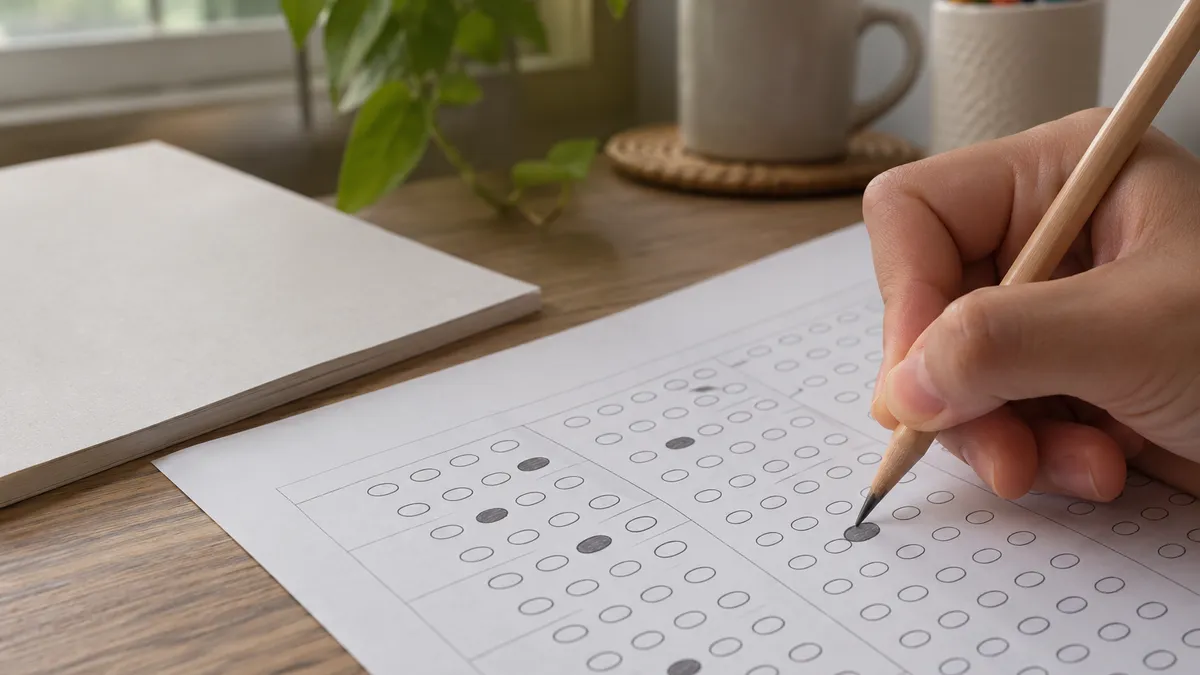
Studying without measuring is guesswork. A well-designed english grammar assessment test tells you which rules you have mastered and which still slip under pressure. The best tests mix recognition tasks, such as choosing the correct verb form, with production tasks, such as rewriting a sentence or correcting an error. Take one at the start of your study plan, one halfway through, and one at the end so you can see real change.
Different tests serve different purposes. Placement tests sort learners into levels, usually from beginner to advanced. Diagnostic tests break results down by topic, such as articles, conditionals, gerunds, and parts of speech. Achievement tests check whether you learned what a specific course covered. When you search for an english language grammar test, decide which of these you need, because a placement result cannot tell you why you keep missing conditional sentences.
Translation-style items belong in your assessment mix too. Try translating five sentences from your first language into English, then compare your versions with a teacher or a reliable answer key. Score yourself on grammar only, ignoring vocabulary slips. Tracking the error type, such as article, tense, preposition, or word order, matters more than the total score because it tells you precisely where to spend your next study session.
Books are the other half of preparation. A good english grammar book pdf offers clear explanations, many examples, and answer keys, and it can be searched, annotated, and carried on any device. Look for a recent edition, a logical table of contents, and exercises that increase in difficulty. Be cautious with unofficial copies: choose publishers' free samples, library lending services, or openly licensed resources so that you get accurate and complete material.
How should you use a grammar book alongside translation? Read one short unit, usually two to four pages, and then write five original sentences using the target rule. Translate two of them into your first language and back into English without looking. If the round trip changes the meaning, you have found a weak spot. Finish by taking a short english grammar practice test on a related topic such as direct objects.
Pay attention to timing and conditions. Many learners score well when they have unlimited time but drop sharply under a clock. Practice with a timer set to roughly 45 to 60 seconds per multiple-choice question, and give yourself a little longer for rewriting tasks. Simulating test conditions reduces anxiety, and it reveals whether your knowledge is automatic or still requires slow, conscious translation in your head.
Finally, interpret your scores honestly. A result of 70 percent on articles but 95 percent on gerunds means your study time should shift toward articles, not that you should celebrate the average. Record each test in a simple spreadsheet with the date, topic, score, and top three errors. After four or five entries you will have a personal map of progress, and it will keep you motivated on the days when improvement feels slow.
Strong results come from small daily habits, not marathon weekend sessions. Aim for 25 to 40 minutes a day, five or six days a week. Split each session into three blocks: ten minutes reviewing a rule, ten minutes of exercises, and ten minutes of writing or speaking. This rhythm keeps grammar active in memory and prevents the burnout that causes so many learners to abandon a study plan within a few weeks.
Turn translation into a stepping stone, not a crutch. Begin with translation for brand-new rules, because it quickly clarifies the contrast with your first language. Once you understand the rule, switch to thinking directly in English. Describe what you see around you in short English sentences, narrate your day silently, and write a three-line journal entry. The aim is to shorten the pause between an idea and a correct English sentence.
Read widely and read actively. Choose material slightly below your comfort level, such as news summaries, graded readers, or short blog posts, and underline one grammar feature per page. Ask yourself why the writer chose that tense or that article. When you notice a structure repeatedly in context, it sticks far better than a rule read once in a textbook, and your instinct for what sounds right grows steadily.
Listening trains grammar too, especially for tense endings and small words like a, the, and to that speakers shorten in fast speech. Use podcasts or videos with transcripts. Listen once without text, once with text, and then shadow a few sentences by repeating them aloud with the same rhythm. Shadowing builds automatic control of word order and contractions, which are exactly the areas where translation-based learners tend to hesitate.
Keep an error log and review it weekly. Each entry should contain the mistaken sentence, the corrected version, and a one-line reason. Group entries by category, and rewrite the three most frequent errors as rules in your own words. Teachers consistently find that learners who log their mistakes improve faster than those who simply do more exercises, because the log forces them to notice patterns instead of repeating them.
Use spaced repetition for tricky items. Review a new rule after one day, then three days, then a week, then a month. Flashcards with a sentence on one side and the rule on the other work well, as do short quizzes on a single topic like conditionals or gerunds. Spacing your practice beats cramming because memory strengthens each time you retrieve information just before you would have forgotten it.
Finally, prepare for test day itself. Do one full timed practice test two or three days before, review only your error log the night before, and sleep properly. During the exam, read each question fully, eliminate clearly wrong options, and skip anything that takes more than a minute, returning at the end. Calm, systematic habits turn the knowledge you built into points, and they are the last piece of preparation.
English Grammar Questions and Answers
What Is Direct Object in English Grammar? Definition, Examples, and Practice

Advanced English Grammar Resources: The Complete 2026 Guide to PDFs, Books, and Practice Materials

English Grammar: What It Is, How It Works, and How to Master It

What Does Subject Mean in English Grammar? A Clear Guide With Examples

Number in English Grammar: Complete Guide to Singular and Plural Forms
How this page was made: written with AI tools and published by Nathan Beja, founder of Practice Test Geeks, who is responsible for its content. We have not yet matched this exam's facts to an official source, so confirm fees, dates and rules with the exam body. Not reviewed by a subject-matter expert. Editorial policy