
EMD Certification 2026 September — Emergency Medical Dispatcher Training Guide
Free EMD Certification Test practice test with instant 🎯 feedback and detailed answer explanations. Prepare for your exam.

What Is an Emergency Medical Dispatcher?
An Emergency Medical Dispatcher (EMD) is a certified professional who manages incoming 911 calls, provides life-saving pre-arrival instructions to callers, and coordinates emergency medical services (EMS) response. EMDs are the critical link between a person in crisis and the ambulance crews responding to the scene.
Unlike a general 911 operator, a certified EMD follows structured protocol cards that guide the caller through interventions such as CPR, childbirth assistance, and choking relief — all before paramedics arrive. This structured approach, known as Dispatch Life Support (DLS), can significantly improve patient outcomes.
EMDs work in 911 dispatch centers, hospital communication hubs, and private EMS agencies, typically covering 12-hour shifts that include nights and weekends. Ready to assess your knowledge before you begin? Try an emergency medical dispatch exam to benchmark your starting point.
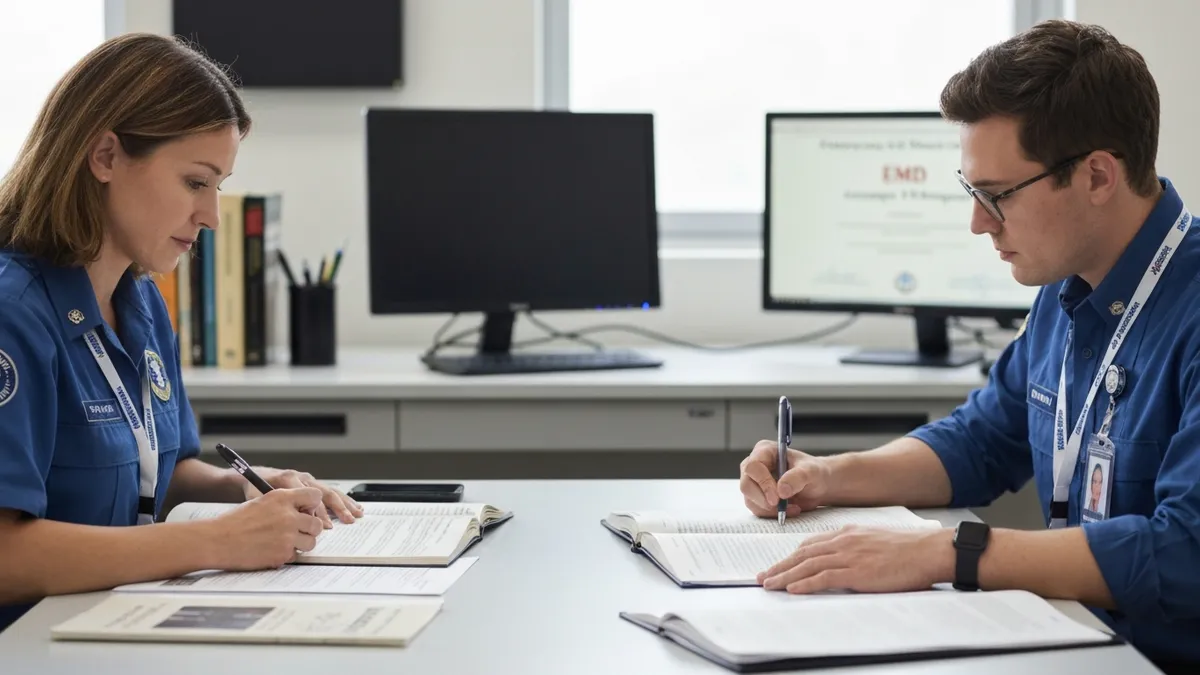
EMD Certifying Bodies
Several organizations offer EMD certification in the United States, each with its own curriculum and protocol system:
- NAED — National Academy of Emergency Dispatch: The most widely adopted certifying body. NAED's Priority Dispatch System (PDS) is used by thousands of 911 centers globally. Certification is earned through an approved training course and a proctored written exam.
- APCO — Association of Public-Safety Communications Officials: Offers the EMD certification as part of its broader public safety communications curriculum. APCO is especially common in law-enforcement-integrated dispatch centers.
- NAEMD — National Association of Emergency Medical Dispatchers: A smaller but accredited certifying organization offering coursework aligned with national EMS standards.
Most employers accept NAED or APCO certification; always confirm which protocol system your target employer uses before selecting a program. For targeted EMD certification prep, explore our EMD practice test covering all major protocol areas.

EMD Certification Requirements
One of the most accessible aspects of EMD certification is its entry-level requirements. Unlike EMT or paramedic credentials, EMD certification does not require prior medical training — the course itself provides everything needed.
Standard prerequisites for NAED EMD certification include:
- High school diploma or GED
- Basic computer skills (dispatchers work with CAD — Computer-Aided Dispatch — software)
- Current CPR certification (many employers require this before the first shift, though not always before the EMD course)
- Ability to pass a background check (required by virtually all 911 centers)
Some jurisdictions add local requirements such as a typing speed minimum (often 35–45 WPM) or a pre-employment hearing test, since dispatchers must accurately interpret information in noisy or high-stress audio environments.
EMD Training Program
NAED EMD training typically runs 16–24 hours over two to three days of intensive classroom instruction. The core curriculum covers:
- Protocol card navigation: Learning to move through the EMD protocol cards quickly and accurately based on the chief complaint
- Pre-Arrival Instructions (PAI): Guiding callers through CPR, bleeding control, childbirth, airway management, and other interventions
- Caller interrogation: Systematic questioning techniques to gather critical patient information efficiently
- Dispatch Life Support (DLS): The overarching framework linking pre-arrival instructions to improved patient outcomes
- Triage and prioritization: Assigning response codes (Echo, Delta, Charlie, Bravo, Alpha, Omega in NAED's system) based on call data
Training is available through NAED-accredited agencies, many regional EMS offices, community colleges, and some private training companies. Online hybrid formats have become increasingly available post-2026.
EMD Key Concepts
What is the passing score for the EMD exam?
Most EMD exams require 70-75% to pass. Check the official exam guide for exact requirements.
How long is the EMD exam?
The EMD exam typically allows 2-3 hours. Time management is critical for success.
How should I prepare for the EMD exam?
Start with a diagnostic test, create a 4-8 week study plan, and take at least 3 full practice exams.
What topics does the EMD exam cover?
The EMD exam covers multiple domains. Review the official content outline for the complete list.
- ✓Obtain a high school diploma or GED and a current CPR card
- ✓Confirm which protocol system (NAED, APCO, or NAEMD) your target employer uses
- ✓Enroll in an accredited EMD training course (16–24 hours)
- ✓Complete classroom training covering protocol cards, PAI, and Dispatch Life Support
- ✓Pass the written certification exam with a minimum score of 80%
- ✓Submit renewal paperwork and 24 hours of CDE every 2 years to maintain certification

Renewal and Continuing Education
EMD certification through NAED must be renewed every two years. Recertification requires completion of 24 hours of Continuing Dispatch Education (CDE) covering updated protocols, case reviews, and skill reinforcement. APCO uses a similar biennial renewal model with its own CDE framework.
Many 911 agencies build CDE into regular training rotations, so dispatchers often accumulate hours through on-the-job education. Online CDE modules are widely available and accepted by most certifying bodies.
Failing to renew results in lapsed certification, which can disqualify a dispatcher from working in jurisdictions that mandate active certification. Track renewal deadlines carefully — a lapse can mean repeating the full initial course.
EMD Salary and Job Outlook
Compensation for Emergency Medical Dispatchers varies widely by jurisdiction, agency type, and experience level:
- Entry-level EMD: $40,000–$55,000 per year
- Experienced 911 dispatcher: $50,000–$70,000 per year
- Senior dispatcher / lead dispatcher: $65,000–$85,000 in high-cost-of-living regions
Government and municipal positions often include strong benefits packages, pension plans, overtime opportunities, and shift differentials for nights, weekends, and holidays — which can meaningfully increase total compensation above base salary.
The U.S. Bureau of Labor Statistics projects 6% employment growth for police, fire, and ambulance dispatchers through 2032 — faster than average for all occupations. Driving this demand is the ongoing consolidation of 911 centers (Consolidated Secondary PSAPs), which centralizes dispatch operations and requires more credentialed personnel. Staffing shortages at many 911 centers have created strong hiring pipelines for newly certified EMDs.
EMD vs EMT: Understanding the Difference
EMDs and EMTs are complementary roles within the emergency medical services system, but they represent distinct career tracks:
| Factor | EMD | EMT |
|---|---|---|
| Work location | 911 dispatch center, communications hub | Ambulance, scene response |
| Training length | 16–24 hours | 120–150+ hours |
| Patient contact | Phone guidance only (pre-arrival) | Direct hands-on patient care |
| Certification body | NAED, APCO, NAEMD | NREMT (National Registry) |
| Entry salary | $40,000–$55,000 | $35,000–$50,000 |
Some professionals hold both credentials — EMT certification provides valuable medical knowledge that enhances an EMD's ability to interpret caller information and select appropriate protocols. However, the two roles have separate licensing requirements and neither is a prerequisite for the other.
Career Advancement for EMDs
EMD certification is the entry point to a structured career ladder in public safety communications:
- Senior Dispatcher: Handles complex multi-agency incidents, mentors new dispatchers, takes on quality assurance roles reviewing calls against protocol compliance standards
- Communications Supervisor: Oversees shift operations, staffing, and performance metrics for a dispatch center team
- Emergency Communications Center (ECC) Manager / Director: Executive-level leadership of a full PSAP — budget, personnel, technology, and interagency coordination
- EMS Coordinator / Training Officer: Specializes in protocol training, CDE delivery, and certification management across an agency or region
Quality Assurance roles have grown significantly as agencies adopt structured call review programs tied to NAED's Accredited Center of Excellence (ACE) designation — a prestigious credential that requires EMDs maintain high protocol compliance scores. Start building your foundation today with a focused EMD certification prep session covering core protocol knowledge.
- +Industry-recognized credential boosts your resume
- +Higher earning potential (10-20% salary increase on average)
- +Demonstrates commitment to professional development
- +Opens doors to advanced career opportunities
- −Exam preparation requires significant time investment (4-8 weeks)
- −Certification fees can be $100-$400+
- −May require continuing education to maintain
- −Some employers may not require certification