
EKG Certification Online: How to Get Certified as an EKG Technician
Get ready for your EKG Certification Online: 📚 How to Get certification. Practice questions with step-by-step answer explanations and instant scoring.
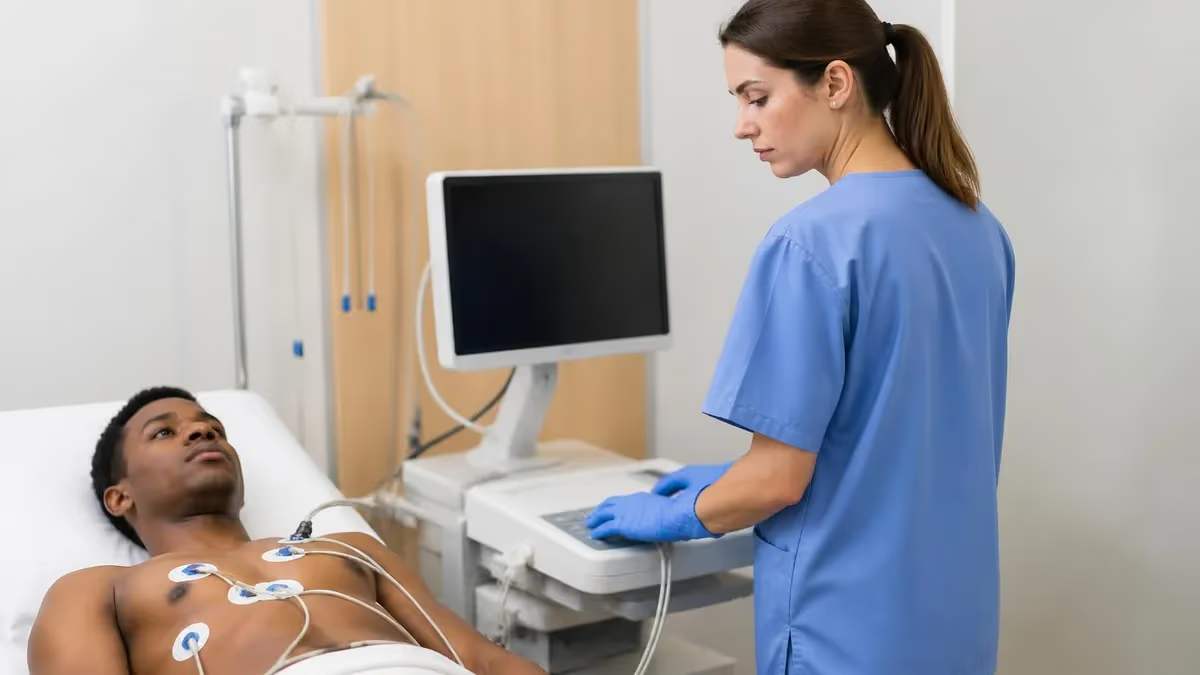
EKG certification validates that a technician can perform electrocardiograms accurately and interpret the cardiac rhythms that appear on the readout — identifying normal sinus rhythm, recognizing arrhythmias, and knowing when an abnormal reading requires immediate escalation to a physician or nurse. It's one of the most accessible entry points into healthcare employment: programs are relatively short, several recognized certifying bodies offer credentials, and online study options have made it possible to complete much of the preparation without attending a physical classroom.
The question most candidates have is whether EKG certification can actually be completed online — and the answer is partly yes. The didactic coursework, exam preparation, and practice testing can all be done online. The hands-on component — actually placing the 10 electrodes on a patient and running a 12-lead EKG on real equipment — typically requires a clinical practicum, lab session, or employer-supervised training. Some programs build this in through affiliated clinical sites; others require candidates to arrange their own hands-on practice. Understanding this distinction upfront helps you evaluate programs accurately and avoid surprises.
There are several recognized certifications for EKG technicians, and they're not all identical. The NHA Certified EKG Technician (CET) is among the most widely recognized. ASET (formerly known as the Alliance of Cardiovascular Professionals) offers certification with a stronger cardiovascular focus. AMCA, NCCT, and ASPT also offer EKG credentials with varying recognition across employers and healthcare systems. Most employers specify which certification they prefer or require; checking the credentials accepted at your target employers before enrolling in a program is worth the 10 minutes it takes.
This guide covers what EKG certification programs look like online, which certifications carry the most employer recognition, what the exams actually test, how much programs and exams cost, and what your career options look like after you're certified. The goal is to give you enough information to pick the right certification path for your situation rather than defaulting to whichever program ranks highest in a paid ad.
EKG technicians work in hospitals, cardiology clinics, ambulatory care centers, and diagnostic imaging facilities. The role is a genuine entry point into clinical healthcare — it typically doesn't require a prior healthcare credential, the training timeline is measured in weeks rather than years, and the skills are transferable to a range of cardiac and allied health roles as you build your career.
For anyone who's been looking for a realistic way into healthcare without the time and cost of nursing school or a two-year allied health degree, EKG certification is worth understanding carefully. Candidates who understand the certification landscape before they start are better positioned to choose the program and credential that actually matches their employment goals rather than defaulting to whichever option appears first in a search result or paid ad.
Online EKG certification programs range from self-paced video courses with practice exams to more structured programs with instructor support, virtual labs, and arranged clinical practicum partnerships. The fully self-paced courses — offered through platforms like Udemy, ed2go, and several healthcare career schools — are the most flexible but require the most self-direction. They work well for candidates who already have some healthcare background and primarily need structured content review and exam prep. Candidates with no prior healthcare experience generally benefit from more structured programs with instructor access.
When evaluating online programs, the key questions are: does the program prepare you for the specific certification exam you're targeting, does it include or arrange the clinical/hands-on component, and is it accredited by a recognized body? The electrocardiogram ecg ekg technician certification program overview covers what accreditation means for EKG programs specifically. Many online programs that look comprehensive on their websites prepare you for a specific exam — so if you're targeting the NHA CET, confirm the program uses NHA's content outline, not a different certifying body's framework.
Community colleges with online allied health programs often offer the best value for structured EKG certification training. They typically charge $500-$900 for a fully structured program including lab access, instructor support, and exam voucher, and their programs are accredited through regional accreditation bodies that employers recognize. Some community college programs are fully online with an intensive in-person clinical day rather than a traditional semester-long clinical rotation — an efficient option for working adults who can't attend class regularly but can block off a single intensive day.
Preparation for the NHA CET specifically benefits from working through EKG arrhythmias and dysrhythmias practice questions early in your study period, not just in the final week before the exam. Arrhythmia recognition is consistently the area where candidates who fail the CET fall short — the rhythm recognition questions require visual pattern recall that builds over repeated practice exposures rather than from a single study session. Starting practice question work within the first two weeks of your program, even before you've finished the full curriculum, builds the recognition pattern more effectively than waiting.
Program length varies significantly: some accelerated programs complete didactic training in four weeks; others spread content over 12 weeks at a lower weekly time commitment. Neither is inherently better — it depends on how quickly you absorb new clinical information and how much time per week you can realistically dedicate to study. Candidates with prior healthcare experience (CNA, phlebotomy, medical assistant) often move faster through the anatomy and patient care content and can complete a compressed timeline effectively.
Candidates coming from non-healthcare backgrounds typically benefit from the longer timeline, which allows more time for rhythm recognition practice to build solid retention. Candidates who've worked in hospitals or clinics in any capacity — dietary, environmental services, patient transport — often have easier access to informal practice time with EKG leads and equipment than those with no healthcare facility access, which can make the hands-on component more manageable.

EKG Certification: Format, Prep, and Outcomes
Online vs In-Person EKG Certification Programs
The core difference between online and in-person programs is the hands-on component. Didactic content — cardiac anatomy, conduction system, waveform identification, lead placement theory, patient interaction protocols — translates well to online delivery through video instruction, interactive modules, and practice testing. The actual skill of placing electrodes correctly on a patient and running an EKG, interpreting the output in real time, and troubleshooting artifact on a live machine requires physical practice that video can demonstrate but can't replace.
In-person programs run the hands-on component throughout the course. Online programs handle it differently depending on the school — some run a weekend intensive clinical day at a partner site, others require students to arrange observation or practice hours at a clinical site independently, and some community college hybrid programs combine online didactic with regularly scheduled lab days. Whichever format you choose, verify before enrolling exactly how the hands-on requirement is handled and what documentation the program provides to certifying bodies confirming you've met clinical practice requirements.
Getting EKG Certified Online: Honest Assessment
- +Short timeline — most programs complete in 4-12 weeks, much faster than most healthcare credentials
- +Flexible online format compatible with full-time work schedules
- +Relatively low cost compared to longer allied health programs
- +Multiple certifying bodies provide options if one exam isn't a good fit
- +Genuine entry point into clinical healthcare without prerequisite healthcare experience at most employers
- +NHA CET and ASET credentials widely recognized across hospital and clinic employers
- −Hands-on component can't be fully completed online — requires clinical practice arrangement
- −Multiple credentials can confuse job seekers — not all certifications have equal employer recognition
- −EKG technician salaries are entry-level; the credential supports career advancement rather than standing alone long-term
- −Quality variation in online programs is significant — thorough research required before enrolling
- −Recertification CE requirements add ongoing cost and time commitment every two years
- −Some hospital employers prefer or require NHA CET specifically — check before pursuing an alternative credential

EKG Certification Online: Getting Started Checklist
- ✓Identify which certification your target employers prefer — NHA CET, ASET, AMCA, or NCCT
- ✓Download the content outline from your target certifying body before choosing a program
- ✓Research program accreditation — regional or programmatic accreditation matters to employers
- ✓Confirm how the program handles the hands-on clinical component
- ✓Compare total cost: program tuition + exam fee + any required materials or clinical fees
- ✓Check if your employer (if you're employed in healthcare) offers tuition reimbursement
- ✓Plan your schedule: realistic weekly study hours determine which program length fits your situation
- ✓Register for the certification exam after completing coursework — don't delay this step
- ✓Build a rhythm recognition practice habit starting in week one of your program
- ✓Request CE documentation after passing — you'll need it for recertification tracking
The NHA CET exam has 100 multiple-choice questions and a 135-minute time limit. The question format mixes recall questions — defining terms, identifying anatomical structures, naming lead placement positions — with application questions that present clinical scenarios and ask what the appropriate action is. Rhythm strip interpretation questions present a printed or digital EKG strip and ask candidates to identify the rhythm. These visual questions can't be answered by process of elimination the way some scenario questions can; they require genuine pattern recognition developed through practice.
Content breakdown by domain: cardiac anatomy and physiology typically comprises 20-25% of the exam; patient preparation and electrode placement about 25-30%; rhythm identification 30-35%; equipment operation and troubleshooting 10-15%; and professional/legal content 5-10%. The rhythm identification domain's high weighting is why candidates who underinvest in arrhythmia practice fail even when they've studied the other domains well. The EKG arrhythmias practice test series builds the recognition pattern across increasingly complex rhythm strips, which is more exam-relevant than working through the same basic strips repeatedly.
Understanding the difference between ekg and electrocardiogram is a detail the exam tests — EKG is derived from the German spelling (Elektrokardiogramm), ECG is the English abbreviation, and both refer to the same test. This kind of terminology precision matters on the NHA CET because some questions use ECG and others use EKG for the same concept. Candidates who haven't seen both terms used interchangeably may hesitate on questions that use the less familiar abbreviation.
Lead placement questions test both the 12-lead configuration and the monitoring lead configurations used in continuous cardiac monitoring. Candidates need to know which electrode placement positions correspond to the standard limb leads (I, II, III, aVR, aVL, aVF) and the precordial chest leads (V1-V6). Common mistakes — swapped limb leads, incorrect V-lead positioning — produce characteristic artifacts on the EKG that the exam may ask you to identify and correct. Hands-on practice with actual lead placement on a training mannequin or practice partner is genuinely useful for this content domain in a way that watching videos isn't.
After passing the NHA CET, candidates receive their CET credential through NHA's digital credentialing system. The credential can be verified by employers through NHA's verification portal. Recertification requires 10 continuing education units every two years. CE can be earned through healthcare professional development courses, NHA-approved programs, employer-provided training, or professional association memberships that include CE content.
Planning for CE from the start — rather than scrambling for credits in the month before recertification deadline — makes the two-year cycle manageable rather than stressful. Candidates who've passed the exam consistently cite arrhythmia strip practice as the preparation habit that made the most difference — more than completing any particular curriculum or taking any specific course.

Career progression from EKG technician follows a few distinct paths depending on your interests and the clinical context. Cardiac monitoring technicians — who analyze continuous EKG telemetry feeds in hospitals — are often promoted or hired from the EKG technician pool, and the position typically pays significantly more than floor EKG work. The monitoring specialist role requires deeper arrhythmia knowledge and the ability to identify life-threatening rhythms in real time, skills that EKG technicians develop through clinical experience over time. The advanced cardiac anatomy and physiology practice tests build the foundation for this expanded role.
The electrocardiogram ekg technician salary data shows meaningful variation by geography, employer type, and shift differential. Hospital positions typically offer higher base pay than clinic positions, and evening/night shifts add differential pay that can meaningfully increase total compensation. Cardiac-focused facilities — hospitals with active cath labs, cardiac care units, or electrophysiology programs — tend to pay EKG technicians more than general hospitals and also offer more exposure to advanced cardiac procedures that support career development.
Some EKG technicians use the credential as the foundation for a cardiovascular technologist (CVT) career, which involves more complex cardiac procedures including echocardiography, stress testing, Holter monitoring, and cardiac catheterization support. CVT roles require additional training and certification, but EKG technicians who've worked in cardiac settings have already built a significant portion of the clinical knowledge base. Associate or bachelor's programs in cardiovascular technology are the typical pathway to full CVT credentialing, and many programs give credit for clinical experience accumulated as an EKG technician.
For candidates currently working in non-clinical healthcare roles — medical billing, healthcare administration, home health aide, nursing assistant — EKG certification is one of the most accessible clinical upgrades available. It requires less time than nursing or most allied health degrees, the online format is compatible with working schedules, and the clinical skills are genuine and in-demand rather than merely supplementary. If you're in healthcare and want to move into a more clinical role without a multi-year educational commitment, the EKG certification pathway is worth taking seriously as a concrete first step.
Cardiology clinic and hospital cardiac monitoring roles specifically value EKG technicians who've shown initiative in their professional development, and having completed the certification process on your own initiative — without employer mandates — is a signal that experienced hiring managers notice. Tracking CE completion in a dedicated folder from day one of certification avoids the scramble that many technicians face at the end of their first two-year cycle.
The online study resources available for EKG certification have improved substantially in recent years. Beyond the materials included in formal programs, candidates have access to free and low-cost practice question banks, YouTube channels dedicated to EKG strip interpretation, and interactive rhythm recognition simulators that generate random strips for practice. Building a multi-resource study approach — formal program materials, external practice tests, rhythm strip simulators — produces stronger exam performance than relying on a single source, particularly for the visual rhythm recognition content that determines results on exam day.
Study groups, whether in-person or through online communities, are underutilized by most EKG certification candidates. Other students preparing for the same exam can share tough practice questions, flag content areas that are more heavily tested than expected, and provide accountability during self-paced online programs where there's no external structure keeping you on schedule. Healthcare student groups on Reddit, Discord, and Facebook have active EKG certification communities with candidates at every stage of preparation.
The employer demand for EKG technicians is steady. Hospitals, cardiology clinics, and cardiac monitoring services consistently post for EKG technician positions, and the credential remains a recognized entry-level qualification that opens doors without requiring years of prior clinical experience. Candidates who've passed their exam and completed the clinical component typically find job applications in EKG roles more productive than most entry-level healthcare job searches — the credential is specific enough that applications that match have a high conversion rate to interviews.
Planning your certification timeline against your job search is worth doing deliberately. If you're targeting a specific employer or a specific hiring window — health system January cohorts, for example, or a local hospital that posts frequently — planning your exam date to be completed four to six weeks before that window gives you time to receive your credential, update your resume, and apply in the active hiring period.
Passing the exam and having your CET credential in hand before you start applying produces better outcomes than applying before you're certified and asking employers to wait. Healthcare employers specifically value EKG technicians who combine the technical credential with genuine patient interaction skills — the certification validates knowledge, but the communication and professional conduct that experienced technicians demonstrate in clinical settings is what drives retention, advancement, and strong performance reviews.
EKG certification Practice Test Questions
Prepare for the EKG certification Certification exam with our free practice test modules. Each quiz covers key topics to help you pass on your first try.
EKG certification EKG Arrhythmias & Dysrhy...
EKG certification Exam Questions covering EKG Arrhythmias & Dysrhythmias. Master EKG certification Test concepts for certification prep.
EKG certification EKG Cardiac Anatomy & Ph...
Free EKG certification Practice Test featuring EKG Cardiac Anatomy & Physiology. Improve your EKG certification Exam score with mock test prep.
EKG certification Certification EKG Arrhyt...
EKG certification Mock Exam on Certification EKG Arrhythmias & Dysrhythmias. EKG certification Study Guide questions to pass on your first try.
EKG certification Certification EKG Cardia...
EKG certification Test Prep for Certification EKG Cardiac Anatomy & Physiology. Practice EKG certification Quiz questions and boost your score.
EKG certification Certification EKG Electr...
EKG certification Questions and Answers on Certification EKG Electrode Placement & Lead Systems. Free EKG certification practice for exam readiness.
EKG certification Certification EKG Equipm...
EKG certification Mock Test covering Certification EKG Equipment & Artifact Troubleshooting. Online EKG certification Test practice with instant feedback.
EKG certification Certification EKG Heart ...
Free EKG certification Quiz on Certification EKG Heart Rate & Rhythm Analysis. EKG certification Exam prep questions with detailed explanations.
EKG certification Certification EKG Interp...
EKG certification Practice Questions for Certification EKG Interpretation & Waveforms. Build confidence for your EKG certification certification exam.
EKG certification Certification EKG Patien...
EKG certification Test Online for Certification EKG Patient Preparation & Clinical Procedures. Free practice with instant results and feedback.
EKG certification Certification EKG Safety...
EKG certification Study Material on Certification EKG Safety & Infection Control Protocols. Prepare effectively with real exam-style questions.
EKG certification Certification EKG Stress...
Free EKG certification Test covering Certification EKG Stress Testing & Holter Monitoring. Practice and track your EKG certification exam readiness.
EKG certification Certification FREE ECG T...
EKG certification Exam Questions covering Certification FREE ECG Technician Certification Exam Question and Answers. Master EKG certification Test concepts for certification prep.
EKG certification Certification FREE EKG C...
Free EKG certification Practice Test featuring Certification FREE EKG Certification General Question and Answers. Improve your EKG certification Exam score with mock test prep.
EKG certification Certification FREE EKG C...
EKG certification Mock Exam on Certification FREE EKG Certification Interpretation Question and Answers. EKG certification Study Guide questions to pass on your first try.
EKG certification Certification FREE EKG C...
EKG certification Test Prep for Certification FREE EKG Certification MCQ Question and Answers. Practice EKG certification Quiz questions and boost your score.
EKG certification Certification FREE EKG C...
EKG certification Questions and Answers on Certification FREE EKG Certification Question and Answers. Free EKG certification practice for exam readiness.
EKG certification Certification FREE EKG C...
EKG certification Mock Test covering Certification FREE EKG Certification Trivia Question and Answers. Online EKG certification Test practice with instant feedback.
EKG certification Certification FREE EKG T...
Free EKG certification Quiz on Certification FREE EKG Technician Certification Question and Answers. EKG certification Exam prep questions with detailed explanations.
EKG certification EKG Electrode Placement ...
EKG certification Practice Questions for EKG Electrode Placement & Lead Systems. Build confidence for your EKG certification certification exam.
EKG certification EKG Heart Rate & Rhythm ...
EKG certification Test Online for EKG Heart Rate & Rhythm Analysis. Free practice with instant results and feedback.
EKG certification EKG Interpretation & Wav...
EKG certification Study Material on EKG Interpretation & Waveforms. Prepare effectively with real exam-style questions.
EKG certification EKG Safety & Infection C...
Free EKG certification Test covering EKG Safety & Infection Control Protocols. Practice and track your EKG certification exam readiness.
EKG certification EKG Stress Testing & Hol...
EKG certification Exam Questions covering EKG Stress Testing & Holter Monitoring. Master EKG certification Test concepts for certification prep.
EKG certification ECG Technician Certifica...
Free EKG certification Practice Test featuring ECG Technician Certification Exam. Improve your EKG certification Exam score with mock test prep.
EKG certification General
EKG certification Mock Exam on General. EKG certification Study Guide questions to pass on your first try.
EKG certification MCQ
EKG certification Test Prep for MCQ. Practice EKG certification Quiz questions and boost your score.
EKG Certification
EKG certification Questions and Answers on EKG Certification. Free EKG certification practice for exam readiness.
EKG Certification Questions and Answers
About the Author

Educational Psychologist & Academic Test Preparation Expert
Columbia University Teachers CollegeDr. Lisa Patel holds a Doctorate in Education from Columbia University Teachers College and has spent 17 years researching standardized test design and academic assessment. She has developed preparation programs for SAT, ACT, GRE, LSAT, UCAT, and numerous professional licensing exams, helping students of all backgrounds achieve their target scores.