
Doula Services: What's Included, Cost, and Insurance Coverage 2026 September
Learn what doula services include, how much they cost, whether insurance covers doulas, and how to find a doula agency or doula near you. 🟢
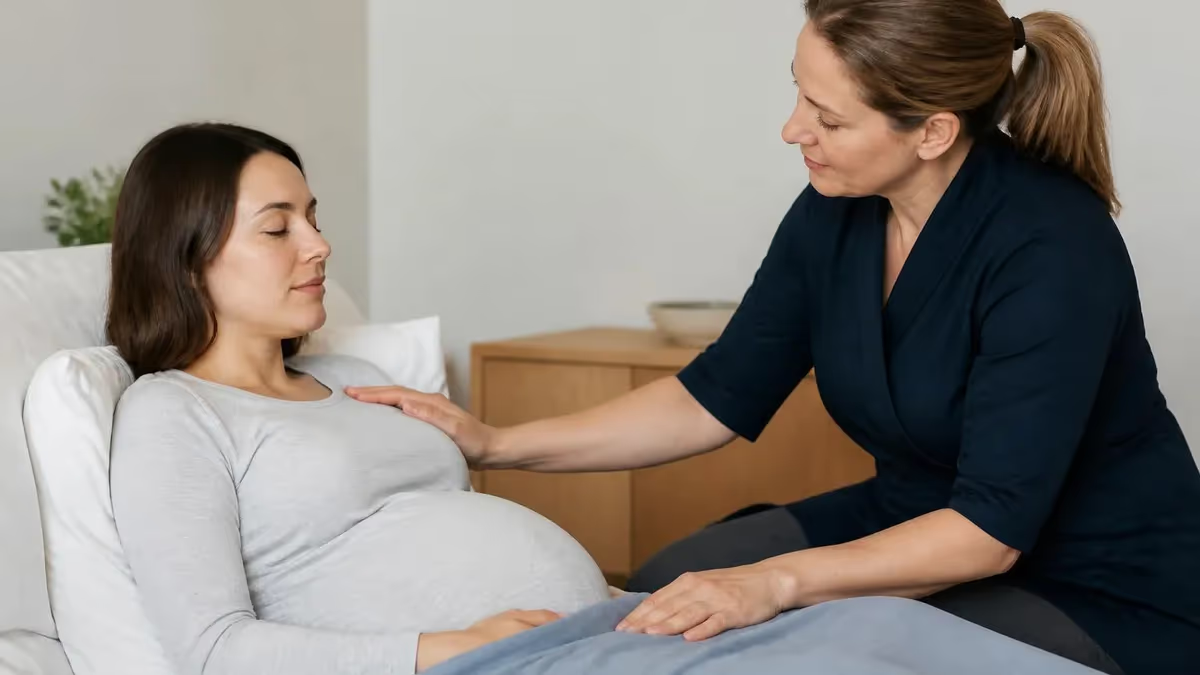
What Are Doula Services?
Doula services provide non-medical emotional, physical, and informational support to individuals and families during some of the most significant transitions in life — childbirth, the postpartum period, pregnancy loss, and end of life. A doula isn't a medical provider and doesn't deliver babies, administer medications, or perform clinical assessments. What a doula does is stay present: offering comfort techniques, answering questions, helping clients communicate with medical staff, and providing continuous support that clinical providers, with their many competing responsibilities, often can't give.
The word doula comes from the Greek word for a woman who serves. Today, the profession has expanded well beyond its original birth-focused roots. Birth doulas attend labor and delivery. Postpartum doulas support new families after the baby arrives. Death doulas (also called end-of-life doulas) support patients and families through dying and grief. Each type of doula service has distinct training, distinct scope, and meets a genuinely different need — but the core principle is the same: sustained, non-judgmental presence during a difficult transition.
Research on birth doula services shows consistent benefits. Studies published in the Cochrane Database found that continuous labor support from a doula reduces the likelihood of cesarean birth, reduces requests for pain medication, and increases satisfaction with the birth experience. These outcomes matter clinically and financially — a c-section costs roughly $5,000-$15,000 more than a vaginal birth, and doula fees typically range from $800-$2,500. For families and health systems thinking about cost-effectiveness, the math often favors doula support.
This guide covers what doula services include, how they're structured, what they cost, whether insurance covers them, and how to find a qualified doula in your area. For a broader introduction to what the profession involves, the what is a doula guide explains the full scope of the role and how doulas differ from midwives and other birth professionals.
The doula field is growing fast. The number of certified doulas in the U.S. has roughly tripled since 2012, driven by growing research evidence, advocacy from maternal health organizations, and increasing recognition from insurers and state Medicaid programs. That growth means more options for families, more employment opportunities for practitioners, and a steadily maturing professional infrastructure with clearer standards, better training programs, and more robust certification systems than existed a decade ago.
- Birth doula: Prenatal support, continuous labor support, immediate postpartum support — present from early labor through the first hours after delivery
- Postpartum doula: Support during the first weeks or months after birth — infant care education, feeding support, emotional support for parents, light household tasks
- Antepartum doula: Support during high-risk pregnancy requiring bed rest or hospital stays — visits, emotional support, information provision before birth
- Death doula (end-of-life doula): Non-medical support for people who are dying and their families — presence, legacy work, vigil support, grief companionship
- Miscarriage/loss doula: Support following pregnancy loss, stillbirth, or infant loss — emotional support, ritual, navigation of medical and administrative processes
- Virtual doula: Video-based birth or postpartum support for remote access — same scope as in-person but via telehealth platform
Birth Doula Services: What Happens and When
Prenatal Meetings (Before Labor)
On-Call Period (Last Weeks of Pregnancy)
Labor Support (Active Labor Through Delivery)
Immediate Postpartum Support (First Hours After Birth)
Postpartum Follow-Up

Birth Doula Services in Detail
Birth doulas provide three overlapping types of support: emotional, physical, and informational. Emotional support is the most fundamental — being present, calm, and reassuring throughout labor, especially during the transition phases that can feel overwhelming. Physical support includes hands-on comfort techniques: counter-pressure on the sacrum during back labor, hip squeezes, massage, help with positioning in water, guidance through breathing patterns, and cold or warm compresses. Informational support means answering questions about what's happening, explaining medical procedures in plain language, and helping clients articulate their preferences to the medical team.
One of the most common misconceptions about birth doula services is that doulas conflict with or undermine the medical team. In practice, doulas work alongside obstetricians, midwives, and nurses — they don't make medical decisions or provide medical advice. Their role is specifically to support the laboring person in ways that clinical providers, with multiple patients and clinical responsibilities, aren't able to. Research consistently shows that hospitals and birth centers with high rates of doula-attended births see improved outcomes and higher patient satisfaction — a finding that has led some hospital systems to create in-house doula programs.
Doulas also support partners and family members in the birth room. Partners who want to be actively involved in supporting the birth can learn techniques from the doula and be guided during labor. Partners who are uncertain or anxious about what to do often find the doula's presence relieves their pressure while keeping them meaningfully involved. The doula isn't replacing the partner — she's supporting the whole room. For a detailed look at what the birth doula role involves professionally, the birth doula covers training paths, certifications, and what clients should look for when hiring.
Language and cultural competency matter more in birth doula work than in most healthcare contexts. Labor is emotionally raw and intensely personal — clients are at their most vulnerable, and a doula who doesn't share or deeply respect a client's cultural framework, family structure, or communication style can do more harm than good.
Many communities now have doulas who specifically serve their own communities: Black doulas serving Black families, Spanish-speaking doulas, doulas with experience serving LGBTQ+ families, and doulas trained in culturally specific birth practices. Seeking a doula whose background and values align with yours isn't just a preference — it's a meaningful part of getting effective support.
Four Types of Doula Services
Prenatal preparation meetings, continuous labor and delivery support, immediate postpartum support, and postpartum follow-up. The most established doula service type. Research shows clear benefits for birth outcomes including reduced cesarean rates and higher patient satisfaction.
In-home support during the first weeks after birth. Infant care education, breastfeeding or bottle feeding support, emotional support for parents, light meal prep and household tasks, sibling care, and newborn guidance. Typically booked by shift (day or overnight) over several weeks.
Non-medical support for people approaching death and their families. Presence during the dying process, legacy and meaning-making projects, advance care planning guidance, vigil support, and bereavement companionship. Complements hospice care without replacing medical services.
Support following miscarriage, stillbirth, or infant loss. Emotional support, ritual creation, guidance through medical and administrative processes (hospital paperwork, memory-making), and referral to grief resources. An emerging specialty addressing a historically underserved need.
Does Insurance Cover Doula Services?
Doula coverage through Medicaid has expanded significantly in recent years. As of 2025, more than a dozen states — including Minnesota, Oregon, Florida, New Jersey, Indiana, and others — have added doula benefits to their Medicaid programs. Coverage typically applies to birth doula services and often includes prenatal visits, labor support, and postpartum visits. Requirements vary by state: some states require doulas to be registered with the state Medicaid program, while others work through managed care organizations.
If you're on Medicaid, contact your state's Medicaid office or your managed care plan directly to ask about doula benefits in your area. Coverage is expanding but patchwork — what's available in Minnesota may not be available in your state. Doula organizations like DONA International and local doula agencies often maintain updated lists of states with Medicaid doula coverage and can connect you with doulas who participate in those programs.

Finding Doula Services Near You
The easiest way to find doula services near you is through a doula directory or doula agency. DONA International, DoulaMatch, and ToLabor all maintain searchable directories of certified doulas searchable by location, type of service (birth, postpartum, death), and fee range. Many doulas also list on local parenting forums, hospital board referral lists, and midwifery practice recommendation pages. Your OB, midwife, or childbirth educator may also know doulas active in your area and can make a personal referral — which carries more weight than a directory listing.
A doula agency (sometimes called a doula collective or cooperative) is an organization that coordinates multiple doulas and matches them with clients. Working with a doula agency offers advantages: backup coverage if your primary doula can't attend your birth, vetting of doulas' credentials and references, and sometimes sliding-scale fee structures. Independent doulas offer more direct relationship-building and often more flexible arrangements. Both are valid options depending on what's most important to you — relationship continuity vs. organizational backup.
When evaluating doulas, a free consultation is standard. Most doulas offer a 30-60 minute consultation at no charge so you can assess the relationship before committing. During this conversation, ask about their training and certification, their philosophy around birth or postpartum support, their backup procedures if they're unavailable, how many clients they take per month, and what their fee structure includes.
Chemistry matters — you'll be spending hours in an intensely personal situation with this person, and genuine comfort with them is a prerequisite for the relationship to work well. For more on what the profession involves day-to-day, the postpartum doula guide covers the specific services and training that postpartum specialists provide.
When you contact a doula, expect to have a real conversation rather than just exchanging quotes. Doula services are relationship-based — the quality of the match matters as much as credentials or price. Be honest with a prospective doula about your situation, your concerns, your birth preferences, and your family's needs. A good doula will ask probing questions in return, not to judge but to understand how to serve you best. If a prospective doula mostly talks about herself rather than asking about you, that's useful information about how the working relationship would likely go.
How to Choose a Doula: Key Considerations
- ✓Check certification: look for DONA, CAPPA, TOLAB, or equivalent certification from a recognized doula organization
- ✓Ask about experience: how many births or postpartum clients has this doula supported, and in what types of settings (hospital, birth center, home)?
- ✓Verify backup arrangements: what happens if your doula is sick or attending another birth when you go into labor?
- ✓Clarify the fee structure: what's included (prenatal meetings, on-call period, labor, postpartum visit) and what costs extra?
- ✓Discuss your values: does this doula support your intended birth plan, feeding choices, and family structure without judgment?
- ✓Ask for references from recent clients — a confident, experienced doula should readily provide contact information for people who've worked with her
- ✓Check insurance and sliding scale: some doulas accept Medicaid, insurance reimbursement, or offer sliding-scale fees for lower-income clients
- ✓Confirm availability around your due date: verify she's not already booked for your likely delivery window or due to be on leave
- ✓For postpartum doulas specifically: ask about shift structure, overnight availability, and what household tasks are and aren't included
- ✓For death doulas: ask about their training in end-of-life care, how they work alongside hospice, and their approach to the vigil period
Hiring a Doula: Benefits and Considerations
- +Research-backed benefits — Cochrane review shows doula support reduces cesarean rates, reduces pain medication use, and increases birth satisfaction
- +Continuous presence — doulas stay with you throughout labor, unlike nurses and OBs who rotate between patients
- +Personalized support — your doula knows your birth preferences before labor starts and advocates for them throughout
- +Partner support — doulas guide partners on how to help, reducing partner anxiety and improving the whole room's comfort
- +Reduced isolation — having a calm, experienced presence during labor and postpartum significantly reduces feelings of fear and overwhelm
- −Out-of-pocket cost — without insurance coverage or Medicaid eligibility, birth doula fees of $800-$2,500 are a real financial barrier for many families
- −No medical scope — doulas can't perform any clinical assessment, administer medication, or intervene in medical emergencies
- −Relationship-dependent value — the benefit of doula services depends heavily on the individual doula; a poor fit reduces the value significantly
- −Availability uncertainty — popular doulas book months in advance, and finding availability in the last trimester can be difficult in high-demand markets
- −Not always accepted — some hospitals or partners may be unfamiliar or initially skeptical of doulas, requiring relationship-building before the birth

Cost of Doula Services
Birth doula fees in the United States typically range from $800 to $2,500 for a full package including prenatal meetings, labor support, and postpartum follow-up. Rates vary significantly by market — doulas in New York City, San Francisco, or Seattle charge more than those in rural or lower cost-of-living markets. Doulas with extensive experience, specialized training (hospital privileges, high-risk pregnancy experience, VBAC specialization), or significant demand command higher fees. New or newly certified doulas often charge less as they build their client base.
Postpartum doula services are typically priced by the shift rather than as a package. Day shifts (8-12 hours) usually run $25-$45/hour. Overnight shifts run slightly higher, $30-$50/hour, because the doula may need to sleep but is on-call for baby care throughout the night. Families typically book postpartum doula support for 2-8 weeks, ranging from a few shifts per week to daily support, depending on their needs and budget. Some doulas offer weekly or monthly packages at a slight discount.
Death doula services are often priced on a sliding scale or by agreement, since many practitioners in this field have a strong values-driven commitment to accessibility. Fees range widely — from free volunteer services through hospice partnerships to $1,000-$3,000+ for comprehensive end-of-life planning, vigil support, and grief companionship. Death doulas who are also social workers, nurses, or chaplains may offer their services differently than those practicing privately.
Regardless of fee structure, a consultation is always free and is the right way to explore whether a specific death doula's approach fits your family's situation and values. For the professional path into doula work, the doula certification guide covers training programs, certification requirements, and how to start a doula practice.
Payment plans are widely available among independent doulas and are worth asking about directly. Many practitioners will accept payment in installments over the pregnancy, which spreads the cost across several months rather than requiring the full fee at once. Some doulas also offer reduced rates for families who agree to provide testimonials, participate in training workshops as a learning birth, or accept a student doula co-attending their birth. These arrangements are informal but commonly offered — you won't know unless you ask.
Community doula programs in many cities provide free or low-cost doula services to families who can't afford private rates. These programs are often affiliated with hospitals, community health centers, or nonprofits and are specifically designed to reduce maternal health disparities. If cost is a significant barrier, search for community doula programs in your county or contact your state's maternal and child health office — many families who assume doula services are out of reach find accessible options they didn't know existed.
When comparing doulas, remember that price isn't the primary quality signal. A newer doula building her practice may be exceptionally well-trained and deeply committed to each client, while a more experienced doula with higher rates may be stretched thin across too many clients. Ask directly how many clients a doula takes per month — more than three active clients simultaneously is a yellow flag for birth doulas, since labor is unpredictable and two clients going into labor simultaneously can leave one uncovered.
Doula Services: Key Facts
Doula Employment Opportunities and Career Paths
Doula employment opportunities have expanded substantially in the past decade, driven by growing evidence of doula effectiveness, Medicaid expansion in multiple states, and increased employer maternity benefits. Most doulas work independently as self-employed practitioners, but hospital-employed doulas, doula agency staff, and community health worker doulas are all established employment models. Hospitals in states with Medicaid doula coverage programs sometimes hire staff doulas who attend births for enrolled Medicaid patients, providing salary and benefits rather than the variable income of self-employment.
Community-based doula programs — often run by nonprofits, community health organizations, or county health departments — hire doulas to serve high-risk populations including low-income families, teens, incarcerated people, and communities with high maternal mortality rates. These positions typically offer modest salaries with organizational support, regular hours, and a mission-driven culture. The trade-off is lower income compared to a thriving independent practice, but the stability and community support make these roles attractive for many practitioners.
Virtual doula services are a growing segment that removes geographic constraints from both clients and practitioners. Video-based birth support, postpartum check-ins via telehealth, and online childbirth education have opened markets that were previously inaccessible — rural families, military families, and clients in states or countries without local doula availability. Doulas who build virtual practices can serve clients nationally and internationally, with income less constrained by local market rates. For study resources toward professional certification, the doula certification practice test videos cover the labor support, anatomy, and professional ethics content tested on major doula certification exams.
Doulas are not medical providers. A doula cannot: diagnose conditions, prescribe or administer medications, perform cervical checks or other clinical assessments, deliver babies, make medical decisions, or override recommendations from your healthcare provider. If a doula presents themselves as providing any clinical service, that's a red flag. The doula's role is support — emotional, physical, and informational — not clinical care. Doulas work alongside your medical team, not as a replacement for it. For high-risk pregnancies, doula support is particularly valuable but remains entirely within the non-medical support role regardless of how complex the clinical situation becomes.
Doula Certification and Professional Standards
Doula certification is voluntary in most states — there's no legal requirement to be certified to call yourself a doula or provide doula services in most jurisdictions. However, certification from a recognized organization signals that a doula has completed training, attended a minimum number of births or client interactions, received feedback from clients and professionals, and committed to a code of ethics. The major certifying bodies include DONA International, CAPPA (Childbirth and Postpartum Professional Association), ToLabor, and the International Doula Institute, among others.
Certification requirements vary by organization but typically include: completion of a training workshop (16-24+ hours), attendance at a minimum number of births or postpartum clients (usually 3-5) with evaluations, reading list completion and written reflections, and client and professional evaluations. The process takes 6-18 months for most doulas. Some organizations offer separate certification tracks for birth doula, postpartum doula, and death doula practice, recognizing that these are distinct specialties requiring different training.
When hiring a doula, certification is one factor among several — not a guarantee of quality on its own. An uncertified doula with 50 attended births and strong references may serve you better than a newly certified doula with the minimum qualifying births. Ask specifically about training, the number of clients served, and what types of situations the doula has navigated.
Certification signals commitment and baseline training; experience, fit, and references tell you more about whether this particular doula will serve you well. The death doula covers the specialized training and certification paths for end-of-life doula practice, which differs substantially from birth and postpartum doula training.
Doula Services Questions and Answers
About the Author

Registered Nurse & Healthcare Educator
Johns Hopkins University School of NursingDr. Sarah Mitchell is a board-certified registered nurse with over 15 years of clinical and academic experience. She completed her PhD in Nursing Science at Johns Hopkins University and has taught NCLEX preparation and clinical skills courses for nursing students across the United States. Her research focuses on evidence-based exam preparation strategies for healthcare certification candidates.