
Schedule DMV Written Test — Complete Guide (2026 October)
📝 Schedule DMV written test online in any state. Required docs, fees, walk-in vs appointment rules, reschedule policy, retake booking — step by step.
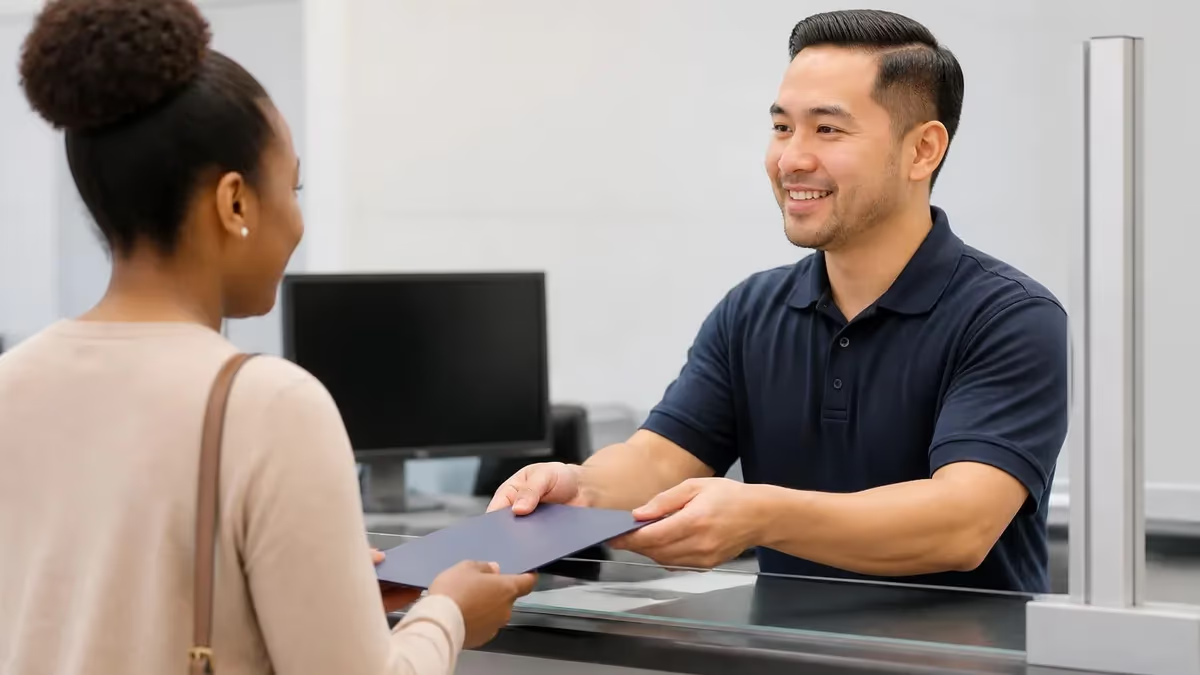
How DMV Written Test Scheduling Actually Works
Walk into your local DMV at 8:01 a.m. on a Monday and you might wait six hours. Book the same test online the night before and you'll be in and out in 40 minutes. That's the gap most first-time applicants don't know exists — and it costs people an entire workday for nothing. Every state DMV runs an online appointment system. Some are slick. Some look like 2003. All of them save you hours.
The written test (also called the knowledge test, permit test, or learner's permit exam) is the multiple-choice exam you sit at a workstation inside the DMV office. You don't need a vehicle. You don't need an instructor. You just need an appointment slot, a valid ID, and the fee. Most states let you walk in too — but in busy metro offices the line for walk-ins can stretch past closing time, meaning you drove there for nothing.
Booking is free in every state. The only money you pay is the test fee itself, charged when you sit down at the workstation or as part of your permit application. Slots open on a rolling 30-to-90-day window depending on the state. In California and Texas, urban offices sometimes book three to four weeks out. In smaller counties you can grab a slot tomorrow.
Before you book anything, pull your state's dmv handbook and skim the road-rules section. The questions on test day come straight from that manual — not from generic permit prep apps. After you've read it once, run a dmv practice test to see where your weak spots are. Most people fail on signs and right-of-way rules, not on speed limits.
Here's the thing most guides skip: scheduling is a two-step process in roughly half the states. Step one is reserving the appointment slot. Step two is filling out the actual permit application (DL-44 in California, DL-14A in Texas, similar codes elsewhere). If you skip step two, you'll show up and they'll send you home. Read the confirmation email all the way through. It tells you exactly what paperwork to bring.

- Find your state DMV's official scheduling URL — never use third-party booking sites that charge a fee.
- Pick the test type: "knowledge test," "written test," or "permit test" depending on the state's wording.
- Choose office, date, and time slot — morning slots fill first, late-afternoon slots are easiest to grab.
- Confirm by email and print or screenshot the confirmation. No confirmation, no appointment.
State Online Scheduling Portals — Where to Book
- Portal: dmv.ca.gov/portal — "Make an Appointment"
- Booking window: Up to 90 days out; urban offices 2–4 weeks
- Pre-application: DL-44 must be completed online before slot
- Fee: $39 (permit + first license)
- Portal: public.txdpsscheduler.com
- Booking window: Up to 6 months; metro Houston/Dallas 4+ weeks
- Pre-application: DL-14A required at appointment
- Fee: $25 permit, $33 license
- Portal: services.flhsmv.gov/virtualoffice
- Booking window: Up to 30 days; same-day common outside Miami
- Pre-application: Online via FLOW portal
- Fee: $48 permit (Class E)
- Portal: dmv.ny.gov — "Reserve a Permit Test"
- Booking window: Up to 60 days; NYC 3–6 weeks out
- Pre-application: MV-44 at the office
- Fee: $80 (covers permit, test, license to age 21)
- Portal: ilsos.gov — Secretary of State, not DMV
- Booking window: Up to 8 weeks; Chicago offices 3 weeks
- Pre-application: Walk through written portion at office
- Fee: $20 permit, $30 first license
- Portal: Search "[state] DMV appointment" — official .gov only
- Booking window: Typically 30–90 days
- Pre-application: Varies — check confirmation email
- Fee: $20–$80 range
Walk-In vs. Scheduled — Which Is Faster?
Short answer: scheduled. Almost always. The exception is rural offices on a Tuesday or Wednesday afternoon where walk-in volume is light. If you're in a city of more than 100,000 people, book.
Walk-in policy varies wildly by state. California officially accepts walk-ins for the knowledge test but warns of multi-hour waits. Texas requires appointments at almost every metro office and only takes walk-ins at smaller county locations. Florida's tax-collector offices (which handle most DMV services in Florida) prioritize appointments and may turn walk-ins away after 2 p.m. New York reserves the morning block for appointments and accepts walk-ins for the rest of the day if space allows.
When walk-in actually wins
You'll save time walking in if: you're at a rural office, it's mid-week, and you arrive within an hour of opening. The trade-off is risk — you might still wait three hours, and if their workstations are full they can send you home. Most people who try walk-in once switch to appointments after that.
The hybrid play
Some applicants book an appointment two weeks out as insurance, then walk in to a different office the same week. If the walk-in works, they cancel the appointment. If it doesn't, they still have the slot. This is legal in every state but you must cancel the appointment you don't use — no-shows count against you.
If your goal is just to take the dmv written test as fast as possible, the appointment route wins. The walk-in route only wins if you're willing to gamble on geography and weekday timing.
What You Need to Bring on Test Day
Forget anything on this list and they'll reschedule you — wasted slot, wasted trip. The required documents fall into four buckets: identity, residency, Social Security, and payment. States layer extra rules on top, but those four buckets are universal.
Identity means a U.S. birth certificate, passport, or court-issued name-change document. Residency means two pieces of mail, a utility bill, lease, or bank statement showing your in-state address. Social Security means your physical card or a W-2 listing the full number. Payment means cash, debit, credit, or money order — many DMVs don't accept personal checks.
If you're under 18, add a parent's signature on the consent form and proof of school enrollment or completion. If you're applying for a dmv real id, bring a second form of residency proof — federal compliance requires two address documents instead of one.
Document Checklist for Test Day
- ✓Primary ID — birth certificate, passport, or court ID
- ✓Social Security card (physical) or W-2 with full SSN
- ✓Two proofs of residency — utility bill, lease, bank statement (dated within 90 days)
- ✓Completed permit application form (state-specific code)
- ✓Parental consent form if under 18
- ✓Proof of school enrollment if under 18 (varies by state)
- ✓Payment method — debit/credit card or money order
- ✓Glasses or contacts if you need them for the vision screening
- ✓Appointment confirmation printout or screenshot
- ✓Driver education completion certificate if your state requires it
Test Fees by State (Selected)
Fees, Payment, and Hidden Costs
The sticker price for the written test is misleading. Almost every state bundles the knowledge-test fee into the broader permit or license application — meaning you pay one combined fee at the workstation, not a separate $10 test charge. The numbers in the table above reflect that bundled cost.
Hidden costs to watch for: some states charge a separate vision-screening fee ($5–$10), and a small handful charge for the photo. Money orders are sometimes the only payment method at older offices. Call ahead if you're unsure — the published fee on the .gov site is the bundled total, not what you'll see itemized on the receipt.
What happens if you fail and have to retake
You don't pay the permit fee twice. You pay a retest fee, which ranges from $5 in Indiana to $25 in California. The retake counts as a fresh appointment slot, so book it the same day you fail — don't wait. Slots disappear fast after weekend testing groups schedule en masse.
Rescheduling and Missed Appointments
Stuff happens. Your kid gets sick. Your car battery dies. Every state lets you reschedule — the question is how late you can do it without penalty. Most states require 24 hours notice. A few require 48. California and New York are lenient: cancel up to one hour before and you're fine.
Missing an appointment without canceling is called a no-show. Two no-shows in California will block you from booking online for 30 days. New York counts no-shows but doesn't lock you out. Texas issues a warning on the first no-show, then locks you out after the second. The pattern is: states care, the penalties are real, but they're not catastrophic. Cancel even five minutes before — that counts as a cancellation, not a no-show.
To reschedule, log back into the same portal you used to book. The confirmation email also has a cancel link. If neither works (older state systems sometimes break), call the office directly. Don't email — most DMV inboxes auto-reply but no human reads them within 48 hours.
What if you're running late
Most DMVs hold your slot for 15 minutes past the appointment time. After 15 minutes, you're a walk-in — they'll fit you in if there's room, otherwise you reschedule. Texas is stricter at 10 minutes. California gives the full 15 plus a small buffer at urban offices that know traffic is real.
Best days and times to book
Tuesday and Wednesday mid-morning are the slowest DMV windows nationwide. Mondays and the day before any federal holiday are the worst — avoid them. If you can take a weekday off, do. Saturday appointments exist in about 20 states but fill within hours of release. The first appointment of the day (usually 7:30 or 8 a.m.) is the most reliable because no prior delay has stacked up yet.
Two no-shows in California, Florida, and several other states will lock you out of online booking for 30 days. You'll have to call in or walk in to reschedule. Cancel even one minute before — that's not a no-show, just a cancellation.
Common Booking Errors and Fixes
This usually means the office you picked is fully booked for the visible window. Try a different office 15–30 miles away. Smaller satellite offices in adjacent counties almost always have slots within a week. Or refresh the calendar at exactly midnight — many states release new slots at 12:00 a.m. local time.
When the Booking Portal Just Doesn't Work
State DMV websites are not built like commercial booking platforms. Outages happen weekly. Sessions expire mid-form. The calendar shows slots that vanish when you click them. Welcome to government tech. Here's what works when the portal doesn't.
First fix: clear cookies for the entire DMV domain and try again. Most state portals lock you out if your session has half-finished applications from a previous visit. Second fix: try a different browser — Chrome and Firefox handle these portals differently, and one will often succeed where the other freezes.
Third fix: try at 3 a.m. local time when traffic is lowest. The systems are often the same, but the database isn't choking. A fourth trick that surprises people: switch from desktop to mobile. The mobile site of several state DMVs runs on a different server stack and sometimes accepts bookings the desktop refuses.
When to call instead
If you've tried all four fixes and the system still won't book, call the state DMV hotline. California: 1-800-777-0133. Texas: 512-424-2600. Florida: varies by county tax collector. The phone agent can book directly into the system and bypass the broken web form. Expect a 20–40 minute hold; mornings are worst, late afternoon is best. Have your full name, date of birth, and address ready when the agent picks up — they'll cut the call short if you fumble for documents.
Booking from out of state
If you just moved and your old state's license is still valid, you can take the written test in your new state without surrendering the old license first. You'll need to bring it to the appointment as identity proof. The DMV will surrender the old license to the originating state automatically after they issue your new one — you don't have to mail anything back. Most states give you 30–60 days after establishing residency before this becomes mandatory.
AAA, Driving Schools, and Third-Party Test Centers
In about a dozen states, you can take the written test at an authorized third-party location instead of a DMV office. The most common are AAA branches (in states like California, Indiana, and Florida), accredited driving schools, and Secretary of State affiliated kiosks. The third-party score is transmitted directly to the DMV — you don't bring a piece of paper anywhere. Save the receipt anyway.
The catch: third-party centers charge a service fee on top of the standard test fee. AAA branches typically charge $15–$25 extra. Driving schools bundle the test fee into their course price. The benefit is much shorter wait times and friendlier service. The other benefit: many third-party centers offer the test in more languages and provide audio assistance for applicants with reading difficulties. State DMVs offer this too but often only at certain hours. Worth knowing: a few third-party providers also schedule the road test for an extra fee, letting you handle both stages outside the official DMV queue entirely.
Third-Party Test Centers — Worth It?
- +Wait times are minutes, not hours
- +Often available evenings and weekends
- +More language options in some states
- +Friendlier staff, less bureaucratic atmosphere
- +Score transmits to DMV automatically
- −Extra $15–$50 service fee
- −Only available in some states (CA, IN, FL, ND, WI, others)
- −Must still visit DMV for permit issuance even after passing
- −Not available for road test in most states — written only
Pros and Cons at a Glance
| Pros | Cons |
|---|---|
| Wait times are minutes, not hours | Only available in some states (CA, IN, FL, ND, WI, others) |
| Often available evenings and weekends | Must still visit DMV for permit issuance even after passing |
| More language options in some states | Not available for road test in most states — written only |

Out-of-State License Transfers — Different Scheduling Rules
If you have a valid license from another state and you're moving, the scheduling is different from a fresh applicant. Most states waive the written test for valid out-of-state license holders, but a dozen still require it — including South Carolina, Florida for commercial transfers, and some Northeast states for licenses older than 12 months.
Check your new state's transfer rules before booking anything. The appointment type matters. Searching for "new permit" in the portal when you actually need "out-of-state transfer" will give you the wrong slot length and the wrong document checklist. The transfer appointment is usually shorter (20–30 minutes vs. 45–60 for a first-time applicant) because you're not taking the test from scratch.
Documents specific to transfers
Bring your existing license, current proof of residency in the new state, proof of legal presence (passport or birth certificate), and your SSN. Some states also require a vision test and a 10-question abbreviated knowledge test on local rules. North Carolina, for example, requires the road-signs portion only — not the full written test — for out-of-state transfers.
If you've never had a driver's license and you're starting from scratch, you'll need the standard learners permit practice test route. Book the same way as a first-time in-state applicant. The difference is purely how the DMV codes your application — they handle it automatically once you select the right starting option in the portal.
Retake Scheduling — How to Book After Failing
You failed. It happens. Most states require a waiting period between attempts — usually 1 to 7 days. California makes you wait 7 days after a fail, Texas 1 day, Florida 1 day, New York 1 day, Illinois 1 day. The waiting period exists so you actually study before retaking, not so you don't show up annoyed.
Book the retake on the same portal. Some states show a retake-specific option after you fail, with a reduced fee already applied. Others charge you the same fee again and refund the difference. The retake appointment can be at a different office than the original — many people switch offices after a fail because they associate the location with the failure.
How many retakes are allowed
Most states allow three attempts before you have to wait a longer period (30 days or 6 months) and pay a new application fee. California allows three attempts within 12 months on the same permit application. After three fails, you start over with a fresh application and fresh fee.
If you keep failing, stop guessing what's wrong. Pull the official handbook, identify which sections you missed, and grind those specific sections. Don't take another dmv permit test attempt until you can hit 90% on practice questions in your weak categories. The DMV passing score is usually 80%, so you need a buffer.
The mindset shift that helps on retake day
People who fail twice usually fail because they walk in tense. The test isn't tricky. The questions repeat across attempts in the same state — the bank is finite. Go in expecting half the questions to look familiar. Read each one twice before answering. Skip any question you're unsure on and come back. That single habit lifts most retake scores by ten points. Eat before the test. Hydrate. Show up rested, not crammed at midnight on practice questions. The brain you have at 8 a.m. answers cleaner than the one running on three hours of sleep and panic.
Booking and Pass-Rate Numbers Worth Knowing
From Booking to Permit — Realistic Timeline
Day 0: Read the handbook
Day 1–3: Practice tests
Day 3: Book online
Day 3–4: Gather documents
Day 14–28: Light review
Test day: Arrive early
Same day: Permit issued
Sample DMV - Representative Exam Practice Questions
Try these questions from our free DMV - Representative Exam practice tests. The correct answer and an explanation follow each question.
Which of the following vehicles is EXEMPT from the FTC Used Car Buyers Guide requirement?
- A. Vehicles sold at auction to the public
- B. Vehicles with fewer than 10,000 miles
- C. Vehicles sold between private parties (not dealers)
- D. Vehicles older than 10 years
Answer: C. Vehicles sold between private parties (not dealers)
The FTC Used Car Rule applies to dealers — private party sales between individuals are exempt from the Buyers Guide requirement.
Under the FTC Used Car Rule, dealers are required to display a Buyers Guide on used vehicles that includes:
- A. The vehicle's full service history
- B. Whether the car is sold 'as is' or with a warranty
- C. The dealer's financing rates
- D. A list of prior owners
Answer: B. Whether the car is sold 'as is' or with a warranty
The FTC Buyers Guide must state whether the car is sold 'as is' or with a dealer warranty, and must describe any warranty coverage provided.
Which federal law requires dealers to provide a written odometer disclosure statement at the time of sale for most vehicles?
- A. Truth in Lending Act
- B. Federal Odometer Act (Motor Vehicle Information and Cost Savings Act)
- C. Magnuson-Moss Warranty Act
- D. Uniform Commercial Code Article 9
Answer: B. Federal Odometer Act (Motor Vehicle Information and Cost Savings Act)
The Federal Odometer Act requires dealers to provide a written odometer disclosure statement signed by both seller and buyer at vehicle transfer.
Read the following passage: 'A flashing yellow light means proceed with caution. Drivers should slow down and be prepared to stop if necessary, but are not required to come to a complete stop.' What does a flashing yellow light require drivers to do?
- A. Come to a complete stop before proceeding
- B. Slow down and proceed with caution
- C. Stop only if other vehicles are present
- D. Treat it the same as a green light
Answer: B. Slow down and proceed with caution
The passage states drivers must slow down and proceed with caution but are not required to stop completely.
DMV Questions and Answers
Related Reading
DMV Appointment Guide: How to Schedule Your Visit in Every State
DMV Permit Test: Study Tips, Practice Questions, and State Requirements

DMV Handbook Guide: State Driver Manuals for Every License Type
DMV Real ID: What It Is, How to Get One, and Deadlines
Learner's Permit Practice Test 2026: Free Study Guide for First-Time Drivers
About the Author
Licensed Driving Instructor & DMV Test Specialist
Penn State UniversityRobert J. Williams graduated from Penn State University with a degree in Transportation Management and has spent 20 years as a certified driving instructor and DMV examiner consultant. He has personally coached thousands of applicants through written knowledge tests, skills assessments, and commercial driver licensing programs across more than 30 states.
Join the Discussion
Connect with other students preparing for this exam. Share tips, ask questions, and get advice from people who have been there.
View discussion (8 replies)