
DLAB Practice Test Guide 2026: Defense Language Aptitude Battery
Boost your DLAB exam score with practice questions and detailed answer explanations. 💯 Track progress with instant feedback.

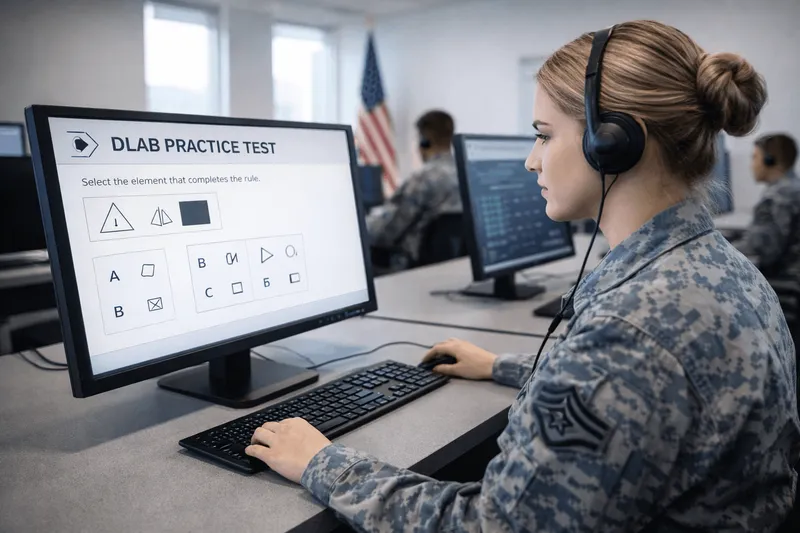
DLAB Overview
Part 1 of the DLAB presents a miniature invented language with its own grammatical rules. You receive a short grammar guide and must apply those rules to translate simple phrases. This part tests your ability to absorb and apply unfamiliar syntax — the core skill of language learning.
- Read grammar rules for a constructed language
- Apply rules to translate phrases from English to the invented language
- Questions escalate in complexity as more rules are introduced
- No prior language knowledge helps — the rules are entirely novel

DLAB Pros and Cons
- +No prior foreign language knowledge is required — the test is intentionally designed for complete beginners
- +The grammar rules are provided during the test — you are not memorizing rules in advance, only applying them quickly
- +The audio section rewards natural phonological awareness, which many people have without realizing it
- +Practice tests can meaningfully improve performance — the rule-application skill is trainable
- +Scores are valid for 2 years, giving you time to retake if needed (waiting period typically 6 months)
- −The invented grammar rules escalate rapidly — by the final items, you are applying 5–6 stacked rules simultaneously
- −The audio section requires distinguishing subtle stress and sound differences in recordings you cannot replay
- −Timed pressure compounds errors — there is no reviewing and returning once you advance past a section
- −There are no official practice materials released by the military — all prep relies on third-party simulations
- −Scores cannot be appealed — if you score below the threshold, you must wait out the retest period
Pros and Cons at a Glance
| Pros | Cons |
|---|---|
| No prior foreign language knowledge is required — the test is intentionally designed for complete beginners | The audio section requires distinguishing subtle stress and sound differences in recordings you cannot replay |
| The grammar rules are provided during the test — you are not memorizing rules in advance, only applying them quickly | Timed pressure compounds errors — there is no reviewing and returning once you advance past a section |
| The audio section rewards natural phonological awareness, which many people have without realizing it | There are no official practice materials released by the military — all prep relies on third-party simulations |
| Practice tests can meaningfully improve performance — the rule-application skill is trainable | Scores cannot be appealed — if you score below the threshold, you must wait out the retest period |
Free DLAB - Defense Language Aptitude Battery Study Tools
Interactive DLAB - Defense Language Aptitude Battery resources on PracticeTestGeeks, free to start:
- Free DLAB Grammar MCQ Questions and Answers — 11 questions with instant scoring and answer explanations
- DLAB - Defense Language Aptitude Battery flashcards — review key terms and concepts card by card
- DLAB - Defense Language Aptitude Battery study guide — topic-by-topic overview of what the exam covers
- DLAB - Defense Language Aptitude Battery cheat sheet — one-page printable summary for last-minute review
DLAB Checklist
- ✓Read every grammar rule in the written section twice — once to understand it, once to confirm before answering
- ✓For the oral section, trust your first impression of stress patterns — over-analysis leads to more errors
- ✓Practice applying multiple stacked rules simultaneously — late-section questions layer 4–6 rules at once
- ✓Study basic linguistics terminology: case, declension, conjugation, stress — this makes rule descriptions faster to parse
- ✓Use free online DLAB practice tests to build familiarity with the question format and timing pressure
- ✓Never leave a blank — no penalty for wrong answers means every guess has positive expected value
- ✓Learn to quickly eliminate impossible answers: if a rule says adjectives follow nouns, any answer with adjective before noun is wrong
- ✓Practice identifying syllabic stress in English first — it trains the auditory discrimination skill the oral section demands
- ✓If retaking: wait the full 6-month period and spend it building pattern-recognition skills through language learning apps
- ✓On test day, arrive well-rested — working memory fatigue has an outsized effect on rule-application accuracy



Sample DLAB - Defense Language Aptitude Battery Practice Questions
Try these questions from our free DLAB - Defense Language Aptitude Battery practice tests. The correct answer and an explanation follow each question.
The DLAB (Defense Language Aptitude Battery) is administered by the US military primarily to assess which capability?
- A. A recruit's potential to learn a foreign language
- B. A recruit's current foreign language proficiency
- C. A recruit's ability to translate military documents
- D. A recruit's knowledge of world geography
Answer: A. A recruit's potential to learn a foreign language
The DLAB measures language-learning aptitude — potential, not current ability.
In Language X, 'ban' and 'pan' are different words with different meanings. What does this tell you about /b/ and /p/ in this language?
- A. They are allophones of the same phoneme
- B. They are separate phonemes (distinctive sounds)
- C. They are in free variation
- D. They cannot appear in the same position
Answer: B. They are separate phonemes (distinctive sounds)
Because swapping /b/ for /p/ changes the word's meaning (ban ≠ pan), these sounds are separate phonemes — they create minimal pairs. A minimal pair proves that two sounds are phonemically distinct in a given language.
In a tone language, 'ma' with a high tone means 'mother' and 'ma' with a low tone means 'horse.' What role does pitch play in this language?
- A. It indicates emotion only
- B. It changes the grammatical category
- C. It distinguishes word meaning (lexical tone)
- D. It marks sentence type (question vs. statement)
Answer: C. It distinguishes word meaning (lexical tone)
When pitch differences change the meaning of otherwise identical syllables, the language has lexical tone. The same consonant-vowel sequence /ma/ has completely different meanings depending on its pitch pattern. Mandarin Chinese has four tones that function this way.
In a test language, underlining a symbol marks it as silent. The word written as b-r̲-e-n (with underlined r) is pronounced:
- A. /bren/
- B. /ben/
- C. /rben/
- D. /bner/
Answer: B. /ben/
The underlined r is silent, so only b, e, and n are pronounced, yielding /ben/.
Take the full DLAB - Defense Language Aptitude Battery practice test
If you want more targeted practice, the dlab practice test page covers the same material with additional questions and explanations.
If you want more targeted practice, the dlab practice test page covers the same material with additional questions and explanations.
If you want more targeted practice, the dlab practice test free online page covers the same material with additional questions and explanations.
For more details, see our DLAB Tips: How to Ace the Defense Language Aptitude Battery Test guide.DLAB Questions and Answers
How this page was made: written with AI tools and published by Nathan Beja, founder of Practice Test Geeks, who is responsible for its content. Exam facts are checked against the official sources listed below. Not reviewed by a subject-matter expert. Editorial policy
Sources & references
Exam facts on this page (fees, format, dates, passing scores) are checked against these official sources; the date is our last check. Editorial policy
- marines.mil — Exam information · verified Oct 2026
- netc.navy.mil — Eligibility, passing score, exam format, time limit · verified Oct 2026
- static.e-publishing.af.mil — Test delivery, retake policy, score validity · verified Oct 2026