
CST Test California: Complete Training Guide & Requirements for Certified Survey Technicians
Master the CST test California requirements. Exam format, study tips, eligibility, and free practice tests. ✅ Start preparing today.

The CST test California is one of the most recognized credentials a survey professional can earn in the western United States. Administered by the National Society of Professional Surveyors (NSPS), the Certified Survey Technician (CST) program validates your technical skills across four progressive levels, from basic field work all the way through advanced computations and legal boundary analysis. In California, where licensed land surveyors must meet strict state board requirements, holding a CST certification signals to employers that you have demonstrated, exam-verified competency at a nationally standardized level.
Understanding the structure of the CST exam is the first step toward passing it. The test is not a single monolithic exam but rather a tiered credential system. Level I focuses on basic field operations, Level II covers instruments and measurements, Level III addresses boundary surveying and legal descriptions, and Level IV tests advanced computations including coordinate geometry and subdivision design. Each level builds on the previous one, so you cannot skip ahead — you must earn your way up the ladder, which rewards genuine mastery over rote memorization.
California employers in civil engineering, public works, and private survey firms actively seek CST-credentialed technicians because the certification reduces liability exposure. When a technician holds a CST, a supervising Licensed Land Surveyor (LLS) can assign more independent field tasks, knowing the individual has been vetted through a standardized testing process. This translates directly into higher earning potential and faster career advancement compared to uncertified peers performing identical duties on a daily basis.
Preparation is the single most decisive factor in CST exam success. Candidates who walk into the exam having completed only on-the-job training without any structured review typically struggle with the calculation-heavy sections, especially the legal descriptions and boundary surveying modules. Structured study using practice tests, flashcards, and timed simulations dramatically improves performance by familiarizing you with the question style, time pressure, and topic weighting before exam day arrives.
The NSPS sets exam windows throughout the year, and registration is handled through their national testing platform. In California, testing centers affiliated with national providers like Prometric or PSI typically host CST exam sessions in major metropolitan areas including Los Angeles, San Francisco, San Diego, Sacramento, and Fresno. Remote or rural candidates may need to plan travel, so checking the exam schedule well in advance is essential to avoid missing a convenient testing window near your home or workplace.
If you are exploring whether the cst test aligns with your long-term career goals, this article will walk you through every requirement — from eligibility and registration to exam structure, study strategies, and what to expect on test day. Whether you are a first-time candidate at Level I or a seasoned technician pursuing Level IV, the information below gives you the roadmap you need to approach your exam with confidence and a clear preparation plan.
One common misconception is that the CST is only for surveyors who want academic credentials. In reality, the certification is deeply practical. Questions draw directly from real-world scenarios: reading field notes, computing traverse closures, interpreting deeds and legal descriptions, and applying state and local code compliance standards. If you have spent time in the field and combined that experience with deliberate study, you are already closer to passing than you might think. The goal of this guide is to close the remaining gaps and help you succeed.
CST Certification by the Numbers
Key Facts at a Glance
| Item | Value | Details |
|---|---|---|
| Exam Time Limit | 3 hrs | Varies slightly by level |
| Passing Score Threshold | 70% | Minimum to earn credential |
| Questions (Level III/IV) | 170 | Multiple choice format |

CST Exam Format & Structure
| Section | Questions | Time | Weight | Notes |
|---|---|---|---|---|
| Legal Descriptions & Boundary Surveys | 55 | ~55 min | 32% | Deeds, metes and bounds, monuments |
| Survey Documentation & Records | 40 | ~40 min | 24% | Field notes, plats, record research |
| Code Compliance | 35 | ~35 min | 21% | State and local regulations |
| Measurements & Computations | 25 | ~25 min | 15% | Traverse closure, coordinate geometry |
| Field Operations & Equipment | 15 | ~15 min | 8% | Instrument setup, safety, field procedures |
| Total | 170 | 3 hours | 100% |
Eligibility for the CST exam is more accessible than many candidates assume. The NSPS does not require a college degree to sit for Levels I or II. Instead, the primary prerequisite is demonstrated work experience in the survey field combined with a completed application and the applicable examination fee. For Level I, candidates typically need to show they are actively employed in a surveying-related role or enrolled in a related educational program. This open-access design means that a motivated high school graduate who has worked even one season in the field can begin the certification journey.
For Level III, candidates must hold a current Level II CST credential and demonstrate additional field experience — typically two or more years of progressively responsible survey work. Level IV, the pinnacle of the CST program, requires holding Level III and is strongly recommended only for technicians who routinely perform advanced computations, subdivision design, or boundary research in their daily professional responsibilities. The experience requirement exists because Level IV questions assume a level of practical depth that textbooks alone cannot fully replicate without hands-on application.
Registration is completed through the NSPS national office or their online portal. Applicants must submit their work history documentation, supervisor verification in some cases, and payment of the exam fee. In California, some local chapters of the California Land Surveyors Association (CLSA) offer assistance with the application process, including mock application reviews and study group coordination. Checking with your local CLSA chapter before submitting your application can help you avoid common errors that delay processing by several weeks.
Exam fees for the CST range from approximately $100 to $200 depending on the level and whether you are an NSPS member. Membership in NSPS provides a discounted exam rate, and the cost savings over multiple exam attempts can quickly offset the annual membership fee. For California candidates, membership in both NSPS and CLSA is common because the two organizations work closely together on continuing education, networking events, and legislative advocacy that directly affects the surveying profession in the state.
Scheduling your exam through an approved testing center requires selecting an available date, typically at least two weeks in advance of your desired testing window. Prometric and PSI are the two most common third-party testing vendors used by NSPS-affiliated programs, and both maintain multiple California locations. When selecting a site, confirm that the specific location administers the CST exam — not all centers at every address test every credential type, so calling ahead or using the vendor's online location filter saves you from arriving at a site that cannot accommodate your exam.
Candidates who fail the CST exam may retake it after a mandatory waiting period, generally 30 to 90 days depending on the level and attempt number. If you fail on a first attempt, the NSPS typically provides a score report that identifies which subject domains were below the passing threshold. This targeted feedback is extremely valuable for your retake preparation strategy because it tells you exactly where to focus your remaining study time rather than forcing you to re-cover material you have already mastered.
It is worth noting that the CST credential must be renewed every three years through continuing education. In California, surveyors and technicians often satisfy renewal requirements by attending CLSA conferences, completing NSPS online courses, or participating in approved workshops on topics such as boundary law, geodetic control, or new instrument technology. Keeping renewal requirements in mind from the start — not just at the three-year mark — helps you build a professional development routine that keeps your skills sharp and your credential current without last-minute scrambling.
CST Study Strategies by Exam Level
Level I and Level II candidates should focus their study efforts on field operations fundamentals: instrument setup procedures, reading and recording field notes, basic traverse calculations, and safety protocols. The questions at these levels are designed to test whether you can perform competently in real field situations, so studying from actual field notes and equipment manuals alongside your NSPS reference materials gives you an authentic context for memorizing procedures and terminology that appears on the exam.
For calculation questions at Level II — which introduces topics like differential leveling, angle measurement, and basic coordinate geometry — working through timed practice sets of 10 to 15 problems daily is more effective than marathon study sessions. Aim to complete each calculation problem in under two minutes on average, since the exam's overall time limit requires pacing discipline. Using a scientific calculator identical to what you will bring to the testing center ensures that your practice habits transfer directly to exam conditions without any adjustment period.

Is the CST Certification Worth Pursuing?
- +Nationally recognized credential that transfers across all 50 states
- +Opens doors to higher-paying technician and crew chief positions
- +Demonstrates verified competency to employers and licensing boards
- +Tiered structure lets you earn credentials incrementally while working
- +Required or preferred qualification for many California government survey jobs
- +Provides a structured learning pathway to eventually pursue licensure as an LLS
- −Exam fees and study materials represent a meaningful out-of-pocket expense
- −Must be renewed every three years through continuing education hours
- −No college credit is awarded — purely a professional credential
- −Higher levels require years of documented field experience before eligibility
- −Study materials and practice tests can be difficult to find compared to other exams
- −Exam windows may be infrequent in rural California areas, requiring travel
CST Exam Day Preparation Checklist
- ✓Confirm your exam appointment date, time, and testing center address at least one week before exam day.
- ✓Bring two valid forms of government-issued photo identification to the testing center.
- ✓Verify which calculators are permitted and bring your approved device with fresh batteries.
- ✓Review the NSPS prohibited items list and leave phones, notes, and unauthorized materials at home.
- ✓Arrive at the testing center at least 30 minutes early to complete check-in procedures without rushing.
- ✓Eat a balanced meal before the exam and bring a water bottle if the center allows outside beverages.
- ✓Complete a final timed practice test two days before the exam — not the night before — to avoid fatigue.
- ✓Review your weakest subject domain one final time using your score reports from prior practice attempts.
- ✓Bring a printed copy of your registration confirmation in case of any check-in discrepancies at the desk.
- ✓Plan your transportation route in advance, including parking or public transit options, to avoid delays.
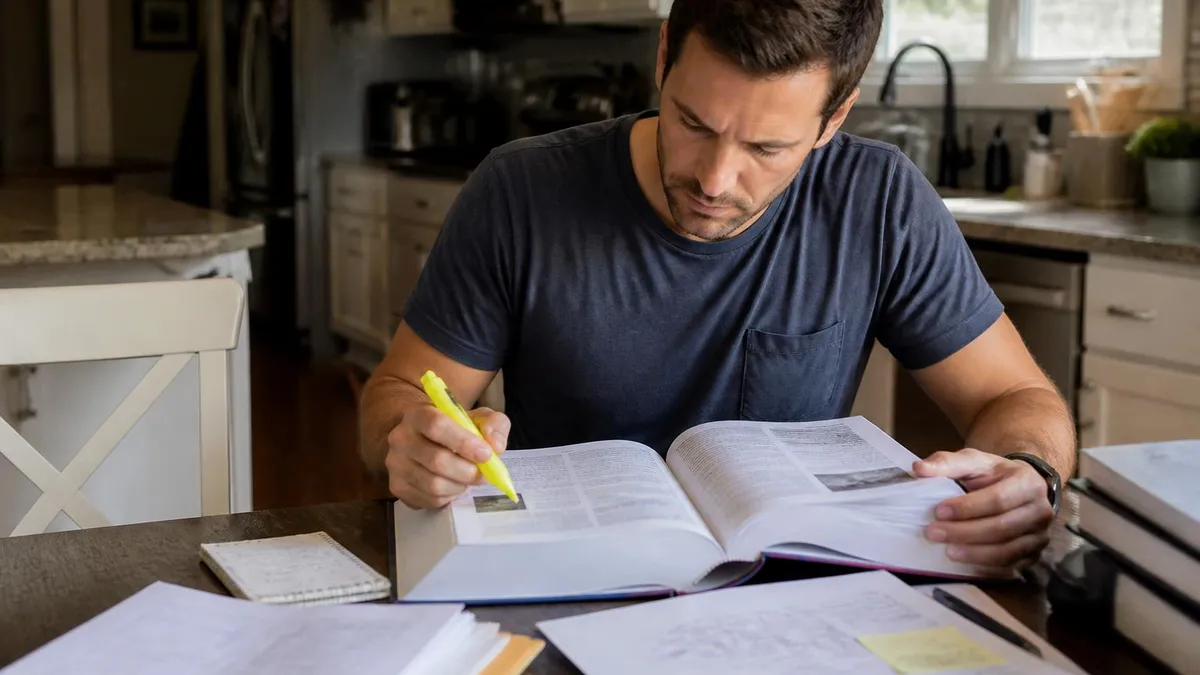
Practice Tests Are Your Single Highest-ROI Study Tool
Research on professional exam outcomes consistently shows that candidates who complete at least five full-length timed practice tests before their actual exam date outperform those who rely solely on reading and passive review. For the CST, this means simulating real exam conditions — timed, no notes, same calculator — at least once per week in the final month of your preparation. The discomfort of timed practice is exactly what prepares you to think clearly under pressure when it matters most.
The subject matter covered on the CST exam spans a wide technical landscape, and understanding exactly which topics carry the most weight helps you allocate your study time efficiently. Legal descriptions and boundary surveys consistently represent the largest single content block across Level III and Level IV exams, accounting for roughly 30 to 35 percent of total questions. This means that mastering metes and bounds descriptions, understanding the Public Land Survey System (PLSS), and being able to interpret deed calls in order of legal priority is the highest-use investment you can make in your preparation time.
Survey documentation and records is the second largest content area, typically comprising 20 to 25 percent of questions. This domain covers everything from how to properly complete and maintain field notes, to how to research existing corner records and plat maps in county or state repositories. In California, the Corner Record system administered by county surveyors is a particularly important reference — knowing how to read, file, and interpret Corner Records is directly tested and directly applicable to real California survey practice in the field and office environment.
Code compliance questions test your familiarity with the professional standards and statutory requirements that govern surveying in California. The Professional Land Surveyors' Act, the Business and Professions Code sections relevant to surveying, and local ordinances regarding subdivision mapping all fall within this domain. Many candidates underestimate code compliance as a study area because it seems like dry reading, but the exam poses it in applied scenarios: given a specific situation, which code section applies, and what is the correct required action? This applied format means you must understand the reasoning behind the rules, not just their citation numbers.
Measurements and computations questions require mathematical fluency. At Level I and II, this means basic traverse calculations and leveling arithmetic. At Level III and IV, the computation difficulty increases substantially to include coordinate geometry, area calculations using the coordinate method, and combined factor adjustments for geodetic versus ground distances. The best way to study computations is by doing them repeatedly under timed conditions, reviewing your errors, and identifying whether mistakes stem from conceptual misunderstanding or arithmetic sloppiness — both of which require different remediation strategies to correct effectively.
Field operations and equipment questions appear at every CST level but carry the smallest overall weight at higher levels. These questions cover instrument setup and calibration, total station operation, GPS receiver setup, and basic field safety. For California candidates, being aware of field safety regulations under Cal/OSHA — including requirements for traffic control when working in or near roadways — adds a California-specific dimension to what might otherwise seem like universally generic field operations content that appears identical across every state that administers the CST exam.
Geodetic and control survey topics become prominent at Level III and IV and reflect the practical reality of modern California surveying. The state has an extensive network of GPS control monuments maintained by NGS and Caltrans, and many urban survey projects require connecting to this network. Understanding datum transformations between NAD 27 and NAD 83, interpreting NGS data sheets, and applying geoid separation values when converting GPS ellipsoid heights to orthometric elevations are all fair game topics that appear in the upper-level exam content areas with increasing regularity.
Finally, boundary law concepts such as senior and junior rights, the rule of presumption of grant, adverse possession, and easement interpretation add a legal dimension to the exam that surprises candidates who assumed the CST is purely a technical test.
These legal concepts do not require a law degree to understand, but they do require careful study of how courts have historically resolved boundary disputes and how those legal principles have been codified into surveying practice standards. Good resources for this area include Walter Robillard's Clark on Surveying and Boundaries and the California-specific supplement materials available through the CLSA educational library and publication catalog.
NSPS exam registration windows typically close 30 to 45 days before the actual test date. If you miss the registration cutoff, you will need to wait for the next available exam cycle, which could delay your credential by three to six months depending on your location and the testing schedule. Set a calendar reminder at least 60 days before your target exam date to begin your registration process and avoid this common and entirely preventable setback.
Once you have passed your CST exam, a clear set of next steps determines how quickly you convert that credential into tangible career benefits. The first action is straightforward: download and save your official certification documentation from the NSPS portal, and immediately add your CST designation to your resume, LinkedIn profile, and any professional directories where your name appears. Many California survey technicians find that simply updating their LinkedIn headline with the CST credential generates recruiter outreach within days, particularly in active hiring markets like the Bay Area, Los Angeles Basin, and the Central Valley infrastructure corridor.
The next strategic step for most CST holders is to use the credential to negotiate a salary adjustment with their current employer. In California, survey technicians who earn a CST typically see salary increases ranging from five to fifteen percent upon credential award, particularly if the employer was subsidizing exam fees or study materials as part of professional development support. If your employer does not offer a raise upon passing, the credential strengthens your hand when interviewing externally — competing candidates without the CST are objectively weaker on paper, which is a powerful negotiating position in a tight labor market.
For technicians at Level II or Level III, the CST is also a stepping stone toward eventually sitting for the California Land Surveyor-In-Training (LSIT) examination, which is the first formal step toward full licensure as a Professional Land Surveyor (PLS) in the state. The technical knowledge you built studying for and passing the CST is directly applicable to the LSIT exam content, meaning the two credentials build on each other in a synergistic way. Many California survey firms actively encourage their CST-certified employees to pursue LSIT within one to two years of certification.
Professional networking accelerates after certification. Joining the California Land Surveyors Association as a full professional member — which requires your CST or enrollment in a survey program — opens access to regional chapter meetings, mentorship programs, and the annual CLSA conference. These in-person connections frequently lead to job referrals, collaboration opportunities, and access to continuing education that satisfies your CST renewal requirements while expanding your professional knowledge base and technical skill set simultaneously.
Continuing education planning should begin immediately after you receive your CST. The three-year renewal cycle means your first renewal arrives faster than most new credential holders anticipate. Creating a simple spreadsheet tracking CE credits earned, sources, and dates ensures you are never scrambling at the end of a renewal cycle. Approved CE sources for CST renewal include NSPS webinars, CLSA chapter events, university extension courses in surveying, and employer-provided training programs that have been pre-approved by NSPS for credit eligibility.
Mentorship is an underutilized resource among newly certified survey technicians. Most experienced Licensed Land Surveyors actively enjoy mentoring CST holders because it benefits the profession broadly and creates a pipeline of skilled talent within their own firms. If your workplace does not have a formal mentorship program, simply asking a senior surveyor if they would be willing to review your field decisions or discuss boundary analysis challenges with you regularly is sufficient. Informal mentorship of this kind accelerates skill development far more effectively than self-directed study alone.
For California survey technicians who have passed their cst test and are considering advanced specialization, several niche areas offer exceptional earning potential and career differentiation. Geodetic control survey work, hydrographic surveying, construction survey coordination on major infrastructure projects like highway interchanges and transit systems, and forensic boundary work for litigation support are all areas where a CST with demonstrated expertise commands premium compensation and project responsibility that exceeds what a typical general-practice technician encounters in routine fieldwork assignments throughout a standard career trajectory.
Practical test-day execution is a skill in itself, separate from content knowledge, and candidates who neglect this dimension often underperform relative to their actual preparation level. One of the most common mistakes is spending too much time on a single difficult question early in the exam, which creates time pressure that cascades across the remaining sections and forces hurried answers on questions you would otherwise answer correctly.
A disciplined pacing strategy — no more than 90 seconds per question on the first pass, with difficult items flagged for review — consistently outperforms approaches that treat every question as equally urgent regardless of difficulty or point value.
Reading each question stem carefully is critical, especially for legal description and code compliance questions that hinge on specific qualifying words. Terms like "must," "shall," "may," "generally," and "typically" have precise meanings in regulatory and legal contexts, and the exam uses them deliberately to test whether you understand the difference between mandatory and discretionary requirements. Misreading a single qualifying word can flip your answer from correct to incorrect on questions that you otherwise fully understand from a technical standpoint, which is a genuinely avoidable source of lost points.
For computation questions, showing your work on the scratch paper provided at the testing center — even though it is not graded — helps you catch arithmetic errors before you bubble in an answer. The structured habit of writing out intermediate steps, labeling units, and double-checking sign conventions is especially important for traverse closure and coordinate calculations where a single sign error propagates through every subsequent step and produces a dramatically wrong final answer that will not match any of the available choices on the multiple-choice answer sheet.
Use the process of elimination aggressively on questions where you are uncertain. CST exam distractors (incorrect answer choices) are carefully written to appeal to common misconceptions, so being aware of typical traps helps you narrow a four-choice question from uncertain to a one-in-two coin flip even when you do not have complete certainty about the correct answer. Common distractor patterns include answers that are correct in a different state's law but not California's, answers that apply to a different CST level's requirements, and computationally plausible but logically inconsistent numeric values that result from predictable arithmetic mistakes.
Managing exam anxiety is a legitimate part of preparation, particularly for candidates who have been out of formal testing environments for years. Simple techniques such as diaphragmatic breathing, a consistent pre-exam morning routine, and completing several full-length practice tests under realistic conditions in the weeks before your exam all reduce the physiological stress response that impairs performance on test day. Familiarity breeds confidence — the more the actual exam resembles your practice sessions in format, pacing, and stress level, the less cognitive disruption you experience when the clock starts at the real testing center.
After your exam, regardless of outcome, document everything you can remember about the experience within 24 hours. Which topics felt adequately covered by your study materials? Which question types surprised you? Which calculation methods felt fluid and which felt rusty under time pressure? This debrief is valuable whether you passed — informing how you advise colleagues who will sit for the same exam — or whether you need to retake, in which case it becomes the foundation of a targeted and efficient study plan for your next attempt at the CST certification program.
The surveying profession in California is growing, driven by infrastructure investment, housing development pressure, environmental monitoring projects, and the ongoing need for accurate property boundary determination in one of the most complex real estate markets in the world. The CST credential positions you at the center of this growth. Every week of preparation you invest now has a direct and measurable return in the form of a credential that will appear on your resume, your business card, and your professional profile for the entirety of your surveying career in California and beyond.
Sample CST - Certified Survey Technician Practice Questions
Try these questions from our free CST - Certified Survey Technician practice tests. The correct answer and an explanation follow each question.
What is the purpose of a retracement survey?
- A. To subdivide a large parcel into smaller lots
- B. To re-establish original boundary locations set by a prior survey
- C. To create a new legal description for a parcel
- D. To measure topographic features of a site
Answer: B. To re-establish original boundary locations set by a prior survey
A retracement survey follows the footsteps of the original surveyor to re-establish previously established boundary corners and lines.
Why is continuing education important for survey professionals?
- A. To get more vacation time
- B. To increase billing rates
- C. To remain competent and current
- D. To impress clients
Answer: C. To remain competent and current
Continuing education is vital for survey professionals to stay abreast of new technologies, evolving regulations, and best practices in the field. The surveying profession is dynamic, with advancements in GPS, LiDAR, and software constantly emerging. Ongoing learning ensures that surveyors maintain their competence, deliver high-quality services, and meet licensing requirements.
What is a 'chain of title' in land survey practice?
- A. The physical chain used in early distance measurement
- B. The sequence of historical ownership transfers for a parcel
- C. A list of survey control monuments
- D. The record of instrument calibrations
Answer: B. The sequence of historical ownership transfers for a parcel
A chain of title is the chronological sequence of deeds, wills, and transfers documenting all past ownerships of a parcel from its original grant to the present.
In the Public Land Survey System (PLSS), a standard township is divided into how many sections?
- A. 16
- B. 36
- C. 24
- D. 48
Answer: B. 36
A standard PLSS township is a 6-mile square subdivided into 36 sections, each nominally one square mile (640 acres).
Take the full CST - Certified Survey Technician practice test
CST Questions and Answers

CST Career: Your Complete Guide to Becoming a Certified Survey Technician

What Is the CST Test? A Complete Guide to the Certified Survey Technician Exam

CST Test Prep: The Complete Study Guide for the Certified Survey Technician Exam

CST Exam Schedule: Everything You Need to Know to Plan Your Testing Day

Certified Survey Technician Exam Guide
About the Author

Educational Psychologist & Academic Test Preparation Expert
Columbia University Teachers CollegeDr. Lisa Patel holds a Doctorate in Education from Columbia University Teachers College and has spent 17 years researching standardized test design and academic assessment. She has developed preparation programs for SAT, ACT, GRE, LSAT, UCAT, and numerous professional licensing exams, helping students of all backgrounds achieve their target scores.