
What Is CPI Training? 2026 October
🔎 CPI training explained: course length, cost, certification, test format, and who needs it. Complete guide to Crisis Prevention Intervention.
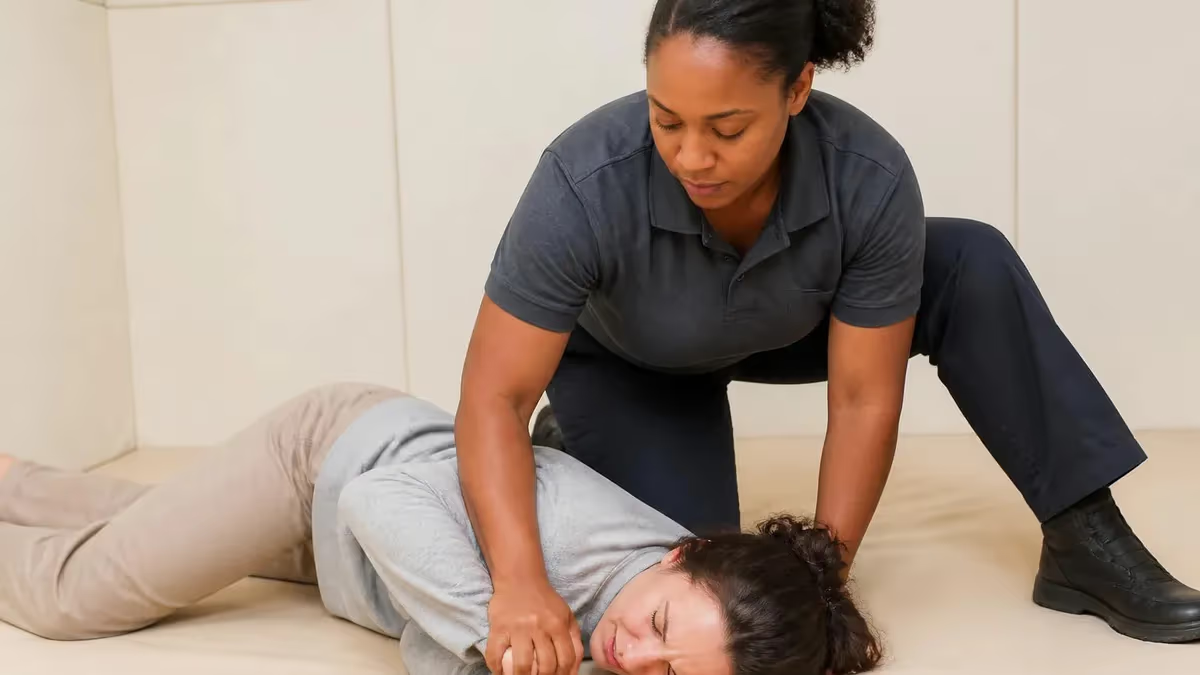
You've probably heard the term tossed around in a staff meeting, on a job posting, or maybe in a frantic email from HR. CPI training — three little letters that, depending on who you ask, mean anything from "that thing we did one rainy Wednesday" to a serious credential that genuinely changes how you handle the toughest moments of your shift. So what is it, really?
CPI stands for Crisis Prevention Institute, and the flagship program — Nonviolent Crisis Intervention — teaches staff how to recognize, de-escalate, and (only as a last resort) safely respond to a person whose behavior has spiraled into a crisis.
Think hospital floors, classrooms, behavioral health units, group homes, schools for kids with complex needs, security teams. The training is widely required, widely respected, and widely misunderstood. Most people walk out of their first day a little tired, a little surprised, and a lot more confident than when they walked in.
The course flips the script on what you thought a "restraint class" would be. The vast majority of the curriculum is about avoiding physical contact entirely — using your voice, your body language, your timing, and a clear framework to bring temperature down before anyone touches anyone. You learn to read escalation like a weather report.
This guide breaks down exactly what CPI training covers, who needs it, how long it takes, what it costs, and how to actually pass the test on the first try.
CPI Training At a Glance
Key Facts at a Glance
| Item | Value | Details |
|---|---|---|
| Course length (Foundation) | 8 hrs | |
| Pass mark | 80% | |
| Certification valid | 1 year |
Let's get specific. The Crisis Prevention Institute has been around since 1980. Over four decades they've trained more than 17 million people across hospitals, schools, and human services agencies in 35 countries.
That's a lot of nurses, paraprofessionals, security officers, and group home staff walking out with a laminated card and a head full of acronyms.
The reason it spread so fast is simple: regulators, insurers, and accreditation bodies kept asking the same question — what training do your frontline people have for managing crisis behavior? CPI gave organizations an answer everyone could agree on.
Now, "cpi training powerpoint" isn't one single class. The institute offers several distinct programs scaled to different risk environments.
The most common one is the Nonviolent Crisis Intervention Foundation course, designed for staff who work with verbally escalated individuals and may occasionally need to use physical disengagement skills. Above that sits the Advanced program, which covers physical intervention techniques for higher-risk environments.
There's also Verbal Intervention — a pure de-escalation course with no physical content at all — and specialty programs for autism support, dementia care, and educational settings. Which one you take depends entirely on what your job actually looks like.
One thing nobody warns you about before your first CPI class: the role-plays are weird at first, and then they get useful. You sit across from a stranger you met an hour ago and you take turns pretending to be a patient who refuses to come back to their room, a parent shouting in a school office, a resident demanding a cigarette twenty minutes after they had one. You feel silly. Then the instructor calls time and asks what you noticed.
The first time you do this exercise well — meaning the simulated person actually calms down because of something specific you said or did — there's a small but real shift in how you think about the work. The skills aren't magic. They're techniques anyone can learn. They scale. They transfer.
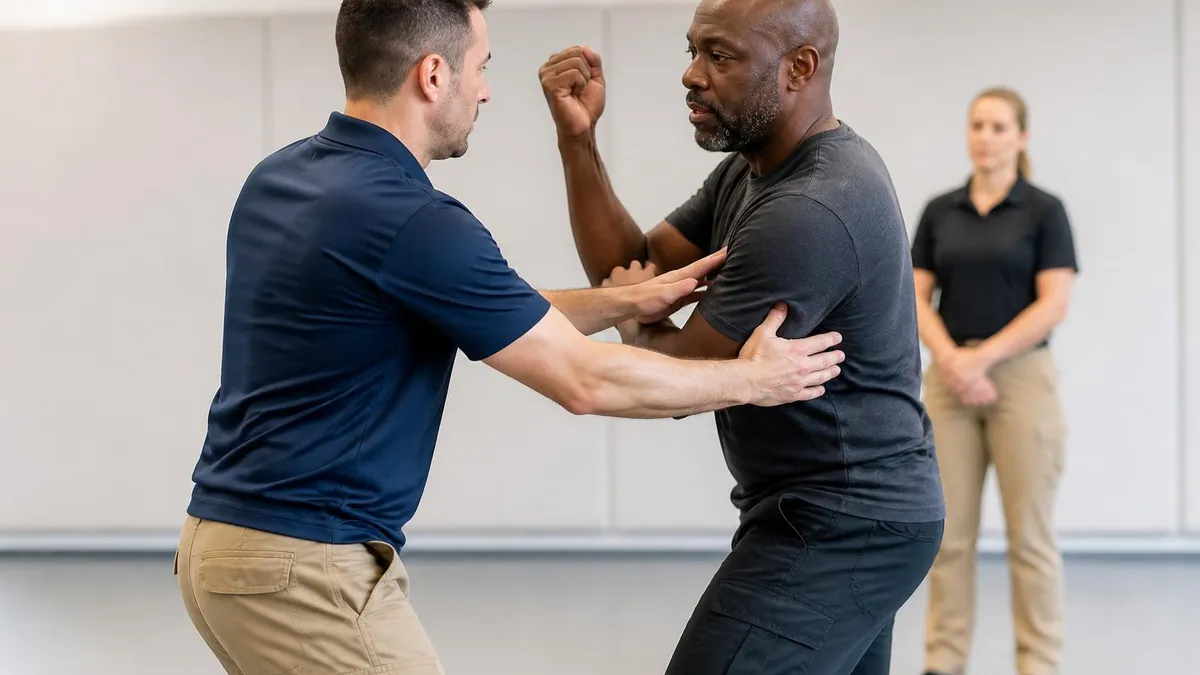
The CPI mindset in one sentence
The goal is never to win the fight. The goal is to prevent the fight from happening in the first place — and if it does happen, to end it with the lowest possible level of force, in the shortest possible time, with zero injuries on either side. That's the whole philosophy. Memorize that and you're already a third of the way through the test.
So who actually sits in a CPI classroom? You'd be surprised by the mix. New grad nurses sit next to twenty-year ER veterans. School aides sit next to special ed teachers, security officers, residential counselors, behavioral health techs, hospital chaplains, EMTs, and the occasional librarian from a downtown branch that sees a lot of foot traffic.
The common thread isn't an industry — it's the reality that, somewhere in your job description (whether it says so explicitly or not), you will eventually face a person who is no longer in control of their own behavior. CPI gives you a shared language and a shared playbook.
When that moment comes, you and everyone around you respond the same way. That last bit — the shared piece — is more important than the training itself.
The biggest risk in any crisis isn't the patient or the student. It's the staff member who freelances. Five colleagues each doing five different things, each one improvising based on a Netflix true-crime documentary they half-watched, is genuinely dangerous.
CPI's value is that everyone in the room knows what the team leader is about to say, knows where their hands go, knows when to take a step back, and knows what "transitioning" means. It's the choreography, not the cardio.
Types of CPI Programs
A pure de-escalation course. No physical content. Common in offices, libraries, customer service, and any environment where you talk people down but never put hands on. Roughly 4 to 6 hours, blended online plus classroom.
The classic. Verbal skills plus disengagement (releases from grabs, hair pulls, bites). Designed for lower-risk physical environments. Most common version. 8 hours, in person, with practical drills.
For locked units, secure facilities, and behavioral health. Adds team holds, transports, and restraint techniques. Requires Foundation as a prerequisite. 8 to 16 additional hours.
Tailored for staff supporting individuals with autism and other neurodevelopmental differences. Focuses on sensory triggers, communication adaptations, and proactive environmental design.
The structure of an actual CPI class follows the same arc almost everywhere you take it. You start with theory — a model called the Crisis Development Model, which is just a fancy way of describing the four stages a person tends to move through when they're heading into crisis.
Anxiety, defensive, risk behavior, and tension reduction. For each stage, there's a matched staff response. Anxiety gets a supportive response. Defensive gets a directive response. Risk behavior gets a safety intervention. Tension reduction gets therapeutic rapport.
Learning these four pairs is half the cognitive content of the course, and they show up on the test every single time.
After theory, you move into verbal skills — empathic listening, paraverbal communication (tone, volume, cadence), and the use of specific phrases that have been tested in actual crises.
Then comes nonverbal — proxemics (the safe physical distance, about an arm and a half away), body posture, and the supportive stance. By lunch, you've usually role-played someone refusing to take their medication or someone shouting in a hallway.
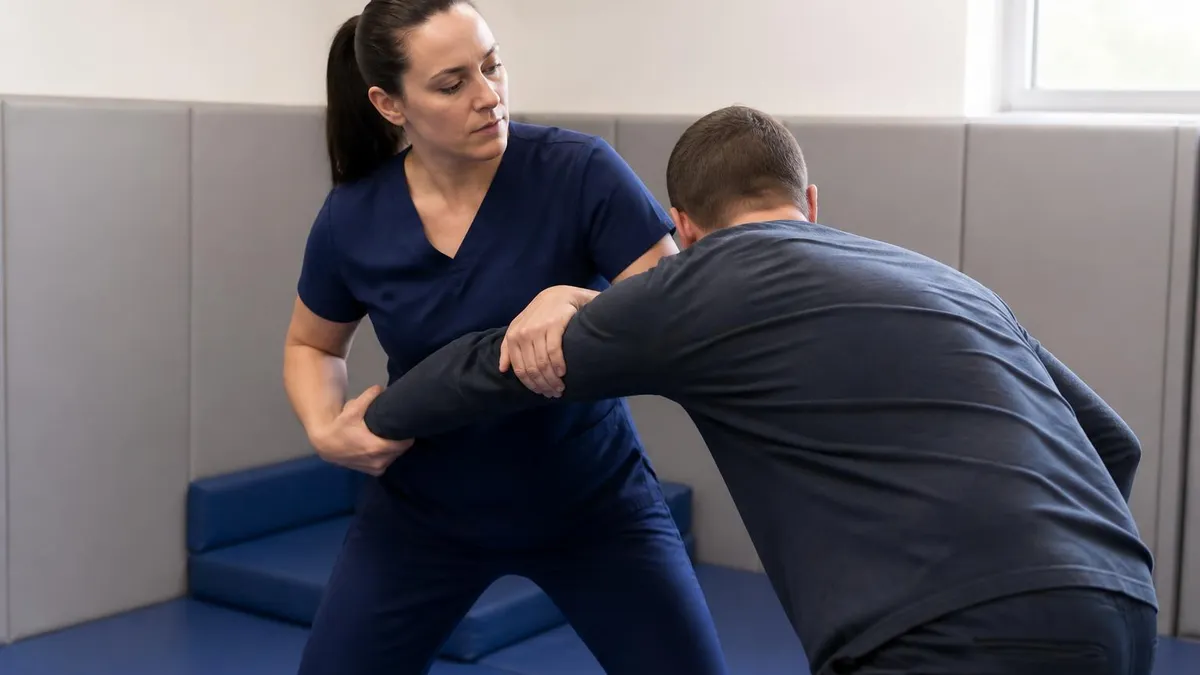
After lunch, the room moves to disengagement skills if your version includes them — practicing how to release safely from a wrist grab without injuring yourself or the other person. Practical, awkward at first, surprisingly fun by the end of the day.
The course typically wraps with a written knowledge check and, if your program includes physical skills, a practical demonstration where an instructor watches you perform the techniques. Pass both and you walk out with a wallet card valid for one year.
A note on instructor quality. The trainer at the front of the room makes a huge difference. Some are decades-deep practitioners — retired nurses, former special ed coordinators, ex-military medics — who can pull out a story for every concept. Others are recently certified internal employees reading from the slide deck. Both are technically CPI-certified to teach. The experience could not be more different.
If you have any choice in the matter, ask coworkers who've taken the class recently who they'd recommend. A great trainer will tell you when a technique you just demonstrated would not have worked on a real patient, and exactly why. A weak trainer will just nod and check the box.
CPI Training Logistics
In nearly every case, your employer foots the bill. CPI is treated as mandatory occupational training, so the cost lands in the staff development budget, not your wallet.
If you're a contractor, a substitute, or a per-diem worker, you may need to find an open public course and pay out of pocket — somewhere between $150 and $400 depending on region and program level. Some community colleges and continuing education centers run subsidized seats. Always ask before you book.
Let's talk about the written test, because that's why most of you are here. The CPI knowledge check is open-book in many programs, which sounds easy until you realize the questions are written in a way that punishes skimming.
You'll be asked to identify the four stages of the Crisis Development Model in order, to match staff responses to behavior stages, to recognize what "setting limits" actually looks like (two simple, clear, and enforceable choices), to identify the components of the integrated experience, and to spell out the difference between rational and irrational behavior.
The test is not designed to trip you up on minutiae. It's designed to confirm you internalized the core concepts well enough to apply them under pressure.
That means the highest-yield study strategy is not memorizing definitions word for word — it's understanding the logic. Why is empathic listening the response to anxiety and not to defensive behavior?
Because at the anxiety stage, the person is still rational and is essentially asking to be heard. By the defensive stage, they need direction, not just an ear. If you understand the why, the multiple-choice options become much easier to navigate.
Practice questions are the single best preparation. Reading the manual cover to cover the night before is a poor use of time. Working through 50 to 100 realistic questions, then going back to the manual only for the concepts you missed, is what consistently produces first-attempt passes.
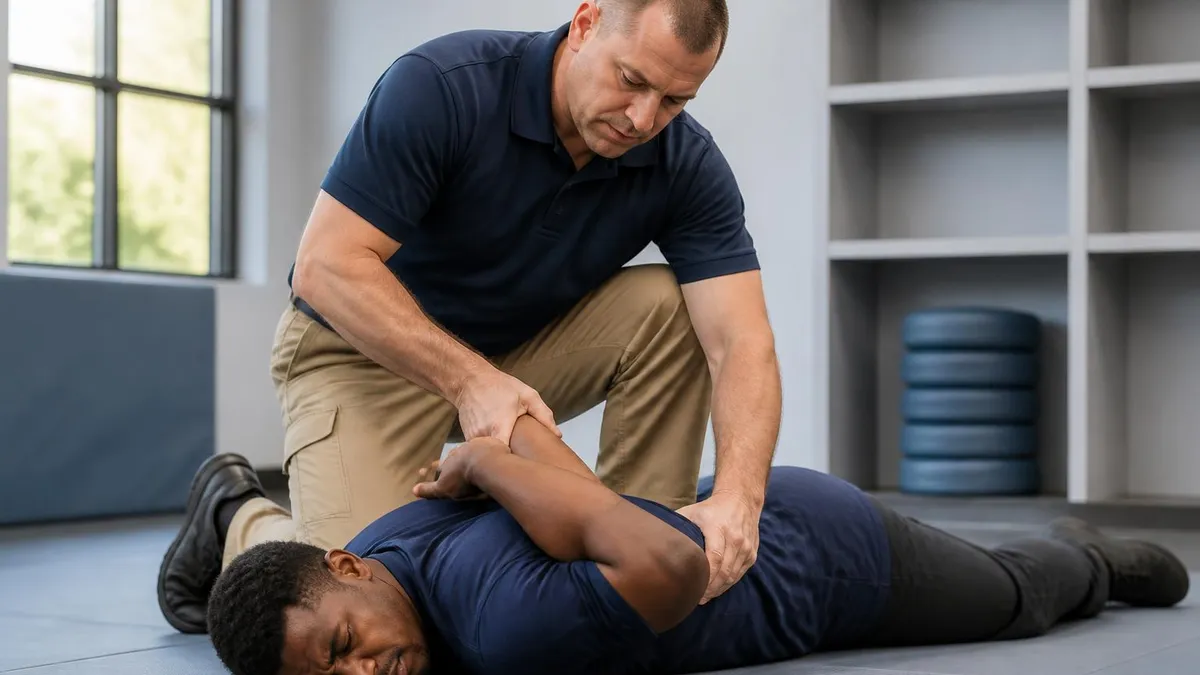
If your CPI course includes a physical component, your instructor must observe you performing each technique correctly to sign off. That's a real evaluation — not a participation trophy. If something doesn't feel safe, say so. Good instructors will pull you aside, re-coach, and let you try again. Bad instructors will rush you through. If you find yourself with the second kind, escalate to your employer.
One question that comes up constantly: does CPI training expire if you don't use it? Technically your card has a one-year shelf life regardless of how often you apply the skills.
But the more interesting answer is that the skills themselves decay much faster than the card. Verbal de-escalation muscle atrophies in weeks if you never use it. Physical disengagement skills, even more so.
That's why employers in higher-risk environments often run informal monthly drills, peer-coaching huddles, or post-incident debriefs that reinforce the techniques between formal refreshers.
If your workplace doesn't do this, consider organizing one — five minutes of role-play before a shift change can save you a serious incident later.
The other big question: can you take CPI training privately, just for yourself? Yes, but it's harder than it sounds. CPI primarily sells to organizations, not to individuals.
Finding a public course often means signing up through a third-party training center, a community college, or a regional behavioral health authority. Bring a notebook, comfortable clothes you can move in, and a willingness to look a little silly while you learn.
For renewal students, a quick word: don't sleepwalk through it. Refresher courses are shorter, lower-stakes, and easier to coast through — which is exactly why they're an opportunity to sharpen skills that have gotten rusty since last year. Treat the refresher as an active reset. Bring a question from a recent real incident. Volunteer for the role-play. Get the credential renewed and walk out genuinely better at your job.
CPI Exam Prep Checklist
- ✓Memorize the four stages of the Crisis Development Model in order — Anxiety, Defensive, Risk Behavior, Tension Reduction.
- ✓Match each stage to its corresponding staff response — Supportive, Directive, Safety Intervention, Therapeutic Rapport.
- ✓Practice the two-rule format for setting limits — simple, clear, enforceable, and offering exactly two choices.
- ✓Understand paraverbal communication — tone, volume, cadence — and why it accounts for roughly 38 percent of perceived message.
- ✓Know the supportive stance — angled body, arm and a half distance, hands visible and below shoulder level.
- ✓Be able to explain the integrated experience — your behavior influences theirs, theirs influences yours, and the loop is constant.
- ✓Take at least one full-length practice test under timed conditions before exam day.
- ✓Sleep eight hours the night before. Tired brains miss obvious cues on multiple-choice tests.
Beyond the test, the real test happens at work. You'll be standing at the nurses' station, or in the back of the classroom, or behind the security desk, and somebody will start to escalate.
Your training fires. You scan the environment, you scan the person, you take one step back into your supportive stance almost without thinking about it. You drop your voice. You ask an open question. You give them space to answer.
Eight times out of ten — closer to nine out of ten in some studies — the situation resolves right there. No restraint, no incident report longer than a paragraph, no injury to anyone.
That's what good CPI training looks like in the wild. It looks like nothing happening.
The remaining one or two times out of ten, things keep escalating despite your best work. Now you're into team response — calling for backup, clearing bystanders, repeating clear directives, and being ready to physically intervene only if the person is about to harm themselves or someone else.
Even then, the training emphasizes ending the intervention as quickly as possible and transitioning back to therapeutic rapport the moment the immediate danger has passed.
CPI Training Pros and Cons
- +Standardized, internationally recognized credential accepted across healthcare, education, and human services.
- +Heavily evidence-based curriculum with decades of incident-data refinement behind every technique.
- +Builds confidence in staff who otherwise feel under-equipped for behavioral crises.
- +Genuinely reduces incidents of restraint use when implemented organization-wide, not just as a checkbox.
- +Refresher courses keep skills fresh and create a culture of ongoing learning rather than one-and-done compliance.
- −Effectiveness collapses if leadership treats it as a checkbox rather than a culture. Bad implementation produces card-holders who never apply the skills.
- −Cost can be a barrier for individual learners outside of employer sponsorship.
- −Physical skills, especially in Advanced, require regular practice that many workplaces don't make time for between annual refreshers.
- −Online-only versions of physical content are not available — instructor-observed practical demonstration is mandatory.
If you're considering CPI as a career credential rather than just an employer requirement, here's some context. The card on its own won't land you a job — but its absence will absolutely cost you one.
Behavioral health technician postings, paraprofessional and special ed aide listings, hospital security roles, and residential counselor positions routinely require current CPI (or equivalent) at application.
Listing it on your resume signals you're ready to step into the role without waiting on a two-week onboarding course. Hiring managers in these fields read it the same way they read "valid driver's license" — boring, expected, mandatory.
For people moving into management, CPI also offers an instructor pathway. The Instructor Certification Program runs four to five days, costs significantly more (typically $2,000 to $3,500 if your employer sends you).
It qualifies you to teach Foundation-level courses inside your own organization. Many hospitals send one or two managers a year through this so they can run training in-house and stop paying outside vendors.
Sample Crisis Prevention Intervention Certification Practice Questions
Try these questions from our free Crisis Prevention Intervention Certification practice tests. The correct answer and an explanation follow each question.
What is the purpose of a 'practice debrief' immediately following a skills exercise in a CPI group training?
- A. To assign grades to participants
- B. To consolidate learning, correct errors, and reinforce safe technique
- C. To give participants free time before the next module
- D. To identify who performed worst so they can repeat the exercise alone
Answer: B. To consolidate learning, correct errors, and reinforce safe technique
Immediate debrief reinforces correct performance, addresses errors before they become habits, and helps participants connect technique to CPI principles.
What does CPI training identify as a key risk factor for positional asphyxia during a restraint?
- A. Placing the individual in a prone (face-down) position
- B. Using a standing hold technique
- C. Restraining both arms simultaneously
- D. Applying pressure to the individual's shoulders
Answer: A. Placing the individual in a prone (face-down) position
Prone restraint significantly increases the risk of positional asphyxia by restricting chest expansion and limiting oxygen intake.
A staff member notices their own frustration rising during a verbal confrontation. What is the CPI-recommended response?
- A. Assert authority more firmly
- B. Pause and use a self-calming technique before continuing
- C. Ask a colleague to take over immediately
- D. Raise their voice to regain control
Answer: B. Pause and use a self-calming technique before continuing
Staff self-awareness and self-regulation are central to CPI; pausing to manage one's own emotions prevents reciprocal escalation.
An organization trains staff in a physical intervention technique not approved by its accrediting body. What is the legal exposure?
- A. None, as long as the technique works effectively
- B. Potential negligence claims and loss of accreditation status
- C. Liability only if the client suffers visible injury
- D. Exposure limited to civil but never criminal liability
Answer: B. Potential negligence claims and loss of accreditation status
Using non-approved techniques can constitute negligence and jeopardize accreditation, exposing the organization to significant legal risk.
Take the full Crisis Prevention Intervention Certification practice test
CPI Questions and Answers
So that's CPI training, end to end. It's a one-day, sometimes two-day course that teaches you how to recognize escalation, respond with the right tools at the right stage, and intervene physically only when there's no safer option left.
It's required almost everywhere people work face-to-face with the public in moments of stress, and it carries a credential that's recognized by accreditation bodies, regulators, and hiring managers across more than thirty industries.
Most people pass on the first try. Most people leave the course quietly more confident. And most people who actually use the skills find that the techniques work — not always, not perfectly, but consistently enough to change outcomes.
If you're about to take the course, walk in expecting to participate, not just observe. Speak up in the role-plays. Ask the awkward questions. Practice the disengagement drills until they feel natural rather than choreographed.
If you're about to take the exam, do practice questions, not passive reading. And if you've already been certified for years and you're reading this as a refresher — go back to the four stages. Quiz yourself in the elevator on the way to your shift. Match the response. Then go put it to work.
About the Author

Educational Psychologist & Academic Test Preparation Expert
Columbia University Teachers CollegeDr. Lisa Patel holds a Doctorate in Education from Columbia University Teachers College and has spent 17 years researching standardized test design and academic assessment. She has developed preparation programs for SAT, ACT, GRE, LSAT, UCAT, and numerous professional licensing exams, helping students of all backgrounds achieve their target scores.
Join the Discussion
Connect with other students preparing for this exam. Share tips, ask questions, and get advice from people who have been there.
View discussion (8 replies)