
What Is a CPC-A? The Entry-Level Certified Professional Coder Credential Explained
What is a CPC-A? Learn how this entry-level certified professional coder credential works, salary ranges, duties & how to remove the -A. ✅
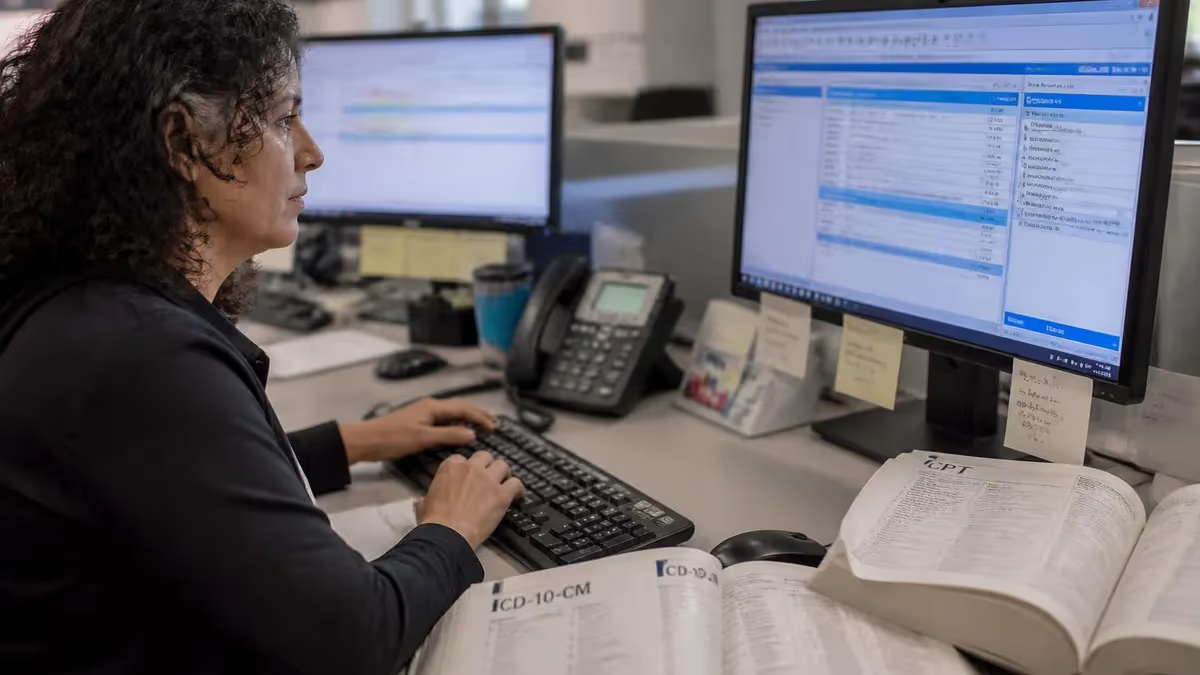
A certified professional coder who has just passed the AAPC CPC exam but lacks the required two years of professional coding experience earns the designation CPC-A — the "A" standing for "apprentice." This entry-level status is an official AAPC credential, not a lesser certification, and it signals to employers that the holder has demonstrated mastery of CPT, ICD-10-CM, and HCPCS Level II coding systems on a rigorous, proctored examination. Understanding what is a certified professional coder helps contextualize why the apprentice suffix matters and how quickly it can be removed once you accumulate real-world experience on the job.
The CPC-A designation was designed to solve a classic catch-22 in medical coding careers: employers frequently post certified professional coder jobs that require both a credential and prior experience, yet new coders cannot gain experience without being hired first. AAPC addressed this barrier by allowing freshly certified candidates to use the CPC-A title immediately after passing the exam, giving employers confidence in the coder's technical knowledge while acknowledging the learning curve that comes with clinical practice. Many hospitals, billing companies, and physician offices specifically recruit CPC-A holders as an affordable way to build their coding workforce pipeline.
From a practical standpoint, the CPC-A functions like a probationary professional license. You can legally use the credential on your resume, LinkedIn profile, and business cards the moment your exam results are confirmed. AAPC lists CPC-A holders in its member directory, which is searchable by employers nationwide. The designation carries the same code-of-ethics obligations as the full CPC, meaning apprentice coders must follow the same standards of accuracy, compliance, and confidentiality that govern senior coders — there is no ethical shortcut embedded in the "A" status.
Salary data for CPC-A holders typically falls slightly below the certified professional coder salary of fully credentialed peers, but the gap is smaller than many candidates expect. According to AAPC's annual salary surveys, CPC-A coders in outpatient and physician-office settings earn median wages in the range of $44,000 to $52,000 annually, while full CPCs in equivalent roles average roughly $54,000 to $68,000. The difference reflects the experience premium rather than a fundamental devaluation of the credential itself, and most apprentice coders see their compensation jump within 12 to 18 months as they complete the experience requirement and upgrade their status.
The pathway to removing the "-A" suffix is straightforward but requires intentional documentation. AAPC requires CPC-A holders to accumulate two years of professional coding experience, defined broadly enough to include employment in physician offices, hospitals, insurance companies, consulting firms, and remote coding positions. You must then submit a verification form signed by a supervisor or employer confirming the nature and duration of your coding work. Once AAPC processes the submission and verifies your AAPC membership is current, the apprentice designation is removed and you become a full CPC — no additional exam required.
For candidates exploring certified professional medical coder jobs remote since yesterday — a phrase that reflects how rapidly remote coding roles turn over on job boards — the CPC-A is increasingly accepted by remote employers. Telehealth expansion and the normalization of work-from-home arrangements in healthcare administration have created hundreds of remote-friendly roles specifically targeting CPC-A holders who can code from home under supervisory oversight. This shift has made the apprentice period far more accessible, allowing new coders to accumulate experience without relocating to a major metro area or accepting a long commute.
In summary, the CPC-A is not a consolation prize — it is a legitimate, recognized credential that opens real doors in medical coding careers. It proves you passed one of the most respected coding examinations in the United States, commits you to ongoing professional development through AAPC membership, and provides a clear, time-bound path to the full CPC designation. Whether you are just starting your studies or have recently received your exam results, understanding what the CPC-A means positions you to market yourself confidently and strategically from day one of your coding career.
CPC-A Credential by the Numbers

How the CPC-A Credential Works
The CPC-A credential is awarded automatically after passing the AAPC CPC examination. There is no separate apprentice test — you sit the same rigorous exam as candidates pursuing the full CPC, covering CPT, ICD-10-CM, HCPCS, anatomy, and medical terminology.
Maintaining CPC-A status requires an active AAPC membership, renewed annually. Membership provides access to the member directory, continuing education resources, coding forums, and employer connections — all critical tools during the apprentice phase of your career.
CPC-A holders must earn 36 continuing education units every two years (AAPC's cycle) to keep their credential active. CEUs can be earned through webinars, local chapter meetings, approved online courses, and AAPC's national conferences — many are free to members.
Once you complete two years of professional coding experience, submit AAPC's experience verification form with employer sign-off. No additional exam is needed. AAPC processes the update and removes the "-A" suffix, granting you the full Certified Professional Coder designation.
The day-to-day duties of a CPC-A are virtually identical to those of a full certified professional coder (CPC), because the apprentice designation reflects experience level rather than a restricted scope of practice. In a typical outpatient physician office, a CPC-A reviews clinical documentation — including physician notes, operative reports, laboratory orders, and discharge summaries — and translates that documentation into standardized alphanumeric codes used for billing and reimbursement. Accuracy is paramount: a single transposed digit in an ICD-10-CM code can trigger a claim denial or, worse, a compliance audit.
Medical coding under the CPC framework requires deep familiarity with the Current Procedural Terminology (CPT) code set published annually by the American Medical Association. CPC-A holders are expected to select the correct procedural codes for evaluation and management visits, surgical procedures, radiology services, and laboratory tests, applying any necessary modifiers that alter how payers interpret and reimburse those services. Modifier usage is one of the most nuanced aspects of the job, and it is tested heavily on the certified professional coder CPC examination precisely because errors here lead directly to revenue loss or fraud risk for the practice.
Beyond selecting codes, CPC-A professionals contribute to the charge entry workflow by reviewing superbills or encounter forms generated by clinical staff, reconciling discrepancies between documented services and billed codes, and flagging cases where documentation is insufficient to support the codes that providers have requested. This documentation integrity function is increasingly important as payers conduct more sophisticated post-payment audits using AI-driven tools that flag statistical outliers in a practice's billing patterns. A coder who catches a documentation gap before submission saves the practice from expensive claw-backs and compliance headaches downstream.
In many practices, CPC-A holders also serve as informal educators for clinical staff. When a physician consistently documents a procedure in a way that does not support the highest appropriate code level, the coder must communicate — diplomatically — that additional specificity in the chart note would allow proper code assignment.
This requires not just coding knowledge but also strong interpersonal skills, since physicians sometimes interpret coding feedback as a challenge to their clinical judgment rather than a revenue-cycle improvement opportunity. Learning to navigate these conversations is a key part of the professional maturation that happens during the CPC-A apprentice period.
Remote CPC-A positions — which now represent a significant share of available certified professional coder jobs — require coders to maintain the same productivity and accuracy standards as in-office peers, but with less real-time supervision. Most remote employers use coding workflow software such as 3M, Optum360, or Nuance that tracks coder productivity metrics including average codes per hour, error rate on audited claims, and claim denial rates attributable to coding errors. CPC-A holders working remotely should expect regular quality reviews during the first six months, with audit frequencies gradually decreasing as the employer gains confidence in their accuracy.
Specialty-specific coding is another dimension of the CPC-A role that develops rapidly with on-the-job experience. A CPC-A placed in an orthopedic surgery practice will quickly become fluent in musculoskeletal CPT codes and fracture care guidelines, while one assigned to a cardiology billing department will develop expertise in cardiac catheterization codes and cardiovascular surgery procedures. This specialization is valuable: coders who develop recognized expertise in a high-complexity specialty can command significantly higher salaries and may pursue additional AAPC specialty credentials such as the Certified Professional Coder — Payer (CPC-P) or specialty-specific certificates in cardiovascular coding, oncology, or pediatric coding.
To explore the full credential pathway and understand how the apprentice period fits into a long-term career arc, review what is a cpc a in the context of AAPC's broader certification ecosystem, which includes not just the CPC but also the CIC for inpatient coding, the COC for outpatient facility coding, and a growing suite of specialty certificates that allow credentialed coders to distinguish themselves in competitive job markets.
Certified Professional Coder Salary, Jobs & Remote Work
The certified professional coder salary for CPC-A holders typically ranges from $42,000 to $55,000 per year depending on geographic location, practice setting, and specialty focus. Entry-level remote roles often start at $18–$22 per hour, while hospital-based apprentice positions in high-cost metro areas can exceed $28 per hour. Annual salary surveys from AAPC consistently show that each year of verified experience adds roughly $2,000–$4,000 to median compensation, making the two-year apprentice phase a financially meaningful investment.
After removing the "-A" designation and reaching full CPC status, median earnings jump to the $54,000–$68,000 range nationally, with senior coders in high-complexity specialties such as cardiovascular surgery or neurology often exceeding $75,000. Coders who add a second AAPC specialty credential, take on auditing responsibilities, or move into coding management roles can see total compensation climb well above $80,000. Tracking current salary benchmarks on AAPC's annual survey and LinkedIn Salary Insights helps CPC-A holders negotiate competitive offers at each career milestone.

Pros and Cons of Starting with the CPC-A Credential
- +Immediate, recognized credential upon passing the CPC exam — no waiting period
- +Opens doors to entry-level certified professional coder jobs at hospitals, offices, and billing firms
- +Same AAPC member benefits, job board access, and directory listing as full CPC holders
- +Remote-friendly: hundreds of work-from-home CPC-A positions posted weekly nationwide
- +Clear, time-bound upgrade path — no second exam required to remove the -A suffix
- +Earns competitive starting salary ($42K–$55K) while building toward full CPC pay scale
- −Some employers filter job postings to "CPC only," requiring applicants to address the -A status in cover letters
- −Slightly lower starting salary than full CPCs in equivalent roles during the two-year apprentice period
- −Requires active AAPC membership maintenance (annual fee) to keep the credential valid
- −Must earn 36 CEUs every two years — requires intentional time and financial investment
- −Limited negotiating leverage on salary until two years of experience documentation is submitted
- −Some payers and credentialing bodies may treat CPC-A differently during provider enrollment processes
Steps to Remove the CPC-A Designation
- ✓Confirm your AAPC membership is active and in good standing before submitting any experience documentation.
- ✓Keep a detailed log of all coding work from your first day of employment, noting dates, employer name, and types of codes assigned.
- ✓Accumulate a minimum of two years (24 months) of professional coding experience in any AAPC-recognized setting.
- ✓Download AAPC's official Experience Verification Form from the member portal — do not use outdated versions.
- ✓Ask your direct supervisor or employer HR representative to complete and sign the verification form.
- ✓Submit the completed form to AAPC via the member portal and retain a copy of the submission confirmation email.
- ✓Confirm that your CEU requirement is fully met for the current two-year cycle before submitting experience documentation.
- ✓Allow two to four weeks for AAPC to process your submission and update your credential status in their system.
- ✓Update your resume, LinkedIn profile, and AAPC member directory listing to reflect your new full CPC designation.
- ✓Notify your current employer's HR department so your personnel file and any credentialing rosters are updated accordingly.
You Don't Need a Second Exam to Upgrade
One of the most common misconceptions among CPC-A holders is that they must sit for another examination to remove the apprentice designation. AAPC does not require any additional testing — only verified work experience and current membership. Submitting your experience documentation as soon as you hit the two-year mark is the single fastest action you can take to boost your earning potential and eliminate employer hesitation about your credential status.
Choosing the right certified professional coder online course or certified professional coder program is the most consequential decision you will make before sitting the CPC examination. The quality of your preparation directly determines your first-attempt pass rate, and AAPC's published statistics suggest that candidates who complete a structured, comprehensive course outperform self-studiers by a meaningful margin. AAPC itself offers the most widely recognized preparatory curriculum through its Online Medical Coding Training (OMCT) program, which covers all 17 body system chapters, medical terminology, anatomy, reimbursement concepts, and exam strategy over a structured 12-to-16-month timeline.
In addition to AAPC's proprietary program, several accredited community colleges and vocational schools offer certified professional coder certification preparation courses that qualify students for federal financial aid. These programs typically run 9 to 24 months and combine medical coding curriculum with healthcare administration fundamentals, giving graduates a broader skill set that appeals to employers seeking coders who can also support billing department operations. The American Health Information Management Association (AHIMA) also offers a Registered Health Information Technician (RHIT) credential pathway that overlaps significantly with CPC content, though AAPC's CPC remains the dominant credential in physician office and outpatient settings.
Self-study candidates using AAPC's study guide, the Official AAPC Practitioner Bundle (which includes current-year CPT, ICD-10-CM, and HCPCS manuals), and supplementary practice exams can absolutely succeed on the CPC exam, but they must be disciplined about covering all content domains.
The exam tests 17 medical specialty sections plus medical terminology, anatomy, compliance, reimbursement, and coding guidelines — a breadth that rewards systematic study over sporadic review. Using timed practice exams in the final four weeks before your test date is especially important, since many candidates find that time management on the actual five-hour, 100-question exam is as challenging as the content itself.
Online coding bootcamps and accelerated programs have proliferated in recent years, offering CPC preparation in compressed timelines of eight to twelve weeks. While these programs can work for candidates with prior healthcare administration experience, they are generally not recommended for complete beginners to medical coding. The conceptual density of the CPT guidelines, the nuances of ICD-10-CM coding conventions, and the specificity required in anatomy knowledge all benefit from slower, more deliberate exposure. Rushing through the material increases the risk of exam failure, which in turn delays credential attainment and career entry.
Continuing education requirements after credentialing are also an important planning consideration. Once you hold the CPC-A, AAPC requires 36 CEUs over a two-year reporting period. These units must be earned through AAPC-approved providers, and at least one CEU must address healthcare compliance topics. AAPC's own webinar library, local chapter meetings, and national symposium sessions are the most convenient CEU sources for most members. Some employers pay for CEU-eligible training as a benefit, but CPC-A holders who work for smaller practices or as independent contractors should budget $200 to $500 annually for continuing education costs.
For candidates interested in specialty coding, AAPC offers a growing catalog of specialty-specific certificates that can be pursued after earning the CPC or CPC-A. These include the Certified Interventional Radiology Cardiovascular Coder (CIRCC), Certified Oncology Coder (COC), Certified Pediatric Coder (CPC-P), and more than a dozen others. Each specialty certificate requires passing a separate examination and demonstrates focused expertise that justifies higher compensation in specialty practices. Building a specialty credential portfolio during or shortly after the CPC-A period is a strategic career move that accelerates salary growth and professional recognition.
Workplace mentorship is perhaps the most undervalued resource for CPC-A holders during the apprentice period. If your employer assigns you a senior coder or coding manager as a mentor, invest heavily in that relationship — ask to review their work on complex cases, request feedback on your own coding decisions, and participate in internal coding audits whenever possible. The practical judgment developed through mentored case review is difficult to replicate through coursework alone, and coders who actively seek out these learning opportunities consistently outperform peers who treat the apprentice period as merely a waiting game before credential upgrade.

If your AAPC membership lapses at any point during the CPC-A period, your credential is suspended and you can no longer legally use the CPC-A designation. This is particularly important for candidates who transition between jobs and might overlook membership renewal during a busy period. Set a calendar reminder two months before your annual renewal date and keep a personal copy of your membership confirmation to present to employers on request.
Transitioning from a CPC-A to a full certified professional coder (cpc) is a milestone that requires both logistical action and strategic career positioning. The most successful coders treat the two-year apprentice window not as a holding pattern but as an accelerated learning opportunity — deliberately seeking out complex coding scenarios, volunteering for internal auditing projects, and building relationships with coding supervisors who can serve as future professional references. This proactive mindset consistently translates into stronger salary negotiations and faster career advancement once the apprentice designation is removed.
Networking within AAPC's local chapter system is one of the most efficient ways to accelerate career development during the CPC-A period. Local chapters host monthly or quarterly meetings that feature guest speakers, case study presentations, and job referral networks. Many CPC-A holders have secured their first coding positions or subsequent promotions through chapter connections rather than public job boards, because chapter members often share unadvertised openings within their employer networks. Joining a chapter and attending consistently — even if meetings are held via webinar — is a low-cost, high-return investment in your professional community.
The certified professional coder cpc certification also carries weight in adjacent career paths beyond direct coding roles. Medical auditors, clinical documentation improvement (CDI) specialists, revenue cycle managers, and healthcare compliance officers all draw on CPC-level knowledge, and many employers prefer or require the CPC for these upstream and downstream roles. CPC-A holders who recognize this broader applicability can position themselves for internal transfers to these higher-paying roles by developing relevant complementary skills during the apprentice period, such as query writing for CDI, familiarity with audit methodology, or proficiency in revenue cycle analytics software.
When evaluating job offers as a CPC-A, pay close attention to whether the employer offers a structured coding quality program that includes regular audits and feedback. Employers who invest in coding quality programs typically produce better-trained coders and provide the documentation-rich environment you need to confidently verify your two years of experience. Conversely, employers who do not audit their coders regularly may expose you to bad coding habits that are difficult to unlearn and that could compromise your accuracy metrics when you move to a new employer after upgrading to full CPC status.
Benefits packages for CPC-A positions often include perks that compensate for entry-level salaries, including employer-paid AAPC membership, reimbursement for coding manuals, paid continuing education time, and in some cases assistance with the cost of specialty certification exams. When comparing offers, calculate the total compensation package rather than focusing solely on base salary. An employer who covers your $195 AAPC membership, $150 in annual CEU costs, and $400 in coding manual updates is effectively offering $745 more per year in non-wage compensation than a slightly higher-paying employer who requires you to cover those costs independently.
Geographic flexibility is an increasingly important advantage for CPC-A job seekers. Because the certification is nationally recognized and most physician-office coding software is cloud-based, a CPC-A in rural Kansas can compete for the same remote roles as a coder in downtown Chicago.
This geographic leveling of the playing field has been one of the most significant developments in medical coding labor markets since 2020, and it particularly benefits CPC-A holders who live in regions where local healthcare employer density is low. Embracing remote work from the outset of your coding career — and building the self-management and cybersecurity hygiene habits that remote employers require — positions you for maximum job market flexibility throughout your coding career.
For a comprehensive overview of the full certification pathway and how the CPC-A fits into the broader landscape of AAPC credentials, visit our complete guide on the certified professional coder certification process, which covers examination registration, study strategies, continuing education planning, and specialty credential options that extend well beyond the apprentice period and into the most advanced levels of professional medical coding practice.
Building a long-term coding career on the foundation of the CPC-A requires deliberate planning across three dimensions: technical skill development, credential portfolio expansion, and professional visibility. On the technical side, the single most valuable habit you can develop during the apprentice period is reading the full coding guidelines — not just the tabular list of codes — every time you encounter an unfamiliar procedure or diagnosis.
The CPT codebook's introductory notes, parenthetical instructions, and section guidelines contain essential information about bundling, sequencing, and modifier application that does not appear in any abbreviated code lookup tool. Coders who read the guidelines consistently make far fewer errors than those who rely on encoder software shortcuts.
Credential portfolio expansion typically begins with the full CPC upgrade but should not stop there. After removing the -A designation, consider pursuing one of AAPC's specialty certificates aligned with the practice setting where you have accumulated the most experience. Specialty certificates require a passing score on a separate, focused examination, but they signal to employers — and justify to salary negotiators — that your expertise in a given clinical area is above average. In competitive job markets, a CPC with a relevant specialty certificate often outcompetes a candidate with two additional years of generic experience but no specialty credential differentiation.
Professional visibility is the third pillar of career development that many new coders underinvest in. Updating your LinkedIn profile immediately upon earning the CPC-A, joining AAPC's online community, contributing answers to coding questions in professional forums, and requesting LinkedIn recommendations from supervisors who observed your work during the apprentice period all contribute to a professional brand that opens doors passively — meaning recruiters find you rather than you constantly having to apply cold.
As your career progresses, consider volunteering to present at AAPC local chapter meetings, contributing to coding-focused blog posts or newsletters, or pursuing AAPC instructor credentials that allow you to teach coding courses while maintaining your own skills at a high level.
The financial trajectory of a medical coding career anchored by the CPC credential is genuinely compelling when viewed over a ten-to-fifteen-year horizon. Entry-level CPC-A compensation in the $44,000–$52,000 range can grow to $65,000–$80,000 for a senior full CPC with specialty credentials and five or more years of focused experience.
Coders who transition into coding management, revenue cycle consulting, or compliance auditing roles can reach $90,000 to $120,000 or more, particularly in large health system environments or as independent contractors serving multiple physician clients. The two years you invest in the CPC-A apprentice period are among the most financially leveraged years of a healthcare administration career.
Healthcare coding is also a remarkably recession-resistant career path. Medical billing occurs regardless of economic conditions — as long as patients receive care, coders are needed to translate that care into billable claims. The Bureau of Labor Statistics projects steady growth in health information technologist roles (which include medical coders) through the next decade, driven by healthcare system expansion, aging demographics, and the increasing complexity of value-based care payment models that require sophisticated coding to capture quality metrics alongside traditional procedure-based billing. CPC-A holders entering the field today are positioned at the beginning of a long, stable career runway.
Maintaining currency with annual code set updates is a professional obligation that distinguishes serious coders from complacent ones. CPT codes are updated by the AMA each October for the following January implementation, ICD-10-CM is updated twice yearly, and HCPCS Level II codes change throughout the year as CMS adds, revises, or deletes codes tied to coverage determinations. Subscribing to AAPC's coding newsletter, attending at least one annual update webinar per code set, and updating your physical codebooks at the start of each new year are non-negotiable professional habits that protect both your accuracy metrics and your employer's revenue cycle integrity.
Finally, approach the CPC-A period with the understanding that you are not just accumulating experience for an AAPC form — you are building the professional identity and judgment that will define your coding career for decades. Every complex case you research carefully, every documentation discrepancy you flag proactively, and every coding guideline you master during these two years compounds into the expert intuition that separates outstanding certified professional coders from merely credentialed ones. The -A is temporary; the foundation you build during this phase is permanent.
CPC Questions and Answers

CPC Medical Meaning: What Certified Professional Coder Really Means

CPC Certification: Complete Guide to Becoming a Certified Professional Coder
CPC Practice Test 2026 — Free Questions

AAPC CPC: The Complete Certified Professional Coder Study Guide

CPC Certification Salary 2026: Complete Pay Guide for Certified Professional Coders
About the Author

Certified Internal Auditor & Compliance Certification Expert
University of Illinois Gies College of BusinessBrian Henderson is a Certified Internal Auditor, Certified Information Systems Auditor, and Certified Fraud Examiner with an MBA from the University of Illinois. He has 19 years of internal audit and regulatory compliance experience across financial services and healthcare industries, and coaches professionals through CIA, CISA, CFE, and SOX compliance certification programs.
Join the Discussion
Connect with other students preparing for this exam. Share tips, ask questions, and get advice from people who have been there.
View discussion (8 replies)