
CPC Exam Retake Policy: How Many Times Can You Take the CPC Exam? 2026 October
How many times can you take the CPC exam? 🎯 Learn AAPC retake rules, fees, wait times, and proven strategies to pass the certified professional coder exam.

If you are wondering how many times can you take the CPC exam, the short answer is that AAPC allows unlimited retake attempts — but each attempt requires paying a retake fee and following specific scheduling rules. The certified professional coder (cpc) exam is one of the most respected credentials in medical coding, and the AAPC's generous retake policy reflects their commitment to helping coders ultimately achieve the certified professional coder certification they have worked so hard to earn. Understanding the rules before you sit for the exam can save you time, money, and stress.
The certified professional coder credential, awarded by the American Academy of Professional Coders (AAPC), validates your ability to translate complex medical procedures, diagnoses, and services into standardized billing codes. Employers across hospitals, physician offices, insurance companies, and remote billing firms actively recruit credentialed coders, making the CPC one of the highest-return certifications in healthcare administration. Given the career stakes, many candidates invest months of study time — yet a significant percentage still need more than one attempt before passing.
According to AAPC data, the CPC exam has a first-time pass rate of approximately 50 to 54 percent, meaning roughly half of all test-takers do not pass on their first try. That statistic should not discourage you — it should simply set realistic expectations and motivate thorough preparation. The retake policy exists precisely because AAPC recognizes that one difficult exam day should not permanently block a dedicated coder from earning the certified professional coder cpc credential they deserve.
Before scheduling a retake, candidates must wait a minimum period and complete the retake application process through their AAPC member portal. The retake fee is substantially lower than the original exam fee, which is one piece of genuinely good news for candidates who did not pass the first time. AAPC members pay less than non-members for every exam attempt, so maintaining an active membership throughout your certification journey is a financially smart move that many candidates overlook until they are already facing a retake situation.
The certified professional coder program covers 17 content domains ranging from evaluation and management coding to surgical procedures, anesthesia, radiology, and compliance. Each domain is weighted differently on the exam, and understanding which domains carry the most questions is critical for targeted retake preparation. Many candidates who fail the first time do so because they underestimated the depth of surgical coding or the complexity of CPC CPT modifier rules, two areas that frequently trip up first-time test-takers.
This comprehensive guide covers everything you need to know about the certified professional coder (CPC) exam retake policy: the exact rules, fees, waiting periods, how to analyze your score report, how to build a smarter study plan, and how to set yourself up for success on your next attempt. Whether this is your second try or your fourth, a structured approach and the right practice resources will dramatically improve your chances of joining the ranks of credentialed certified professional medical coder jobs remote and on-site professionals who rely on this credential every day.
Throughout this article you will find actionable retake strategies, cost breakdowns, a study schedule framework, and answers to the most frequently asked questions about CPC retake logistics. By the time you finish reading, you will have a clear, confident plan for your next exam attempt — and a much better understanding of exactly what the AAPC's retake policy allows, requires, and recommends for candidates pursuing the certified professional coder certification.
CPC Exam Retake Policy by the Numbers

AAPC CPC Exam Retake Process: Step-by-Step
Receive Your Score Report
Wait the Minimum 45-Day Period
Submit Retake Application & Fee
Schedule at a Proctored Test Center or Online
Complete Targeted Study & Practice Tests
Sit for Your Retake and Pass
Understanding the full cost picture of a CPC retake is essential for budgeting your certification journey. AAPC members pay a retake fee that is significantly lower than the initial exam registration fee. As of current AAPC pricing schedules, members pay approximately $150 to $200 per retake attempt, compared to the full registration fee of around $399 for AAPC members or $499 for non-members. Keeping your annual AAPC membership current — which runs approximately $180 to $199 per year — pays for itself after just one retake attempt in reduced exam fees alone.
The retake fee structure rewards persistence and makes multiple attempts financially accessible for most candidates. Unlike some professional certification programs that charge full price for every attempt or cap the number of allowed retakes, the AAPC's unlimited retake policy with a reduced fee structure demonstrates genuine support for candidates who are committed to achieving the certified professional coder exam credential. This is particularly meaningful for candidates who may be studying while working full-time in entry-level medical billing roles.
Beyond the retake exam fee itself, candidates should budget for supplementary study materials if their initial preparation resources were insufficient. Investing $50 to $100 in a targeted practice question bank, a domain-specific study guide for surgical coding, or a CPC-focused online refresher course can make the difference between passing and failing a retake attempt. The certified professional coder salary premium — typically $10,000 to $20,000 more annually than uncredentialed coders — makes even a $300 total investment in retake fees and materials highly cost-effective.
Some employers will reimburse CPC exam fees, including retake fees, as part of professional development benefits. If you are currently employed at a hospital, physician group, or billing company, check with your human resources department before paying out of pocket. Many healthcare employers explicitly include CPC exam reimbursement in their tuition assistance or professional certification programs. Getting reimbursed for your retake fee eliminates the financial barrier entirely and lets you focus entirely on preparation rather than cost concerns.
Candidates enrolled in a certified professional coder online course or formal training program should also check whether their program includes any exam vouchers, retake fee credits, or pass guarantees. Some programs offer conditional retake support, meaning they will provide additional tutoring or study resources if you do not pass on your first attempt. These guarantees can be valuable, but read the fine print carefully — most require you to complete all coursework and attempt the exam within a specific timeframe to qualify for any retake support benefits.
It is also worth noting that AAPC occasionally offers promotional pricing on exam fees and retakes during member appreciation events or new year enrollment periods. Signing up for AAPC email newsletters and checking the member portal regularly can alert you to fee discounts that could reduce your retake cost by 10 to 20 percent. While you should not delay your retake simply to wait for a discount, if you are already in the middle of your study period and see a promotion announced, timing your application accordingly can result in meaningful savings over the course of multiple attempts.
Finally, remember that the cost of not retaking — remaining in an uncredentialed position — is far greater over a five-year career horizon than the cost of any number of retake attempts. Certified professional coder jobs command higher salaries, better benefits, and more career advancement opportunities than positions that do not require the credential. Every dollar invested in retake fees and preparation materials is a direct investment in a career trajectory that will return that investment many times over within the first year of working as a credentialed certified professional coder.
CPC Exam Retake Study Strategies by Domain
Surgical coding accounts for the largest portion of the CPC exam and is the domain where most retake candidates lost the most points. To master this area before your retake, work through CPT chapters 10000 through 69990 systematically, paying close attention to bundling rules, separate procedure designations, and add-on code relationships. Practice identifying the correct parent procedure before assigning modifiers, and drill Medicare's National Correct Coding Initiative (NCCI) edits to understand which code combinations are routinely bundled by payers.
When reviewing surgical coding for your retake, focus especially on integumentary, musculoskeletal, digestive, and urinary system chapters, as these appear most frequently on the CPC exam. Use real operative reports from coding textbooks or practice workbooks to simulate actual exam conditions. For each case, practice writing out your code selection rationale before checking the answer — this active recall approach builds deeper understanding than passive reading and significantly improves retention for exam-day performance.

Is Retaking the CPC Exam Worth It? Pros and Cons
- +Unlimited retake attempts allowed — no lifetime cap prevents you from passing eventually
- +Reduced retake fee (approximately $150–$200 for members) is far lower than original exam cost
- +Score report pinpoints exact domain weaknesses so you can study smarter, not harder
- +Certified professional coder salary premium ($10K–$20K/year) makes retake investment worthwhile
- +Each attempt builds familiarity with exam format, question style, and time management
- +Many employers reimburse retake fees as part of professional development benefits
- −45-day minimum wait period delays your credential and job search timeline
- −Each retake requires an additional fee investment of $150–$200 or more
- −Test anxiety may worsen after a failed attempt without deliberate mental preparation
- −Time spent re-studying delays entry into higher-paying certified professional coder jobs
- −Without analyzing score report carefully, retake preparation may repeat original mistakes
- −Online proctoring technical issues or scheduling delays can extend the waiting period further
Pros and Cons at a Glance
| Pros | Cons |
|---|---|
| Unlimited retake attempts allowed — no lifetime cap prevents you from passing eventually | Test anxiety may worsen after a failed attempt without deliberate mental preparation |
| Score report pinpoints exact domain weaknesses so you can study smarter, not harder | Time spent re-studying delays entry into higher-paying certified professional coder jobs |
| Each attempt builds familiarity with exam format, question style, and time management | Without analyzing score report carefully, retake preparation may repeat original mistakes |
| Many employers reimburse retake fees as part of professional development benefits | Online proctoring technical issues or scheduling delays can extend the waiting period further |
CPC Retake Preparation Checklist: 10 Steps Before You Sit Again
- ✓Request and thoroughly review your AAPC score report to identify every domain scoring below 70 percent.
- ✓Confirm your AAPC membership is active and renew if needed to qualify for the lower member retake fee.
- ✓Submit your retake application through the AAPC member portal after the 45-day waiting period has passed.
- ✓Update your CPT, ICD-10-CM, and HCPCS Level II code books to the current-year editions.
- ✓Re-tab and annotate your code books with color-coded flags for surgery, E&M, modifiers, and anesthesia sections.
- ✓Complete at least three full-length, timed practice exams (150 questions each) under real test conditions.
- ✓Drill a minimum of 50 targeted practice questions in each of your three weakest scoring domains.
- ✓Review the 2021 and later E&M documentation guidelines, especially MDM complexity tables and time-based rules.
- ✓Study NCCI edit logic for your weakest surgical chapters to avoid bundling errors on exam day.
- ✓Arrange a quiet, distraction-free environment or confirm your Prometric test center seat at least two weeks in advance.
Use Domain Scores to Build a Targeted Study Plan
AAPC's detailed score report breaks your performance into all 17 exam content domains. Candidates who spend 70 percent of their retake study time on domains where they scored below 65 percent — rather than reviewing content they already know — improve their total score by an average of 8 to 12 percentage points on the retake attempt, according to AAPC educator estimates.
Analyzing your CPC score report is the single most important step you can take after a failed attempt, and it deserves far more attention than most candidates give it. The AAPC report breaks your performance into individual content domains, showing you exactly how many questions you answered correctly in each area relative to the number asked. This granular breakdown transforms a demoralizing result into a precise study roadmap — one that tells you exactly where to invest your next eight to twelve weeks of preparation effort.
Start by sorting your domain scores from lowest to highest. Any domain where you scored below 65 percent should be classified as a critical weakness requiring intensive review. Domains scoring between 65 and 74 percent are borderline and deserve targeted practice. Domains above 75 percent are relative strengths — you can maintain these with lighter review while investing the bulk of your time in the critical and borderline categories. This triage approach ensures you are maximizing the impact of every study hour before your retake attempt.
Common patterns in failed CPC score reports include low scores in musculoskeletal surgery, cardiovascular coding, radiology, and pathology — all areas that require memorizing nuanced procedural distinctions and understanding anatomy at a level that surprises many first-time candidates. If your report shows weakness in cardiovascular coding, for example, you will want to spend dedicated sessions on cardiac catheterization codes, pacemaker insertion versus replacement coding, and the distinction between open and endovascular vascular procedures, all of which appear regularly on the exam.
Beyond domain scores, pay attention to the total number of questions you left unanswered or had to guess on. If time management was a significant factor in your performance, your retake preparation needs to incorporate timed practice sessions that simulate the actual exam pace of approximately one minute and fifteen seconds per question. Many candidates who know the material still fail because they spend seven minutes on a single complex surgical coding question and run out of time before reaching easier questions in the final sections of the exam.
The certified professional coder program requires mastery of all 17 domains to achieve the 70 percent passing threshold, but the weighting of those domains is not equal. Surgery questions typically account for 25 to 30 percent of the 100 scored questions, while topics like Evaluation and Management account for another 15 to 20 percent. Knowing the approximate weight of each domain helps you allocate study time proportionally — a domain worth 15 percent of your score deserves more preparation investment than a domain worth only 3 percent, even if both showed similar weaknesses in your score report.
If your score was very close to the passing threshold — say, 68 or 69 percent — your retake strategy should be different from someone who scored 55 percent. Near-misses often indicate that targeted improvement in just two or three domains will be sufficient to push you over the 70 percent threshold.
Far misses suggest broader preparation gaps that require a more comprehensive review of foundational coding principles, guideline application, and code book navigation skills. Be honest with yourself about which situation you are in — wishful thinking about preparation gaps is the most expensive mistake a retake candidate can make.
Many successful retake candidates also benefit from joining an AAPC local chapter or online study group between their first and second exam attempts. Explaining coding concepts to peers reinforces your own understanding and exposes you to question-solving approaches you might not have considered on your own. The certified professional coder jobs market is highly social — coders regularly consult with colleagues on complex cases — and the study group environment mimics the collaborative problem-solving that defines the real-world profession you are working to enter.
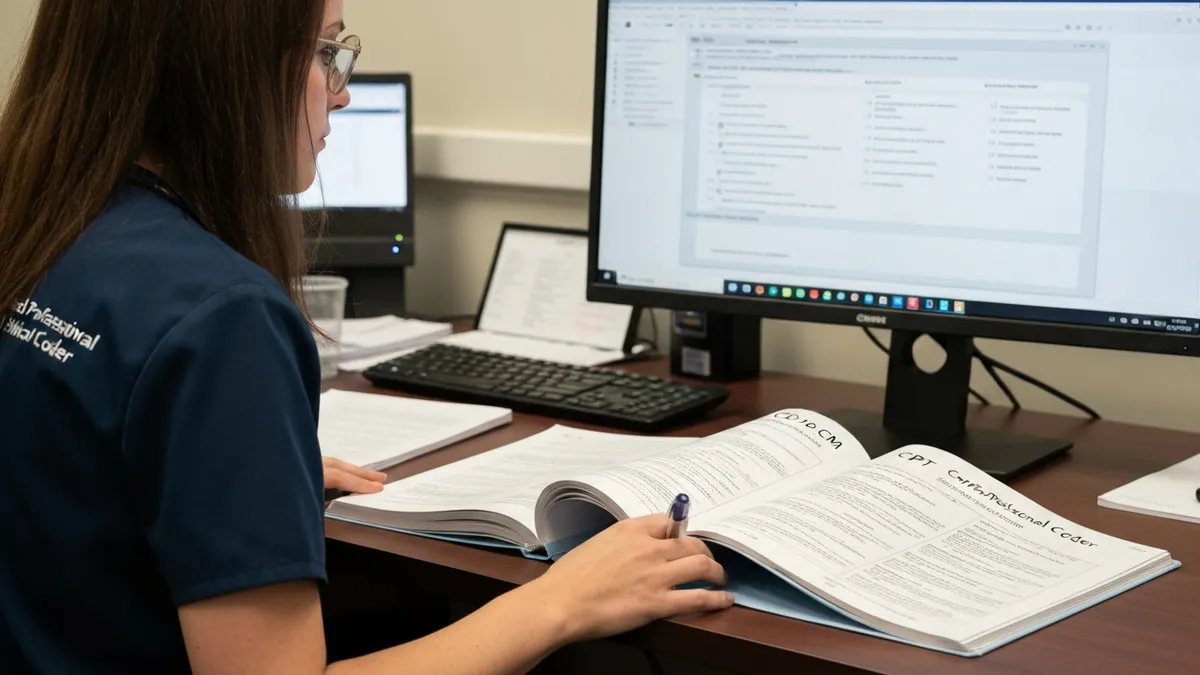
AAPC requires that you use the current-year editions of CPT, ICD-10-CM, and HCPCS Level II code books for every exam attempt. If your original exam was taken in a prior year, your existing code books may be out of date. Using an outdated code book on exam day is an immediate disadvantage — new codes, revised guidelines, and deleted codes from previous years will not appear correctly, potentially causing you to miss questions that candidates with current books answer correctly.
Building a structured, calendar-based study plan for your CPC retake is far more effective than studying whenever you find a free moment. Most successful retake candidates schedule eight to twelve weeks of focused preparation, dedicating a minimum of ten to fifteen hours per week to targeted coding study. That may sound like a heavy commitment if you are working full-time, but breaking it down into daily sessions of ninety minutes to two hours makes the schedule manageable — and the cpc exam retake policy gives you the time you need to do it right.
The first two weeks of your retake study plan should be devoted entirely to analysis and foundation-building. Review your score report, gather updated code books and study materials, and complete one baseline practice exam under timed conditions to establish where you stand today relative to your original attempt.
This baseline measurement gives you a clear starting point and helps you track improvement as you move through your structured study period. Many candidates are surprised to find they score noticeably higher on the baseline than they did on the actual exam — exam-day nerves and time pressure often suppress performance below true knowledge levels.
Weeks three through eight should focus on domain-specific deep dives, rotating through your three to five weakest domains in two-week cycles. For each domain, begin with a conceptual review of the relevant CPT or ICD-10-CM chapter guidelines, then work through 30 to 50 targeted practice questions, reviewing every incorrect answer in detail. The goal is not to memorize the correct answers to specific practice questions — the goal is to understand the coding principle underlying each question so you can apply that principle to novel scenarios on the actual exam.
During weeks nine and ten, shift from domain-specific drilling to full-length timed practice exams. Complete at least two or three complete 150-question practice exams, timing yourself strictly and simulating real testing conditions as closely as possible — including using only your tabbed code books and no other reference materials. After each practice exam, spend at least as much time reviewing your answers as you spent taking the test. The review phase is where learning actually happens, and skipping it is one of the most common mistakes retake candidates make under time pressure.
The final week before your retake should be a light review week focused on confidence-building rather than intensive new learning. Review your quick-reference summary cards for modifiers, E&M MDM tables, and anesthesia conversion factors. Do a few short practice sessions of 25 to 30 questions each, but avoid cramming entire new chapters two or three days before the exam. Your brain needs time to consolidate the information you have been absorbing over the preceding weeks, and last-minute intensive studying often introduces confusion rather than clarity.
Certified professional coder online course options can supplement your self-study retake preparation significantly. Structured video-based courses that cover the full CPC exam curriculum in domain-specific modules allow you to efficiently review topics where you have conceptual gaps. Look for courses that include integrated practice questions, written rationales for each answer, and instructor-led code book navigation demonstrations. The ability to pause and rewatch explanations of complex surgical coding scenarios is a significant advantage over traditional textbook study for visual learners.
Test-taking strategy improvements can also meaningfully boost your retake score independent of content knowledge gains. Practice reading each question stem carefully before looking at the answer choices, identifying the key coding scenario elements (procedure type, site, laterality, approach, complexity) before turning to your code book. Develop a consistent time management habit — if a question takes more than two minutes, mark it and move on, returning to marked questions only after completing the rest of the section. Consistently applying this discipline across 150 questions can recover five to ten points that anxiety-driven time management cost you on your first attempt.
Test anxiety is one of the most underestimated factors in CPC exam performance, and it deserves serious attention in your retake preparation. Candidates who have already experienced a failed attempt often carry heightened anxiety into their second attempt — the fear of failing again can trigger the same fight-or-flight response that impairs working memory and time management during the actual exam. Addressing test anxiety through deliberate practice is not optional for high-anxiety candidates; it is a core component of retake preparation that is just as important as content knowledge improvement.
The most effective strategy for reducing test anxiety is repeated exposure to realistic exam simulations. Each time you complete a full-length, strictly timed practice exam under real testing conditions, you reduce the novelty and perceived threat of the exam environment. Your nervous system habituates to the pressure of the experience, making it progressively less disruptive to your cognitive performance. Aim to complete at least three to five full simulations in the weeks before your retake, and treat each one as an opportunity to practice staying calm and focused rather than simply an exercise in answering questions correctly.
Physical preparation on exam day matters more than many candidates realize. Arriving at the test center or setting up your online proctoring environment well in advance of your start time eliminates a major source of last-minute stress. Bring multiple sharpened pencils if testing in person, confirm your identification documents are in order, and have a light snack before the exam to maintain blood sugar and focus during the three-hour testing period. Small logistical preparations that feel trivial in hindsight can have an outsized impact on your mental state when exam pressure is at its highest.
Code book organization is another practical area where retake candidates can gain a meaningful advantage over their first attempt. Well-tabbed, annotated code books dramatically reduce look-up time during the exam, which directly translates into more time available for reasoning through difficult coding scenarios. Use color-coded tabs to mark the beginning of each major CPT code section — surgery subsections by body system, anesthesia, radiology, pathology, and E&M — and add brief handwritten notes at frequently tested guidelines so you can find critical information in seconds rather than minutes.
Many experienced CPC instructors recommend creating a personalized quick-reference sheet for the topics you find most difficult to remember under pressure. Write out the anesthesia conversion formula, the E&M MDM complexity table, the global surgery period definitions (0-day, 10-day, 90-day), and your most frequently missed modifier application rules on a single index card that you review before walking into the exam. While you cannot bring this card into the actual testing environment, the act of writing and reviewing it repeatedly in the days before your retake builds the kind of automatic recall that exam-day performance demands.
Connecting with the AAPC community between exam attempts is one of the most overlooked resources available to retake candidates. The AAPC member forum and local chapter networks include thousands of credentialed coders who have been exactly where you are now and who are genuinely invested in helping fellow candidates succeed. Posting your specific domain weakness questions on the AAPC forum often generates detailed, practical answers from experienced coders within hours. This peer learning resource is included in your AAPC membership and costs nothing beyond the membership fee you are already paying.
Looking at the bigger picture can also help sustain the motivation needed for a rigorous retake preparation period. The certified professional coder credential opens doors to a wide range of career opportunities — from certified professional medical coder jobs remote positions at national billing companies to hospital-based coding auditor roles to revenue cycle management leadership tracks.
The CPC is widely recognized as the gold standard of medical coding credentials, and earning it after a retake demonstrates exactly the kind of persistence and dedication that makes you a valuable hire. Every successful coder who passed on their second, third, or fourth attempt has the same credential as those who passed on the first try — and no employer ever asks how many attempts it took.
Sample Certified Procedural Coder Practice Questions
Try these questions from our free Certified Procedural Coder practice tests. The correct answer and an explanation follow each question.
When calculating anesthesia time units for a 45-minute procedure (1 unit per 15 minutes), how many time units are reported?
- A. 3 units
- B. 2 units
- C. 4 units
- D. 5 units
Answer: A. 3 units
At one unit per 15 minutes, 45 minutes equals exactly 3 time units (45 ÷ 15 = 3).
The 'three-day payment window' rule requires that outpatient services provided within how many days before an inpatient admission must be bundled into the inpatient DRG payment?
- A. 1 day
- B. 3 days
- C. 7 days
- D. 14 days
Answer: B. 3 days
CMS's three-day payment window rule requires that most outpatient diagnostic services and related non-diagnostic services provided within 3 days prior to inpatient admission be included in the DRG payment.
In ICD-10-CM, how many characters can a valid code have?
- A. 1–5 characters
- B. 3–7 characters
- C. 4–8 characters
- D. 2–6 characters
Answer: B. 3–7 characters
ICD-10-CM codes range from 3 to 7 characters in length, always beginning with a letter.
What is the difference between a CPT code and a HCPCS code?
- A. CPT codes track prescriptions, and HCPCS are for diagnoses
- B. CPT codes cover procedures, and HCPCS cover supplies, equipment, and services
- C. CPT codes track patient behavior
- D. CPT codes track symptoms, and HCPCS track treatment outcomes
Answer: B. CPT codes cover procedures, and HCPCS cover supplies, equipment, and services
CPT (Current Procedural Terminology) codes are used to describe medical, surgical, and diagnostic services and procedures performed by physicians and other healthcare providers. In contrast, HCPCS (Healthcare Common Procedure Coding System) codes, specifically Level II, are used to report supplies, durable medical equipment, drugs, non-physician services, and other items not covered by CPT codes. Both systems are essential for accurate billing and reimbursement in healthcare.
CPC Questions and Answers

CPC Medical Meaning: What Certified Professional Coder Really Means

CPC Certification: Complete Guide to Becoming a Certified Professional Coder

What Is a CPC-A? The Entry-Level Certified Professional Coder Credential Explained

CPC Certification Online Courses: Your Complete Training Guide for Becoming a Certified Professional Coder

Online CPC Training: Your Complete Guide to Becoming a Certified Professional Coder
About the Author

Certified Internal Auditor & Compliance Certification Expert
University of Illinois Gies College of BusinessBrian Henderson is a Certified Internal Auditor, Certified Information Systems Auditor, and Certified Fraud Examiner with an MBA from the University of Illinois. He has 19 years of internal audit and regulatory compliance experience across financial services and healthcare industries, and coaches professionals through CIA, CISA, CFE, and SOX compliance certification programs.
Join the Discussion
Connect with other students preparing for this exam. Share tips, ask questions, and get advice from people who have been there.
View discussion (8 replies)