
CPC Exam Prep: Study Guide & Tips 2026 September
Free CPC practice test with questions and answer explanations. 🗨️ Prepare for the 2026 September exam with instant scoring.
CPC Exam Format and Open-Book Strategy
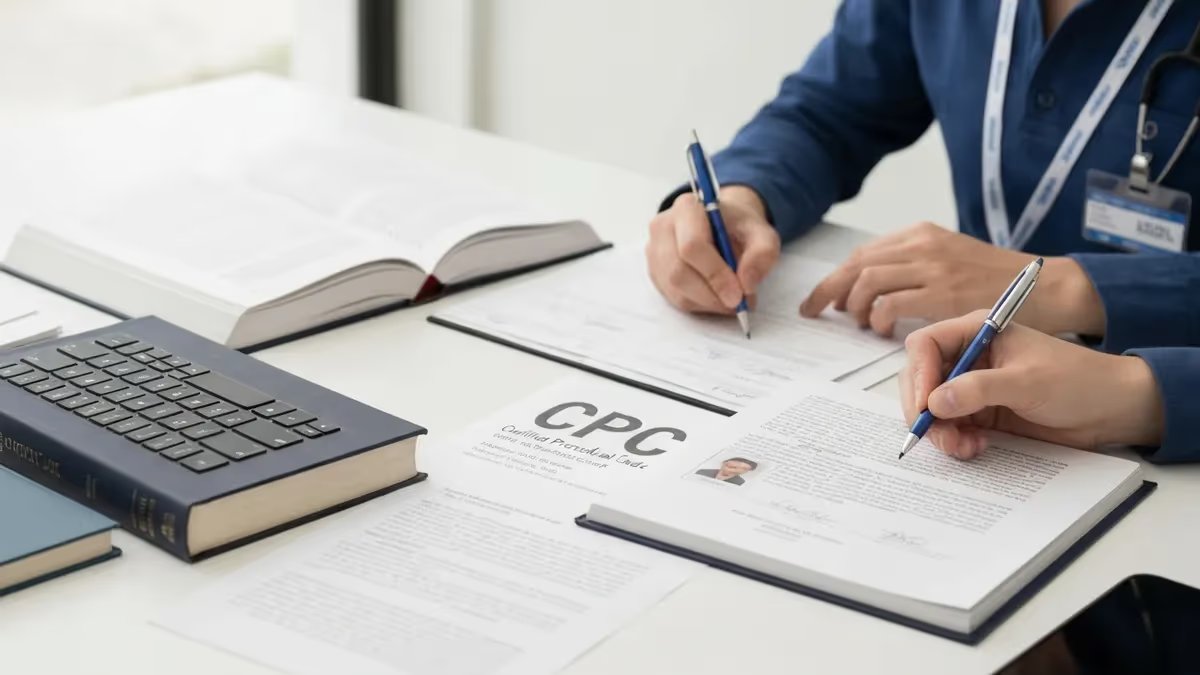
The CPC exam consists of exactly 100 multiple-choice questions administered over 5 hours and 40 minutes — giving you roughly 3.4 minutes per question. AAPC permits candidates to bring physical codebooks into the testing room, but browsing through unmarked manuals mid-exam is a major time drain. The candidates who score highest are the ones who pre-tabbed their books before exam day.
Effective tabbing means indexing every major chapter break in your CPT manual (E/M, Surgery subsections, Radiology, Pathology, Medicine), color-coding ICD-10-CM sections by body system, and flagging frequently referenced HCPCS modifiers. During the exam, treat your manuals as a confirmation tool, not a discovery tool — you should already know approximately where the code lives before you open the book.
Time management is the other hidden challenge. Allocate the first 15 minutes to skim all 100 questions and flag the ones you can answer in under 90 seconds. Work those first, then circle back to complex operative reports and multi-system E/M scenarios. Never leave a question blank — there is no penalty for guessing on the CPC.
CPC Exam Content Domains
AAPC organizes the CPC exam across 17 content areas. Surgery sections (Integumentary, Musculoskeletal, Respiratory, Cardiovascular, Digestive, Urinary, and others) account for the largest share of questions — approximately 45 to 50 combined. Evaluation and Management (E/M) coding typically represents 10 to 15 questions and is one of the highest-value areas to master because E/M rules changed significantly in 2026 and 2026.
The remaining domains include Anesthesia, Radiology, Pathology/Laboratory, Medicine, ICD-10-CM diagnosis coding, HCPCS Level II, medical terminology, anatomy, and compliance/regulatory topics. Candidates who spend the bulk of their prep on surgical coding and E/M guidelines — while staying current on official AAPC exam blueprints — consistently outperform those who study evenly across all sections. Related credentials like RHIT certification and CCMA certification share overlapping health information and clinical knowledge, making them complementary study paths for healthcare professionals broadening their credentials.

8-to-12-Week CPC Study Timeline
A structured study plan keeps you from cramming and ensures every content domain gets coverage. The framework below assumes 2 to 3 study hours per day. Compress or expand based on your schedule.
Weeks 1–2: Foundation. Review anatomy, medical terminology, and AAPC's Official Study Guide introduction. Tab and annotate all three codebooks. Take a diagnostic practice test — not to pass, but to identify your weakest domains.
Weeks 3–5: Core Coding. Work through E/M guidelines (2026 outpatient rules and inpatient MDC table), CPT Surgery sections in order of exam weight (Musculoskeletal → Cardiovascular → Digestive → Integumentary), and ICD-10-CM sequencing rules. Code at least 20 operative report scenarios per week.
Weeks 6–8: Specialty Areas. Cover Radiology, Pathology/Laboratory, Anesthesia (base units + time units), Medicine section, and HCPCS Level II modifier rules. Run weekly timed practice tests of 25 questions per domain and track your accuracy by section.
Weeks 9–10: Integration. Switch to full 100-question timed mocks. Review every wrong answer at the code level — look up the actual code in your tabbed manual so the book navigation becomes automatic. Target 75%+ before scheduling your exam date.
Weeks 11–12: Refinement. Focus exclusively on your bottom two or three domains. Re-do any practice questions you missed. Final week: no new material — review notes, rest well, and verify your exam-day logistics (testing center location, ID requirements, codebook policies).
Practice Test Strategies That Build Real Exam Readiness
Taking practice tests is not the same as taking them effectively. Passive repetition — answering questions without reviewing wrong answers at the source — provides false confidence without real learning.
The most effective practice test strategy has three phases. First, simulate real exam conditions: no open browser tabs, a physical timer, and only your pre-tabbed codebooks. Second, score your results section by section rather than as a single percentage — a candidate averaging 80% overall but only 55% on Cardiovascular Surgery needs targeted drilling, not general review. Third, for every wrong answer, write out the correct code path: locate the code in the index, verify in the tabular section, confirm the descriptor matches the operative scenario, and note the guideline that applies.
AAPC offers official practice exams through its member portal, and PracticeTestGeeks provides free CPC practice questions organized by content domain. Mixing both sources ensures you see varied question styles — some straightforward code lookups, some complex multi-code scenarios with sequencing rules, and some compliance and regulatory knowledge questions that require no codebook at all.
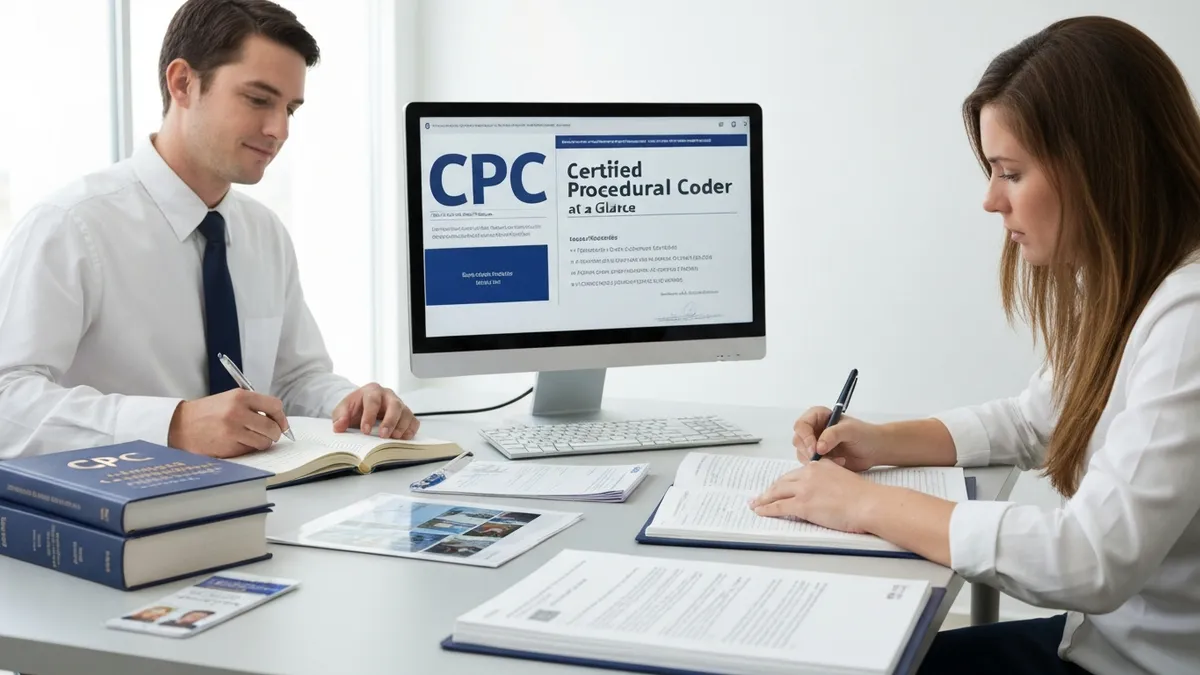
- ✓Confirm your exam appointment and location
- ✓Bring required identification documents
- ✓Arrive 30 minutes early to check in
- ✓Read each question carefully before answering
- ✓Flag difficult questions and return to them later
- ✓Manage your time — don't spend too long on one question
- ✓Review flagged questions before submitting
CPC Study Tips
What's the best study strategy for CPC?
Focus on weak areas first. Use practice tests to identify gaps, then study those topics intensively.
How far in advance should I start studying?
Most successful candidates begin 4-8 weeks before the exam. Create a structured study schedule.
Should I retake practice tests?
Yes! Take each practice test 2-3 times. Focus on understanding why answers are correct, not memorizing.
What should I do on exam day?
Arrive 30 min early, bring required ID, read questions carefully, flag difficult ones, and review before submitting.
- +Recognized by most US healthcare employers
- +Open-book exam — coding manual allowed
- +Higher pay vs uncertified coders (~15% premium)
- +Clear career pathway into medical billing and compliance
- −Exam is 5 hrs 40 min — demands strong stamina and time management
- −Must join AAPC to take exam ($199+ membership)
- −Requires frequent CEU credits for renewal
- −Manual tabbing and preparation takes significant time
CPC Exam Prep Questions and Answers
More Healthcare Certification Resources
Join the Discussion
Connect with other students preparing for this exam. Share tips, ask questions, and get advice from people who have been there.
View discussion (8 replies)