

CNIM Practice Test
Updated October 2026Facts verified Oct 31, 2026 against ABRET Neurodiagnostic Credentialing and Accreditation
CNIM Certification has four eligibility pathways: a Bachelor's degree plus 150 NIOM cases, an R.EEG T./R.EP T. credential plus 150 cases, a CAAHEP-accredited NIOM program plus 100 cases, or a non-CAAHEP-accredited NIOM program plus 150 cases. The Certification in Neurophysiologic Intraoperative Monitoring is recognized globally as a mark of excellence in patient safety. Practice with the free CNIM - Certification for Neurophysiological Intraoperative Monitoring practice test on PracticeTestGeeks (100+ questions with answer explanations).
The CNIM takes about 4 hours and costs $700[1][2] (ABRET Neurodiagnostic Credentialing and Accreditation, verified Oct 26, 2026).
- The CNIM exam is a computer-based multiple-choice test with a total testing time of four hours.[1]
- ABRET's Board sets the CNIM passing standard as the number of questions a minimally competent candidate must answer correctly and does not publish a fixed cut score.[1]
- The CNIM exam application fee is $700, and ABRET does not refund, extend or transfer it.[2]
- A CNIM candidate who fails three times within two years must wait six months and submit 15 more NIOM-related education hours before retesting.[1]
- The CNIM credential is awarded for five years.[3]
- The CNIM exam is given as a computer-based test at Prometric testing centers, Monday through Saturday except holidays.[1]
- CNIM candidates get an unofficial result by email before leaving the test center, and the official result is posted to their ABRET Certemy account about 4–6 weeks later.[1]
Numbers in brackets link to the official sources listed under Sources & last verified. Dates that have passed are removed automatically.
CNIM Exam at a Glance
| Item | Detail | Source · Verified |
|---|---|---|
| Time limit | 4 hours[1] | ABRET Neurodiagnostic Credentialing and Accreditation · Oct 26, 2026 |
| Passing score | Criterion-referenced standard set by the Board; no published number[1] | ABRET Neurodiagnostic Credentialing and Accreditation · Oct 26, 2026 |
| Exam fee | $700 application/exam fee (no refunds, extensions or transfers)[2] | ABRET Neurodiagnostic Credentialing and Accreditation · Oct 26, 2026 |
| Retake policy | One attempt per application; after 3 fails in 2 years, wait 6 months and add 15 NIOM education hours[1] | ABRET Neurodiagnostic Credentialing and Accreditation · Oct 26, 2026 |
| Validity | 5 years[3] | ABRET Neurodiagnostic Credentialing and Accreditation · Oct 26, 2026 |
| Delivery | Computer-based at Prometric test centers, Monday–Saturday[1] | ABRET Neurodiagnostic Credentialing and Accreditation · Oct 26, 2026 |
| Score release | Unofficial result by email at test end; official result in about 4–6 weeks[1] | ABRET Neurodiagnostic Credentialing and Accreditation · Oct 26, 2026 |
| Late registration deadline | Recertification grace period to Jan 31 for an extra $100 ($200 total)[4] | ABRET Neurodiagnostic Credentialing and Accreditation · Oct 26, 2026 |
| Registration deadline | No fixed deadline; reschedule free 30+ days ahead, $50 at 5–29 days, not allowed within 5 days[1] | ABRET Neurodiagnostic Credentialing and Accreditation · Oct 26, 2026 |
| Testing window | 3 months from "Eligible to Test" status[1] | ABRET Neurodiagnostic Credentialing and Accreditation · Oct 26, 2026 |
What changed for CNIM in 2026
- Oct 26, 2026: Retake policy changed to One attempt per application; after 3 fails in 2 years, wait 6 months and add 15 NIOM education hours (previously One attempt per application; after 3 fails in 2 years, wait 6 months and add 15 education hours).[1]
- Oct 26, 2026: Testing window changed to 3 months from "Eligible to Test" status (previously 3-month window from "Eligible to Test"; testing Monday–Saturday).[1]
- Oct 26, 2026: Delivery changed to Computer-based at Prometric test centers, Monday–Saturday (previously Computer-based at Prometric test centers).[1]
- Oct 26, 2026: Passing score changed to Criterion-referenced standard set by the Board; no published number (previously Criterion-referenced cut set by the Board; no published number).[1]
- Oct 26, 2026: Score release changed to Unofficial result by email at test end; official result in about 4–6 weeks (previously Unofficial result at the test center; official result in about 4–6 weeks).[1]
Free CNIM - Certification for Neurophysiological Intraoperative Monitoring Study Tools
Interactive CNIM - Certification for Neurophysiological Intraoperative Monitoring resources on PracticeTestGeeks, free to start:
- Free CNIM Neurosurgery Questions and Answers — 11 questions with instant scoring and answer explanations
- CNIM - Certification for Neurophysiological Intraoperative Monitoring flashcards — review key terms and concepts card by card
- CNIM - Certification for Neurophysiological Intraoperative Monitoring study guide — topic-by-topic overview of what the exam covers
- CNIM - Certification for Neurophysiological Intraoperative Monitoring cheat sheet — one-page printable summary for last-minute review
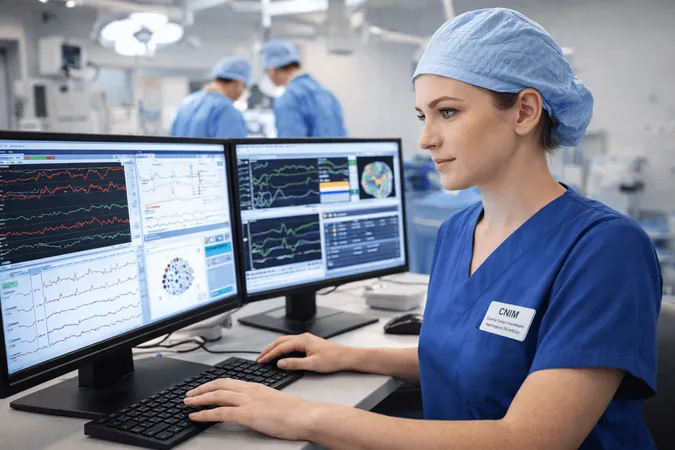
According to ABRET Neurodiagnostic Credentialing and Accreditation, “The Board set the passing standard as the number of test questions it determines to be necessary for candidates to answer correctly in order to be considered at least minimally competent.”[1]
CNIM content outline and where to practise each area
The content areas below are copied from the official CNIM content outline published by ABRET Neurodiagnostic Credentialing and Accreditation, with the share of the exam each area carries. The right-hand column shows which of our practice sets covers it.
| Official content area | Weight | Practice on this site |
|---|---|---|
| Intraoperative Phase[5] | 25% | CNIM Somatosensory Evoked Potentials (SSEP) Practise recognising baseline changes in evoked potentials during surgery and deciding what to check and report, using the SSEP, MEP, EEG, EMG and BAEP sets. |
| Post-Operative Phase[5] | — | Mixed practice tests above Review what happens after the case ends, including final documentation, handoff of findings and how monitoring data relate to the patient's outcome. |
| Preparation and Application of Fundamental Concepts[5] | 25% | CNIM Anesthesia Effects on Neurophysiologi... Practise how anesthetic agents, electrode placement, montages and stimulation settings shape the signals you record. |
| Provider Communication and Documentation[5] | — | CNIM Exam Fundamentals and Professional Pr... Practise who must be told about a change, how quickly, and what the record needs to show. |
| Safety and Ethics[5] | — | CNIM Exam Fundamentals and Professional Pr... Practise scope-of-practice limits, patient safety during stimulation and the obligations that apply when an alarm criterion is met. |
CNIM Practice Test Questions
Prepare for the CNIM - Certification for Neurophysiological Intraoperative Monitoring exam with our free practice test modules. Each quiz covers key topics to help you pass on your first try.
CNIM Anesthesia Effects on Neurophysiologi...
CNIM Exam Questions covering Anesthesia Effects on Neurophysiological Monitoring. Master CNIM Test concepts for certification prep.
CNIM Brainstem Auditory Evoked Potentials ...
Free CNIM Practice Test featuring Brainstem Auditory Evoked Potentials (BAEP). Improve your CNIM Exam score with mock test prep.
CNIM Exam Fundamentals and Professional Pr...
CNIM Mock Exam on CNIM Exam Fundamentals and Professional Practice. CNIM Study Guide questions to pass on your first try.
CNIM Electroencephalography (EEG) in the O...
CNIM Test Prep for Electroencephalography (EEG) in the Operating Room. Practice CNIM Quiz questions and boost your score.
CNIM Electromyography (EMG) and Nerve Moni...
CNIM Questions and Answers on Electromyography (EMG) and Nerve Monitoring. Free CNIM practice for exam readiness.
CNIM Motor Evoked Potentials (MEP)
CNIM Mock Test covering Motor Evoked Potentials (MEP). Online CNIM Test practice with instant feedback.
CNIM Somatosensory Evoked Potentials (SSEP)
Free CNIM Quiz on Somatosensory Evoked Potentials (SSEP). CNIM Exam prep questions with detailed explanations.
Worked examples: how to reason through CNIM questions
These are practice questions written for this site, not questions from the real exam. Each explanation shows why the right answer is right and why the others are wrong.
Example 1
Question: In intraoperative EEG, a bipolar montage differs from a referential montage in that it:
- Compares each electrode to a single distant reference
- Compares adjacent electrodes to one another in a chain
- Averages all electrodes into a single summary channel
- Uses only four electrodes placed over the temporal lobes
Answer: B. Compares adjacent electrodes to one another in a chain
Explanation:
Option B is correct. A bipolar montage records the voltage difference between neighbouring electrode pairs, linked in a chain across the scalp. Because adjacent electrodes share most of the background activity, that activity cancels, and a focal change stands out where the chain shows a reversal of polarity.
Option A describes a referential montage, where every electrode is compared with one common reference. Option C describes an averaged output, not a pairing of neighbours. Option D is wrong because a montage is a way of connecting electrodes for display. It does not fix where or how many electrodes are used.
Rule to remember: bipolar means neighbour against neighbour and helps localise focal activity. Referential means each electrode against a shared reference and shows the broader field.
Example 2
Question: In ethical IONM practice, when an alarm criterion is met, the CNIM practitioner MUST:
- Wait to see if the signal recovers before notifying anyone
- Immediately notify the responsible surgeon and document the communication
- Notify only the anesthesiologist
- Adjust monitoring parameters and continue without reporting
Answer: B. Immediately notify the responsible surgeon and document the communication
Explanation:
Option B is correct. When an alarm criterion is met, the practitioner notifies the responsible surgeon immediately and documents that the communication happened. The surgeon can change what they are doing only if they know, and the record shows that the information was passed on.
Option A is wrong because waiting to see whether the signal recovers delays a time-sensitive warning. Option C is wrong because the anesthesiologist is an important partner in troubleshooting, but they are not the person who decides how to adjust the surgery. Option D is wrong because changing parameters and continuing without reporting can hide a real change and breaks professional duty.
Rule to remember: report first, then troubleshoot alongside the team, and write down what you reported and when.
Example 3
Question: Why is total intravenous anesthesia (TIVA) preferred over volatile anesthetics for tcMEP monitoring?
- TIVA is cheaper
- Volatile agents cause dose-dependent suppression of tcMEP amplitudes
- TIVA eliminates all muscle artifact
- Volatile agents increase seizure risk from transcranial stimulation
Answer: B. Volatile agents cause dose-dependent suppression of tcMEP amplitudes
Explanation:
Option B is correct. Volatile anesthetic agents suppress transcranial motor evoked potential amplitudes in a dose-dependent way, so a signal that is present at one concentration can fade or vanish at another. That makes it hard to tell an anesthetic effect from true injury. Total intravenous anesthesia gives a steadier recording environment.
Option A is wrong because cost is not the reason for the choice. Option C is wrong because TIVA does not remove muscle artifact, and the stimulation itself still produces movement and other interference. Option D is wrong because the concern with volatile agents is suppression of the response, not an increased seizure risk from stimulation.
Rule to remember: for motor evoked potentials, keep the anesthetic as stable as possible and avoid agents that depress the corticospinal pathway.
How to use these practice tests
Start with the ABRET handbook and content outline so you know which areas the exam draws from. Then take the exam fundamentals and professional practice set cold, without notes, and note which topics you missed. That result tells you where to spend your time, not how you will score on test day.
Work through the modality sets one at a time: SSEP, MEP, BAEP, EEG and EMG and nerve monitoring. After each set, read every explanation, including those for questions you got right, and write one line on the rule behind each miss. For each modality, be able to explain in your own words what is recorded, what stimulates it, which anesthetic agents affect it and what change should be reported.
Next, do the anesthesia effects set and the neurosurgery and vascular surgery sets, which tie the modalities to real cases. Return to your missed-question notes and retry those questions after a gap, not the same day. In the final days, review alarm criteria, communication and documentation duties, and the logistics of your appointment, including the rescheduling cutoffs. Treat our questions as practice for reasoning. They are not real exam questions, so do not try to memorise them.
CNIM Flashcards
Quick review for the Certification in Neurophysiologic Intraoperative Monitoring
👂What do BAEPs monitor?
Brainstem Auditory Evoked Potentials (BAEPs) monitor the auditory nerve and brainstem function, often used in CPA tumor surgeries.
REVIEW CNIM QUESTIONS📉What constitutes a significant change in SSEPs?
A decrease in amplitude of 50% or more and/or an increase in latency of 10% or more is considered significant.
TRY CNIM MOCK EXAM💉Which anesthesia agents affect MEPs the most?
Inhalational agents (halogenated gases) and neuromuscular blocking agents significantly suppress Motor Evoked Potentials.
ACCESS CNIM STUDY GUIDE📊What is the Nyquist frequency?
The minimum sampling rate required to avoid aliasing, which must be at least twice the highest frequency component of the signal.
PRACTICE CNIM TEST NOWCNIM Exam Study Guide
Use this CNIM study guide to navigate the key aspects of the certification process. From understanding the ABRET CNIM requirements to mastering exam content, this resource covers essential CNIM prep topics.
- Topics: Stimulation, recording, interpretation
- Questions: ~60 items
Considering the high CNIM salary, the certification cost is typically recovered within the first few months of employment.

CNIM Test Day Checklist
- ✓Valid Government ID
- ✓Admission Ticket/Email
- ✓Arrive 30 mins early
- ✓Leave electronics in car/locker
- ✓Review exam center rules
- ✓Comfortable clothing (layers)
- ✓Hydrate before (no water allowed)
- ✓Positive attitude!
Start CNIM Prep
Get instant access to our complete CNIM study materials and practice questions.
Keep track of your CEUs annually to ensure a smooth CNIM renewal process.
- +Validates your knowledge and skills objectively
- +Increases job market competitiveness
- +Provides structured learning goals
- +Networking opportunities with other certified professionals
- −Study materials can be expensive
- −Exam anxiety can affect performance
- −Requires dedicated preparation time
- −Retake fees apply if you don't pass
Pros and Cons at a Glance
| Pros | Cons |
|---|---|
| Validates your knowledge and skills objectively | Study materials can be expensive |
| Increases job market competitiveness | Exam anxiety can affect performance |
| Provides structured learning goals | Requires dedicated preparation time |
| Networking opportunities with other certified professionals | Retake fees apply if you don't pass |
Sample CNIM - Certification for Neurophysiological Intraoperative Monitoring Practice Questions
Try these questions from our free CNIM - Certification for Neurophysiological Intraoperative Monitoring practice tests. The correct answer and an explanation follow each question.
Which documentation is a critical responsibility of the CNIM practitioner during an intraoperative case?
- A. Surgical instrument counts
- B. Detailed IONM report including baselines, changes, alarms, and communications with the surgical team
- C. Patient billing codes
- D. Anesthesia drug records
Answer: B. Detailed IONM report including baselines, changes, alarms, and communications with the surgical team
The CNIM practitioner is responsible for a comprehensive IONM report documenting baseline waveforms, all significant changes, alarm criteria met, surgeon notifications, and clinical outcomes.
What is the typical stimulus repetition rate used for intraoperative BAEP recording?
- A. 1–5 Hz
- B. 10–20 Hz
- C. 50–100 Hz
- D. 200–500 Hz
Answer: B. 10–20 Hz
BAEP stimuli are typically delivered at 10–20 Hz, balancing the need for rapid averaging with avoiding response habituation or overlapping echoes.
Dexmedetomidine's effect on intraoperative SSEP and MEP monitoring is best described as:
- A. Profound suppression requiring cessation before monitoring
- B. Mild to moderate amplitude reduction with relative preservation at typical clinical doses
- C. Complete abolition of cortical potentials
- D. No measurable effect on any evoked potential
Answer: B. Mild to moderate amplitude reduction with relative preservation at typical clinical doses
Dexmedetomidine causes mild to moderate, dose-dependent reductions in SSEP and MEP amplitudes at typical clinical infusion rates but is generally compatible with intraoperative monitoring.
Mean arterial pressure (MAP) below what threshold is considered physiologically significant for intraoperative SSEP monitoring?
- A. Below 100 mmHg
- B. Below 80 mmHg
- C. Below 60 mmHg
- D. Below 40 mmHg
Answer: C. Below 60 mmHg
MAP below 60 mmHg is generally considered the threshold below which cerebral and spinal cord perfusion may be compromised, causing ischemia-related SSEP amplitude decreases.
Take the full CNIM - Certification for Neurophysiological Intraoperative Monitoring practice test
CNIM Questions and Answers
Sources & last verified
- ABRET Neurodiagnostic Credentialing and Accreditation — time limit, passing score, retake policy, delivery (official source). “The Certification Examination in Neurophysiologic Intraoperative Monitoring is a computer based examination composed of multiple-choice, objective questions with a total testing time of four (4)…” Verified Oct 26, 2026.
- ABRET Neurodiagnostic Credentialing and Accreditation — exam fee (official source). “CNIM - $700” Verified Oct 26, 2026.
- ABRET Neurodiagnostic Credentialing and Accreditation — validity (official source). “The CNIM credential is awarded for five years.” Verified Oct 26, 2026 · source checked Oct 21, 2026.
- ABRET Neurodiagnostic Credentialing and Accreditation — late registration deadline (official source). “All credentials expire on December 31st of your expiration year. There is a one (1) month grace period until January 31st for an additional $100…” Verified Oct 26, 2026 · source checked Oct 16, 2026.
- ABRET Neurodiagnostic Credentialing and Accreditation — other (official source). “intraoperative phase 25%” Verified Nov 1, 2026.
How we verify: editorial & fact-checking policy. Report an error: contact us.
How this page was made: written with AI tools and published by Nathan Beja, founder of Practice Test Geeks, who is responsible for its content. Exam facts are checked against the official sources listed below. Not reviewed by a subject-matter expert. Editorial policy
Sources & references
Exam facts on this page (fees, format, dates, passing scores) are checked against these official sources; the date is our last check. Editorial policy
- abret.org — Late registration, score validity, test delivery, passing score, registration deadline, retake policy, score release, test dates, time limit, fees · verified Nov 2026