
CNG Fueling Stations: How to Find, Use, and Pay Less in 2026 October
CNG fueling stations guide: 💯 1,500 U.S. locations, fast-fill vs time-fill, prices per GGE, locator apps, step-by-step how to refuel.

CNG fueling stations are the public and private dispensing sites that let compressed-natural-gas vehicles refill the high-pressure tanks they run on. As of 2024, the U.S. Department of Energy's Alternative Fuels Data Center counts roughly 1,500 public CNG fueling stations spread across the country, with another several hundred private fleet depots filling buses, refuse trucks, and long-haul tractors. If you drive a CNG sedan, pickup, or Class 8 truck, knowing where these stations sit and how to use them turns natural gas from an interesting idea into a daily routine.
The biggest reason CNG infrastructure keeps growing is simple economics. A gallon of gasoline in early 2026 averages around $3.50 to $5.00 nationally, while CNG sells for roughly $1.85 to $3.50 per gasoline gallon equivalent, depending on the state and the type of station. For a refuse truck burning 14,000 gallons a year, that gap is real money — often $25,000 to $35,000 saved annually per vehicle. Multiply that across a fleet of 50 trucks and you can see why municipal fleets, transit agencies, and waste haulers built out the first wave of CNG sites.
Stations come in two flavors that operate on completely different timelines. Fast-fill stations behave like a normal gasoline pump: pull up, swipe a card, connect a nozzle, and you are full in 5 to 10 minutes. Time-fill stations, on the other hand, trickle gas into the tank over 6 to 8 hours and are designed for fleets that park overnight at a depot. Both deliver the same finished product, but they serve different operational needs and cost very different amounts to build.
Understanding the layout of the national network helps before you plan a route. California, Texas, Oklahoma, New York, and Utah host the highest concentrations of public CNG fueling stations. Clean Energy Fuels alone operates about 580 stations under its own brand, making it the largest single network. Add the Trillium (TruStar Energy) sites, Pilot Flying J's CNG locations, Love's Travel Stops with CNG islands, Questar's Utah-and-Colorado footprint, and the regional independents, and you get a usable national grid for heavy-duty trucking — although light-duty drivers still need to plan carefully outside major metros.
The dispensing experience is straightforward once you have done it once or twice. Modern dispensers default to either 3,000 psi or 3,600 psi (P30 or P36), and the nozzle locks to your fill receptacle with a positive engagement before flow begins. You press a start button, the unit pressurizes, gas flows until the tank reaches target pressure or temperature compensation kicks in, and the dispenser shuts off automatically. There is no slow-roll trickle at the end like with gasoline — when it stops, you are done.
Locator tools have matured significantly since the early CNG days. The AFDC alt fuel station locator at afdc.energy.gov/stations is the authoritative database and updates monthly with new openings and closures. The Clean Energy Fuels app routes you between its stations with real-time pressure and price data, NGV America publishes its own mobile-friendly directory, and GasBuddy added alternative-fuel filters that include CNG. For long-haul planners, the AFDC API even lets dispatch software pull station coordinates straight into routing engines.
Vehicle compatibility used to be the limiting factor — and to a degree, it still is for passenger cars. Heavy-duty trucks from Mack, Peterbilt, Freightliner, and Kenworth offer factory CNG and LNG options. Refuse trucks built by Heil and McNeilus on natural-gas chassis dominate the waste industry. Transit buses across hundreds of U.S. cities run CNG. Light-duty options are scarcer: the Honda Civic GX (discontinued but still on roads), Ford E-450 Bi-Fuel transit cutaways, and a small number of bi-fuel pickups from cng vehicles manufacturers cover most of the remaining catalog.
CNG dispensers price the fuel in gasoline gallon equivalents, or GGE. One GGE contains the same energy as one gallon of gasoline — about 5.66 pounds of natural gas at standard conditions. When you see $2.49 per GGE on the screen, you are paying for an energy unit that will move your vehicle roughly the same distance as one gallon of regular unleaded. Diesel gallon equivalents (DGE) appear on some heavy-duty dispensers and equal 6.38 pounds of natural gas.
Fast-fill stations are the most visible and the most expensive piece of CNG infrastructure. A typical fast-fill site uses one or more multi-stage compressors feeding a high-pressure storage cascade, with priority panels that direct gas from the highest available bank to top off a vehicle in 5 to 10 minutes. Build costs run $1.2 million to $3 million per station depending on throughput, with the largest truck-stop installations exceeding $5 million. These sites are concentrated along Interstate corridors, near major freight hubs, and at high-traffic truck stops where Class 8 tractors can roll in 24/7.
Time-fill stations are an entirely different animal. Instead of holding pressurized storage, they run a smaller compressor directly into vehicle tanks one hose at a time, taking advantage of the long parked window between shifts. A 30-truck depot might run 15 to 30 hoses through a control manifold and a single compressor that cycles through the night. Capital cost is far lower — often $300,000 to $800,000 — and operating cost per GGE drops because you skip the high-pressure storage and refrigeration overhead.
Many depots run combination stations: time-fill posts handle the overnight fleet while a small fast-fill island covers backup, visitor, and emergency dispensing. This hybrid approach has become the dominant design for transit barns and large refuse yards because it eliminates the operational risk of a single failed compressor stranding 40 vehicles before dawn. If you are evaluating a new build, ask your engineer whether a hybrid layout fits your duty cycle.
One detail worth knowing: cold weather changes everything. Compressed natural gas heats up as it is pressurized into a vehicle tank — sometimes by 40 to 60 degrees Fahrenheit. Modern dispensers use temperature compensation to stop the fill at a pressure that will settle to 3,000 or 3,600 psi after the gas cools back to ambient. In a Minnesota winter, you might fill to 4,200 psi indicated, knowing the tank will cool to spec within 15 minutes. Older dispensers without compensation can leave a tank 20 percent short on a sub-zero morning.
U.S. CNG Fueling Network by the Numbers (2024)
Key Facts at a Glance
| Item | Value | Details |
|---|---|---|
| Typical Price per GGE | $1.85–$3.50 | vs $3.50–$5.00/gal gasoline |
| Fast-Fill Refuel Time | 5–10 min | Similar to gasoline experience |
| Time-Fill Duration | 6–8 hr | Overnight depot model |
Finding a CNG fueling station near you is a five-minute exercise once you know the right tools. The AFDC alt fuel station locator at afdc.energy.gov/stations remains the gold standard because the DOE updates it monthly with verified status — open, planned, temporarily closed, or permanently shut. Filter for CNG, choose public or private access, narrow by payment type, and the map returns every station within your selected radius. The export-to-CSV button gives fleet managers a clean address list for dispatch software.
Network-specific apps cover the gaps the federal locator misses. The Clean Energy Fuels app shows live dispenser status, current GGE price, and bay availability at the network's roughly 580 sites. The NGV America mobile directory covers all member-operated stations including small co-ops that sometimes lag the AFDC update cycle. Google Maps now indexes most public CNG sites if you search for "CNG station near me," although the data quality varies by region.
For dispatchers and fleet planners, the smartest move is to import the AFDC data feed directly. The DOE publishes a public API that returns geocoded station records in JSON or XML. Many telematics platforms — Geotab, Samsara, Verizon Connect — already integrate this feed and surface CNG-aware routing inside their dispatch screens. If your fleet runs CNG, ask your provider whether alternative-fuel routing is turned on for your account.
Pricing transparency varies wildly. Clean Energy publishes prices network-wide and locks fleet customers into multi-year contract rates. Trillium does the same for its larger accounts. Independent station operators, however, post prices that change weekly with the spot gas market. If you fill in unfamiliar territory, check the pump display before you start dispensing — a few sites in remote areas push GGE prices above $4.00 when local gas costs spike.
Card acceptance has standardized in the last decade. Most public stations accept Voyager, WEX, Comdata, FleetOne, and major credit cards. A handful of older sites still require pre-arranged accounts with the network operator, but those are easy to spot — the AFDC listing always notes "private access" or "contact required." If you are passing through and unsure, call the listed station phone number before you arrive empty.
Always check the dispenser pressure rating before you fill
CNG vehicles are built for either 3,000 psi (P30) or 3,600 psi (P36) service. The fill receptacle is keyed differently for each, so a P30 nozzle physically cannot connect to a P36 tank and vice versa — but at multi-bay sites you still want to confirm you are at the right dispenser. Filling a P30 tank from a P36 dispenser will simply stop short, leaving you with a partial fill and a confused look. The receptacle on your vehicle is labeled near the fill point with the maximum service pressure.
Walking up to a CNG dispenser the first time can feel intimidating because the equipment looks more industrial than a typical gasoline pump — there are valves, locking levers, hissing pressure release sounds, and a stiffer hose. The process itself, though, breaks down into seven repeatable steps that become automatic after two or three fills. Most fleet drivers complete a full CNG fueling sequence in under six minutes from arrival to ignition-on.
The very first action is the same as at any fuel station: shut off the engine, ground yourself by touching a metal panel on the vehicle, and clear any open flames. Static discharge during a CNG fill is rare but possible, and operator manuals universally recommend the touch-the-vehicle-frame habit. Place the transmission in park, set the brake, and confirm passengers are clear of the dispenser area before you walk to the pump.
Next, open the fill cap or door on the vehicle. On most CNG light-duty vehicles, the receptacle hides behind the same fuel door as the gasoline filler on a bi-fuel system or in a dedicated rear or side panel on a CNG-only vehicle. Refuse trucks and transit buses typically use a receptacle near the rear or roof. Wipe the receptacle face with a clean cloth — a single grain of grit can damage the o-ring seal during a 3,600 psi dispense.
Authorize at the dispenser. Modern stations follow the same card-swipe-then-PIN sequence as gasoline pumps. After authorization, select the dispenser nozzle that matches your vehicle's pressure rating (P30 or P36), and verify the price-per-GGE display before you continue. Some dispensers also ask for an odometer reading at this step — fleets use that data to validate fuel-economy reports.
Connect the nozzle by aligning it square to the fill receptacle, pushing forward until the internal poppet seats, and rotating or pulling the locking lever depending on the manufacturer. You will feel a positive lock and hear a small click when the connection is complete. The dispenser will not release gas without a positive lock detection, which is a built-in safety interlock. If the lever resists, back off and re-seat — never force it.
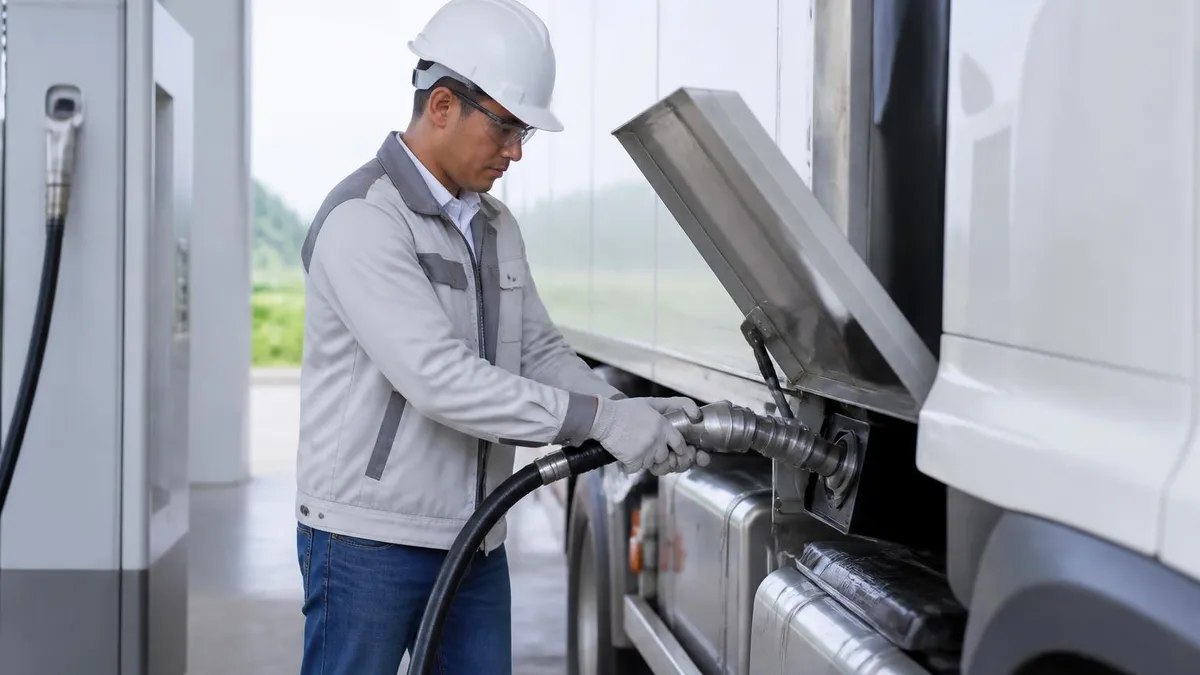
Press the start button on the dispenser. Gas begins flowing immediately. You will hear a strong rush sound and the hose will become slightly stiffer as it pressurizes. The dispenser monitors flow rate, tank temperature, and pressure simultaneously and shuts off automatically when target pressure is reached. Most fills complete in 5 to 10 minutes for a passenger-vehicle tank and 12 to 18 minutes for a Class 8 tractor.
Finish the sequence by pressing the stop button, depressurizing the hose, releasing the lock, and detaching the nozzle. A small puff of gas may release as you disconnect — this is normal and is the gas trapped in the nozzle body, not a leak. Cap the receptacle, return the nozzle to its holster, take your receipt, and roll out. Total time from pull-up to drive-off: roughly six to eight minutes for a typical light-duty fill.
CNG Station Types Compared
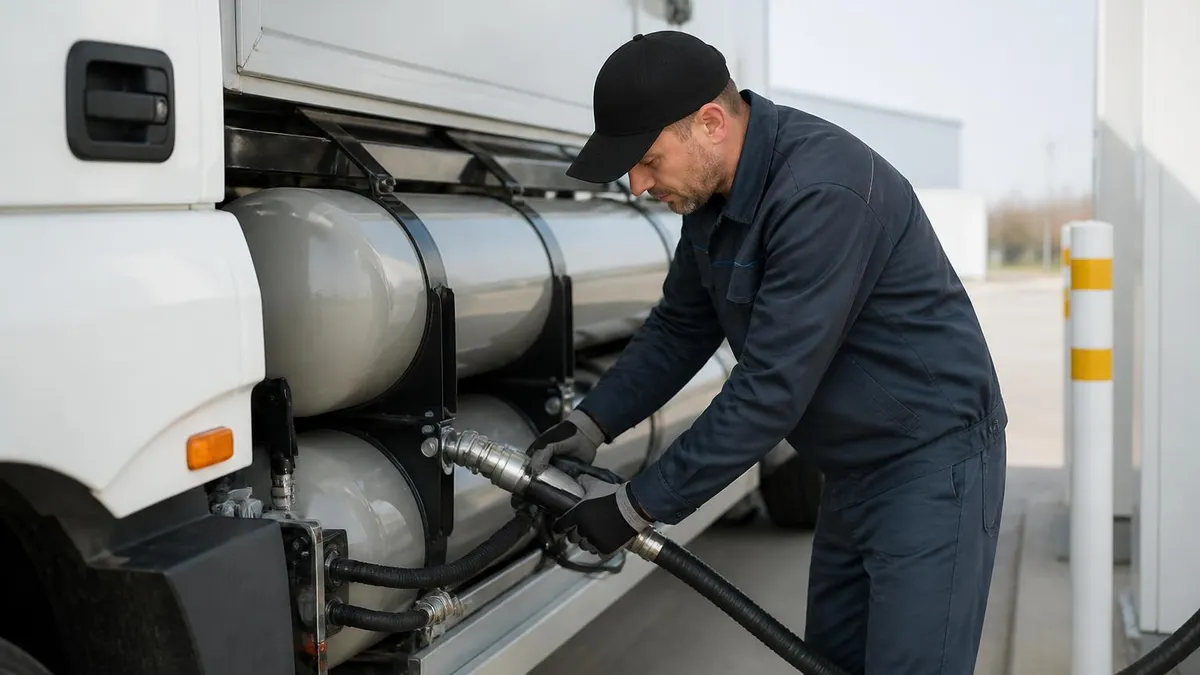
High-pressure cascade storage feeds the vehicle in 5 to 10 minutes, mimicking the gasoline experience.
- ▸Refuel time: 5 to 10 minutes
- ▸Build cost: $1.2M to $3M per site
- ▸Best for: highway corridors, retail truck stops, mixed fleets
- ▸Operators: Clean Energy Fuels, Trillium, Pilot Flying J, Love's
Smaller compressor trickles gas directly into parked vehicles overnight — no cascade storage required.
- ▸Refuel time: 6 to 8 hours overnight
- ▸Build cost: $300K to $800K per site
- ▸Best for: transit barns, refuse depots, predictable parked fleets
- ▸Lower per-GGE operating cost than fast-fill
Time-fill posts cover the overnight fleet while a small fast-fill island handles backup and visitor traffic.
- ▸Eliminates single-compressor-failure risk
- ▸Dominant design for transit and refuse depots
- ▸Capital cost between time-fill and full fast-fill
- ▸Allows guest vehicles and emergency rapid refuel
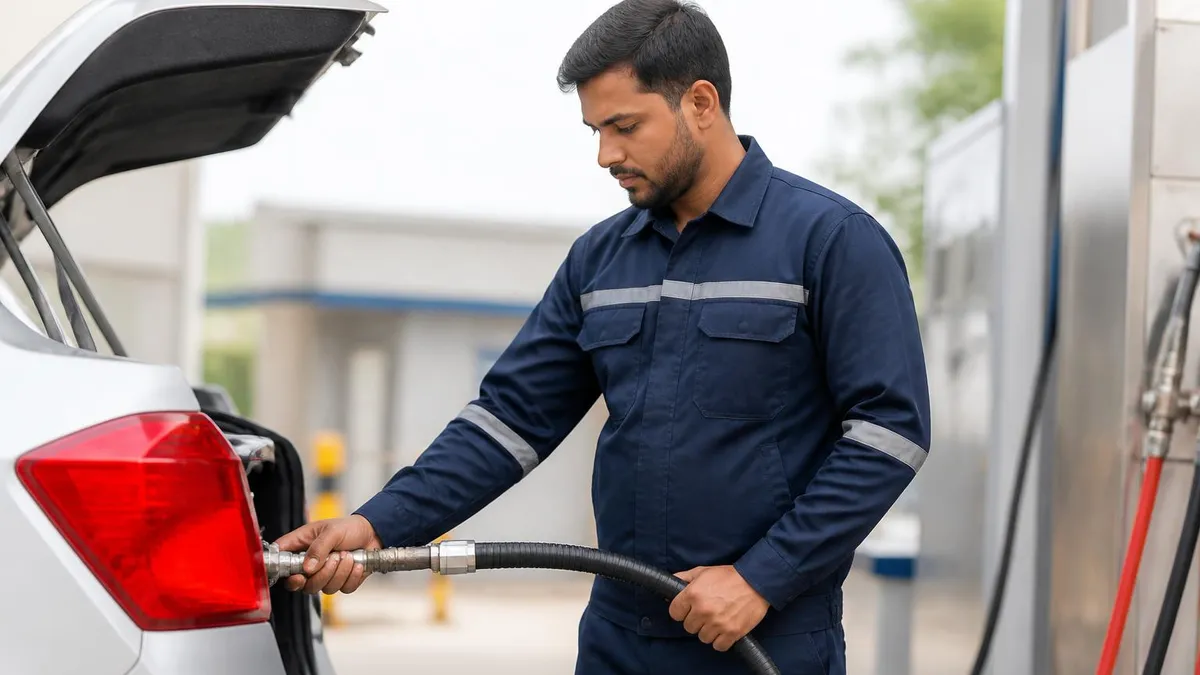
Wall-mounted compressor pulls from residential gas line and slow-fills a passenger CNG vehicle overnight.
- ▸3,600 psi home filling station, typically 0.5 GGE per hour
- ▸Install cost: $4,000 to $6,000 plus electrical work
- ▸Convenient for Honda Civic GX and bi-fuel pickup owners
- ▸Limited new-unit availability in 2026 — used market active
Pricing for CNG fueling has stayed remarkably stable compared with retail gasoline since 2020, and that is the core reason fleet operators keep buying natural-gas trucks despite the rise of electric alternatives. The wholesale Henry Hub natural-gas price has cycled between $2.50 and $5.50 per million BTU over the last six years, which translates to a relatively narrow $1.85 to $3.50 retail GGE band after compression, dispensing, and margin. Gasoline, in contrast, has swung from $1.95 to $5.00 a gallon during the same period.
Fleet contract rates almost always undercut the posted retail GGE. Clean Energy and Trillium routinely lock multi-year supply contracts for refuse haulers and transit agencies at $1.25 to $1.75 per GGE, especially when the fleet commits volume of 200,000 GGE per year or more. For a refuse truck burning 14,000 GGE annually, that contract pricing produces $28,000 to $42,000 in fuel savings per truck versus diesel — and refuse fleets buy in quantities of 50 to 500 trucks at a time.
The federal alternative-fuel infrastructure tax credit under Section 30C of the Internal Revenue Code returns 30 percent of station construction costs up to $30,000 per fueling property (rising to $100,000 per item under the Inflation Reduction Act expansion). This credit alone has reopened the economic case for new fast-fill stations along Interstate corridors, and the IRS has issued clear guidance on stacking it with state grants.
State incentives stack on top of the federal credit. The California Energy Commission funds CNG and renewable-natural-gas station expansion through the Clean Transportation Program. The Texas Emissions Reduction Plan (TERP) offers grants up to $500,000 per heavy-duty CNG vehicle plus station-build matching funds. Pennsylvania, Colorado, Oklahoma, Utah, and New York all run active incentive programs as well. A fleet operator considering a new build should always confirm both federal and state availability before signing the construction contract.
Renewable natural gas (RNG), also called biomethane, is now the fastest-growing fuel slice at U.S. CNG stations. RNG is captured from landfills, dairy farms, and wastewater plants, cleaned to pipeline spec, and dispensed through existing CNG infrastructure with zero hardware changes. Clean Energy now reports more than 70 percent of the fuel it dispenses is RNG, and the EPA's Renewable Fuel Standard provides credit revenue that often makes RNG cheaper than fossil CNG on a net basis. That credit value is part of why station economics have stayed strong even as light-duty vehicles electrify.
Who Uses CNG Fueling Stations
Class 8 tractors from Peterbilt, Freightliner, Kenworth, and Mack now ship factory-built CNG and LNG variants with Cummins ISX12N engines that meet ultra-low-NOx standards. These trucks dominate regional drayage at the Port of Los Angeles, Port of Long Beach, and Port of Newark, where local clean-air rules favor or require natural gas powertrains. A typical port drayage tractor burns 9,000 to 12,000 GGE annually and refuels at fleet-operated fast-fill stations every shift.
Over-the-road haulage along the I-10, I-40, I-80, and I-5 corridors is the second big use case. Carriers like UPS, Saddle Creek Logistics, and Ryder operate large CNG fleets and route specifically through the public truck-stop CNG network. The economics work whenever a route consistently hits Clean Energy or Pilot CNG stops every 350 to 450 miles, the typical CNG tractor range.
Safety standards at CNG fueling stations are governed by NFPA 52 (Vehicular Natural Gas Fuel Systems Code) and SAE J2600 for dispensing equipment. These codes drive everything from setback distances to ventilation requirements to overpressure protection. Operators are required to perform annual third-party inspections, daily visual checks of dispensers and hoses, and methane-leak surveys every six months in most jurisdictions.
For the driver, the most important safety habit is the receptacle inspection. Before connecting any CNG nozzle, look at the fill receptacle on your vehicle for visible damage to the threads, the o-ring seat, or the housing. A damaged receptacle can fail catastrophically at 3,600 psi — though incidents are rare, they are usually traceable to a previously damaged part that nobody flagged. If anything looks wrong, drive to a different vehicle or call the operator before you fill.
The second habit is the post-fill leak check. After disconnecting, lean toward the receptacle for two seconds and smell — natural gas is odorized with mercaptan, so any leak above a trace is immediately obvious. If you smell gas, do not start the engine. Cap the receptacle, walk back to the dispenser, and notify the station operator. Most fleet-operator manuals require a written incident note even for trace leaks.
Hose handling matters more on CNG than on gasoline pumps because the hose carries 3,000 to 3,600 psi during dispensing. Never kink the hose, never let it dangle off the side of the truck after fueling, and always inspect it briefly for abrasion or cracking before connecting. Operators replace dispensing hoses on a 3 to 5 year cycle, but daily-use inspection is still a federal recommendation.
One question that comes up repeatedly: is CNG safer or more dangerous than gasoline? The honest engineering answer is that CNG is genuinely safer in collision and spill scenarios because the gas disperses upward and dilutes below the lower flammability limit (5 percent in air) within seconds. Gasoline pools and ignites; CNG vents and dissipates. The trade-off is the high storage pressure, which requires more discipline from the operator and the dispensing equipment.
Planning a long route on CNG used to require a paper map and a phone call to every potential refuel stop. In 2026 the process is far easier but still requires more thought than a gasoline trip.
The general rule is to set 350 miles as your maximum reliable single-fill range for a Class 8 tractor and 220 miles for most light-duty CNG vehicles, then plot stops with at least 75 miles of cushion before each one. Always identify a backup station within 25 miles of every primary stop — about 4 to 6 percent of public CNG sites experience an unplanned outage on any given day.
When you fuel along an unfamiliar corridor, double-check three pieces of information before you commit to the route. First, confirm the station accepts your card brand. Second, verify the dispenser pressure (P30 vs P36). Third, look at the AFDC "last verified" date — anything older than 60 days should be confirmed by phone before you arrive empty. Truck stops with attended hours are safer bets than unattended sites in remote areas where a dispenser fault can leave you stranded until morning.
Carrying basic spares pays off. Most experienced CNG drivers keep a clean shop rag in the cab for wiping receptacles, a spare receptacle dust cap, and a small flashlight for after-dark fills. Class 8 operators add a torque wrench preset to the manufacturer's spec for the receptacle's mounting bolts in case a fill receptacle ever needs to be re-secured on the road. None of this is heavy gear, but the small kit eliminates 90 percent of the inconveniences that occasionally interrupt a CNG route.
Maintenance for CNG vehicles is largely identical to diesel or gasoline counterparts with two exceptions: tank inspection and the fuel system itself. Federal regulations require a visual tank inspection every 36 months or 36,000 miles, plus after any collision affecting the tank area. Most fleets contract certified CNG inspectors to perform these checks at a depot rather than dispatching to a third-party shop. The fuel filter on the vehicle side is also a CNG-specific item replaced every 25,000 to 50,000 miles depending on the OEM service interval.
If you are still learning the differences between fuel types, the broader picture on cng fuel compared with gasoline and diesel covers chemistry, energy density, and the practical implications for drivers and fleets. Beyond the station, the underlying fuel system on the vehicle is what determines how often you visit and how confident you can be in winter cold-start performance.
Your Pre-Fill Checklist Before Every CNG Stop
- ✓Confirm dispenser pressure rating matches your vehicle (P30 or P36)
- ✓Shut off the engine and set the parking brake before approaching the pump
- ✓Touch the vehicle frame to discharge static before handling the nozzle
- ✓Inspect the fill receptacle for visible damage, debris, or worn o-rings
- ✓Wipe the receptacle face with a clean dry cloth — no shop towels with grit
- ✓Authorize the dispenser and verify the price per GGE matches your expectation
- ✓Connect and lock the nozzle squarely — never force the lever if it resists
- ✓Stay near the dispenser during the fill; do not return to the cab
- ✓Sniff-check the receptacle for mercaptan odor after disconnecting
- ✓Cap the receptacle, take your receipt, and log the gallons before driving off
The future of the CNG fueling network is a more nuanced conversation in 2026 than it was even three years ago. Battery-electric and hydrogen fuel-cell vehicles have captured most of the policy attention and federal funding flowing toward heavy-duty zero-emission transportation. That has pushed some observers to write off natural gas as a transitional fuel that will fade quickly. The actual market data tells a more complicated story, especially for the heavy-duty segments where CNG is currently strongest.
Refuse, transit, and regional drayage continue to add CNG units, with Cummins's new X15N 15-liter natural-gas engine for long-haul applications adding range, towing capacity, and emissions credits that closed the remaining performance gap with diesel. Several large carriers placed multi-hundred-unit orders for X15N tractors in 2025, signaling that CNG is still attracting capital investment at the OEM and fleet level despite the electrification narrative.
On the light-duty side, the picture is honestly less rosy. New CNG passenger vehicles are essentially unavailable in 2026, and used Honda Civic GX values have started to decline as the existing fleet ages out. Drivers who are committed to natural gas for personal-use passenger cars are increasingly looking at aftermarket bi-fuel conversions on trucks and SUVs, which remain legal in most states but require certified installers and careful EPA compliance documentation.
The RNG-CNG combination is where the long-term durability of the network probably lies. As waste-to-energy and dairy-digester projects come online over the next decade, the supply of renewable natural gas keeps growing, and dispensing it through existing CNG stations requires zero hardware changes on either the station or the vehicle side. The DOE projects RNG could supply 30 to 50 percent of total U.S. natural gas vehicle fuel by 2030, up from roughly 22 percent in 2024.
Policy is the wild card. The 30C federal infrastructure credit, state-level low-carbon fuel standards in California, Oregon, and Washington, and EPA Renewable Fuel Standard credits all currently favor CNG and RNG. Any major federal rollback could change the build economics quickly. Fleet operators who are evaluating new station construction in 2026 should model two or three policy scenarios before committing to a 25-year asset.
For the individual driver, the practical takeaway is simpler: the existing network of roughly 1,500 public CNG fueling stations is not going to disappear in the next decade. Anyone considering a used Honda Civic GX, a bi-fuel pickup, or a small fleet of CNG vans can plan with reasonable confidence that fueling will remain available, especially in the high-density states. If you are also evaluating the broader category of cng stations versus emerging zero-emission infrastructure, the realistic answer is that both will coexist for at least the rest of the decade.
CNG Fueling Stations Pros and Cons
- +Substantially cheaper than gasoline — typically $1.85 to $3.50 per GGE versus $3.50 to $5.00 per gallon
- +Strong heavy-duty network along Interstate corridors and at major truck stops
- +Refueling experience nearly identical to gasoline at fast-fill stations once you learn it
- +Federal Section 30C tax credit returns up to $100,000 per fueling property for new builds
- +RNG supply now exceeds 70 percent of fuel dispensed at the Clean Energy network
- +Significantly cleaner emissions profile than diesel for refuse, transit, and drayage
- +Time-fill depot model unlocks lower-cost fueling for predictable parked fleets
- −Light-duty passenger vehicle options have largely disappeared from new-car showrooms
- −Rural and small-state coverage is thin — long routes require careful pre-planning
- −Station outages happen on about 4 to 6 percent of sites on any given day
- −Fill receptacle pressure ratings (P30 vs P36) create minor compatibility planning needs
- −Tank inspections every 36 months or 36,000 miles add a maintenance step diesel does not have
- −Cold-weather temperature compensation matters and varies by dispenser generation
- −Capital cost of new fast-fill stations remains $1.2M to $3M before incentives
If you are evaluating CNG for the first time — whether for a personal vehicle or a fleet — the smartest approach is to take a half-day field trip to your nearest public station and watch a few fills happen. Most station operators are happy to walk you through the basics, especially during slower midday hours. Bring questions about contract pricing, after-hours access, and card brands accepted. A 30-minute conversation at the station counter usually answers everything a brochure would have left ambiguous.
For fleets, the cost-benefit analysis depends almost entirely on your vehicle duty cycle and parking pattern. A regional drayage tractor that runs 95,000 miles a year, fuels at the same depot every shift, and stays inside a 350-mile loop is a textbook CNG candidate. A long-haul tractor that runs 130,000 miles across 35 states and fuels at random truck stops needs much more careful route analysis. Most fleet consultants recommend a 12-month pilot of three to five trucks before committing to full conversion.
Drivers transitioning from diesel often report a 1 to 2 week learning curve before CNG fueling feels routine. The mechanical procedures are slightly different, the pressures are higher, and the dispenser interfaces are not yet as standardized as gasoline pumps. After that initial adjustment, most drivers report no day-to-day difference in convenience or schedule. The economics keep the fleets buying, and the cleaner emissions keep the regulators friendly.
One last practical note worth knowing: most CNG dispensers in 2026 have started accepting mobile-wallet payment through Apple Pay or Google Pay, and several networks now publish their full station list inside in-vehicle navigation systems from Garmin, TomTom, and OEM head units. If your truck is newer than model year 2022, check whether your factory navigation system includes alternative-fuel routing — you may already have what you need without installing a separate app.
Sample Compressed Natural Gas Practice Questions
Try these questions from our free Compressed Natural Gas practice tests. The correct answer and an explanation follow each question.
What type of compressor is most commonly used in CNG fueling stations for achieving the high pressures required for vehicle fueling?
- A. Centrifugal compressor
- B. Axial flow compressor
- C. Reciprocating piston compressor
- D. Rotary screw compressor
Answer: C. Reciprocating piston compressor
Reciprocating piston compressors are the industry standard for CNG stations because they can achieve the high pressures (3,600 psi) needed for vehicle fueling.
Which federal agency requires CNG fueling stations to comply with process safety management (PSM) rules if they exceed threshold quantities?
- A. OSHA
- B. DOT
- C. EPA
- D. PHMSA
Answer: A. OSHA
OSHA's PSM standard (29 CFR 1910.119) applies to facilities handling flammable gases above threshold quantities.
Under EPA regulations, which CNG fueling stations must conduct a risk management plan (RMP)?
- A. All CNG stations regardless of size
- B. Stations storing more than 10,000 lbs of natural gas
- C. Stations exceeding the Clean Air Act Section 112(r) threshold quantity for flammable gases
- D. Only CNG stations serving public transit fleets
Answer: C. Stations exceeding the Clean Air Act Section 112(r) threshold quantity for flammable gases
EPA's RMP rule (40 CFR Part 68) applies to facilities that hold regulated substances above threshold quantities per Clean Air Act Section 112(r).
Which standard governs the design and construction of CNG pressure vessels used in stationary storage at fueling stations?
- A. NFPA 52
- B. ASME Boiler and Pressure Vessel Code Section VIII
- C. DOT 49 CFR Part 178
- D. API 650
Answer: B. ASME Boiler and Pressure Vessel Code Section VIII
Stationary CNG storage vessels must be constructed per ASME BPVC Section VIII, Division 1 or Division 3 for high-pressure applications.
CNG Questions and Answers
About the Author

Educational Psychologist & Academic Test Preparation Expert
Columbia University Teachers CollegeDr. Lisa Patel holds a Doctorate in Education from Columbia University Teachers College and has spent 17 years researching standardized test design and academic assessment. She has developed preparation programs for SAT, ACT, GRE, LSAT, UCAT, and numerous professional licensing exams, helping students of all backgrounds achieve their target scores.
Join the Discussion
Connect with other students preparing for this exam. Share tips, ask questions, and get advice from people who have been there.
View discussion (8 replies)