
CNG Cars: Buying Guide, Mileage, Maintenance & Real Costs 2026 October
🗨️ CNG cars buying guide: top models, fuel economy, conversion kits, real running costs, pros and cons, and certification tips for safer driving.

If you keep watching pump prices climb and wondering whether a CNG car is finally worth it, you are not alone. Compressed natural gas vehicles sit in a strange middle ground between old-school petrol cars and the shiny new EV crowd, and most online guides either over-sell them or write them off without doing the math.
Here is the straight version. CNG cars run on the same kind of natural gas that heats homes, just squeezed into a high-pressure cylinder mounted in the boot or under the chassis. You still drive a familiar internal combustion engine, but the running cost per kilometre is often half what petrol owners pay, and tailpipe emissions drop noticeably. The trade-off is boot space, refuelling time, and a smaller station network that requires a little planning on long trips.
This guide walks through what a CNG car actually is, the best factory-fit and converted models on the road right now, real-world fuel economy, what conversion kits cost, the safety story (it is better than rumour suggests), and the everyday maintenance habits that keep these engines reliable for 200,000 km and beyond. By the end you should know whether parking a green-stickered hatchback in your driveway makes sense, or whether a hybrid or used diesel still wins for your routine.
What Is a CNG Car and How Does It Work?
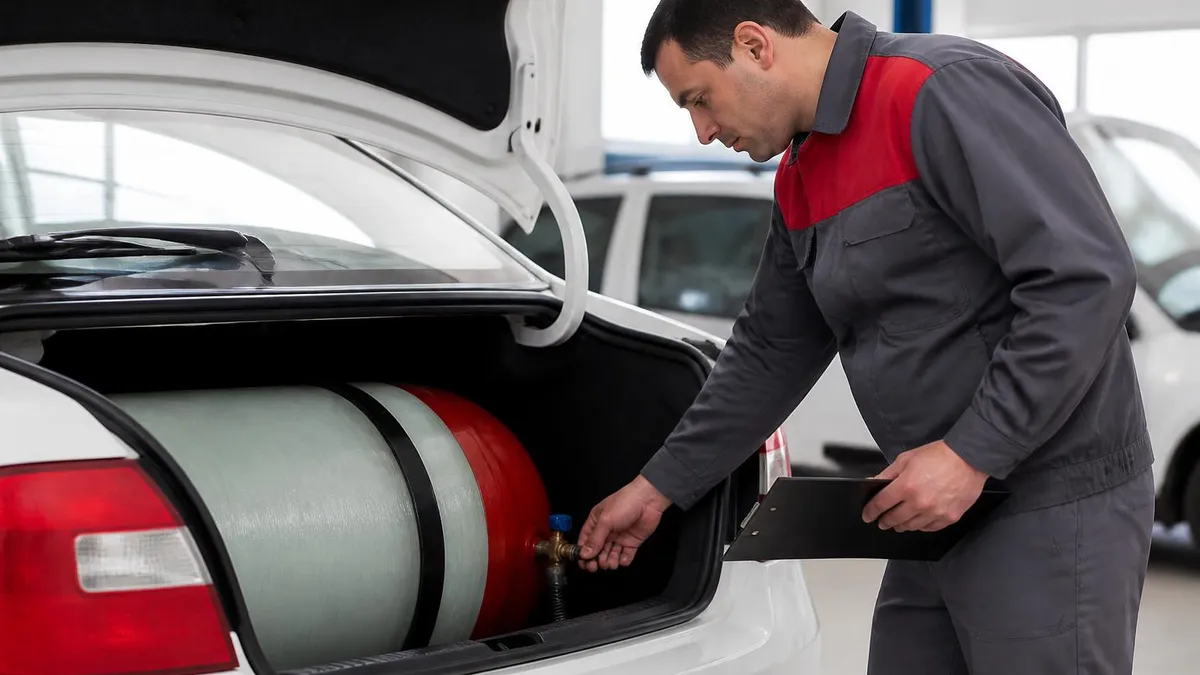
A CNG car burns compressed natural gas, which is mostly methane, instead of petrol. The fuel sits inside a reinforced steel or composite cylinder pressurised to roughly 200 bar. From the cylinder, gas travels through a high-pressure line to a pressure regulator that drops it down to the level the engine can handle, then on to gas injectors near each cylinder, much like petrol injectors. The ECU swaps fuel maps on the fly, so the engine timing, air-fuel mix, and ignition all shift to match whichever fuel you are using.
Most factory CNG cars are bi-fuel. You start cold on petrol, the system warms up, and it switches to gas automatically. A dash button lets you flip back to petrol any time, which is handy in areas where stations are sparse. The petrol tank stays in place, just smaller, giving you a backup range of around 200 to 400 km.
Why bother? Three reasons keep showing up in owner surveys. Running cost per kilometre is the headline, often 40 to 60 percent less than petrol depending on local prices. Engine internals stay cleaner because methane burns without leaving the carbon residue you get from heavier hydrocarbons. And CO2 output drops by roughly 20 to 25 percent compared with the same engine on petrol, with much lower particulate emissions than diesel. None of this is magic, but it adds up over a 15,000 km year.

How a CNG Car Works
Start on petrol, switch to CNG once the engine warms. A dashboard button lets you toggle fuels on demand, useful in regions where station coverage is patchy.
Stores methane at 200 bar in a crash-tested steel or composite tank mounted in the boot or under the chassis on factory-fit vehicles.
Gas injectors near each cylinder deliver methane in time with engine cycles, exactly like petrol injectors but with their own dedicated fuel rail.
Engine map automatically changes fuel timing, ignition, and air mix when you swap fuels so combustion stays clean and consistent.
Best CNG Cars to Buy in 2026
India, Italy, Iran, Pakistan, and parts of South America have the strongest factory CNG lineups. In Europe the segment shrank as automakers chased electrification, though Fiat, SEAT, and Skoda still build excellent gas-ready models. Here is a practical shortlist that owners actually recommend.
Maruti Suzuki Wagon R CNG. The everyman pick. A 1.0 litre K-series engine, factory cylinder, and certified mileage near 34 km/kg. It is cheap to buy, cheaper to feed, and parts are everywhere. Boot space drops to about 130 litres, which is the main complaint.
Hyundai Aura CNG. A compact sedan with a quieter cabin than the Wagon R and a more refined gearbox. Fuel economy hovers around 28 km/kg, and the boot keeps a usable 230 litres because Hyundai mounts the cylinder lower.
Tata Tiago iCNG. Notable because Tata was the first to offer a true twin-cylinder layout in this price band, which restores meaningful boot space and improves weight balance. Mileage sits at 26 to 28 km/kg in mixed driving.
Fiat Panda Hybrid CNG. The European staple. A small, light city car with a frugal 1.0 litre engine and mild hybrid assist. Real owners report around 4.0 kg per 100 km, which on current Italian metano prices works out cheaper than a small diesel.
SEAT Arona TGI and Skoda Octavia G-TEC. If you want a real cruiser, these two share the same 1.5 litre TGI engine. Three tanks give a combined CNG range above 400 km, with petrol as a long-distance backup. The G-TEC Octavia in particular has become a popular taxi platform in Germany and the Czech Republic because the engine routinely covers 300,000 km without major work.
Used buyers should also look at older Volkswagen eco up!, Opel Combo CNG, and the Honda Civic GX from the early 2010s, all of which still trade for sensible money. A quick check on a high-traffic resource like the CNG knowledge hub can help you cross-reference any model you find for owner-reported quirks.
CNG At a Glance
Real-World Mileage and Running Costs
Manufacturer mileage figures look great on the brochure, but the only number that matters is what your car returns on the way to work. Most owners log between 22 and 32 km per kg of CNG in mixed city and highway driving. Small hatchbacks at the lighter end of the scale top the table; larger sedans, MPVs, and anything carrying a roof box will be closer to 18 to 22 km/kg.
To put that in money terms, take a Wagon R CNG returning 28 km/kg at a pump price of roughly 90 currency units per kg. That works out to about 3.2 units per km. The same car on petrol returning 20 km/l at 105 units per litre costs 5.2 units per km. Over 15,000 km a year you save around 30,000 units, which more than covers the price premium of the factory CNG variant inside two years.
Three habits stretch your tank further. Inflate tyres to the upper end of the recommended range, keep RPM below 2,500 in normal driving since CNG engines make peak torque lower than petrol, and avoid heavy roof loads. Air conditioning costs less on CNG than petrol because the gas-mode ECU manages idle speed more tightly, so do not be shy with the AC in summer.
Quick reality check, though. If you only drive 6,000 km a year, the payback period stretches well past four years and the convenience tax of slower refuelling is hard to justify. CNG rewards higher mileage drivers, taxi operators, and delivery routes more than weekend commuters.

CNG by Use Case
CNG shines in stop-start traffic because methane combustion is cleaner and the gas-mode ECU keeps idle smooth. Expect 28 to 32 km/kg in light city driving with disciplined throttle inputs and well-maintained tyres at the upper recommended pressure.
Aftermarket CNG Conversion: Is It Worth It?
If your car was not built for gas, you can still convert it. A typical sequential-injection kit costs between 800 and 1,800 currency units depending on the number of cylinders, the brand of the kit, and whether you choose a 60 litre or 80 litre tank. Quality matters here more than almost any other car decision you will make.
Stick with certified kits from Landi Renzo, BRC, Lovato, Tomasetto, or Tartarini. These names dominate the European and South Asian markets because they pass type approval and have a real service network. Cheap unbranded kits flood online marketplaces and they are the single biggest reason CNG gets a bad safety reputation. A poorly crimped fitting on a 200 bar line is not a place to economise.
Find a workshop that has done at least a few hundred installs, ideally one approved by the kit manufacturer. The job takes one to three days. Once installed, you must register the conversion with your road transport authority, which usually issues a new registration card noting CNG as a fuel. Skipping this step is illegal in most countries and voids your insurance the moment you fill up.
A few engines simply do not respond well to gas. Direct-injection turbocharged petrol engines, especially older ones, can suffer accelerated valve seat wear if you do not retrofit a valve lubricant kit. Stick to port-injection naturally aspirated engines or modern dual-injection units where possible. Diesel conversions exist (dual-fuel diesel-CNG) but require expert calibration and are usually only worth it on fleet trucks.
Cheap conversion kits are the single biggest cause of CNG safety incidents. Stick with Landi Renzo, BRC, Lovato, Tomasetto, or Tartarini and use an installer the manufacturer approves. A poorly crimped fitting on a 200 bar line is not the place to save money on installation.
Are CNG Cars Safe?
Short answer, yes, often safer than petrol. The cylinder is the strongest single component on the vehicle, certified to crash standards, fire standards, and bullet impact tests far beyond what a steel petrol tank survives. Gas is also lighter than air, so a leak rises and disperses rather than pooling under the car the way petrol vapour does.
Where safety problems do appear, the cause is almost always badly installed or expired equipment. Cylinders have a stamped expiry date, typically 15 to 20 years from manufacture, with hydrostatic re-tests every three to five years depending on jurisdiction. Skipping the re-test or driving on a damaged regulator is the modern equivalent of running on a leaky brake line. Just do not.
Daily safety habits are simple. Smell of gas inside the cabin or under the bonnet? Switch to petrol immediately, ventilate, and get the car checked. Never park a leaking gas vehicle in an underground garage. Keep the spare cylinder area clear of loose cargo that could chafe the high-pressure line. And use the manual cylinder valve to shut off supply if the car will sit unused for more than a few weeks.
CNG Maintenance Checklist
- ✓Change spark plugs every 20,000 km using iridium grade specified for gas use
- ✓Check valve clearance every 40,000 km on engines without hydraulic lash adjusters
- ✓Pressure-test the gas system annually with a certified technician
- ✓Re-test cylinder hydrostatically every 3 to 5 years per local rules
- ✓Inspect high-pressure line clips and regulator for oily residue or chafe
- ✓Keep tyre pressure at the upper end of the recommended limit
- ✓Verify cylinder mounting bolts are torqued to specification
- ✓Switch to petrol immediately if you smell gas inside the cabin
Maintenance: What Actually Changes
Owners often hear that CNG ruins engines. That is half-truth from the early days of cheap conversion kits. A modern factory or well-converted CNG car needs three small habits beyond a normal service schedule.
Spark plugs work harder because methane has a higher ignition temperature than petrol. Change them every 20,000 km instead of the 40,000 to 60,000 km interval you might be used to, and use the iridium plug grade specified by the kit or vehicle manufacturer. Cheap copper plugs degrade fast on gas.
Valve clearance should be checked every 40,000 km on engines without hydraulic lash adjusters. Methane burns hotter and slightly drier, which can accelerate seat recession on older designs. The fix is either a lubricant additive dosed by an inline reservoir, or simply choosing an engine with hardened valve seats from the factory.
Annual gas-system inspection is non-negotiable. A technician should pressure-test the lines, check the regulator for residue, and confirm the cylinder mounting hardware is torqued correctly. This visit costs roughly the same as a normal oil change and prevents 90 percent of the problems that scare owners off CNG.
CNG Pros and Cons
- +Running cost roughly half of petrol per km
- +Lower CO2 and almost zero particulate emissions
- +Cleaner combustion extends engine life
- +Uses existing fuelling infrastructure, no charging stop
- +Petrol backup tank means you never get stranded
- −Reduced boot space due to the cylinder
- −Refuelling takes 5 to 7 minutes versus 2 minutes for petrol
- −CNG station network is uneven outside major cities
- −Slight 5 to 10 percent power loss vs same engine on petrol
- −Annual gas-system inspection adds a small running cost
Pros and Cons at a Glance
| Pros | Cons |
|---|---|
| Running cost roughly half of petrol per km | Reduced boot space due to the cylinder |
| Cleaner combustion extends engine life | CNG station network is uneven outside major cities |
| Uses existing fuelling infrastructure, no charging stop | Annual gas-system inspection adds a small running cost |
CNG vs Petrol, Diesel, Hybrid, and EV
No single fuel wins for everyone. The honest comparison goes like this.
CNG vs petrol. CNG nearly always wins on fuel cost and on tailpipe emissions, loses on boot space and station availability. If your annual mileage is above 12,000 km, the math favours gas.
CNG vs diesel. Diesels still beat CNG on highway efficiency for heavy or long-distance vehicles, but cities are squeezing diesels out with low-emission zones. CNG passes most low-emission zone rules and has dramatically lower NOx and particulate output. For urban use, gas wins easily.
CNG vs hybrid. A petrol hybrid can match or beat a CNG car on per-km cost in pure city driving, but at a higher purchase price. The break-even tilts toward CNG for higher mileage drivers and toward hybrids for stop-start commuters with shorter daily distances.
CNG vs EV. Electricity at home beats CNG on cost per km, full stop. The question is up-front price and access to charging. EVs are unbeatable for owners with a driveway charger and a sub-200 km daily routine. CNG remains attractive for renters, rural drivers, and anyone who refuses to plan around charging stops. Both fuels make sense; pick the one that fits your parking situation honestly.
Buying Checklist: What to Look For
If you are buying new, the decision is straightforward. Choose a factory CNG variant from a reputable brand, register the warranty, and follow the service book.
Used CNG cars need a sharper eye. Walk around the boot first and look for a clean cylinder mounting plate, no rust runs, no bulges in the steel. Check the cylinder stamp for the manufacture date and the next hydrostatic test date. Inside the engine bay, the high-pressure line should be neatly clipped, the regulator dry and free of oily residue, and the ECU loom tidy rather than wrapped in random insulation tape.
Ask the seller for the conversion certificate if the car is retrofitted, plus any pressure test records. Take it for a proper test drive in both fuel modes. Switch from petrol to CNG at speed; it should feel smooth, with maybe a tiny pause from the fuel map handover. Hard jerks, hesitation, or persistent check engine lights point to a tired kit that may cost as much as the car to fix.
Finally, get the gas system inspected by an independent shop before you sign. Spending 30 to 50 currency units on a pre-purchase inspection is cheap protection against buying somebody else's headache. If you want broader background on certification, working with gas safely, or testing your own knowledge, the CNG practice test library is a useful starting point.
CNG Buying Timeline
Step 1: Choose new vs used
Step 2: Inspect cylinder dates
Step 3: Test-drive bi-fuel switch
Step 4: Independent inspection
Step 5: Register and insure
Where CNG Cars Fit in the Future
Critics call CNG a bridge fuel, and they are partly right. As EV charging networks expand and battery prices fall, the case for buying a new fossil-burning car of any kind narrows. But CNG keeps two real advantages that will not disappear overnight. It uses existing pump infrastructure that is far cheaper to build than fast-charging networks, and it pairs naturally with biomethane, which is methane produced from organic waste rather than gas wells.
Several European fleet operators already run on biomethane CNG, which is effectively carbon-neutral over the lifecycle. India is investing heavily in compressed bio-gas plants, with a target of replacing a significant share of imported LNG with domestic bio-CNG within the decade. For drivers, the takeaway is that the same car you buy today can run greener in five years as the fuel mix shifts, without changing anything in the engine bay.
If you do 12,000 km or more a year, park in a city with active CNG stations, and want lower running costs without giving up familiar petrol-station refuelling, a CNG car is one of the most underrated decisions on the market right now. Just buy a known model, fit a reputable kit if converting, follow the service schedule, and the same engine will out-last the loan.
Sample Compressed Natural Gas Practice Questions
Try these questions from our free Compressed Natural Gas practice tests. The correct answer and an explanation follow each question.
What telematics data point is most important for a CNG fleet manager to monitor in real time for safety compliance?
- A. Fuel system pressure readings and any low-pressure fault codes
- B. Engine RPM during highway cruising
- C. Cabin temperature settings
- D. Infotainment system usage logs
Answer: A. Fuel system pressure readings and any low-pressure fault codes
Real-time fuel system pressure monitoring can detect anomalies that indicate leaks, regulator failures, or other safety-critical CNG system issues.
A technician needs to perform maintenance that requires depressurizing the low-pressure side of a CNG fuel system. After closing the manual cylinder valves, what is the next critical step in the procedure?
- A. Immediately open the bleed valve at the regulator.
- B. Disconnect the fuel line at the engine.
- C. Start and run the engine until it stalls from lack of fuel.
- D. Use a sniffer to check for leaks around the cylinder valves.
Answer: C. Start and run the engine until it stalls from lack of fuel.
After isolating the high-pressure cylinders by closing their manual valves, the correct procedure to depressurize the lines leading to the engine is to run the engine until it consumes the remaining fuel in the lines and stalls. This safely purges the low-pressure side of the system. Only after the engine has stalled and the ignition is secured should a technician proceed to bleed any minimal remaining pressure.
A CNG vehicle experiences hard starting in cold weather. Which maintenance item should be inspected first?
- A. High-pressure cylinder hydrostatic test date
- B. Low-pressure fuel filter and regulator heating element or coolant lines
- C. Cylinder valve manual shutoff position
- D. CNG dispenser nozzle compatibility
Answer: B. Low-pressure fuel filter and regulator heating element or coolant lines
Cold-weather hard starting on CNG vehicles is commonly caused by a failed regulator heater or blocked coolant line that prevents the regulator from vaporizing fuel properly.
A CNG vehicle that operates normally in warm weather has difficulty starting and runs rough in sub-freezing temperatures. The issue resolves after the engine warms up. Which maintenance issue is the most likely cause?
- A. The engine's spark plugs have an incorrect heat range.
- B. Moisture has frozen within the high-pressure regulator.
- C. The PRDs on the cylinders have become too sensitive to cold.
- D. The CNG's methane number is too low for winter operation.
Answer: B. Moisture has frozen within the high-pressure regulator.
When high-pressure CNG expands in the regulator, it undergoes significant cooling due to the Joule-Thomson effect. If any moisture is present in the fuel, it can freeze inside the regulator, restricting or blocking gas flow until the engine bay's heat thaws it. This is a classic symptom of "regulator freezing" and points to a need to check gas quality or coalescing filters.
CNG Questions and Answers
About the Author

Educational Psychologist & Academic Test Preparation Expert
Columbia University Teachers CollegeDr. Lisa Patel holds a Doctorate in Education from Columbia University Teachers College and has spent 17 years researching standardized test design and academic assessment. She has developed preparation programs for SAT, ACT, GRE, LSAT, UCAT, and numerous professional licensing exams, helping students of all backgrounds achieve their target scores.
Join the Discussion
Connect with other students preparing for this exam. Share tips, ask questions, and get advice from people who have been there.
View discussion (8 replies)