
CNA in Missouri 2026: Training, Certification, Salary, and Requirements
Missouri CNA: 75 hours training (federal minimum), D&S Diversified exam (not Prometric), MO DHSS Nurse Aide Registry. Salary $26K–$32K. BJC HealthCare,...
Missouri Key Facts and Figures

Missouri Important Details
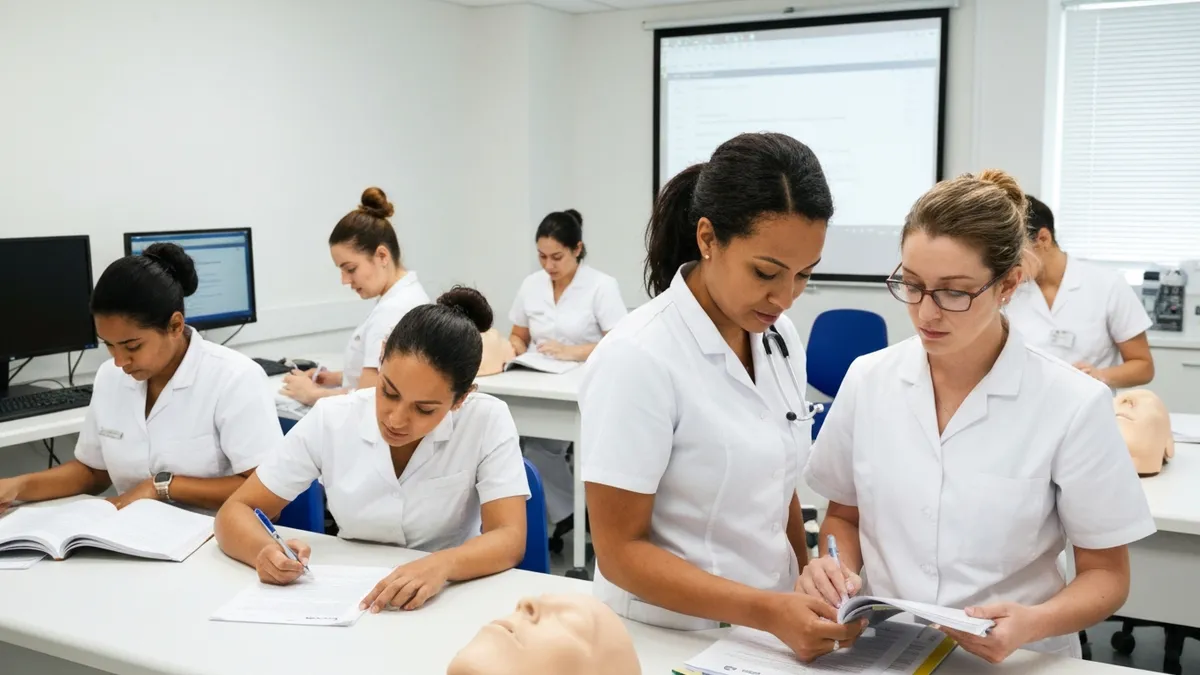
Missouri requires exactly 75 hours of CNA training — the federal minimum established by OBRA 1987 — making it one of the most accessible states for CNA certification. Training must include at least 16 hours of classroom/theory instruction and at least 16 hours of supervised clinical practice at a licensed Missouri nursing facility. The remaining hours can be split between laboratory training and additional instruction. Programs must be approved by the Missouri Department of Health and Senior Services (DHSS). Training is offered at community colleges (e.g., Metropolitan Community College, St. Louis Community College), vocational schools, hospital systems, and employer-based programs at nursing homes and long-term care facilities. Accelerated full-time programs complete in 2–3 weeks; part-time evening programs take 6–10 weeks.
- Total Required Hours: 75 hours minimum
- Classroom/Theory Hours: Minimum 16 hours
- Clinical Hours: Minimum 16 hours supervised
- Federal Minimum: 75 hours (MO meets exactly)
- Program Approval: MO DHSS-approved programs only
- Note: One of the lowest training requirements in the US — tied with several states
Missouri uses D&S Diversified Technologies — not Prometric — to administer the state CNA competency exam. This is the same vendor used by Kansas, Georgia, Arizona, and Oklahoma, so practice resources designed for D&S Diversified's NNAAP format are directly applicable. The written section contains 70 multiple-choice questions with a 105-minute time limit. The clinical skills evaluation requires demonstrating 5 randomly selected nursing skills from the approved Missouri skills list in front of a trained evaluator. Both sections must be passed to receive Missouri CNA certification. Candidates have up to 3 attempts within 24 months of completing their DHSS-approved training program. Testing sites are available in Kansas City, St. Louis, Springfield, and other Missouri cities.
- Written Section: 70 questions, 105 minutes
- Skills Section: 5 randomly selected skills
- Passing Score: 70% written, all 5 skills passed
- Exam Provider: D&S Diversified Technologies (not Prometric)
- Oral Option: Available for candidates with reading difficulties
- Attempts: 3 attempts within 24 months of training completion
Missouri requires a criminal background check for all CNA candidates seeking to work in nursing facilities and other DHSS-licensed settings. The background check is conducted through the Missouri State Highway Patrol (MSHP) and includes both state and federal criminal history via fingerprinting. The Missouri DHSS maintains an Employee Disqualification List (EDL) — individuals on the EDL are barred from employment in any licensed Missouri healthcare facility, regardless of CNA certification status. Medicaid and Medicare-funded employers must also verify candidates are not on the OIG exclusions list. Most DHSS-approved CNA training programs require background check clearance before clinical rotations begin.
- Check Type: Missouri State + FBI fingerprint-based check
- Administered By: Missouri State Highway Patrol (MSHP)
- Disqualifying: Abuse, neglect, exploitation, theft — felony and Class A misdemeanors
- Registry Block: MO DHSS Employee Disqualification List (EDL)
- OIG Check: Required for all Medicaid/Medicare-funded facilities
Before beginning supervised clinical rotations at a Missouri nursing facility, CNA students must provide a negative TB test result (Mantoux PPD or QuantiFERON Gold blood test) within the past 12 months, a physician's physical clearance form, and current CPR/BLS certification. Most DHSS-approved programs also require documentation of Hepatitis B, MMR, Varicella, Tdap, and seasonal flu vaccinations. Major Missouri health systems — including BJC HealthCare and Mercy — require a pre-employment drug screen in addition to the background check. These requirements are consistent across Kansas City and St. Louis metro area programs.
- TB Test: Required within 12 months (PPD or QuantiFERON Gold)
- Physical Exam: Physician clearance required
- Immunizations: Hep B series, MMR, Varicella, Tdap, annual Flu
- CPR: BLS/CPR certification required (AHA or Red Cross)
- Drug Screen: Required by most programs and employers
Missouri Detailed Breakdown
The Kansas City metro area — on the Missouri side encompassing Jackson County, Clay County, and Cass County — is Missouri's largest CNA market. Kansas City, MO anchors this region with a mix of acute care hospitals, skilled nursing facilities, home health agencies, and assisted living communities. Saint Luke's Health System, one of the most respected integrated health systems in the Midwest, operates Saint Luke's Hospital of Kansas City and multiple satellite campuses — a major CNA employer known for strong wages and career advancement. HCA Midwest Health operates several Kansas City-area hospitals including Research Medical Center and Menorah Medical Center. Veterans Affairs Medical Center Kansas City employs a significant number of CNAs serving Missouri's veteran population. For training, Metropolitan Community College (MCC) — with campuses across the KC metro — offers some of the most accessible and affordable DHSS-approved CNA programs in Missouri. Penn Valley Community College (MCC Penn Valley, Kansas City) and State Fair Community College also offer CNA pathways. CNA wages in Kansas City, MO average $13–$17/hour, with hospital positions at Saint Luke's and HCA reaching $17–$21/hour. Free CNA training programs may be available through Missouri Workforce Development centers and employer-sponsored programs at long-term care facilities. Important: CNAs working on the Kansas side of the KC metro must hold a separate Kansas CNA certification — see the KC Metro dual licensing highlight below.

Missouri Costs and Pricing
Missouri Step-by-Step Process
Find a DHSS-Approved CNA Program in Missouri
Complete Prerequisites and Enrollment
Complete 75-Hour DHSS-Approved Training
Register with D&S Diversified Technologies
Pass the Missouri CNA Competency Exam
Missouri DHSS Nurse Aide Registry Placement
Apply for CNA Positions in Missouri
Renew Missouri CNA Certification Every 2 Years
Missouri Essential Checklist
Kansas City Metro: MO vs KS CNA License — Dual Licensing Explained
The Kansas City metro straddles the Missouri-Kansas state line, and this creates a real licensing challenge for CNAs working in the region. Missouri and Kansas are two separate states with two separate nurse aide registries, two different training hour requirements, and separate exam registrations. Here is exactly what you need to know:
Missouri Side (Jackson County, Clay County, Cass County): CNAs working in Kansas City MO, Independence, Lee's Summit, Blue Springs, Liberty, or Raytown must hold a Missouri CNA certification — listed on the Missouri DHSS Nurse Aide Registry. Missouri requires only 75 hours of training and uses D&S Diversified for the competency exam. The Missouri DHSS manages the registry — not the Board of Nursing.
Kansas Side (Johnson County, Wyandotte County, Leavenworth County): CNAs working in Overland Park, Olathe, Leawood, Prairie Village, Kansas City KS, or Leavenworth must hold a Kansas CNA certification — listed on the Kansas Nurse Aide Registry managed by KDADS. Kansas requires 90 hours of training (15 more than Missouri) and also uses D&S Diversified. The registries are completely separate.
Can you hold both? Yes. Many KC metro CNAs maintain dual certification in both Missouri and Kansas to maximize job opportunities, staffing agency placement, and facility choice. Kansas will accept reciprocity from Missouri without retesting if your MO certification is active and in good standing with no abuse/neglect findings. The reverse is also possible: a Kansas-certified CNA can apply to Missouri DHSS for reciprocity.
Important for staffing agency workers: If you are placed by a Kansas City staffing agency, always confirm on which side of the state line your assignment facility is located before accepting. Working at a Missouri facility without valid Missouri CNA certification (or vice versa for Kansas) is a regulatory violation. When in doubt, verify the facility's state with your agency coordinator using the full street address. See our CNA reciprocity guide for the full multi-state transfer process.
Missouri Advantages and Disadvantages
- +Only 75 hours required — the federal minimum; most full-time programs complete in 2–3 weeks
- +D&S Diversified exam (same vendor as Kansas, Georgia, Arizona) — extensive national prep resources available
- +BJC HealthCare and Mercy offer some of the Midwest's best CNA wages, benefits, and career advancement
- +Two major metro markets (St. Louis and Kansas City) provide diverse employment options and specialties
- +DHSS registry is straightforward to navigate online — status checks, lookups, and renewal are web-accessible
- +Low cost of living — CNA salary of $26K–$32K stretches further in Missouri than coastal markets
- +HCBS waiver programs fund home-based CNA positions across all 114 counties — flexible work options statewide
- +KC metro dual MO/KS certification is achievable and dramatically expands job placement options
- +Missouri has a large and growing senior population, ensuring sustained CNA demand across the state
- −Salaries ($26K–$32K) are below the national median — coastal and Sun Belt markets pay significantly more
- −DHSS manages the registry (not the Board of Nursing) — candidates must know the correct agency for inquiries
- −Rural Missouri counties (Bootheel, northern MO) have limited CNA training programs and lower wages ($11–$13/hr)
- −KC metro cross-border licensing adds complexity — dual MO/KS certification requires extra steps and fees
- −D&S Diversified exam (not Prometric) — verify practice resources specifically match the D&S NNAAP format before studying
- −Missouri Employee Disqualification List (EDL) blocks many candidates with prior healthcare violations
- −Limited public transportation in many Missouri cities — CNAs may need reliable personal transportation
- −Only 75 hours of training is minimal by national standards — some candidates feel underprepared for clinical realities
About the Author
Registered Nurse & Healthcare Educator
Johns Hopkins University School of NursingDr. Sarah Mitchell is a board-certified registered nurse with over 15 years of clinical and academic experience. She completed her PhD in Nursing Science at Johns Hopkins University and has taught NCLEX preparation and clinical skills courses for nursing students across the United States. Her research focuses on evidence-based exam preparation strategies for healthcare certification candidates.