
CDPH CNA: California Nurse Assistant Certification Guide 2026 October
🗨️ CDPH CNA certification: California's 150-hour training, ATCS portal, Live Scan, state competency exam, renewal & reciprocity rules explained.
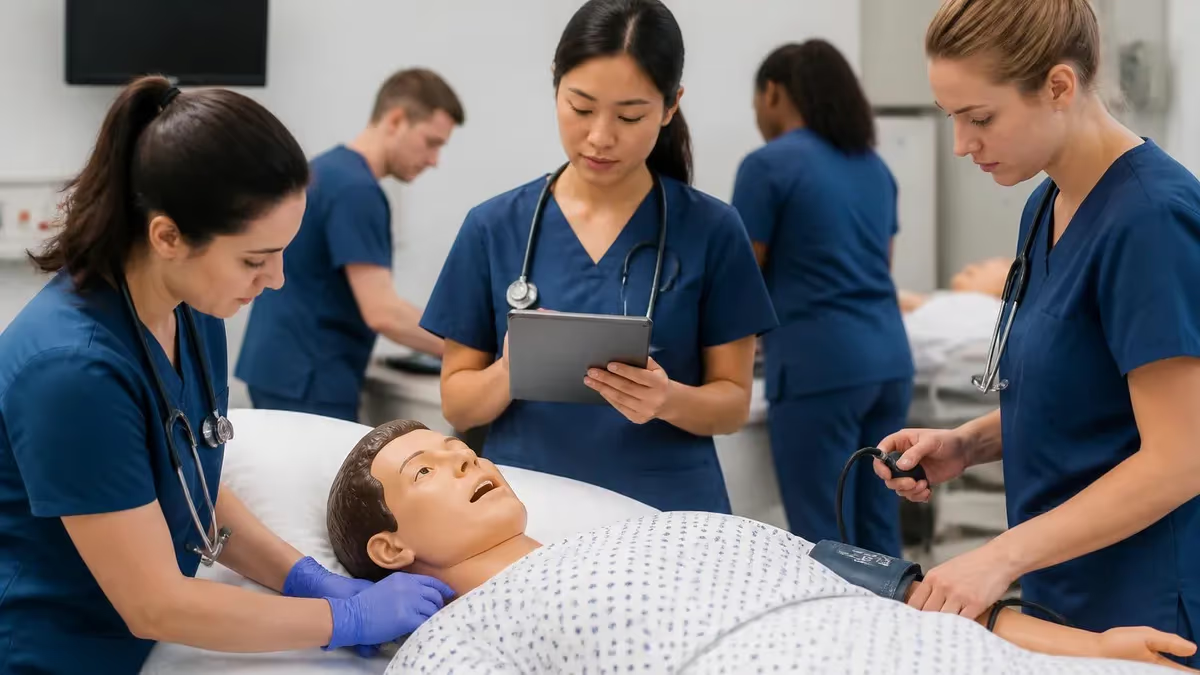
The CDPH CNA credential is the official certification that allows you to work as a Certified Nurse Assistant in California. It is issued and regulated by the California Department of Public Health.
Unlike many other states that lean on federal minimums, California sets its own bar for Nurse Assistant training and testing. That bar is meaningfully higher than what you will see in places like Texas, Florida, or Nevada.
If you plan to work in a skilled nursing facility, an intermediate care facility, or any long-term care setting in the state, the CDPH-issued certificate is not optional. Hospitals that hire patient care techs frequently require the CDPH CNA card too.
Most candidates run into the same kind of friction during the process. They start a training program before checking whether the school is on the CDPH-approved list. They apply through the wrong online system.
They forget to schedule Live Scan fingerprinting until the program ends, which delays everything by a month or more. Or they assume that an out-of-state CNA license transfers in cleanly when it usually does not.
This guide breaks down every CDPH-specific requirement, walks through the ATCS application portal step by step, explains the state competency exam delivered by D&S Diversified Technologies (Headmaster), and covers what most candidates miss at renewal time.
One thing worth saying up front. California's 150-hour training requirement is exactly double the federal floor of 75 hours. That extra clinical and theory time is not a formality.
It shapes how facilities trust new hires. It influences pay bands at large hospital systems. And it shows up on the competency exam in ways that catch under-prepared candidates by surprise.
If you trained in another state and you are trying to bring your card to California, you will almost certainly need to top up your hours before CDPH will even look at your application.
CDPH CNA By the Numbers
Key Facts at a Glance
| Item | Value | Details |
|---|---|---|
| Hours of state-approved training required | 150 | |
| Multiple-choice questions on the written exam | 60 | |
| Certificate validity before renewal | 2 yrs | |
| CE hours required per renewal cycle | 48 | |
| State certification fee (excluding testing & Live Scan) | $35 | |
| Minimum paid nursing work required for renewal | 8 hrs |
The Aide and Technician Certification Section, known as ATCS, is the unit inside the California Department of Public Health that processes every CNA application, renewal, and reciprocity request.
Their online portal is the only legitimate place to submit your paperwork. You will see third-party sites that promise to file on your behalf for a fee. Skip them.
The CDPH ATCS portal is free to use. The actual certification fee paid to the state is $35 for a new certificate.
Add the cost of fingerprinting (around $75 depending on the Live Scan vendor) and the testing fee (around $90 to $120 for the written or oral plus the manual skills section). Your total out-of-pocket lands between roughly $200 and $250 before any training tuition.
Here is a piece of advice nobody puts in the official guidebook. When you create your ATCS account, use a personal email that you check every day, not a school-issued one.
Approval emails and request-for-evidence letters land in inboxes that students forget about the moment they finish their program. Missing one of those emails can mean restarting parts of the application from scratch.
Same goes for your phone number. ATCS staff occasionally call to clarify documents, and an unreturned call holds the file.
ATCS Portal Quick Facts
The Aide and Technician Certification Section (ATCS) inside CDPH is the only legitimate way to apply, renew, or check status. The portal is free. Third-party 'expediting' services have no real ability to speed up state processing — they are a waste of money. Always use a personal email and current phone number on your ATCS account.
The state-approved training piece confuses a lot of people. California has hundreds of programs, but only the ones with current CDPH approval count.
Community colleges, regional occupational programs, Red Cross chapters, and many for-profit vocational schools all offer Nurse Assistant courses. Before you enroll, search the CDPH training program directory by county.
If a school is not on that list on the date you start, your hours will not transfer to your application — no matter how good the curriculum looks on paper. This is the single most common preventable mistake we see.
It is heartbreaking when a candidate finishes 150 hours only to learn the credit will not count.
The training itself splits into 60 hours of theory and 100 hours of clinical practice. The headline number is usually quoted as 150 because of how the clinical and lab hours are accounted.
The theory component covers infection control, communication, residents' rights, body mechanics, nutrition, and basic emergency procedures.
The clinical portion takes place in an actual long-term care facility supervised by an RN. You will perform real care tasks under direct observation: bed baths, transfers, vital signs, feeding assistance, range of motion exercises, and end-of-life care basics.
Programs typically run between 6 and 16 weeks depending on schedule density. Evening and weekend tracks exist but they stretch out the calendar.
California 150-Hour Program Breakdown
Infection control, communication, residents' rights, body mechanics, nutrition, basic emergencies, end-of-life care principles. Classroom-based and tested before clinical begins.
Supervised patient care in a real skilled nursing facility under an RN instructor. Real residents, real tasks: bed baths, transfers, vital signs, feeding, ROM, ostomy care, end-of-life support.
Practice each of the ~22 testable skills until you can perform them in the exact order the competency checklist requires. Skip a step and the evaluator marks you failed.
Internal exam before you sit the state competency test. Use this as a dress rehearsal and ask for skills retraining if anything feels shaky.
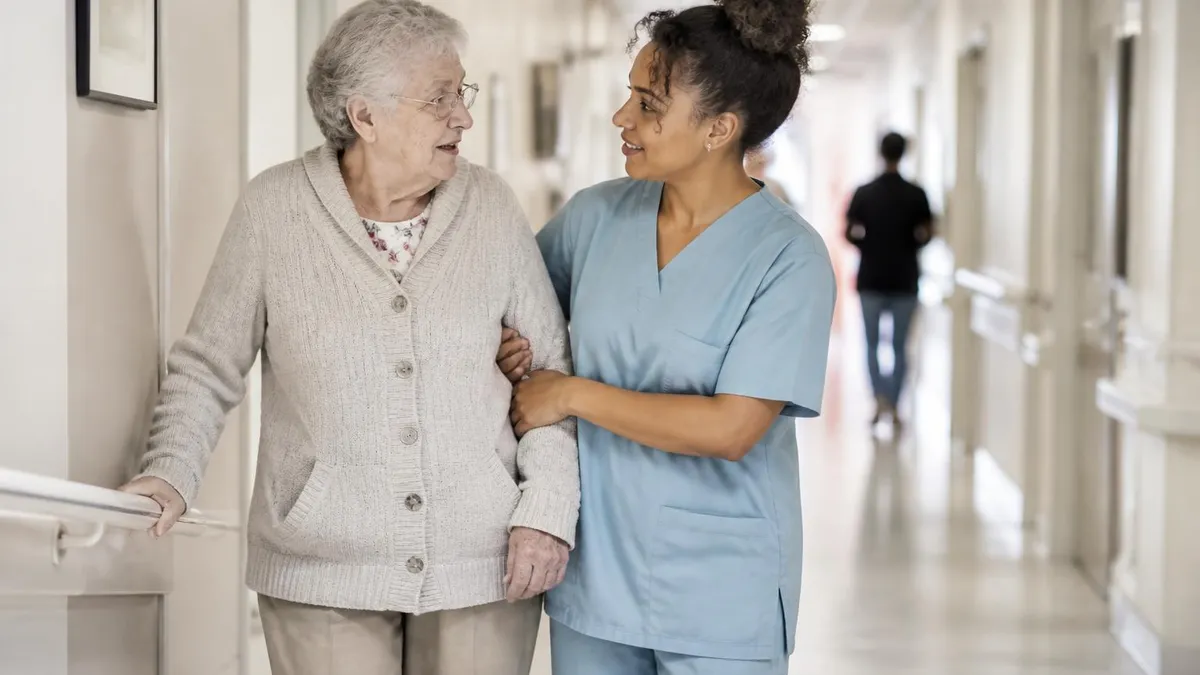
Fingerprinting in California means Live Scan, an electronic submission system that pushes your prints directly to the Department of Justice and the FBI for background checking.
The form you need is called the BCIA 8016 (Request for Live Scan Service). CDPH publishes a pre-filled version specific to CNA applicants on the ATCS site.
Print three copies. The Live Scan operator keeps one, you keep one, and you submit the third to CDPH if requested.
Pick a Live Scan location that handles healthcare submissions regularly. Some UPS Stores and check-cashing places offer Live Scan but their staff make small data-entry mistakes that bounce the submission.
Police stations and dedicated fingerprinting offices tend to be more reliable.
The background check itself looks at any criminal history that might disqualify you from working with vulnerable adults. Convictions involving violence, theft from elders, drug trafficking, and certain sexual offenses are automatic bars.
Other convictions may be eligible for a CDPH exemption review. That is a separate process where you submit court documents and explain rehabilitation.
If you have anything on your record, address it during the application rather than hoping it will be missed. ATCS finds everything, and an undisclosed prior is a far bigger problem than a disclosed one.
Live Scan and Background Check FAQ
Electronic fingerprinting that sends prints directly to the California DOJ and FBI. Replaces ink-card fingerprinting entirely. CDPH only accepts Live Scan submissions for CNA applicants.
The state competency evaluation has two parts: a written (or oral) knowledge exam and a manual skills demonstration.
Both are administered by D&S Diversified Technologies, doing business as Headmaster, the CDPH-approved outside testing vendor for the state competency exam. You will receive scheduling instructions from Headmaster after CDPH clears your eligibility.
The written exam contains 60 multiple-choice questions covering the same topical areas as your training. You need a passing score on each major content area, not just an overall percentage.
The oral version exists for candidates whose reading proficiency in English is limited. You can choose oral when you apply, and the questions are read to you with the same multiple-choice format.
The manual skills test is where most failures happen. You will be assigned five randomly selected skills out of a pool of about twenty-two.
Indirect care skills like hand washing and providing for resident privacy are included in every test. You must perform each skill exactly as the checklist requires, including infection control, communication with the simulated resident, and final cleanup.
The evaluator watches silently. Common failure points are forgetting to lock wheelchair brakes during transfers, skipping the hand hygiene step between tasks, and not informing the resident before each action.
If you fail any single skill, you must retest the entire skills portion, not just the failed item.
You get three attempts at the competency exam within a 24-month window before your training expires and you would need to retake the course. That sounds generous but it is tighter than it looks because each retest has to be rescheduled and paid for separately.
Most candidates pass on the first try if they have practiced the skills checklists deliberately. But rushing through a single skill demonstration is the fastest way to fail.
Forgetting hand hygiene between tasks, skipping wheelchair brake locks during transfers, not informing the simulated resident before each action, and rushing through indirect care steps are the four most common reasons candidates fail the manual skills portion. Slow down. The evaluator is timing for completeness, not speed.
Out-of-state CNAs assume reciprocity is straightforward and it usually is not. California will recognize an active CNA certificate from another state — but only under strict conditions.
Your training program must have met or exceeded California's hour requirements, and your home-state registry must show no findings of abuse, neglect, or misappropriation.
If you trained in a 75-hour or 100-hour state, you will need supplemental hours through a CDPH-approved program before the reciprocity application can be approved.
There is no formal supplemental program track. Most candidates end up taking specific modules at a community college and getting documentation to submit with their reciprocity packet.
Active military spouses get expedited processing and a fee waiver under California's expedited licensure law for military families.
If that applies to you, mention it explicitly in your ATCS application and attach a copy of military orders. The handling time drops from the standard 8 to 12 weeks down to roughly 4 weeks.
Refugees and asylees with foreign nursing credentials sometimes apply through reciprocity hoping their foreign training will count. It generally will not unless the credential was already converted to a US CNA certificate in another state.
Foreign-trained candidates almost always need to complete the full California 150-hour program.
CDPH CNA Application Checklist
- ✓Confirm your training program is on the current CDPH-approved list (search by county on the ATCS site)
- ✓Complete 150 hours of training (60 theory + 100 clinical) at the approved program
- ✓Create an ATCS account using a personal email you check daily — not a school address
- ✓Schedule Live Scan fingerprinting in your final week of training using the CDPH-specific BCIA 8016 form
- ✓Submit your ATCS application within 14 days of program completion
- ✓Wait for the eligibility letter (typically 4 to 8 weeks), then schedule with Headmaster (D&S Diversified Technologies)
- ✓Pass both the written (or oral) exam and the manual skills demonstration
- ✓Receive your CDPH CNA certificate by mail (4 to 6 weeks after passing both portions)
- ✓Register your card with your employer and begin working immediately
- ✓Track CE hours and the 8-hour paid-work minimum throughout your two-year renewal cycle
Renewal is straightforward but easy to miss. Your CDPH CNA certificate is valid for two years.
Renewal requires 48 hours of continuing education across the two-year cycle, with at least 12 of those hours completed during the second year. You also need to have worked at least eight hours providing nursing services for pay during the two-year period.
That work requirement is one of the most overlooked rules. If you stop working as a CNA, even briefly, and the renewal date arrives without those paid hours logged, your certificate lapses.
You then have to re-test through the competency exam to get back in.
Most employers track your CE hours and submit a renewal packet on your behalf. But the responsibility legally rests with you, not the facility.
Pull your own record from the ATCS portal once a year to confirm hours are posted correctly. Renewal can be filed up to 60 days before expiration, and CDPH recommends submitting at least 30 days out to avoid lapses.
Late renewals filed within 24 months of expiration are allowed with a delinquency fee. Past 24 months, you start over from scratch.
Reciprocity vs Retraining in California
- +Reciprocity saves $1,500 to $3,000 in training tuition if your home-state hours meet California's 150-hour minimum
- +Active duty military spouses qualify for expedited processing and fee waivers under California's expedited licensure law
- +Existing clinical experience strengthens your job applications even before the card arrives
- +ATCS reciprocity decisions average 6 to 10 weeks, faster than completing a new 150-hour program
- −If your home-state training was 75 or 100 hours, you must take supplemental coursework through a CDPH-approved program before reciprocity applies
- −Foreign nursing credentials almost never satisfy reciprocity — most internationally trained candidates must complete the full California program
- −Federal-registry findings of abuse or neglect from any state are immediate disqualifiers, even if your home-state license remains active
- −Self-employment as a private caregiver in your prior state does not count toward documented patient-care hours
A few application errors come up over and over again and are worth flagging.
Name mismatches between your training certificate, Live Scan submission, and ATCS application cause automatic holds. Make sure all three documents show your legal name exactly the same way, including middle names and suffixes.
Address changes during the application window also delay processing because the background check is tied to the address on file.
Incomplete clinical hours from a training program that ended early (common during COVID-era cohorts) require a written explanation from the program director.
Self-employment as a private caregiver does not count toward the 8-hour paid work requirement for renewal unless you can document W-2 or 1099 earnings tied to nursing tasks.
Finally, do not pay anyone to expedite your application. ATCS has internal processing times that are not affected by third-party services.
The only legitimate expedited pathways are the military spouse track and certain disaster-response waivers that CDPH announces publicly. Anything else is a scam.
Save your money for the actual fees and for a solid review course before the competency exam. Practice testing is where the ROI is real.
Once you have your CDPH CNA card in hand, the job market in California is one of the strongest in the country.
Skilled nursing facilities, hospitals, home health agencies, and hospice organizations all compete for certified candidates. California's minimum wage rules plus union density in metro areas push CNA pay above the national average.
Entry-level wages typically start in the $19 to $23 per hour range in Los Angeles, San Diego, the Bay Area, and Sacramento.
Experienced CNAs and those with specialty certifications (Restorative Nurse Assistant, Hemodialysis Technician) earn $26 to $32 per hour in major systems.
Career laddering is a real option. Many California community colleges run articulated pathways from CNA to LVN (Licensed Vocational Nurse) and from LVN to RN, with prior CNA hours counting toward admission preference.
If nursing is your long-term goal, get the CDPH CNA, work for 12 to 18 months to build clinical confidence and patient care references, then apply to an LVN program.
The CNA experience translates directly into stronger performance in pharmacology, med-surg fundamentals, and clinical rotations.
The students who skip CNA and jump straight into LVN or BSN programs often struggle with the practical care side of nursing in their first clinical year.
If you are starting from zero today, here is the realistic sequence.
Pick a CDPH-approved training program in your county that fits your schedule, ideally one connected to a community college. Tuition is meaningfully lower than for-profit alternatives, and the credit hours often transfer toward future nursing degrees.
Complete the 150-hour program. Schedule Live Scan during your final week of training, not after, so the fingerprints are processed in parallel with your final paperwork.
Submit the ATCS application within two weeks of program completion to keep your training current.
Schedule the competency exam as soon as ATCS approves your eligibility letter. Waitlists at popular testing sites can stretch four to six weeks during peak months.
Pass the exam, get the card, and start applying. The whole sequence from enrollment to first paycheck typically takes 14 to 22 weeks if you keep paperwork moving and avoid the common pitfalls.
Use the practice questions and skills checklists linked throughout this guide. Candidates who deliberately practice the exam format pass at significantly higher rates than those who only rely on classroom review.
The CDPH CNA process is not difficult if you respect the order of operations. But it punishes shortcuts and assumptions. Take it one step at a time and you will be on the floor caring for residents in a few months.
Sample CNA Practice Questions
Try these questions from our free CNA practice tests. The correct answer and an explanation follow each question.
A resident tells a nurse aide, 'My daughter took all the money from my wallet last week and won't give it back.' The nurse aide should:
- A. Tell the resident this is a family matter and the facility cannot get involved
- B. Advise the resident to talk to their daughter directly and resolve it privately
- C. Report the disclosure to the charge nurse immediately, as this may be financial exploitation
- D. Ask other staff whether they have noticed money missing from the resident before reporting
Answer: C. Report the disclosure to the charge nurse immediately, as this may be financial exploitation
Taking a resident's money or property without permission is financial exploitation — a form of abuse. The nurse aide must report this disclosure immediately to the charge nurse. Family relationship does not exempt someone from abuse reporting requirements.
The nurse aide is going to help the client walk from the bed to a chair. What should the nurse aide put on the client’s feet?
- A. Nothing
- B. Cloth-soled slippers
- C. Rubber-soled slippers or shoes
- D. Socks or stockings only
Answer: C. Rubber-soled slippers or shoes
When helping a client walk, it is crucial to ensure their footwear provides good traction and stability to prevent falls. Rubber-soled slippers or shoes offer the best grip on various floor surfaces, reducing the risk of slipping. Cloth-soled slippers or socks alone do not provide adequate friction and can be dangerous.
After Mr. Johnson’s bath, the nurse aide realizes she needs another towel to completely dry Mr. Johnson. The nurse aide should
- A. ask Mr. Johnson to wait while you quickly go to get a clean towel.
- B. use a towel left in the shower room by another aide.
- C. use Mr. Johnson's clothing to dry him.
- D. ask a co-worker to bring a towel from the clean linen cart.
Answer: D. ask a co-worker to bring a towel from the clean linen cart.
Leaving a client unattended, especially during a bath, can compromise their safety, privacy, and dignity. Asking a co-worker to retrieve a clean towel ensures the client remains safe and attended to, while also maintaining the sterility of the clean linen supply. This demonstrates good teamwork, adherence to patient safety protocols, and efficient workflow without compromising care.
A nursing assistant is helping a resident to walk. If the resident becomes faint and begins to fall, the assistant should
- A. Hold the resident up and continue walking
- B. Ease the resident to the floor and call for help
- C. Carry the resident back to bed and then go for help
- D. Hold the resident up and call for help
Answer: B. Ease the resident to the floor and call for help
If a resident begins to fall, the safest action is to ease them gently to the floor, controlling the fall as much as possible, to minimize injury to both the resident and the aide. Attempting to hold them up completely can result in injury to both parties due to the sudden shift in weight. Once safely on the floor, the aide should call for help and assess the resident for injuries before attempting to move them.
CNA Questions and Answers
About the Author

Registered Nurse & Healthcare Educator
Johns Hopkins University School of NursingDr. Sarah Mitchell is a board-certified registered nurse with over 15 years of clinical and academic experience. She completed her PhD in Nursing Science at Johns Hopkins University and has taught NCLEX preparation and clinical skills courses for nursing students across the United States. Her research focuses on evidence-based exam preparation strategies for healthcare certification candidates.
Join the Discussion
Connect with other students preparing for this exam. Share tips, ask questions, and get advice from people who have been there.
View discussion (8 replies)