
CHFI vs CEH: Which Cybersecurity Certification Is Right for Your Career?
CHFI vs CEH compared side by side — costs, difficulty, salary, and career paths. 🎓 Find out which cybersecurity cert fits your goals in 2026 October.

When cybersecurity professionals debate chfi vs ceh, they are really asking a deeper question: do you want to investigate digital crimes after they happen, or do you want to think like an attacker to stop them before they occur? Both credentials are issued by EC-Council, both are globally recognized, and both can meaningfully accelerate a cybersecurity career — yet they serve fundamentally different roles in the security ecosystem.
Understanding where each certification fits will save you months of prep time and thousands of dollars in tuition and exam fees. If you are serious about the chfi path, this comparison will give you a clear, unbiased breakdown of every factor that matters.
The Certified Ethical Hacker (CEH) credential has been around since 2003 and is widely considered an entry point into offensive security. It teaches penetration testing methodologies, vulnerability scanning, social engineering, and network-level attack techniques. Employers looking for red-team members, penetration testers, or security analysts frequently list CEH as a preferred or required qualification. The exam is challenging but broad, covering roughly 20 domains of ethical hacking knowledge that range from footprinting and reconnaissance all the way to cloud and IoT attacks.
The Computer Hacking Forensic Investigator, better known as CHFI, takes the opposite vantage point. Rather than simulating an attack, CHFI professionals arrive after the breach has already occurred. Their job is to preserve digital evidence, reconstruct timelines, identify threat actors, and present findings in a legally defensible manner. Law enforcement agencies, corporate legal teams, insurance investigators, and government agencies all rely on CHFI-certified professionals to handle sensitive post-incident work. The chfi certification validates that you can perform this work to an internationally accepted standard.
Salary data from 2025 and early 2026 paints an interesting picture. CEH holders typically report median salaries in the $85,000 to $105,000 range for mid-level roles in the United States, with penetration testers in high-cost-of-living markets sometimes exceeding $130,000. CHFI professionals tend to cluster in the $75,000 to $100,000 band, though senior digital forensics examiners working for federal agencies or major financial institutions can earn significantly more. Neither credential dominates on compensation — much depends on the specific role, industry vertical, and geographic market.
Job demand for both credentials has grown sharply since 2020, driven by the surge in ransomware attacks, data breaches, and regulatory scrutiny around incident response. The U.S. Bureau of Labor Statistics projects information security analyst employment to grow 32 percent through 2032, far outpacing average job growth across all industries. That rising tide lifts both CEH and CHFI professionals, but the types of organizations hiring each are quite different. Law firms, insurance companies, and government agencies lean heavily toward CHFI, while technology startups, managed security service providers (MSSPs), and consulting firms tend to prioritize CEH or related offensive credentials.
Preparation difficulty is another major differentiator. The CEH exam (312-50) consists of 125 multiple-choice questions administered over four hours, with a passing threshold around 70 percent depending on the exam form. Most candidates report needing 60 to 100 hours of structured study, and EC-Council's official courseware is dense but comprehensive.
The CHFI exam (312-49) is similarly structured at 150 questions over four hours, but the subject matter — evidence acquisition, chain of custody, file system forensics, memory analysis, mobile device forensics — requires hands-on familiarity with specialized tools like Autopsy, FTK, and EnCase that many candidates encounter for the first time during prep.
This article will walk you through every meaningful dimension of the chfi vs ceh debate: prerequisites, exam formats, costs, career paths, and which credential makes the most sense depending on where you are in your cybersecurity journey. Whether you are a recent graduate mapping out your first certifications or an experienced IT professional pivoting into security, the analysis below will help you make a confident, well-informed decision about where to invest your time and money in 2026.
CHFI vs CEH by the Numbers

Key Differences: CHFI vs CEH at a Glance
CEH targets offensive security — how attackers think and operate. CHFI targets defensive forensics — how investigators collect, preserve, and analyze digital evidence after a breach. These are opposite ends of the security lifecycle, requiring different mindsets and toolsets.
CEH (312-50) features 125 questions in 4 hours; CHFI (312-49) has 150 questions in 4 hours. Both use multiple-choice format with a passing score around 70%. CHFI questions lean more heavily on tool-specific and procedural knowledge than CEH.
CEH holders are sought by MSSPs, consultancies, and tech companies building red teams. CHFI professionals are hired by law enforcement, legal firms, financial institutions, government agencies, and corporate compliance departments that handle post-incident investigations.
Both credentials require 120 EC-Council Continuing Education (ECE) credits over a 3-year cycle to maintain certification. Earning CEH and CHFI simultaneously counts shared credits, making dual-certification an efficient long-term investment for security generalists.
Before registering for either exam, candidates must understand the eligibility requirements that EC-Council enforces. For the CHFI certification, you need to either complete an official EC-Council training program or demonstrate at least two years of information security work experience. This experience requirement is not a formality — EC-Council's application process requires you to submit a signed affidavit and sometimes supporting documentation from your employer. The chfi cert is not designed for entry-level candidates, and exam centers do verify credentials before allowing registration to proceed.
CEH has similar gating. You can bypass the experience requirement by attending an authorized EC-Council training program, which typically runs three to five days and costs between $1,500 and $3,000 depending on the provider. Alternatively, you need two years of demonstrated information security experience, also verified through an application. Many candidates who attempt CEH without the training or solid hands-on background struggle with the exam's scenario-based questions, which assume familiarity with real attack tools like Metasploit, Wireshark, Nmap, and Burp Suite.
For IT professionals already holding CompTIA Security+, the jump to either CHFI or CEH is manageable but still significant. Security+ covers about 30 to 40 percent of the material tested on CEH and perhaps 20 to 25 percent of CHFI content, since forensics tools and procedures are largely outside the CompTIA ecosystem. If you hold CompTIA CySA+ (Cybersecurity Analyst), you will find more overlap with CHFI's incident analysis modules. Network+ and A+ holders should plan for at least 80 to 120 hours of dedicated study before feeling prepared for either EC-Council exam.
One commonly overlooked prerequisite for CHFI is a working familiarity with legal frameworks. Digital evidence is only useful if it is collected in a way courts will accept. CHFI candidates must understand concepts like the Federal Rules of Evidence, chain of custody documentation, admissibility standards, and expert witness obligations. This legal dimension makes CHFI somewhat unique among technical certifications — it is not enough to know how to extract a forensic image; you must know how to prove to a judge that the image was taken correctly and has not been tampered with since collection.
CEH prerequisites skew more toward networking fundamentals. Understanding TCP/IP, packet structure, routing protocols, DNS, and HTTP is essential for making sense of attack methodologies. Many CEH study guides recommend candidates hold or be comfortable with material equivalent to CompTIA Network+ before diving into ethical hacking content. Without that foundation, concepts like ARP poisoning, session hijacking, and buffer overflows will feel disconnected and abstract rather than grounded in how real networks operate.
Both exams are available through Pearson VUE testing centers and can also be taken as remote proctored exams through EC-Council's own ECCEXAM platform. The remote proctoring option has improved considerably since 2022 and is now a reliable alternative for candidates who do not live near a testing center. However, the technical requirements — stable internet, a webcam, a cleared desk, a specific browser — must be verified well in advance of exam day. Technical failures during a remote proctored attempt can result in exam forfeiture, so testing center delivery remains the lower-risk option for most candidates.
One strategic consideration that many candidates overlook is the sequencing of these credentials. A significant number of working security professionals pursue CEH first, spend three to five years doing penetration testing or security analysis work, and then add CHFI to transition into forensics or incident response leadership roles. This sequence gives you the attacker's mindset before you start reconstructing what attackers actually did — a perspective that forensics professionals find invaluable when interpreting evidence and attributing responsibility for a breach.
CHFI Certification Cost vs CEH: Full Breakdown
The CHFI exam voucher costs approximately $500 to $550 when purchased directly through EC-Council, while the CEH exam voucher runs similarly at $500 to $600. Both prices are subject to change and may vary slightly by region. Candidates who purchase official EC-Council training bundles often receive the exam voucher included in the package price, which can represent meaningful savings when training costs $1,500 to $3,000 on their own. Always verify current pricing at EC-Council's official website before budgeting your certification investment.
Retake fees apply if you do not pass on the first attempt. EC-Council charges $150 to $250 per retake depending on which exam and region. Most candidates who prepare thoroughly with practice exams and hands-on labs pass on their first attempt, but budgeting for one retake is a prudent financial plan. Third-party practice test providers and study guides run an additional $50 to $200, making total preparation costs realistically land between $700 and $1,200 for a well-prepared candidate pursuing either credential.

CHFI vs CEH: Pros and Cons for Your Career
- +CHFI is uniquely valued in law enforcement, legal, and government roles that CEH does not target
- +CEH is more widely recognized by private-sector employers as an offensive security baseline
- +Both credentials are issued by EC-Council, so renewal credits can be shared across certifications
- +CHFI teaches legally defensible evidence handling, a skill set with no direct CEH equivalent
- +CEH provides hands-on exposure to real attack tools used daily by penetration testers
- +Dual CHFI + CEH certification positions professionals for senior incident response leadership roles
- −Both exams cost $500 or more per attempt, plus additional training costs of $1,000 to $3,000
- −CEH knowledge dates quickly as new attack vectors emerge, requiring continuous CPE investment
- −CHFI is less recognized outside of forensics-specific roles, limiting general security job applications
- −Neither credential alone is sufficient for senior positions — experience and additional certs are expected
- −The EC-Council 120 ECE renewal requirement every three years demands ongoing time and financial commitment
- −CHFI's legal and procedural content has a steep learning curve for candidates from purely technical backgrounds
Pros and Cons at a Glance
| Pros | Cons |
|---|---|
| CHFI is uniquely valued in law enforcement, legal, and government roles that CEH does not target | CEH knowledge dates quickly as new attack vectors emerge, requiring continuous CPE investment |
| CEH is more widely recognized by private-sector employers as an offensive security baseline | CHFI is less recognized outside of forensics-specific roles, limiting general security job applications |
| Both credentials are issued by EC-Council, so renewal credits can be shared across certifications | Neither credential alone is sufficient for senior positions — experience and additional certs are expected |
| CHFI teaches legally defensible evidence handling, a skill set with no direct CEH equivalent | CHFI's legal and procedural content has a steep learning curve for candidates from purely technical backgrounds |
Career Path Checklist: CHFI vs CEH Decision Guide
- ✓Identify whether your target employer values offensive (CEH) or investigative (CHFI) skills more heavily.
- ✓Confirm you meet the two-year experience requirement or plan to attend official EC-Council training.
- ✓Review current job postings in your area and count how often each certification appears as required or preferred.
- ✓Budget a realistic total of $1,000 to $1,500 for exam fees, study materials, and one potential retake.
- ✓Schedule at least 80 hours of dedicated study time over 8 to 12 weeks before your exam date.
- ✓Set up a home lab with Autopsy, FTK Imager, or Wireshark to practice tool-based forensics scenarios.
- ✓Complete at least 300 practice questions per certification before registering for the real exam.
- ✓Request employer tuition reimbursement in writing before paying any registration or training fees.
- ✓Plan your EC-Council application submission at least 3 to 4 weeks before your intended exam date.
- ✓Map out a continuing education plan to earn 120 ECE credits over three years after passing.
Start with CEH if You Are Unsure — Then Add CHFI
Career advisors consistently recommend CEH as the first EC-Council certification because it opens more doors across the broadest range of security roles. Once you have two to three years of security experience under your belt, adding CHFI transforms your profile from generalist to specialist and makes you competitive for the fastest-growing segment of the market: forensics, incident response, and post-breach investigation.
Choosing between CHFI and CEH ultimately comes down to three questions: What kind of work energizes you? What does your target employer value? And where do you want to be in five years? If the idea of sitting across from a compromised server, methodically extracting evidence, and reconstructing what a threat actor did excites you, CHFI is almost certainly the right fit. If you prefer the puzzle-solving challenge of finding vulnerabilities before attackers do, CEH aligns with your instincts and the penetration testing career path that flows from it.
Industry sector matters enormously here. The legal and compliance world — law firms, corporate legal departments, regulatory agencies, and insurance adjusters — relies heavily on CHFI professionals. When a company experiences a data breach, its lawyers need someone who can appear in court and explain how the evidence was collected and why it should be trusted. That someone needs the CHFI credential and the procedural knowledge that comes with it. No amount of ethical hacking experience substitutes for that specific competency in a courtroom or regulatory hearing.
The private technology sector, on the other hand, leans harder toward CEH and related offensive credentials. Startups building security products, consulting firms offering penetration testing services, and MSSPs managing security operations for hundreds of clients all need people who can actively probe systems, identify weaknesses, and recommend remediations. These organizations tend to view forensics as a reactive capability — important, but secondary to prevention. CEH aligns squarely with the prevention-first mindset that dominates in technology-driven industries.
Government and defense sector roles represent an interesting middle ground. Agencies like the FBI, DHS, and the various branches of the military's cyber commands value both credentials, often requiring forensics investigators to also understand offensive techniques and vice versa. Contractors supporting these agencies — companies like Booz Allen Hamilton, SAIC, Leidos, and Raytheon — regularly post job descriptions listing both CEH and CHFI as preferred qualifications alongside clearance requirements. If federal work is your ambition, pursuing both credentials over a two- to three-year window is a well-established career strategy.
Healthcare and financial services are two more sectors worth examining separately. Healthcare organizations deal with HIPAA breach notification requirements that mandate specific investigation procedures — procedures that map directly to CHFI's chain-of-custody and evidence-handling curriculum. Financial institutions subject to regulations like PCI DSS, GLBA, and SOX face similar mandates. Compliance teams in these industries are increasingly seeking CHFI professionals who can manage the forensics component of regulatory breach response, not just the technical remediation piece that a generalist security analyst would handle.
The cloud computing dimension has grown significantly in recent CHFI exam versions. Cloud forensics — investigating incidents that occur in AWS, Azure, or Google Cloud environments — presents unique challenges because cloud infrastructure is ephemeral and shared. Evidence that would exist on a physical server may not persist in a cloud environment after an instance is terminated. CHFI v10 and the upcoming v11 both emphasize cloud forensics, IoT forensics, and dark web investigations as emerging practice areas. Candidates who develop deep expertise in these sub-specialties will find themselves ahead of the market in a sector where forensics professionals are scarce.
Ultimately, the chfi vs ceh decision is not permanent. Many of the most respected security professionals in the industry hold both credentials alongside others like CISSP, GCIH, or GCFE. Treating certification as a career-long investment rather than a one-time achievement positions you to adapt as the threat landscape evolves. If budget and time allow, a multi-year plan that includes both credentials — CEH first, CHFI second — will give you the broadest possible foundation and the most flexibility as your career develops.

EC-Council requires that your eligibility application be approved before you can purchase an exam voucher. The approval process can take two to three weeks, and applications missing documentation are returned without action, restarting the clock. Submit your application at least four weeks before your planned exam date to avoid scheduling delays — and double-check that your experience documentation covers the full two-year minimum before submitting.
Once you have decided which credential to pursue first, building an effective study plan is your most important next step. Both the CHFI and CEH exams reward systematic preparation over cramming, and candidates who spread their study across eight to twelve weeks consistently outperform those who attempt an intensive two-week sprint. The primary reason is retention: cybersecurity concepts build on each other in ways that require time for the underlying mental models to solidify before advanced topics make sense.
For CHFI preparation specifically, begin with the conceptual framework of digital forensics: what constitutes evidence, how the investigative process works, and what legal standards govern admissibility. The EC-Council courseware covers this in the opening modules, and it provides the scaffolding that makes all subsequent tool-specific content more meaningful. Without this foundation, memorizing commands in FTK or procedures in Autopsy feels like rote learning rather than understanding. Understanding why you perform each step is what lets you adapt when the exam presents a scenario you have not seen before.
Practice questions are essential for both exams, but they serve a different purpose than simply accumulating correct answers. The most valuable practice questions are the ones you get wrong — they reveal gaps in your understanding that reading alone cannot expose. After each incorrect answer, read the full explanation carefully, locate the relevant section of your study material, and re-read it within 24 hours. This active error-correction loop is the single highest-return study activity available, and candidates who follow it consistently report significantly better first-attempt pass rates than those who simply read through question banks without analyzing misses.
Hands-on lab practice is non-negotiable for CHFI. The exam includes scenario-based questions that describe a specific forensic situation — a suspected insider threat, a ransomware infection, a compromised mobile device — and ask what tool you would use, what command you would run, or what procedure you would follow. These questions are nearly impossible to answer correctly from reading alone. Spin up a virtual lab environment using free tools like VirtualBox, install Autopsy and FTK Imager, and practice acquiring forensic images from virtual disks. Even five to ten hours of hands-on work will dramatically improve your performance on scenario questions.
CEH preparation follows a similar logic but with different tools. Install Kali Linux in a virtual machine and work through the core toolkit: Nmap for network scanning, Metasploit for exploitation practice, Wireshark for packet analysis, and Burp Suite for web application testing. EC-Council's iLabs platform provides structured lab environments that align directly with exam domains, and purchasing iLabs access alongside your study materials is money well spent. The practical, hands-on nature of ethical hacking means you will learn more in one hour of active lab work than in three hours of passive reading.
Study groups and online communities are underrated resources for both exams. The Reddit communities r/CEH and r/computerforensics both contain active discussions, study tips, and exam experience reports from recent test-takers. EC-Council's own community forum also has subject-matter experts who answer questions.
Engaging with these communities early in your preparation — rather than waiting until the week before your exam — gives you access to a collective knowledge base that no single study guide can replicate. Peers who recently passed can tell you exactly which domains received heavy emphasis on their specific exam version and which areas you can afford to cover more lightly.
Finally, treat the week before your exam as a review period, not a learning period. If there are major topics you have not yet studied by the seven-day mark, accept that you will have gaps and focus on consolidating what you already know. Attempting to learn new material in the final days introduces stress and confusion that undermines the retention of concepts you have already mastered.
Run through your weakest areas one more time, skim your notes on legal frameworks or key tool commands, get eight hours of sleep the night before, and arrive at the testing center or log into your remote exam platform with calm confidence built on weeks of disciplined preparation.
As you finalize your certification strategy, it is worth zooming out to consider how the cybersecurity credential landscape is evolving in 2026. The proliferation of certifications over the past decade has made the market more competitive and, frankly, more confusing for employers trying to evaluate candidates.
A CHFI or CEH credential from EC-Council carries weight partly because EC-Council has maintained consistent quality and global recognition since the early 2000s. But employers are increasingly pairing credential verification with practical assessments — coding challenges, live forensics exercises, or CTF participation records — to distinguish candidates who have real skills from those who simply tested well.
This shift toward practical validation actually benefits candidates who prepared with hands-on labs rather than passive reading. If you built a home forensics lab, practiced with real forensic tools, and participated in platforms like CyberDefenders or BlueTeamLabs Online during your CHFI preparation, you will have concrete portfolio evidence to present alongside your certification. Similarly, CEH candidates who maintained a record of Hack The Box or TryHackMe completions during their study period have something tangible to show employers beyond the certification line on their resume. Treat your preparation period as a portfolio-building exercise, not just an exam-passing exercise.
The geographic dimension of the job market also deserves attention. Remote work has significantly expanded access to high-paying security roles for professionals who do not live in traditional tech hubs. CHFI professionals in particular are finding remote forensics consultant roles that were once exclusively on-site in major cities.
Law firms and corporations now regularly engage remote digital forensics specialists on a per-incident basis, creating a consulting market that rewards deep expertise over proximity to a major office. Building a reputation in the forensics community through conference presentations, blog posts, or open-source tool contributions can open these consulting opportunities in ways that a certification alone cannot.
For candidates early in their cybersecurity careers, the question of which certification to pursue first is less important than simply beginning. The biggest risk is analysis paralysis — spending months researching the perfect certification sequence while peers are already accumulating hands-on experience and credentials. Both CHFI and CEH are excellent investments in your professional future. Both are achievable with disciplined preparation. Both will open doors that are currently closed to you as an uncertified candidate. Pick one, build a study plan, schedule your exam date, and start the work. The perfect credential strategy is the one you actually execute.
A word about the CHFI radio confusion that occasionally appears in search results: the keyword cluster around this topic includes traffic from people searching for 98.1 CHFI, a Canadian radio station broadcasting from Toronto. If you landed here looking for the radio station, CHFI FM 98.1 is an adult contemporary radio station in Toronto, Ontario — entirely unrelated to the EC-Council cybersecurity certification that this article covers. The cybersecurity CHFI stands for Computer Hacking Forensic Investigator, not the call letters of the CHFI FM radio station. Both are legitimate searches; they just lead to very different destinations.
Looking five years into the future, the professionals who will be most valuable in the cybersecurity market are those who combine technical depth with business acumen and communication skills. A CHFI professional who can write a clear, executive-ready incident report is worth far more than one who can only produce technical logs.
A CEH professional who can articulate the business risk implications of a discovered vulnerability — not just the CVSS score — will advance faster than peers who speak only in technical terms. Both certifications now include elements that address this communication dimension, and candidates who lean into those modules rather than skimming them are setting themselves up for leadership trajectories.
The bottom line on chfi vs ceh is this: if you want to investigate, attribute, and prosecute cybercrime, CHFI is your credential. If you want to simulate attacks and help organizations fix their defenses before a real attacker finds the same holes, CEH is your credential.
If you want to do both — and the most resilient cybersecurity careers often do — plan a two- to three-year roadmap that earns you both certifications alongside meaningful hands-on experience. The investment is substantial, but the career reward, measured in job security, compensation, and professional satisfaction, makes it one of the most reliable returns available in the technology sector today.
Sample CHFI - Computer Hacking Forensic Investigator Practice Questions
Try these questions from our free CHFI - Computer Hacking Forensic Investigator practice tests. The correct answer and an explanation follow each question.
A CHFI is conducting dynamic analysis of a suspected ransomware sample in an isolated, sandboxed environment. Which of the following actions would be the primary focus of the analyst's monitoring to confirm the malware's classification and behavior?
- A. Observing rapid and widespread file read/write/rename operations, especially with a new file extension being added.
- B. Analyzing the PE header of the file to determine the compile time and linked libraries.
- C. Extracting all embedded strings from the binary to look for keywords like 'encrypt'.
- D. Checking for an increase in CPU usage and memory consumption by the suspicious process.
Answer: A. Observing rapid and widespread file read/write/rename operations, especially with a new file extension being added.
Dynamic analysis focuses on observing the malware's behavior at runtime. The defining characteristic of ransomware is its encryption of user files. Therefore, monitoring for high-volume file system I/O, particularly operations that involve reading original files and writing newly encrypted versions (often with a specific extension), is the most direct way to observe and confirm its malicious intent.
During an investigation into a suspected malware infection, a CHFI analyst discovers an unusually high volume of DNS queries for various, seemingly random subdomains of a single parent domain (e.g., `axj34.evil.com`, `b9dk1.evil.com`). The compromised host is not receiving valid IP addresses in response. This pattern is a strong indicator of which activity?
- A. Data exfiltration or Command and Control (C2) communication using DNS tunneling.
- B. A DNS zone transfer attempt to enumerate all hosts in the domain.
- C. A Distributed Denial of Service (DDoS) attack against the organization's DNS server.
- D. A DNS amplification attack originating from the compromised host.
Answer: A. Data exfiltration or Command and Control (C2) communication using DNS tunneling.
This pattern is a classic indicator of DNS tunneling, a technique used to bypass firewalls by encoding data into DNS queries. Malware on a compromised host encodes stolen data or C2 communications into the subdomain portion of a DNS query, which is then sent to a malicious DNS server controlled by the attacker. The high volume of queries with long, randomized subdomains is a key giveaway.
During the analysis of a suspect's Windows user profile, a forensic examiner is trying to reconstruct the user's folder navigation habits, including which folders were opened and what view settings were used (e.g., Details, Icons). Which of the following artifacts specifically stores this type of information?
- A. Prefetch files
- B. Shimcache (Amcache.hve)
- C. The Security Account Manager (SAM) hive
- D. Shellbags
Answer: D. Shellbags
Shellbags are a set of registry keys that store details about a user's viewing preferences for folders in Windows Explorer, such as window size, position, and view mode. Analyzing Shellbags can reveal which folders a user has accessed, even if those folders no longer exist, providing a history of directory navigation.
A CHFI investigator discovers an encrypted TrueCrypt/VeraCrypt container. Which approach is legally and forensically sound?
- A. Delete the container since it cannot be analyzed
- B. Image the container and attempt password attacks in a lab environment
- C. Directly mount the container on the evidence drive
- D. Ask the suspect for the password verbally without documentation
Answer: B. Image the container and attempt password attacks in a lab environment
The correct approach is to image the encrypted container and perform password/brute-force attacks against the copy in a controlled lab to avoid altering the original.
Take the full CHFI - Computer Hacking Forensic Investigator practice test
CHFI Questions and Answers

CHFI Computer Hacking Forensic Investigator Practice Test PDF (Free Printable 2026)
CHFI Practice Test Video Answers
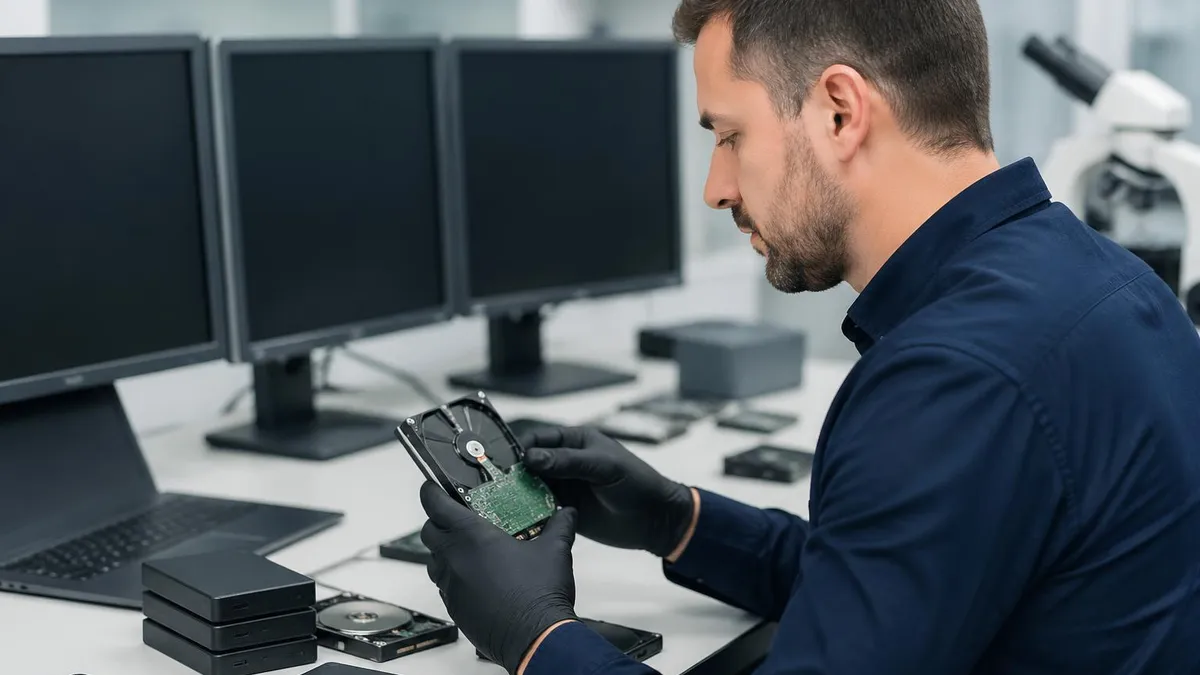
CHFI Certification: Complete Guide to Computer Hacking Forensic Investigation

Master the CHFI Certification: 7 Essential Tips

CEH vs CHFI: Which Cybersecurity Certification Is Right for Your Career?
About the Author

Educational Psychologist & Academic Test Preparation Expert
Columbia University Teachers CollegeDr. Lisa Patel holds a Doctorate in Education from Columbia University Teachers College and has spent 17 years researching standardized test design and academic assessment. She has developed preparation programs for SAT, ACT, GRE, LSAT, UCAT, and numerous professional licensing exams, helping students of all backgrounds achieve their target scores.