
Certified Welder: Complete Study Guide 2026
🧠 Free Certified Welder: Complete Study Guide practice test with questions and answer explanations. Prepare for the 2026 exam with instant scoring.
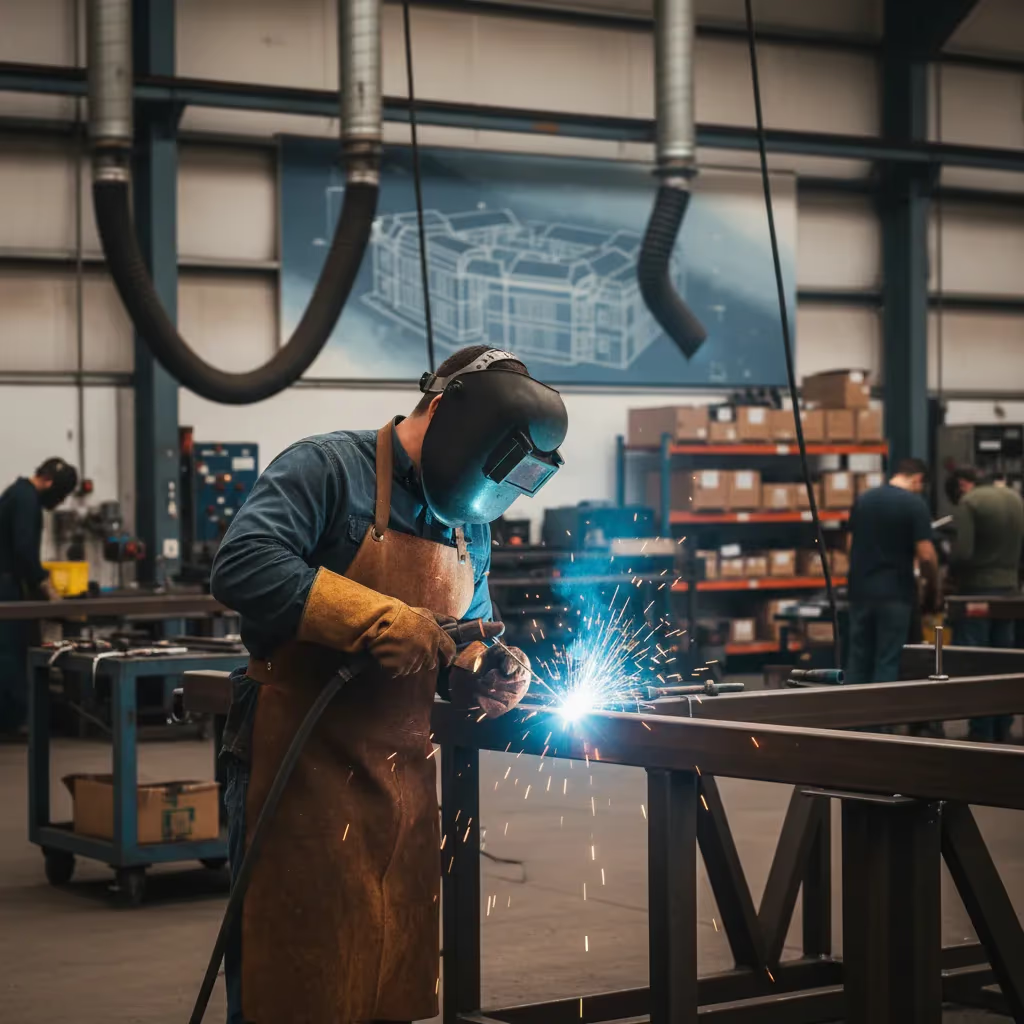
Certified Welder Exam Overview
The Certified Welder exam validates your knowledge and skills in the field. Understanding the exam format, duration, and passing requirements is the first step toward successful preparation. Practice with the free Certified Welder practice test on PracticeTestGeeks (9 questions with answer explanations).
Before diving into study materials, take a certified welder to assess your current knowledge level. This baseline assessment helps you identify which topics need the most attention and creates a more efficient study plan.
| Exam Detail | Information |
|---|---|
| Exam Format | Multiple choice and scenario-based questions |
| Duration | Varies by certification level |
| Passing Score | Determined by the certifying body |
| Prerequisites | Check official requirements for your level |
| Recertification | Periodic renewal required |
- The AWS Certified Welder test is a hands-on welding performance test with no written exam: the candidate welds to a specific Welding Procedure Specification. (American Welding Society)
- An AWS Certified Welder test is passed when the completed weld meets the acceptance criteria of the applicable code or standard on inspection; there is no numeric passing score. (American Welding Society)
- The AWS Certified Welder application fee is $70 for members and non-members (price list effective January 1, 2026); the test itself is priced separately by each AWS Accredited Test Facility. (American Welding Society)
- Retest fees for the AWS Certified Welder test are set by each AWS Accredited Test Facility, so candidates must get current pricing from the facility directly. (American Welding Society)
- A welder who fails the AWS Certified Welder test may retest at any time, and there is no limit on the number of attempts. (American Welding Society)
- AWS Certified Welder certification stays valid indefinitely as long as the welder submits continuity maintenance documentation every six months showing they still use the certified process. (American Welding Society)
- Maintaining AWS Certified Welder certification requires a $105 yearly AWS WeldCert Pro subscription that covers unlimited renewals; there is no grace period, so a late submission loses the certification and requires a retest. (American Welding Society)
- AWS Certified Welder tests are taken in person, by appointment, at AWS Accredited Test Facilities in the United States and internationally. (American Welding Society)
- The AWS Certified Welder program is open to anyone who can pass the welding performance test, with no education, certification or minimum experience requirements. (American Welding Society)
Facts verified Oct 21, 2026 against American Welding Society. Dates that have passed are removed automatically.
Certified Welder Exam at a Glance
| Item | Detail | Official source |
|---|---|---|
| Number of questions | Hands-on welding performance test, no written exam | American Welding Society |
| Passing score | Weld must meet the acceptance criteria of the applicable code | American Welding Society |
| Exam fee | $70 AWS Certified Welder application (test facility fee extra) | American Welding Society |
| Retake fee | Set by each Accredited Test Facility | American Welding Society |
| Retake policy | Retest any time, no attempt limit | American Welding Society |
| Validity | Valid indefinitely while continuity is kept (every 6 months) | American Welding Society |
| Renewal | $105/year WeldCert Pro subscription, unlimited renewals, no grace period | American Welding Society |
| Delivery | In person at AWS Accredited Test Facilities (US and international) | American Welding Society |
| Eligibility | Open to anyone; no education, certification or experience prerequisites | American Welding Society |
| Score release | Digital credential 2–3 weeks after AWS receives the application | American Welding Society |
Facts verified Oct 21, 2026 against American Welding Society. Dates that have passed are removed automatically.
Free Certified Welder Study Tools
Interactive Certified Welder resources on PracticeTestGeeks, free to start:
- Welder Welding Processes & Techniques 1 — 9 questions with answer explanations
- Certified Welder flashcards — review key terms and concepts card by card
- Certified Welder study guide — topic-by-topic overview of what the exam covers
- Certified Welder cheat sheet — one-page printable summary for last-minute review
Key Topics and Domains
Success on the Certified Welder exam requires thorough understanding of all tested domains. Focus your study time proportionally based on the weight each domain carries on the actual exam.
The exam covers both theoretical knowledge and practical application. Make sure you can not only recall facts but also apply concepts to real-world scenarios. Practice with Welder Welding Processes & Techniques and Welder Welding Positions & Joint Types to test your understanding of these core topics.
Core Knowledge Areas
- Foundational Concepts — Understanding the fundamental principles, terminology, and frameworks that form the basis of the certification
- Practical Application — Applying theoretical knowledge to workplace scenarios, case studies, and problem-solving exercises
- Standards and Best Practices — Knowledge of industry standards, regulations, compliance requirements, and professional guidelines
- Analysis and Decision Making — Evaluating situations, interpreting data, and making informed professional decisions
- Professional Ethics — Understanding ethical considerations, professional responsibilities, and code of conduct requirements

Certified Welder Study Plan and Timeline
A structured study plan significantly increases your chances of passing the Certified Welder exam on your first attempt. Here is a recommended timeline based on your experience level:
| Experience Level | Recommended Study Time | Daily Study Hours | Focus Areas |
|---|---|---|---|
| Beginner | 8-12 weeks | 2-3 hours | All domains equally, extra time on fundamentals |
| Intermediate | 4-8 weeks | 1.5-2 hours | Weak areas identified through practice tests |
| Experienced | 2-4 weeks | 1-2 hours | Practice exams and scenario-based questions |
Week-by-Week Approach
- Weeks 1-2: Take a diagnostic practice test, review all domain objectives, gather study materials
- Weeks 3-4: Deep study of the highest-weighted domains, daily flashcard review
- Weeks 5-6: Cover remaining domains, begin timed practice tests
- Weeks 7-8: Full-length practice exams, review weak areas, focus on question patterns
Proven Preparation Strategies
These evidence-based strategies will help you study more effectively for the Certified Welder certification:
- Active recall over passive reading — Test yourself frequently rather than re-reading notes. Practice tests are more effective than highlighting textbooks.
- Spaced repetition — Review material at increasing intervals (1 day, 3 days, 7 days, 14 days) to move knowledge into long-term memory.
- Focus on understanding, not memorization — The exam tests application of concepts. Understand why an answer is correct, not just what the answer is.
- Simulate exam conditions — Take practice tests in a quiet environment with the same time constraints as the actual exam.
- Join study groups — Discussing concepts with peers reinforces understanding and exposes you to different perspectives.
- Use official study materials — Start with the certifying body's recommended resources, then supplement with third-party materials.
- Track your progress — Keep a log of practice test scores to identify trends and weak areas that need additional review.

Certified Welder: Pros and Cons
- +Structured Certified study guides organize all required content in exam-aligned order, reducing time spent identifying what to study
- +Combining review guides with practice questions provides both content knowledge and test-taking fluency
- +Focused study plans allow candidates to allocate more time to weak areas rather than reviewing already-mastered content
- +Free and low-cost study resources mean comprehensive preparation is accessible at any budget level
- +Spaced repetition techniques (Anki, regular review sessions) significantly improve long-term retention of tested facts
- −No single study guide covers all tested content optimally — most candidates need 2–3 resources for complete preparation
- −Study guides can become outdated quickly when exam content is updated; verify edition currency before purchasing
- −Self-study requires self-discipline; candidates without structured external accountability often underallocate preparation time
- −Coverage breadth in comprehensive guides can create false confidence — recognizing content is not the same as answering questions correctly under timed conditions
- −Study time estimates in guides often assume ideal conditions; real preparation time is typically 30–50% longer due to life disruptions
Sample Certified Welder Practice Questions
Try these questions from our free Certified Welder practice tests. The correct answer and an explanation follow each question.
A blueprint calls for a V-groove weld. The symbol includes the numbers '1/2 (5/8)' to the left of the V-groove symbol. What does the number in the parentheses, (5/8), typically represent?
- A. The root opening of the joint.
- B. The groove angle in degrees.
- C. The effective throat thickness required for the weld.
- D. The length of the required weld.
Answer: C. The effective throat thickness required for the weld.
In a groove weld symbol, a dimension to the left indicates the depth of preparation. When a second number is shown in parentheses, it specifies the required effective throat, which is the fusion penetration needed for the weld's strength.
When performing Gas Tungsten Arc Welding (GTAW) on aluminum, which type of current and tungsten electrode tip preparation is most commonly recommended?
- A. DCEN with a pointed tip
- B. DCEP with a balled tip
- C. AC with a balled tip
- D. AC with a pointed tip
Answer: C. AC with a balled tip
Alternating Current (AC) is preferred for welding aluminum because its cleaning action helps remove the resilient aluminum oxide layer. A balled tip, which forms naturally on pure or zirconiated tungsten electrodes under AC conditions, provides a stable arc for this application.
The mill scale on carbon steel base metal can cause which welding problem?
- A. Excessive penetration
- B. Porosity and incomplete fusion
- C. Hot cracking in the HAZ
- D. Underbead cracking
Answer: B. Porosity and incomplete fusion
Mill scale traps gases and impedes fusion, leading to porosity and lack-of-fusion defects.
In the AWS classification system for welding positions, what does the designation '2F' represent?
- A. A groove weld in the horizontal position.
- B. A fillet weld in the flat position.
- C. A groove weld in the vertical position.
- D. A fillet weld in the horizontal position.
Answer: D. A fillet weld in the horizontal position.
The number '2' in AWS position designations refers to the horizontal position, and the letter 'F' designates a fillet weld. Therefore, 2F is a fillet weld performed on a joint where the weld axis is horizontal.
Certified Welder Questions and Answers

How this page was made: written with AI tools and published by Nathan Beja, founder of Practice Test Geeks, who is responsible for its content. Exam facts are checked against the official sources listed below. Not reviewed by a subject-matter expert. Editorial policy
Sources & references
Exam facts on this page (fees, format, dates, passing scores) are checked against these official sources; the date is our last check. Editorial policy
- aws.org — Renewal, test delivery, eligibility, exam format, passing score, retake policy, score release, retake fee · verified Oct 2026